It’s Wednesday (I think) and we’re still in Kyoto. As we fly home on Friday we are also in a place between here and there. Here, being an island in the Pacific Ocean. And there being an island in the Atlantic Ocean. This happens at the tail end of every journey away but I don’t usually notice it. This time I’m noticing. And the reason I am noticing… Japan is so different to Ireland yet today I forgot I was in a strange land. It didn’t feel strange. It felt normal. That’s odd.
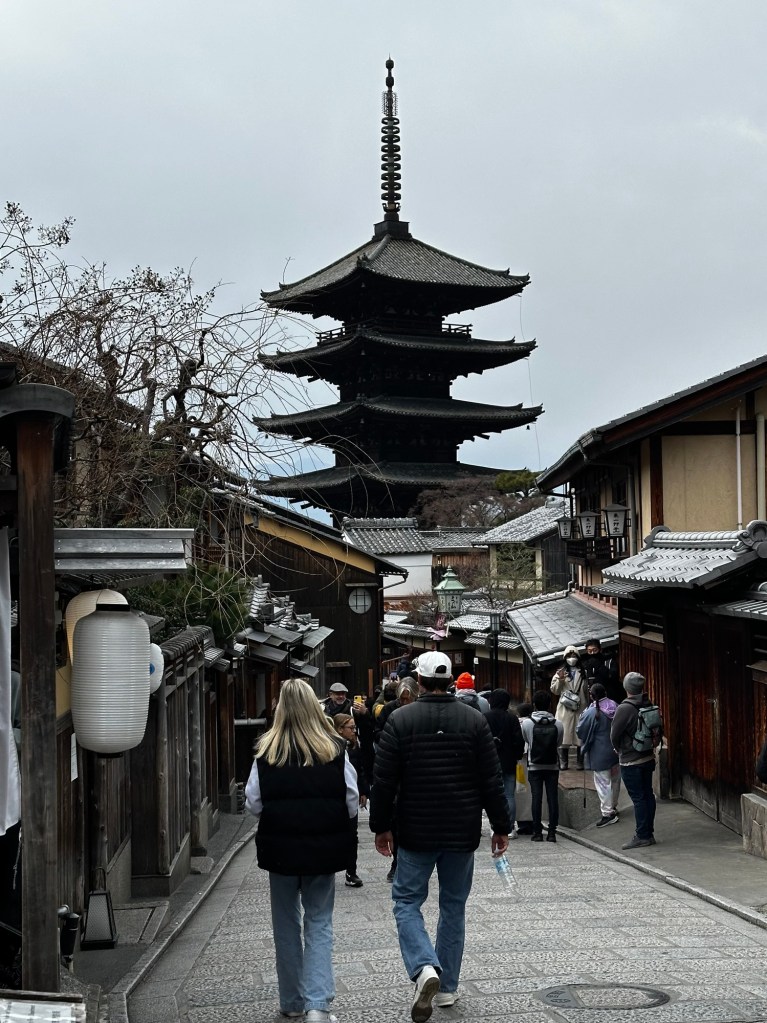
The Yasaka Pagoda, Kyoto
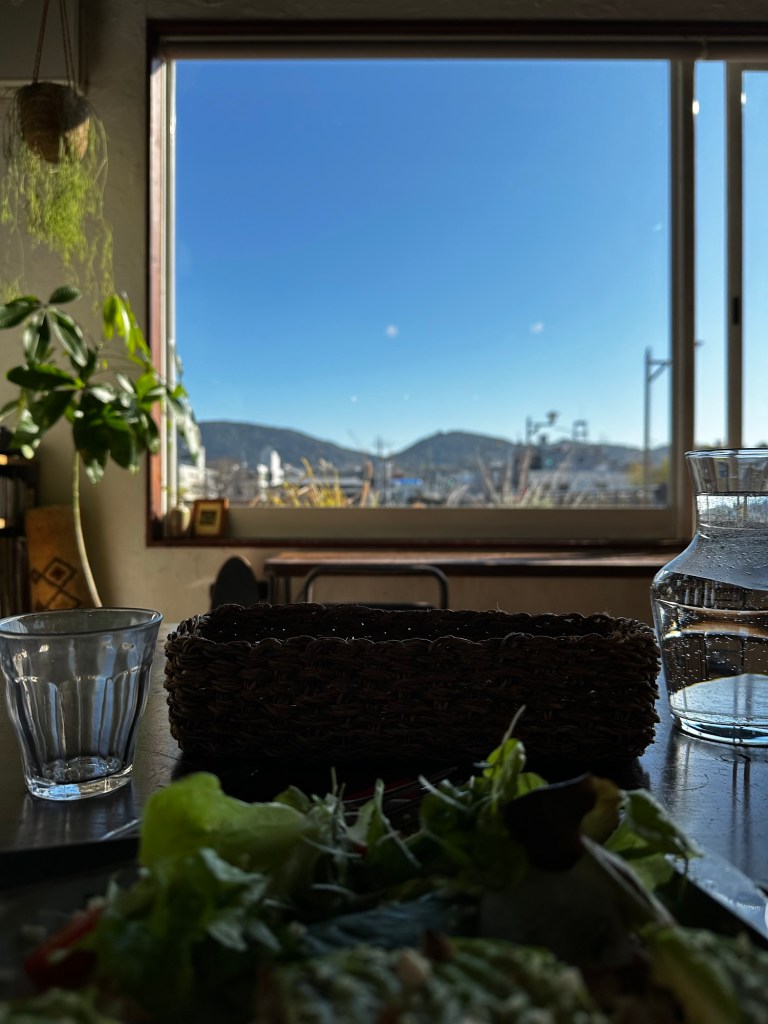
Maybe it’s because I went to a vegan cafe that could have been in Greystones. The big window looked out onto the water (a river granted, but it could have been the sea) and you could see mountains in the distance. A flock of white birds, geese-sized flew past. I ate avocado toast and drank an americano and heard languages from behind the counter that were not Japanese, not English, not Irish, just like I would at home. I wrote down everything that was in my head with a pen on paper and felt at home.
Kyoto Tower at night
At home is a mass of things I can’t list. Things fuzed into me I can only recognise in hindsight or by writing “everything that it’s not” down. It’s not… what I like, what I hate, what I want to buy, what I have to do, what I want to do, what I want to give up, what I’m not good at, what I did wrong, what I did right, what I forgot to do, what I should have done, what I should do now, what I need to learn, what I’m bad at learning. It’s not, what I forgot to be grateful for. But these things get in the way of feeling at home.
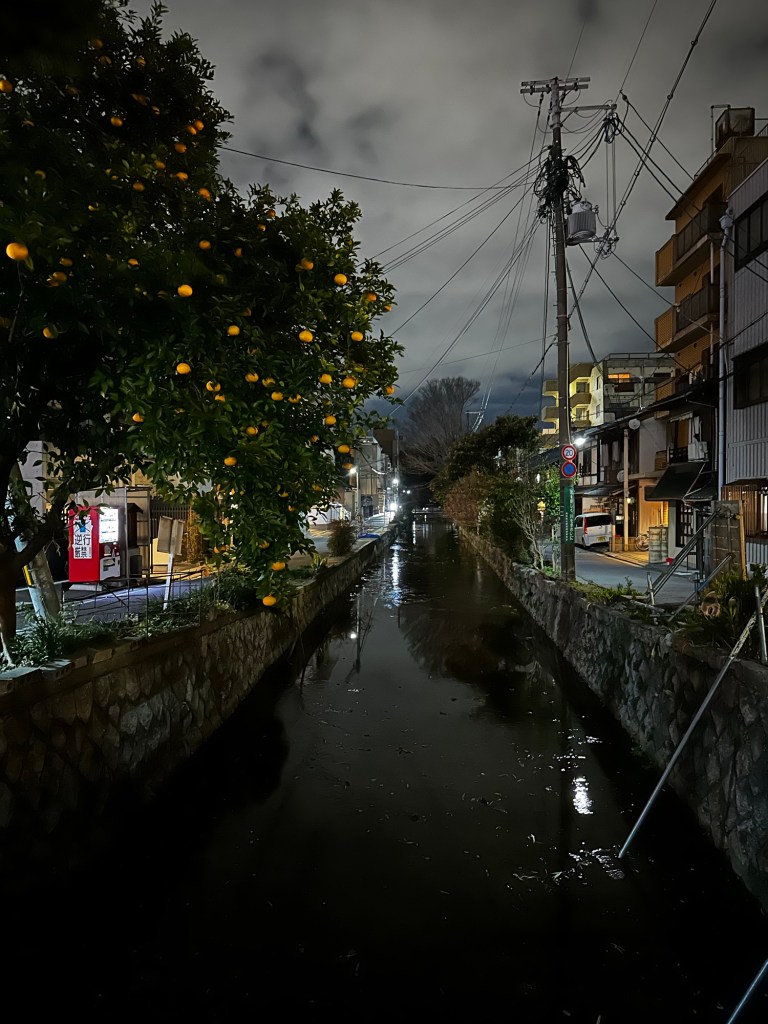
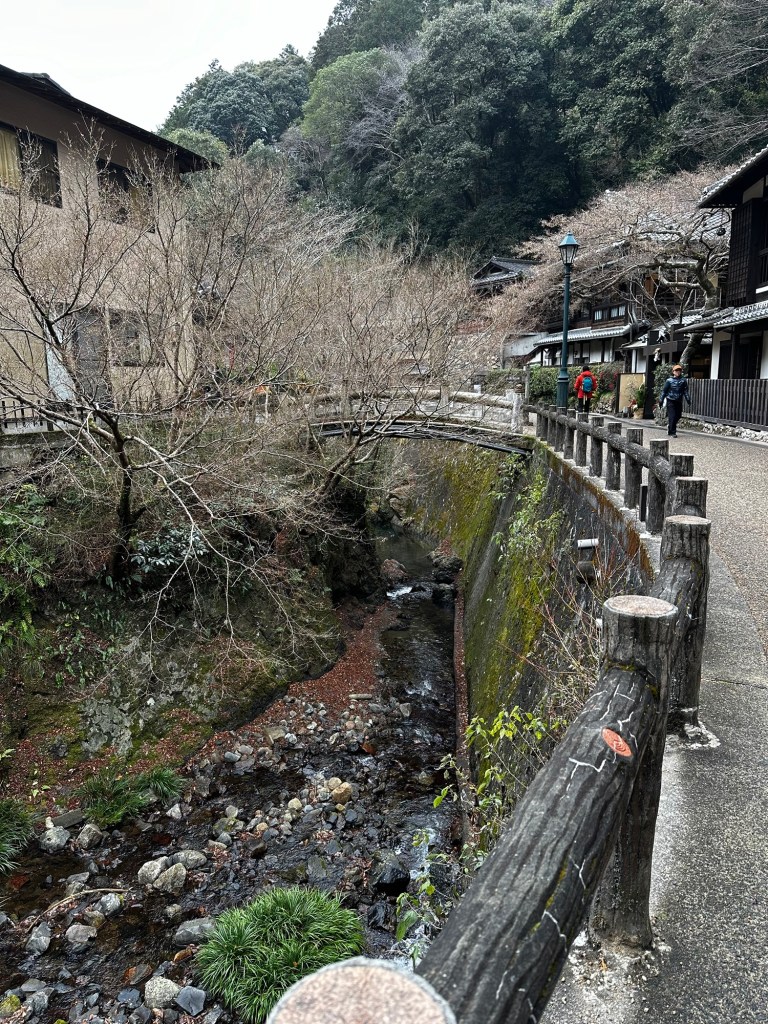
The Takase River beside our hotel, it stretches to the center of Kyoto
In these past weeks I have seen enough wondrous sights, bought enough stationery, eaten enough food, walked enough steps, ridden enough trains, learned (just) enough Japanese, written enough blogs, posted enough postcards, sent enough birthday greetings, made enough phone calls. There is nothing more I need/want/have to do. I can be at home now. Right now. Here.
The gates to the temple at Fushimi for one moment when there was no one else nearby…
But already I’m trying to imagine what it would be like to be at home even when I hadn’t done enough. Stop. Now. I am telling you (myself) you have a unique opportunity at the tail end of this journey, with everything done enough, to be at home. Take it.
…where did all all these these people come from?
The list I can’t list… when I see patterns in fabric, wool, needles, colour, wood, metal, stone, ceramics. When I sense a connection with another human by expression, word, emotion. When I wake up in the night and it’s at least 5am. When I contribute and then walk away. When I get excited by a “great” idea (if I remember I don’t have to bring it to fruition.)
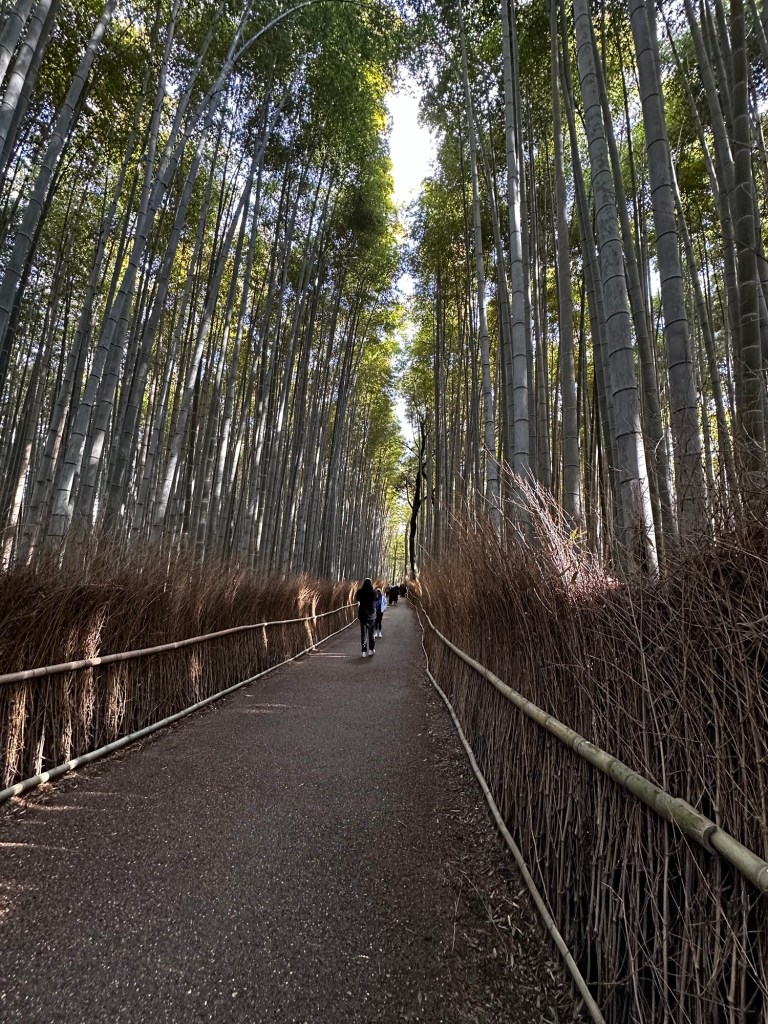
Arashiyama Bamboo Forest
When I sit in silence with someone even if they are silent too. When I spend time on my own. When I create. When a thought works itself into a sentence and then a paragraph. When something comes to an end.
We went on a Hop on Hop off bus tour around Kyoto yesterday. Not the best way of touring a city, I’ll admit, especially as it was Monday and a lot of the sites were closed for a holiday or maybe they just close on Mondays. But it’s great way of getting a feel for a city and staying warm. That last bit, staying warm is particularly important at the moment as it’s been bitterly cold for several days. I have always believed people when they said the humidity in Ireland makes the low temperatures we experience feel worse than the frighteningly low temperatures you hear of in other countries. I no longer believe them. It was a gentle 5 degrees celsius here today and I thought I would literally freeze. I am very sorry I used that phrase at home where I was never in danger of freezing so it’ll be like I cried wolf but it’s woeful cold here, I am not lying.
Entrance to temple through bus window
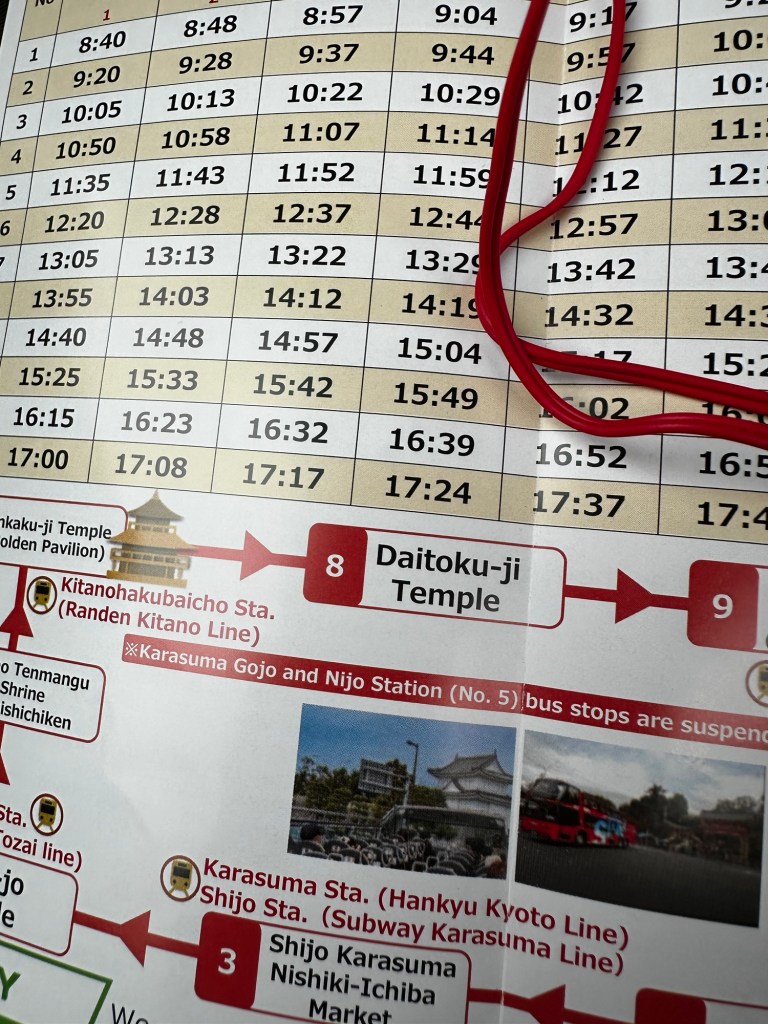
So we took the tour to keep warm, basically. And we were warm and toasty inside the bus. One of the best things about this mode of tourist experience is that you from time to time get off and wander around an interesting location. A castle, maybe? A temple, perhaps? A shrine, perchance? Or what about the Imperial Palace? I was very tempted, fortunately it was one of the places that were closed, no hopping off for us. We stayed for the whole journey, marvelling at the time keeping of the driver. Now, I can’t say the traffic was heavy but there were red lights and pedestrians crossing when he wanted to turn left at a red light (all legal in Japan) so it was steady traffic and yet as I consulted the brochure showing the forecast timing of each bus stop pick up, he was always on time. Always. It was possibly the most exciting thing about the tour, waiting to see if he’d make it. He came close once but only close. It must be wonderful to live here and know the buses and trains will always be on time.
Normal bus through the tour bus window. The city bus drivers (and the train drivers) wear white gloves
We loved having such a great transport system. We never needed to be on time anywhere… oh wait we did when we were going on the Shinkansen our tickets were reserved and timed. But with our homeland experience of a notional train and bus schedule we arrived more than an hour early. But back to the transport, it is so useful to have a rail transport system that goes from the airport to the city, we really should think about something similar in Dublin or maybe Cork? If it could be in place by the time we get home later this week all the better.
Another temple on the other side of the bus
Anyway back to our bus tour, it became obvious about halfway around that there were far too many temples, shrines, museums, markets and other amazingly beautiful places to visit in Kyoto. We would stop at a shrine and see at least two impressive rooftops (a tell tales sign) in the vicinity. Then we could see a passenger asking the conductor for directions to the proposed site from the brochure and be pointed in a completely different direction to the impressive rooftops we were looking at. I did mean to google a list of the temple, shrines and museums in Kyoto and if I do that I’ll include a screenshot of it here…
Enormous shrine gate
I got as far as googling how many? and there’s 1600 temples and 400 shrines, right. The Hop on Hop off tour is now sounding like the best idea we had. We’re obviously settling into tourist life fine and there’s nothing we need to change. The photos perhaps? Yes they are a little indistinct through the bus window and behind other people’s heads with the high back seats and all but small price to pay for the warmth. It’s freezing out there (not literally).
That’s a castle
But then today we went to two absolutely must get off the bus places. We didn’t go on a bus we took the normal train (have I mentioned how great the transport system is here in Kyoto? It was great in Osaka too. And in Hiroshima where they have Streetcars or trams) There’ll be better photos tomorrow… all going well.
On Sunday I had the best time. I found my own way (using the maps app, granted)I to a paper making workshop in the middle of Kyoto. Washi paper is a particular kind of paper brought to Japan from China by a monk more than a thousand years ago. He was looking to introduce Buddha to Japan and needed to record the teachings but there was no paper, he introduced washi paper. I always thought washi paper was just the pretty colourful paper tape you see in stationery shops at home. It is that but it’s more than just tape.
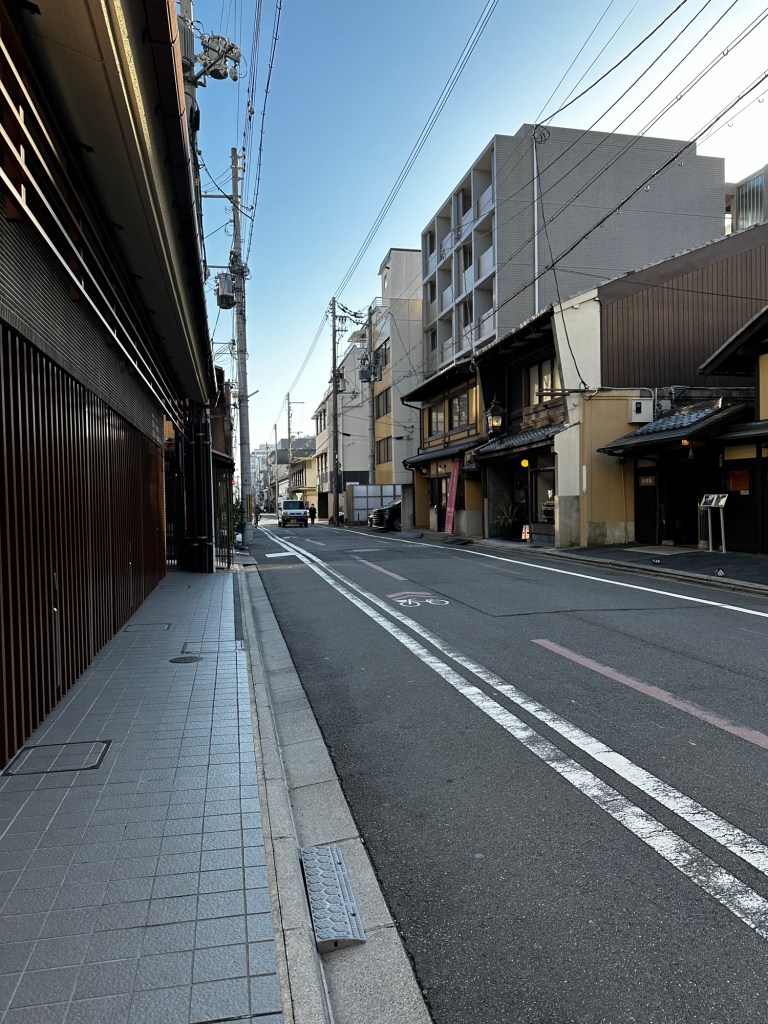
I found the right street
So at the short workshop (that I found in Airbnb experiences ([link to workshop])we watched a video about the tradition of making this paper from the bark of the paper mulberry tree. It’s a very long process that starts in November when the farmer cuts the branches. I wasn’t taking notes so I may have misremembered the steps and order but here goes… The branches are then steamed until the bark lifts away a little so it’s possible to strip it from the branch. Then the outer part of the bark is scraped off and the inner white part is washed and beaten. And eventually it’s ready to be turned into paper.
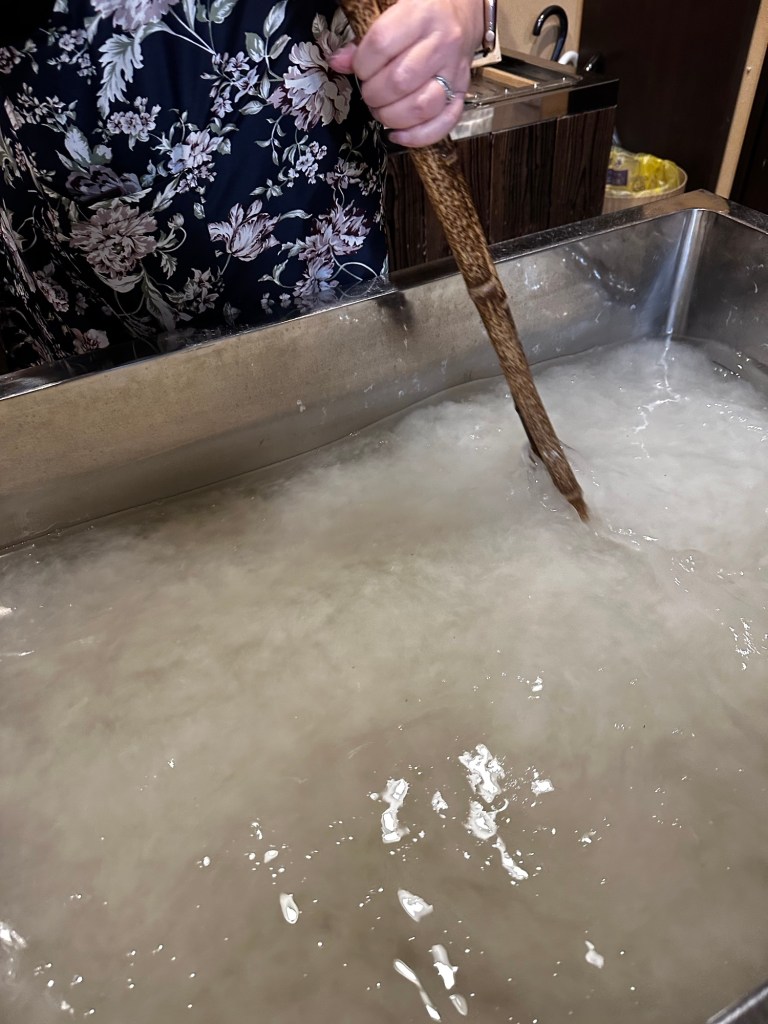
Stirring the fiber water and glue in the big vat with a bamboo stick
At the workshop we got to use this pulp to make our own sheet of paper! I’m not really getting across my excitement at this but believe me I was really excited. I still feel a little emotional that I got to participate in something so old in the Japanese tradition. I also think crafting is very curative for the weary human and I am weary.
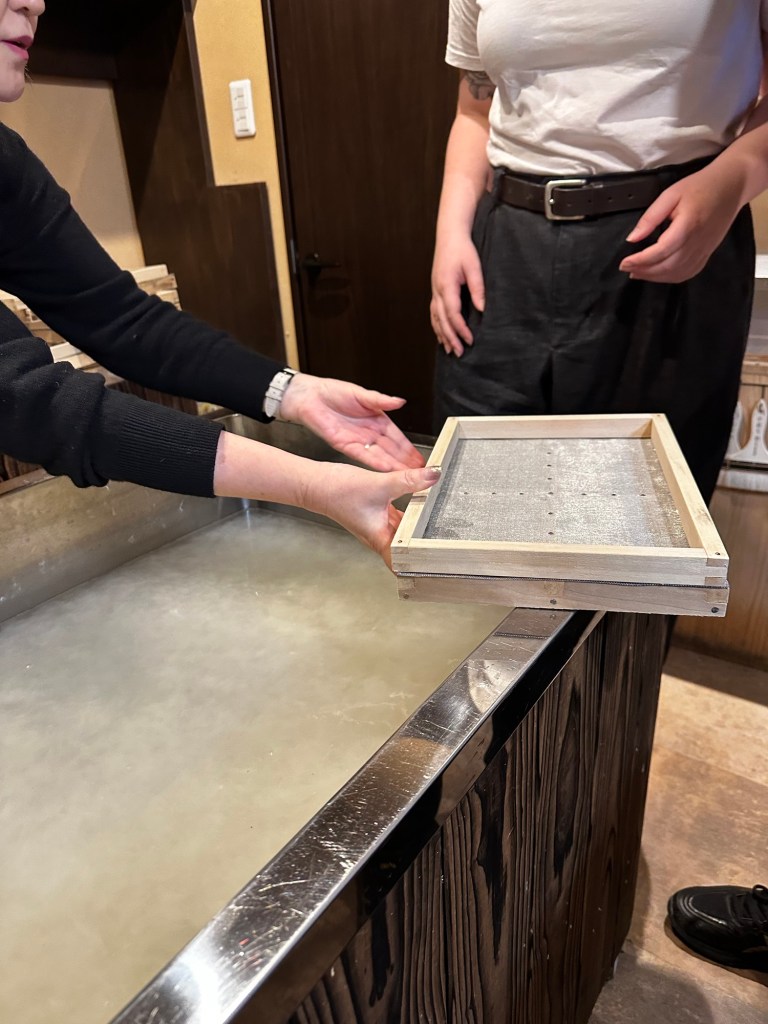
The frame has two parts
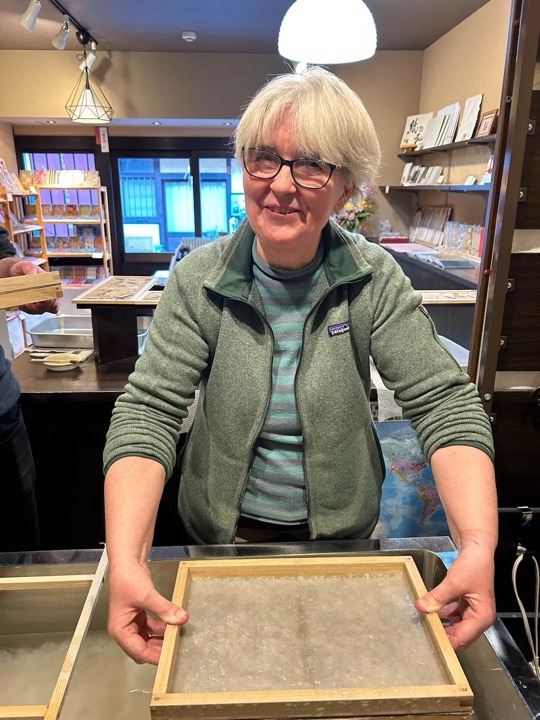
So our teacher had filled a huge vat with water and fiber and she added a glue (whose name I cannot remember) and stirred the whole thing up with bamboo sticks. Then it was our turn to dip the paper frame into the fiber/glue/water and scoop up some of that solution into the frame while moving it all the time to keep the frame level. If it’s not level the paper will be thicker at one side or in one corner and no one wants that. The biggest shock to me was the water was cold when I dipped my frame in. You dip your frame in three times and then move to the drier.
Here’s me trying to keep the frame level while smiling
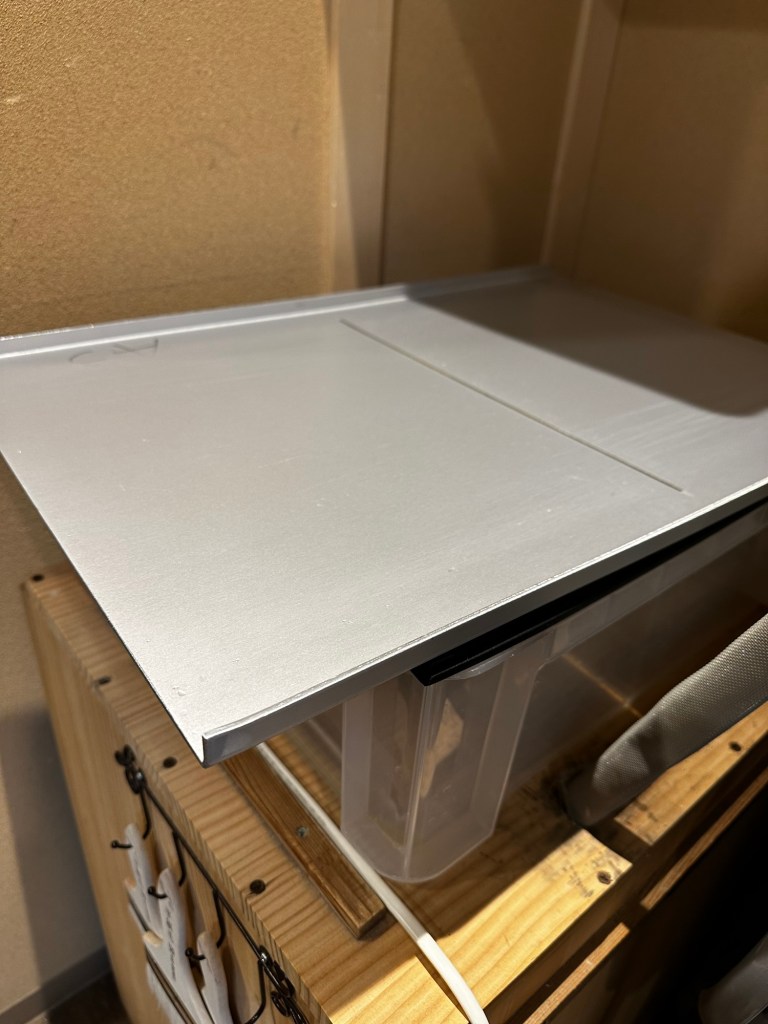
Our teacher’s husband made the drier for her. I was very impressed. I made paper a few times (not entirely successfully) in the past from shredded paper… so not exactly making paper more like recycling paper. I bought a kit and used my food processor to mulch the paper with water. I added more water and put the solution in a big basin. The kit had a small frame and I dipped that in the solution and again it had to be kept level. I didn’t have a drier but now I know husbands can make them… I used loads of j-cloths and old towels to press all the water out. It still took days for my paper to dry. So I was wondering how we would be able to complete our washi paper in the 90 minute workshop. The drier. It sucked the water out of the solution on the frame. But that still wasn’t enough.
The drier. Do you see the slit across the middle? Thats the part that sucks out the water
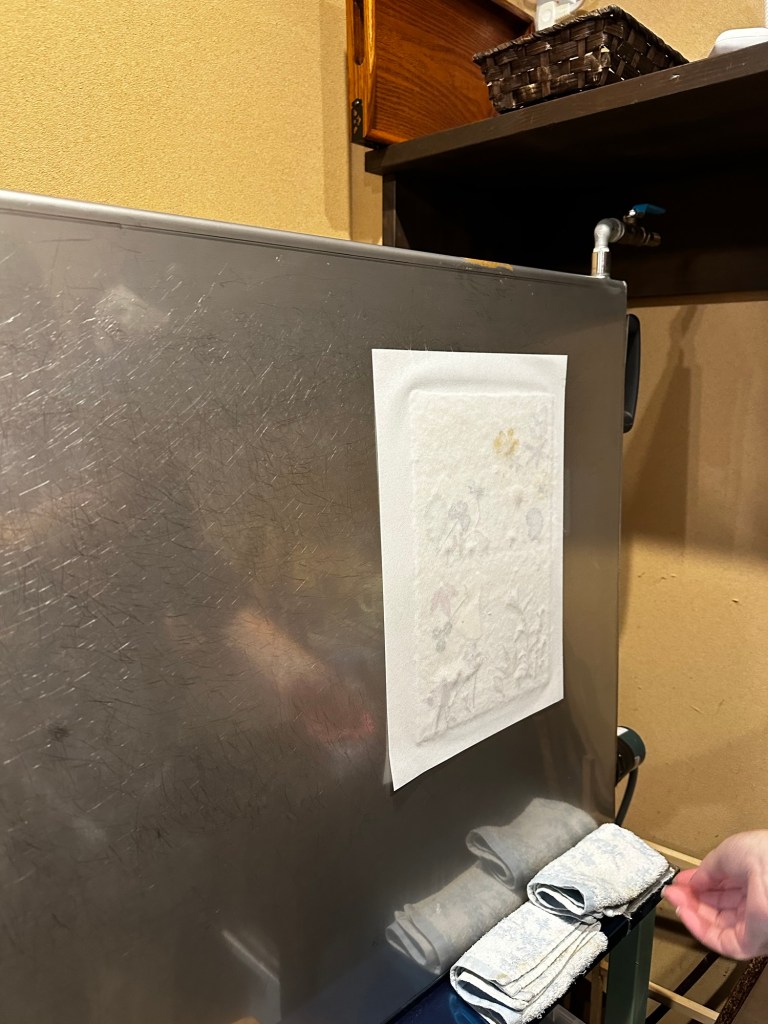
Behind the vat of pulp/water/glue solution there was a heated metal sheet, the size of a white board. (I don’t know if her husband made this one because in the video the farmer making the paper had one too, a bigger one so I’m going to assume this is a normal tool of the trade and she had to buy it.) You place (without touching the hot metal) your damp new paper up onto the surface and using an authentically old looking brush, you brush your paper gently against the hot metal. And then leave it for a bit…
Here’s my paper on the hot metal sheet
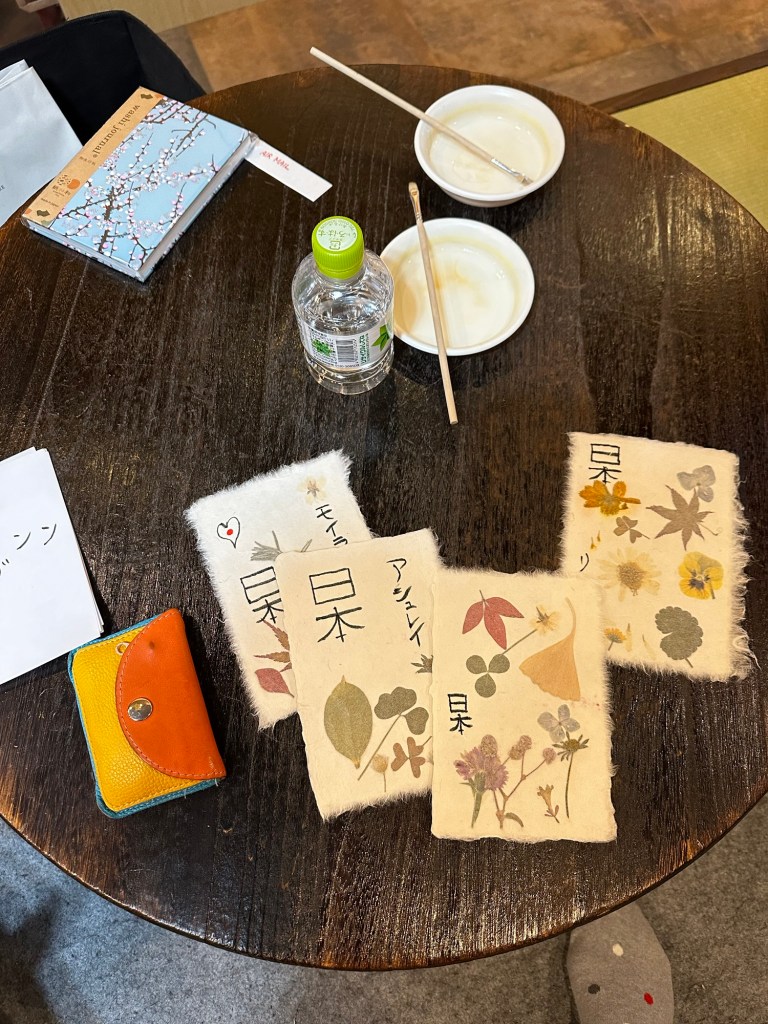
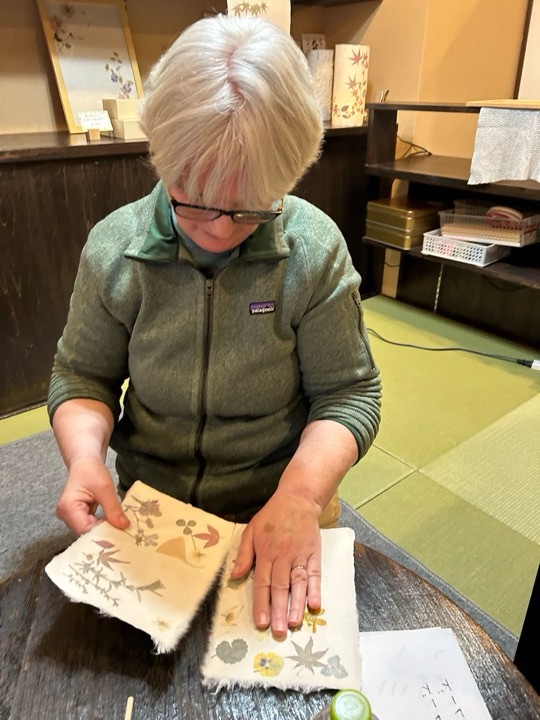
I’ve already left out the bit where I put pressed flowers on my frame to decorate my paper. I used up every flower and leaf telling a story of them in my head and then laid paper on top… I think that paper kept the decoration in place.
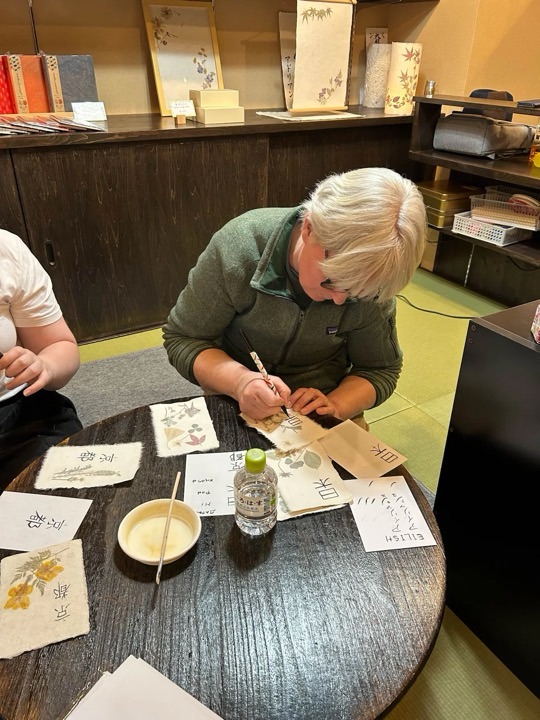
Cutting my paper into postcards with water. Also, can you see the grey mat I’m kneeling on? It’s heated! How will we survive? The green mat is made from the washi string.
There used to be thousands of paper mulberry tree farmers and now there are about four hundred. I was surprised there were even that many needed to produce some pretty paper but again I had missed the many things the Japanese do with this particular paper.
Need more practice with my Japanese characters
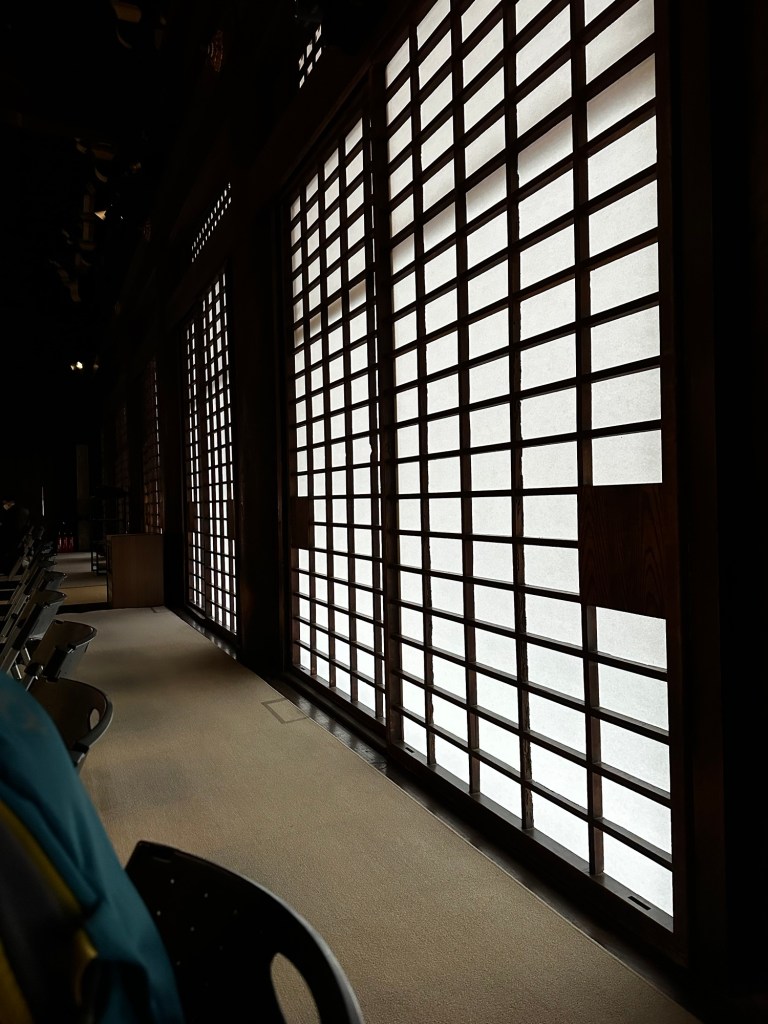
We visited a temple today, the Nishi Hongwanji and saw how they used washi paper in their doors to let the light in and keep out the breeze… not double glazing but these monks seem to be a hardy bunch. Also washi paper is used for lanterns.
Washi paper in the doors of the temple
For mats, the stringy quality of the pulp used to weave the mats. (Don’t make the mistake I did of walking on these mats in your shoes, they last so long because they are only walked on in bare feet.)
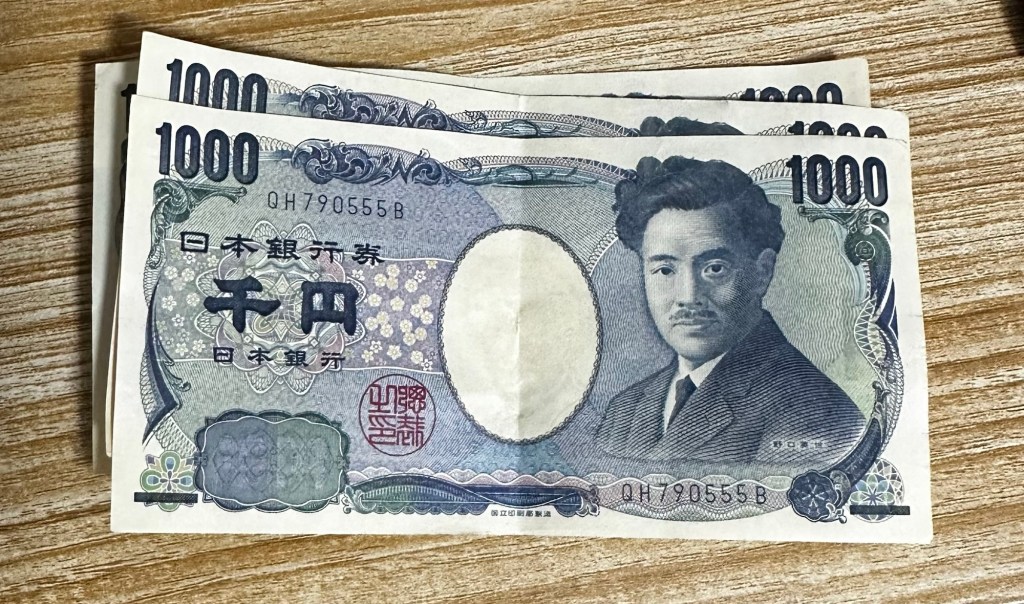
Washi money!
But the biggest use of washi paper is money! The Japanese Yen notes are made of washi paper. I was thinking… if I get a bit better at the scooping and my Japanese characters and Denis makes the drier and the heated metal sheet and I can get the paper mulberry fiber I’ll have to give the money a go…
I took no pictures. Denis took that one picture. He didn’t ask he just knew I’d want it. We walked around the museum alone and silent. At least a hundred people were in that dark room and there was only the sound of shuffling and sniffling. Alone together.
I think the reason I came here was to witness the pain. It hurts to witness pain. It’s the small human details that hurt the most. Our pain will pass, we’ll forget what we saw here, what we read, what we heard on the audio guide before we turned it off because we couldn’t hear any more. I can’t tell you the stories only snippets remain in my memory and even they are too much.
You see we could imagine ourselves, the parents running to the school to find our children. And we could imagine ourselves, the children sitting day after day in the place where the bomb went off waiting for our parents, who never come to find us.
At the start of the stories there’s a photograph taken soon after the blast, of a young girl with cuts and bandages and then at the exit just as you’re gathering yourself to leave there’s a second photo a few years later, all healed. She looks happy, she had made it. A happy ending.
But she hadn’t made it, she had died a few years later of what they were calling the a-bomb-disease, one of the cancers. I was cheated out of my happy ending. There is no happy ending. While we continue to believe there are others who are less human than we are, we will continue to inflect damage on them and their children. Until we are all human there is no ending. There is no happy.
I remember worrying about overcrowding on Japanese trains before we got here and until today there was no overcrowding. We had an early checkout time so we decided to go to the train station and get breakfast there rather than at one of our regular small cafes. But for some reason today the trains were a reduced service. There were delays, trains not going to the usual station and packed carriages. We had never experienced a delay or a train not going to the end of the route..
Big insect at Nippombashi, Osaka
So when our train stopped two stations short of the station where we’d get the bullet train we had to get out and wait for another one. We had all our gear on our backs, that’s a good sized rucksack and a day bag each. We waited with everyone else who had to leave the train early. And then the next train came in and it was chock full. I had always thought if this happened I’d just wait for the next one… but in all likelihood the next one would be just as full. What to do?
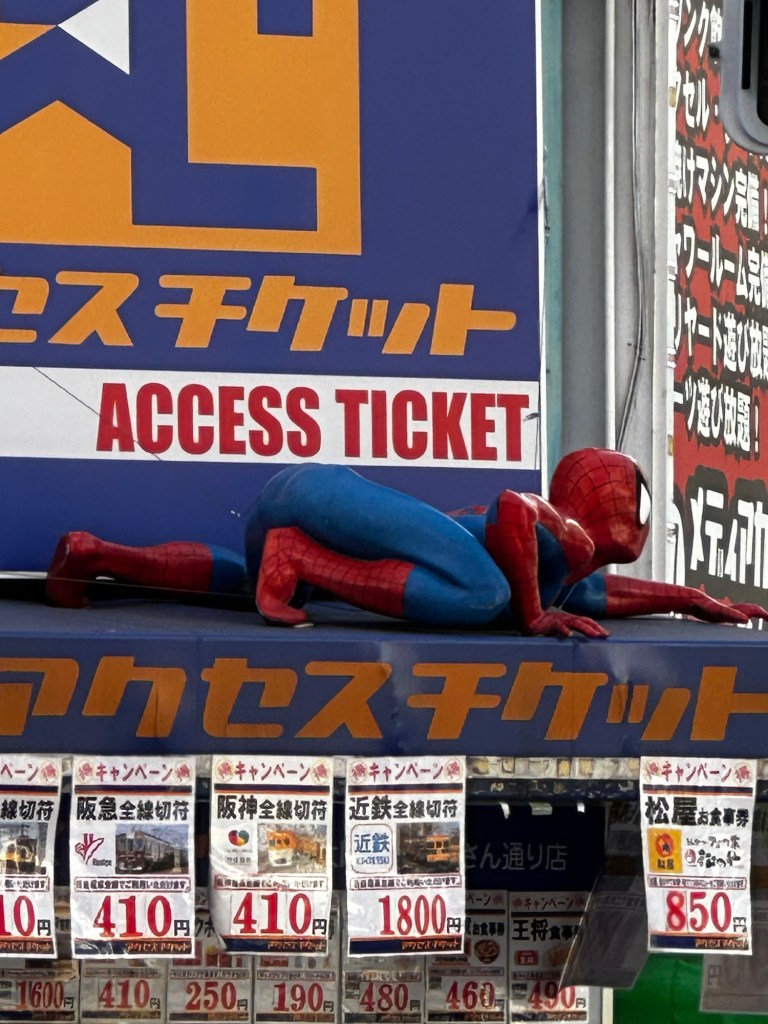
Spider-Man selling stuff at Nambanaka, Osaka
Denis walked onto the train and I followed. There wasn’t room for me to hold onto the hand rails and I couldn’t reach the swinging rings so I held onto Denis. It wasn’t as bad as I thought it would be and it was only two stops. When we got off we took the first chance to sit down and grab a coffee at Tullys Coffee. It’s a Japanese (even if the name sounds Irish and they serve a pretend Irish coffee!) chain of cafes and there’s no need to drink up and move on, so we’re here for a while reading and watching other people drink coffee. Or drink cups full of whipped cream – don’t know what else is in it but that’s a drink you see a lot of here.
Green desk lights at Tully’s Coffee, Shin-Osaka train station
There’s a very stylish older man sitting in one of the green light seats nearby reading his phone. Earlier I saw a lady on the train reading a book. Did you know in Japanese you read books from the back (I mean, what we would think of as the back) and the characters are read in columns from top to bottom, right to left? But magazines are read front to back because they are compiled (like ours) in rows (not columns) from top to bottom?
Temple at Ebisunishi, Osaka
I would love to pick up a second hand book to use in collage projects. And I did see a second hand book shop near our hotel but the guy also sold magazines with scantily clad women on the cover so I was a little concerned the books could possibly be pornographic and how would I know? And there I’d be putting them into a collage as innocent as you like. Would Shiori tell me? Or would she think I was being artistic? There’s so much potential for misunderstanding, maybe I should look for a children’s book…?
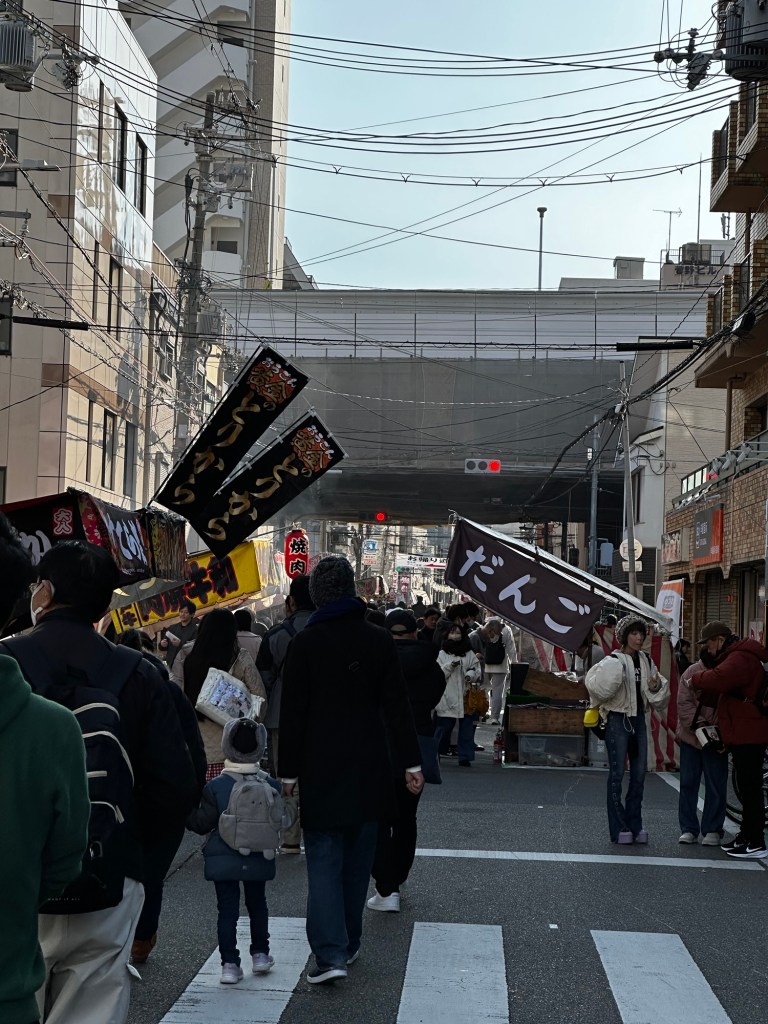
Street food near the temple
Anyway the stylish man is reading as he scrolls up on his phone. I wonder does it feel different reading a book from reading a magazine?
We went back to our first breakfast cafe in this area of Osaka and got a great welcome. The lady was out and the owner was doing all the cooking and welcoming by himself. We had more of their amazing toast with maple syrup. As we were eating the lady returned on her bike. As we got up to pay the owner came around the counter and with the help of his phone said, very nice to see you again and then asked if we were going home today? We said we were going to Hiroshima tomorrow and he became animated and pointed to the lady – and his phone said, it is her hometown! Oh Japan, stop with all your kindness I’m not able to cope. We bowed and I’ve a new addition to my bow – my hand jumps up to my heart. It means, Stop, please don’t stop, you’re making me cry.
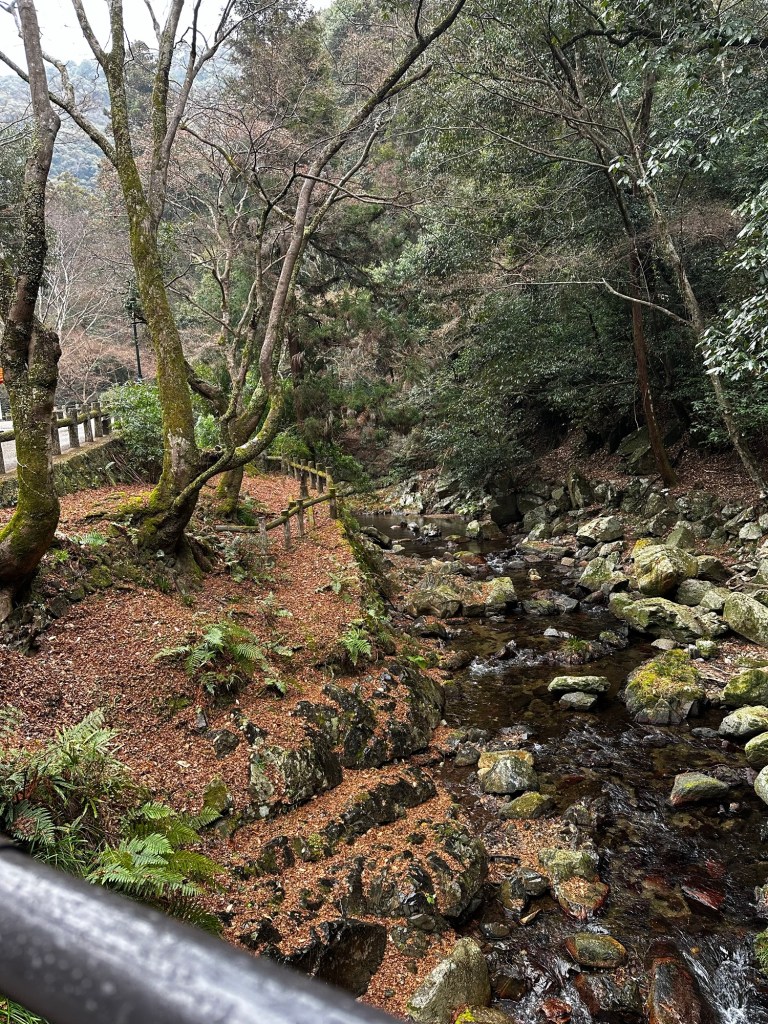
River running through Minoh park
This would be our last full day in Osaka. Tomorrow at noon we are leaving on the Shinkansen and travelling to Hiroshima where we will spend one night before going to Kyoto where we expect to see lots of pretty temples. Then back to the hotel near Osaka Kix airport (the one on the manmade island) for our last night in Japan.
Secret footpath
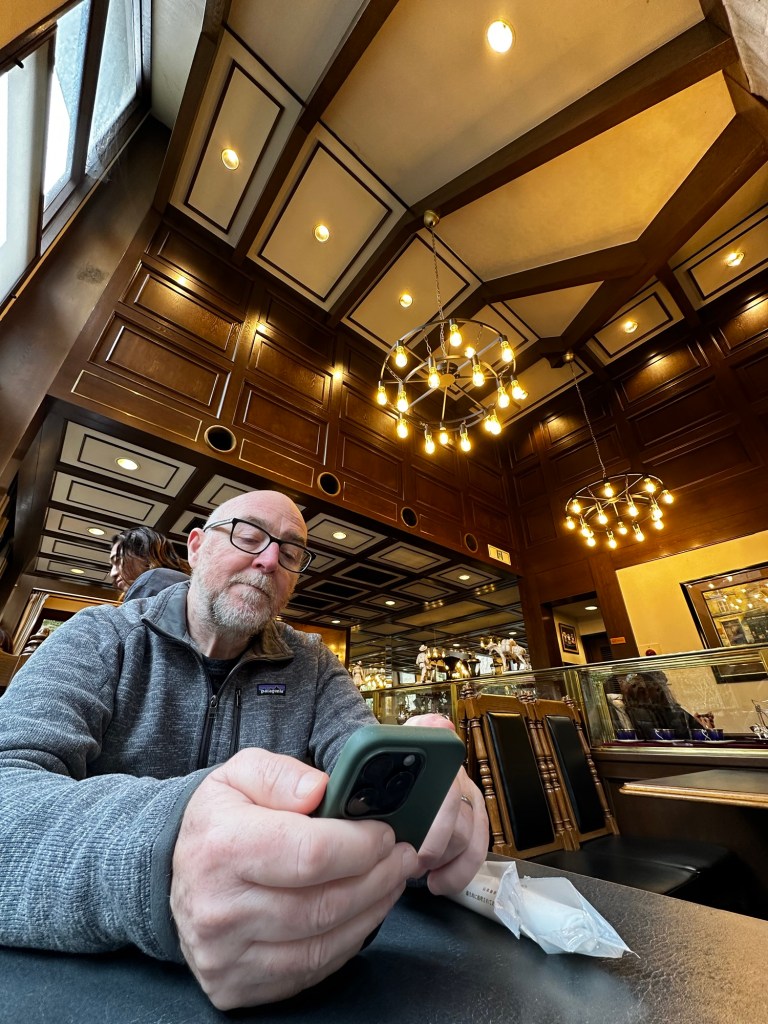
As I write we are in the Minoh Park, a big forested park in the north of Osaka. We walked about 2km to the Minoh Waterfall and on the way back spotted a cafe in amongst the trees. The most fancy looking cafe we’ve been in here. There’s classical music playing and all around us are coffee themed antiques. When our coffee arrived earlier we were more than surprised by the grandeur of silver coffee pots, cream jug and sugar bowl.
Afternoon tea anyone?
Needless to say, matching cups and saucers also arrived and everything was laid out so precisely by the young waitress. Our only small concern with all this grandeur is that if they don’t take credit cards our Yen reserves of cash may not cover this feast. We ordered coffee and sandwiches.
I bet it looks spectacular in cherry blossom season
We always forget to top up the cash… And there are no atms here in the forest. We are 1km from the station so even if I stay as collateral it would take Denis more than 20 minutes to get there and back. But there may not even be atms at the station… Would he come back without the cash? Or would he take the train into the city to look for one there? And this cafe closes in an hour. These are the questions they don’t ask you to consider on a pre-marriage course… What will become of me here on my own in the forest?
Look, Denis! Look at the pretty lights! Hmmm.
They accepted our credit card. And it cost less than two coffees plus sandwiches at home.
Can you see the guy with long legs walking on the surface?
There’s also an insect museum in this park. There’s a lot of big insects here that I hope never to meet but big and small they are all providing a service to us and the food we need to nourish us. Without them we wouldn’t survive because our food wouldn’t have an environment it could grown in or the assistance it needs in procreating. We are closely connected to insects whether I like it or not.
Cute stripes, I suppose…
There was one section I loved – The Butterfly Garden. It was a two story humid glass house full of green trees and plants with colourful butterflies flying freely. They flew close enough you could feel the breeze from their wings. You know the Chinese saying that goes something like, the flapping of a butterfly’s wings can be felt on the other side of the world? It’s a metaphor for how interconnected we are. How we are dependent on each other, how what happens here has effects there.
Here’s a Rice Paper Butterfly taking a drink
We will be visiting the peace museum in Hiroshima. One of the things I want to see is the Children’s Peace Monument. Shiori told me about the little girl, Sadako, who was only 2 years old and 2 km from where the bomb fell but was uninjured. At least they thought she was uninjured. When she was 8 she was diagnosed with the A-bomb-disease, leukemia. In the hospital her friend brought her origami paper and told her about a legend. It goes that if a sick person folds 1,000 paper crane birds they will get better soon.
Shiori’s Mum gave us these ceramic cranes
Sadako made even more than 1,000 cranes but she knew she wasn’t getting better, she did not get well, she died within the year. But her school friends had joined her making paper cranes and the idea spread across Japan and around the world. And money was collected and they built the Children’s Peace Monument.
Engraved on the base of the statue are the words: This is our cry. This is our prayer. Peace in the world.
Yaa! Our colds and jet lag seems to be gone! Yaa! We did have another visit to our chemist in the little shop with (secret?) shopfront. And she gave me tablets to stop my cough. She remembered us from theee days earlier which is nice. We seem to be settling into the community. She has a little dog but asking his name was beyond our capabilities. Now we think she lives above or behind the shop because when we walk in she’s never there but a bell rings and she comes out one of the doors behind the counter.
Not Japan’s then?
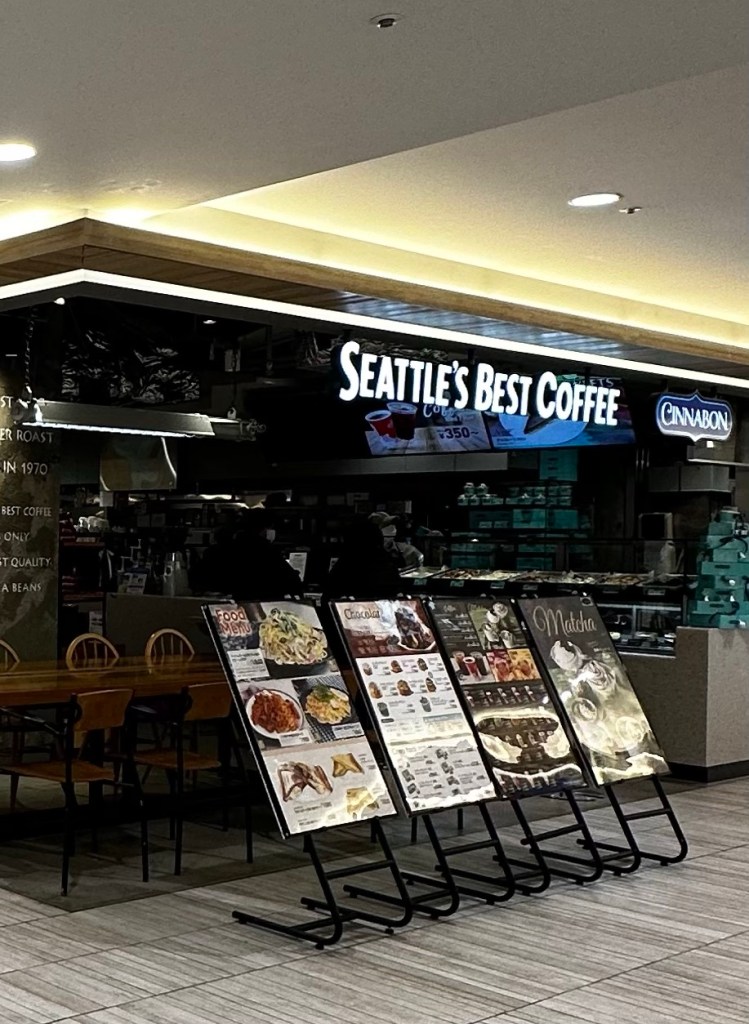
Right now I’m sitting in a cafe called Seattle’s Best Coffee… probably not original Japanese then? We chose it because they also sell Cinnabon buns… I thought that was a make up thing? Before we left for Japan we had been watching Better Call Saul, a Netflix series and really good spinoff of Breaking Bad. At one low point in the main character, Saul’s life he was working in a bun shop called Cinnabon. I didn’t know it was a real thing. It is and it’s here in Osaka! And they have scones. And they call them scones! When we travel to Portugal the one thing I miss is scones, you can’t get them in Spain or France either… but you can get them in Japan!
Coffee and Cinnabon
This is actually our second coffee today. We have a routine now when we wake up (which is getting later and later, thankfully) Denis looks for a Japanese cafe for breakfast and off we go. The scene is the same each time. There’s a counter with seats on the customer side. On the other side the owner (they all seem to be family run places) makes the coffee and the breakfast orders. His wife welcomes you in the door and brings you in iced water and a warm face towel – to use like a napkin (we think…) Then she takes the order with minimal words, pointing at photos in the menu and plenty of smiles. The coffee comes in china cups on matching saucers.
Traditional breakfast and the nicest coffee in Osaka… so far
There’s always a choice of breakfast orders. Today we had toast and beside it a boiled egg sliced with cucumber and chopped cabbage topped with a delicious sauce. For two of us it cost approximately €5. There’s no tipping. I tried it the first day and the lady handed it back to me thinking I got the amount wrong. Generally the little cafes don’t take credit cards so we always have to have cash too.
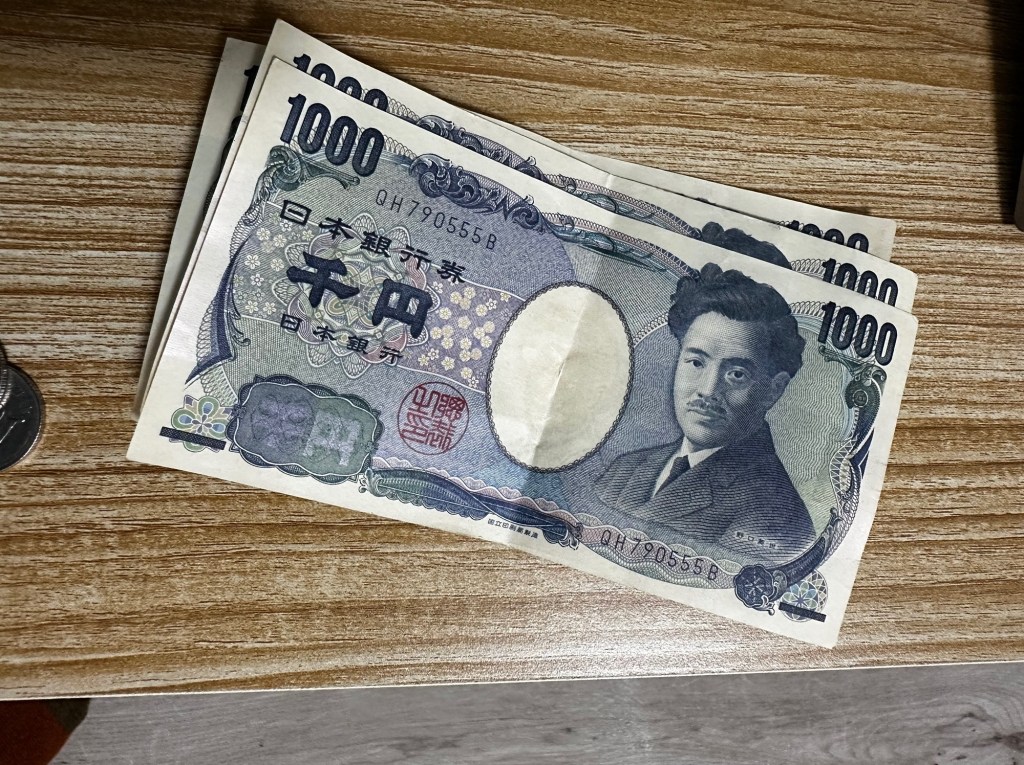
¥1,000 worth about €6
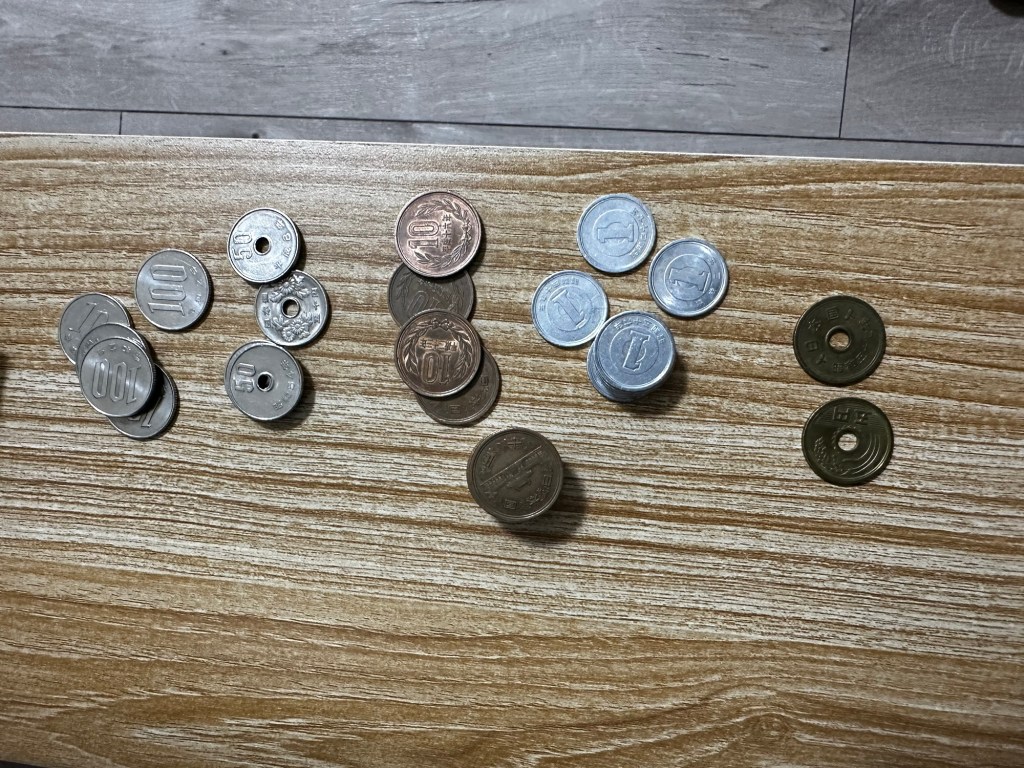
The notes we’ve seen most of are the 1,000 ¥ (Yen) and then there’s coins for 500¥ and 100¥ and smaller. When working out what something costs in € (euro) I have a quick calculation. If it’s something Denis wants I knock off the last two zeros and divide the rest by three and double the result. So for example, if something was 3,500¥, take off the last two zeros, it becomes 35, divide by 3, it becomes 11.66, double it, it becomes €23.32. On the other hand if it’s something I want I keep it simple. First, take off the last two zeros, it becomes 35 and the divide that in half, it becomes €17.50. My method means Denis has been spending far more than me so I’m in credit and can get more things… like stationery.
From left to right, the first set of coins are 100¥ (€0.60) next 50¥ (€0.30) next 10¥ (€0.06) next 1¥ (does not compute) and finally the coins on the right have no numbers on them so I don’t know how much they are?
We are nearly at the end of our visit to Osaka and it’s been a very easy city to get around. The transport system is extensive in that it seems to cover every corner. Which makes it a little overwhelming to me but as the days go by I realise it’s easier when I slow down and take a minute.
My fortune for 2024
Did I mention that on new year’s day when we went to visit the shrine that we each paid the equivalent about €1 (well of course Denis paid €2) to get our fortune for the year? Mine told me to slow down. It also said there’d be no great things and no very bad things happening this year – sounds like my kind of year. And I’m practicing the slow down already.
We’ve been visiting museums. Last Friday we went to the Sewage Science Museum of Osaka. Very interesting. It seemed fitting to go there when we realised they had a museum with all the excitement about the toilets. I had hoped we’d be able to get a tour of the sewers but this was not to be.
View of the city from the Sewage Science Museum
Then today we went to see the Earthquake memorial near Kobe. There was a huge earthquake (7.3 magnitude) in this area in 1995 and more than 6,400 people died. Doesn’t seem that long ago to me. I had small children in primary school I was on the parents association and trying to survive life. I think that’s why this museum and the movies and sets affected me. I didn’t take many photos.
The dots show earthquakes of magnitude 2 or more in Japan in the year 2018!
It was on January 17th at 5.46am 1995. (There was a grandfather clock in the exhibition that had fallen over and stopped working at the exact time.) We heard first hand stories from people who were children at the time. About how family members died beside them and how their homes were destroyed and all their possessions lost. About how they were living in a gym with food provided by emergency services. Eventually emergency cabins were set up but not in their own communities and the older people found this the hardest.
The stops signs look like the yield signs?
Volunteers came from all over Japan to help and eventually the area was rebuilt and people went back to their own neighbourhoods.
That was one part of the exhibition and the next part was manned mainly by volunteers, possibly retired people who could speak different languages. We met a lovely man full of energy for his topic who was guiding us through what happens when the earth’s plates collide. I think he said there’s only 11 plates in all the earth and when they don’t slide harmlessly over each other the earth quakes happen. Did you ever play trains crashing with your brother? If he’s stronger then his train can carry on forward while yours tips upward or falls over… something like that is happening with the plates.
We’re seeing emergency signs everywhere
Being near the edge of a plate is unlucky, Japan is near the edge of three plates! (Ireland isn’t near any plate edges, no harm in mentioning here, Ireland is the best place to live as far as natural disasters are concerned.) He showed us a fault line off the coast of Japan that they have predicted (70%-80% chance) that there will be a major earthquake causing numerous huge tsunamis all over Japan within the next 30 years. Gulp.
The dots above show plate edges…
Then he went on to tell us about typhoons with the aid of a video game – which I won by diverting the typhoon with my high pressure… you had to be there. And finally he sent us into an earthquake simulator. Wearing VR (virtual reality) glasses we were in a house when the earthquake started and furniture started moving around. The most surprising thing was how long the shaking lasted. Maybe because all we’ve ever seen are clips on tv or the internet of actual footage that we somehow thought it was just a short experience. It’s longer than a clip and even thought I knew it was a simulation I still wanted it to end.
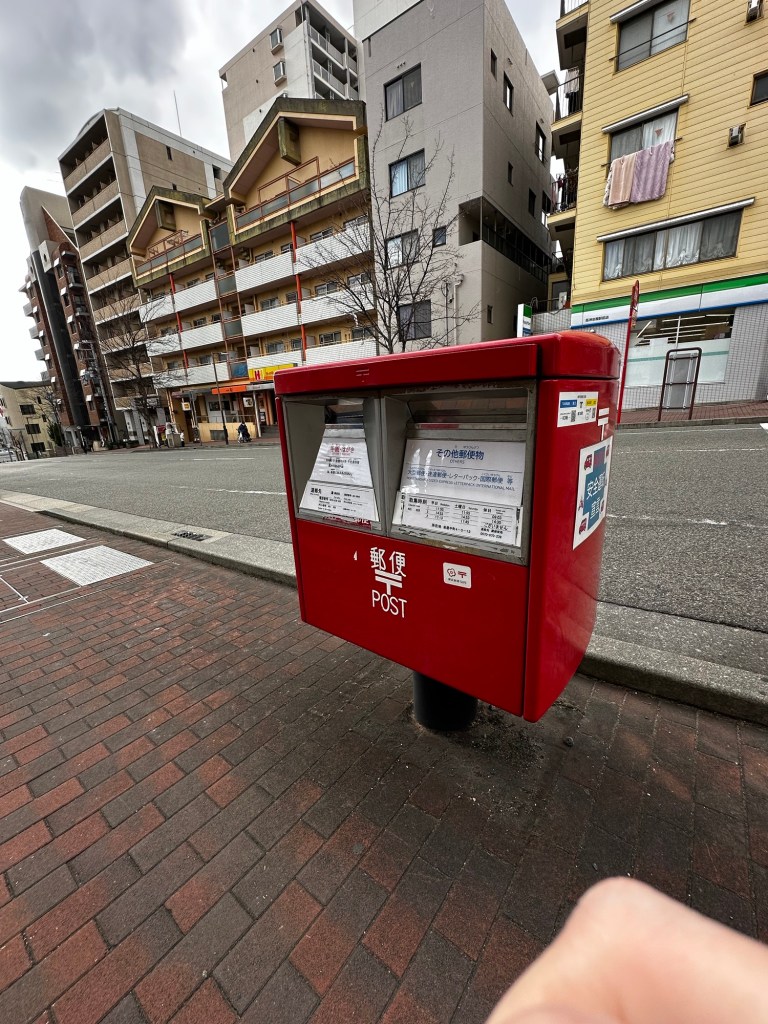
Still haven’t found a post office
The whole experience was both disturbing and inspiring. Disturbing because no one wants a high percentage chance of disaster and hearing real human stories of what happened was disturbing. But inspiring because our guide was an older man but full of energy and passion for the subject of weather and natural disasters and how we can learn from them and make things a bit better next time. And each volunteer asked where we came from and recognized Ireland and were delighted we had come so far to visit.
The green man for crossing the road, is blue in Japan
And the recent earthquake on New Year’s Day on the Noto Peninsula? At the moment the toll is 168 fatalities and 103 still missing. There are 31,800 people in shelters in the Ishikawa Prefecture. You read about these things on the internet or see them in the news but seeing this exhibition today brings these people and their experiences closer. Can you imagine, your home is gone and you’re living in an evacuation center?
We’ll be going to Hiroshima next week and I thought that would be a major emotional experience and it probably will be but I wasn’t expecting this museum to be so emotional. It’s hard to ignore pain and suffering when you see it clearly and even harder when there’s no one to blame. Bad things happen.
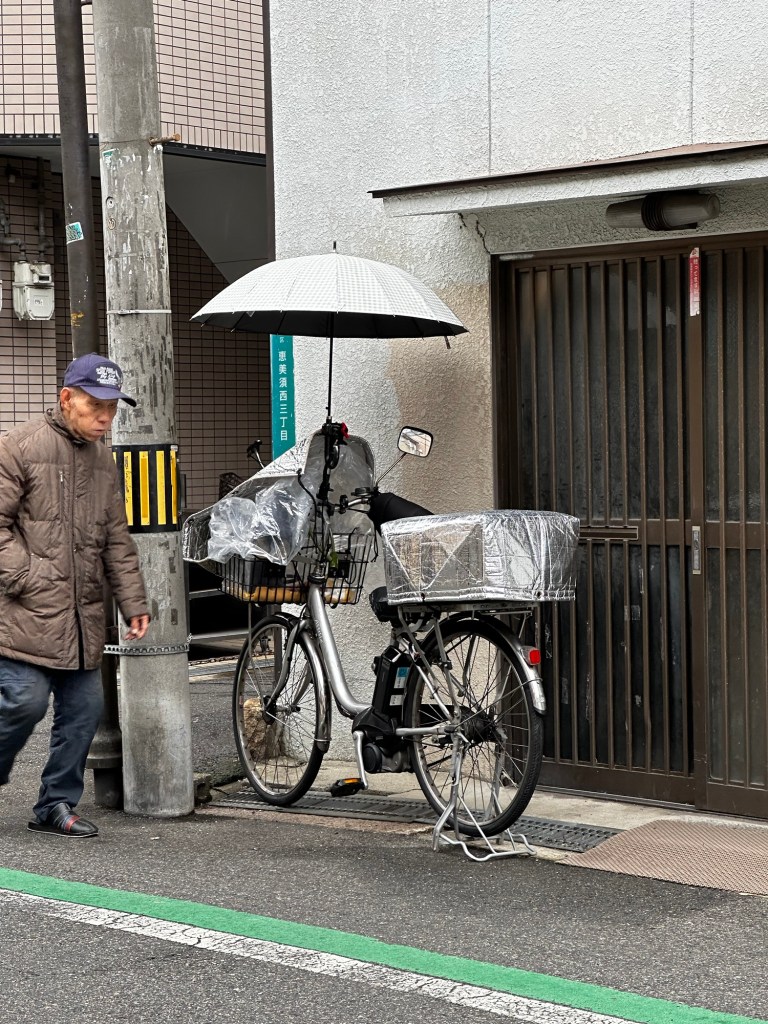
Lines of bicycles on every street with flimsy locks… untouched
I wanted to experience the things that made this culture different. I’ve seen the smiles, the dedication to work, the politeness, the kindness, the not-stolen bicycles and in this museum I see resilience. Last night in a local cafe an old man came up to us and nodded and smiled and looked so happy as he said, “Welcome”. He didn’t have any other English except the word, American. He asked, “American?” and we said no we were from Ireland. He nodded, smiled and went off. Knowing the history between these two countries how can he be so kind and welcoming to us whom he thought were American?
And we’re back in Osaka. We arrived by bullet train but I slept through most of it. I’m coming down with something. (If you’re waiting for pictures of the toilets on the bulletin board train, sorry, we’ll be travelling again at the end of the week and hopefully I’ll be awake enough to go check them out!)
We arrived in Shin-Osaka station again and took the metro 9 stops to our hotel. When we got out at the station we realised we were somewhere very different. Our first hotel near the bridge to the airport was in a very modern area but here we have gone back in time. The streets are full of people, shops, food stalls, lights, casinos, and a train the crosses the footpath and runs between the buildings.
Walking along the footpath and the train comes out between two buildings… this is different but it works
There are also plenty of combinis. The combini is a convenience store. A corner shop would be similar except the combini provides so much. You want to get tickets printed? Go to the combini. You want a cold snack, a microwave snack and you don’t have a microwave, go to the combine. You want to post within Japan, get groceries or hot coffee, cold coffee, toothpaste?Combini is for you. They are literally on every street, maybe twice or three times. There’s two names we keep seeing, 7Eleven and Lawsons but there’s plenty more.
Here’s some – HOT – coffee at the combini. There is heat coming from the shelves keeping the drinks hot. There’s also a coffee machine if you want your coffee old school
We were looking for a throat gargle and realise there something the combini doesn’t do – medicines. We looked up and down the streets for the blue cross international symbol for chemist or medical centre but there was nothing. Passing a small doorway, which looked like the entrance to a storeroom I could see an old counter. Further in some basic shelves with what looked like boxes of medicine. I don’t know what made them look like medicine, are all medicines a particular colour or hue? Maybe. Anyway I was willing to walk into this tardis and find out.
The chemist
We approached the counter. A woman in a white mask appeared and using a combination of phone translate and miming to gargle, she understood and brought us something and even explained how to use it. Easy. Even easier was when we got back to the hotel we saw there were instructions in English on the box too. Easy.
Inside the chemist
We have stayed at three different hotels on this trip so far and we will stay at two more before we leave and each has been different and great in their own way. The first one had a great view, a deep bath and hot water all the time, there was also loads of space for charging our phones, watches and laptop. The second one was smaller but adorable for that with so much squeezed into the space. The powerful shower in your room and an onsen on the 14th floor.
The gargle medicine
An onsen is a public bath where everyone is comfortable being naked. Yes, what a great opportunity to try something different and so handy in our hotel (which by the way was a fraction of the cost of a hotel in Dublin). But alas no, we did not take the opportunity. It sounded lovely and warm and relaxing (maybe not relaxing now that I think of it) you shower first before you go in and the main rule is you can’t wear anything in there, not even a towel. I’m not sure but I think there’s separate male and female areas? Probably.
We’re near the Tsutenkaku Tower
Now this hotel, closer to the centre of Osaka, is more like an apartment with part time reception. We have a large fridge, bins, hob, microwave, bath, shower and balcony – with our very own emergency ladder… We have to work out how to heat the water though. There are instructions but I tried last night and each time a Japanese voice told me something but I don’t know what. I’ll try again. I’d love a bath, the Japanese baths are so deep. But just on my own…
Sunset by the tracks… of the train, that crosses the footpath
We had a plan this morning to go for breakfast at a traditional cafe just around the corner. It was hard to find because it didn’t stand out but inside it was like we’d gone back in time. There was a sign saying no photos, so I’m sorry to say there are no photos instead I’ll try to paint a picture.
Here’s the outside of our breakfast cafe. A secret doorway to deliciousness
Everything is in dark wood, there’s a counter to the right with seats and behind the counter an older lady is making coffee with very strange implements. On the right are a number of tables, maybe five filled with customers. The coffee making implement is like a large glass with a test tube coming out of the base. Where the glass and tube meet there’s a paper filter squished and layered in place. The older lady is putting ground coffee into the glass and adding water. She swirls the water. And the coffee drips out from the tube. She is doing this continuously making coffee for all the people here. Her assistant is younger, maybe a daughter? They have a very familiar relationship and it seems like the older lady is the boss.
Lunch was takeaway, less subtle but equally delicious
The very friendly assistant brings us a menu (with English names) and we order coffee and toast, normal for Denis and cinnamon for me. The toast is what we used to call a doorstep – really thick cut, maybe two inches thick (5cm). It’s very lightly toasted so that the bread in the middle is still soft and it’s also slightly gooey. When you pull it apart it separates in layers. It is divine. Definitely worth the calories. Our coffee comes in white china cups on saucers. As we eat and drink I notice behind the counter there are shelves with more old china cups and saucers and tea pots. And a small drawing of the coffee apparatus with some Japanese writing, I imagine someone who enjoyed this experience drew it and wrote, Thank you for the coffee.
There’s the train on the footpath again!
Leaving, the old lady and her assistant say, goodbye and we say, Arigatō (thank you) and smile, she gets back to her coffee and we get back to wandering. I suppose it goes to show you can’t be judging the inside by the outside, be it chemist or cafe… or your body in the onsen?





















 Travel stories