High Expectations

The Buck Inn

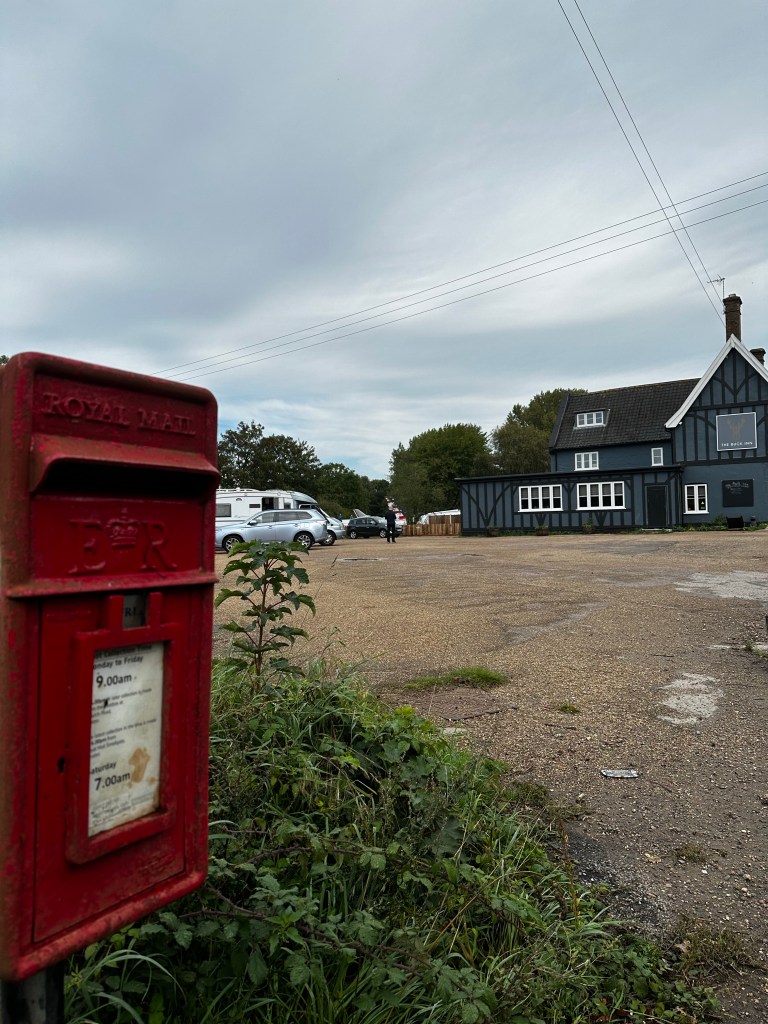
On Wednesday we enquired about staying overnight in the car park of a pub called the Buck Inn. The arrangement for staying was to buy a meal and the menu looked good so we reserved a table and a parking spot and drove to a place called Flixton near the village of Bungay in the county of Suffolk. We still hadn’t found gas but as we were eating out, we probably wouldn’t need it.
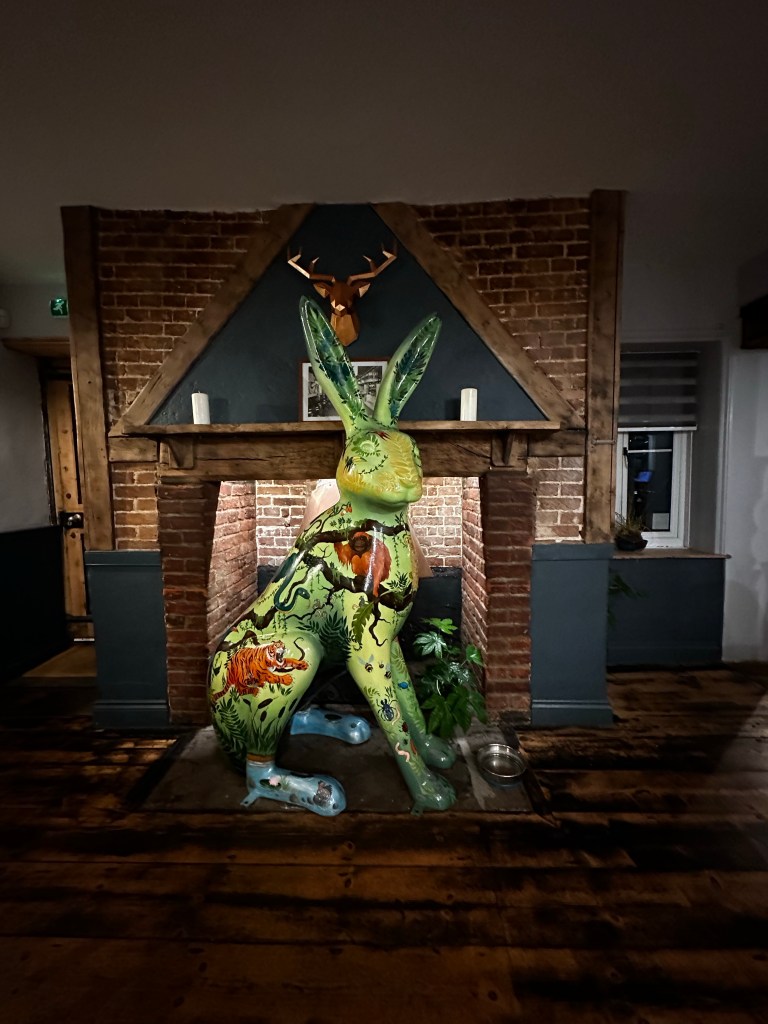
A huge colourful rabbit inside at the bar

We pulled into the car park in the late afternoon and Denis noticed that right next door was The Norfolk and Suffolk Aviation Museum. We went to have a look. Unfortunately… they were closing and they wouldn’t be open again until Saturday. Like the National Trust, this museum was run by volunteers so the hours are restricted to volunteer hours. But they took pity on us (as we wouldn’t be here on Saturday) and said we could wander in after 9am the following morning as there would be someone working there. That sorted we went back to the van and Denis set about doing some work.
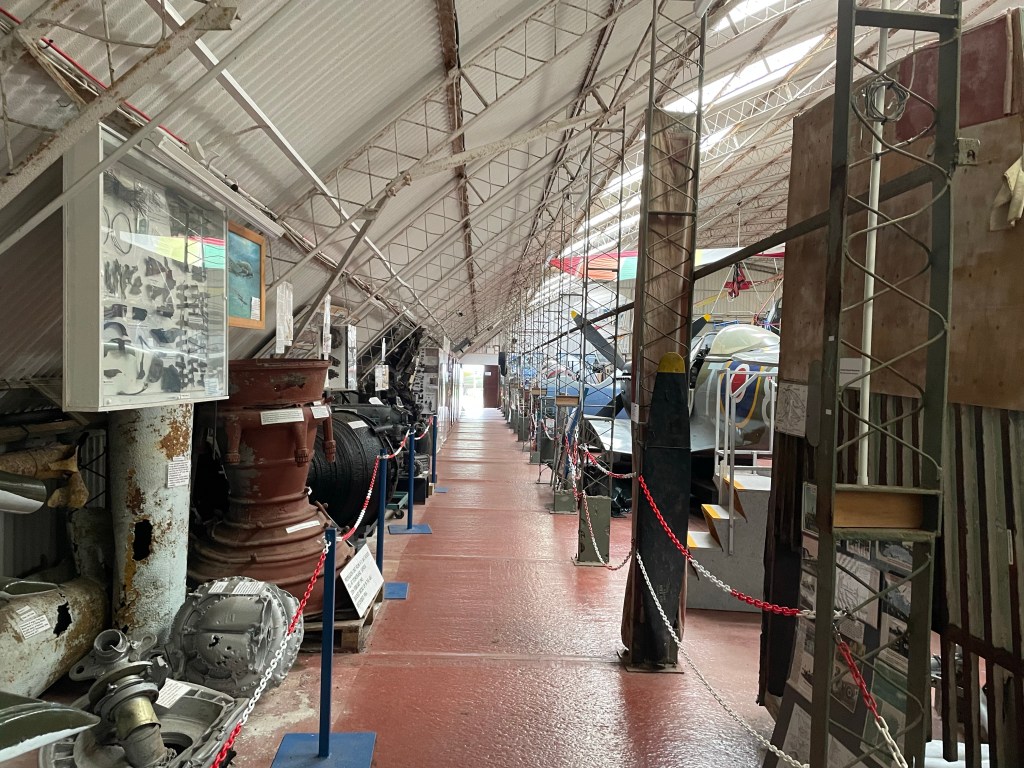
One of the hangers at The Norfolk and Suffolk Aviation Museum and Denis had it all to himself

That’s when we realised the roaming phone data (for internet connection) was non existent. Never mind, the pub had wifi, we went in, ordered coffees from the really friendly staff and started work. But the wifi was disturbingly slow and the acoustics (from the small group of people present) were disturbingly unpleasant. I went back to the data free van and read a book – paper. Around 7pm we went for dinner and it was very good. There were two other couples in the dining room but I don’t like crowds so no complaints from me. Our young server commiserated with us about the data problem, he said he lived up the road and it was just as bad there.
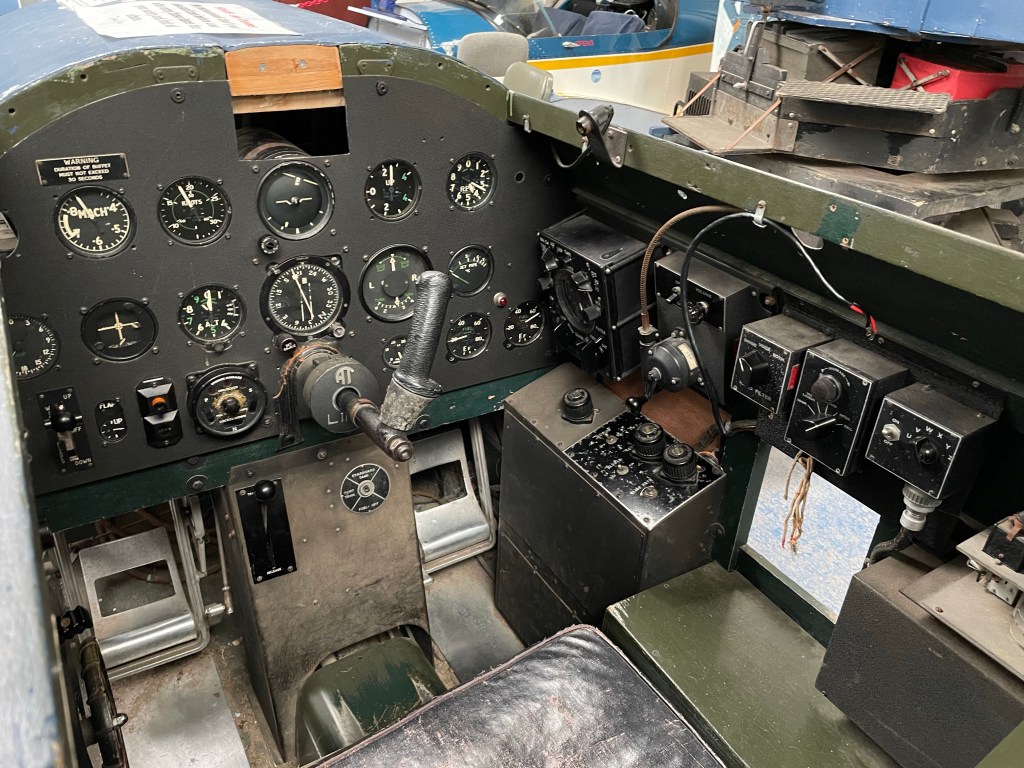
Denis took these photos… I asked him why he took this one he said it was interesting to see what a pilot would see…

Next morning I convinced Denis I’d rather clean the van than go to the museum so he went along on his own and really enjoyed it. He says it was huge and there were lots of people working on different projects and they were all very friendly. There was also a shop selling souvenirs and books. He said he could have spent a full day in there and not seen everything. Admission is by donation.
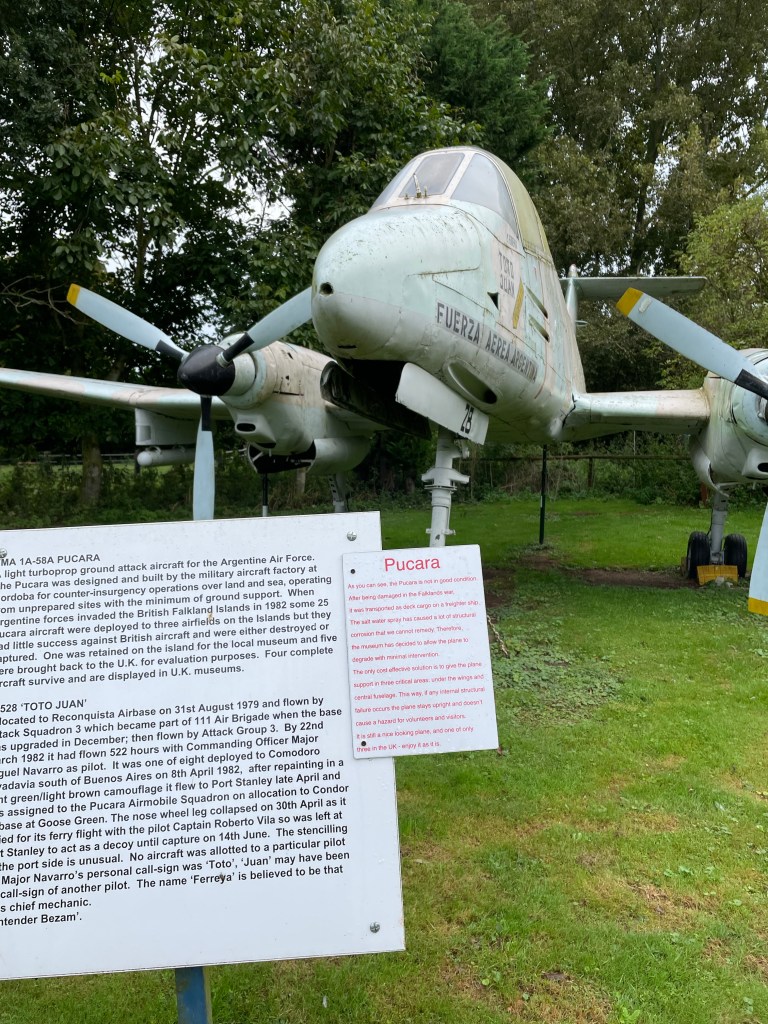
This one was in the Falklands War

And then it was time to get the gas. Denis had rung a garage and the nice lady said she had gas at the moment but there was no way of knowing if she’d have it by the time we arrived. You see there’s no gauge… to tell if there was any LPG in their tank. They only knew for sure when it ran out and then they would ring the gas company but it could take a week for a delivery. Well that did explain why we were having difficulty – we were just unlucky. Fingers crossed this garage wouldn’t have run out. And it hadn’t! Well it hadn’t run out of gas but it had run out of petrol and diesel!
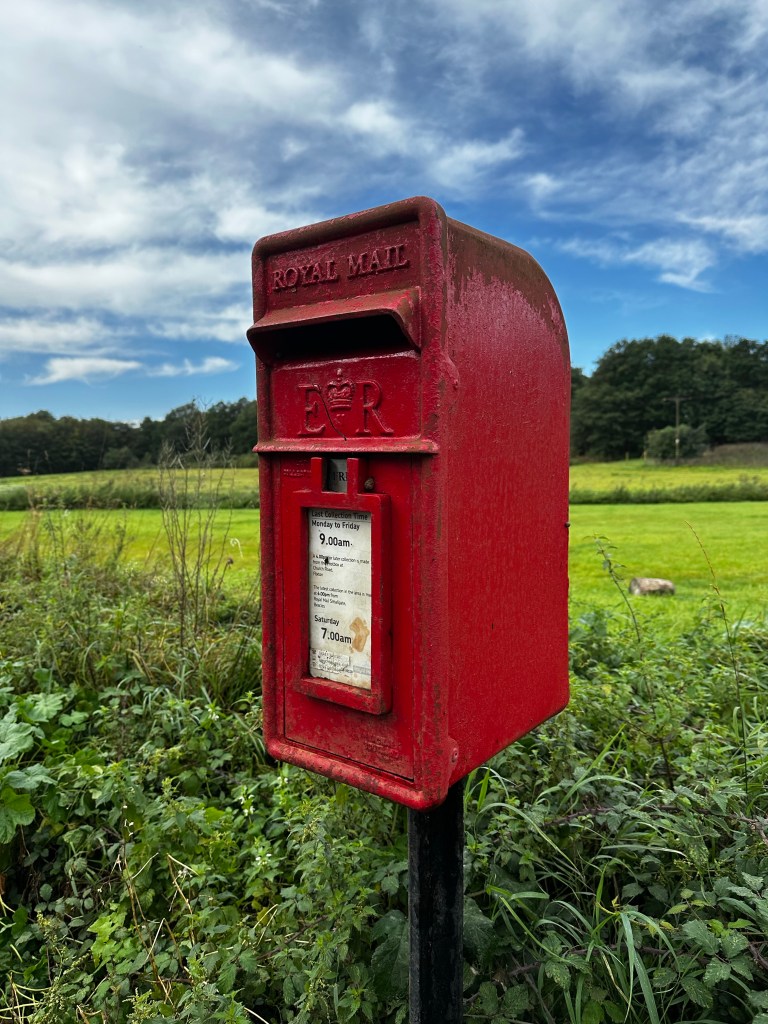
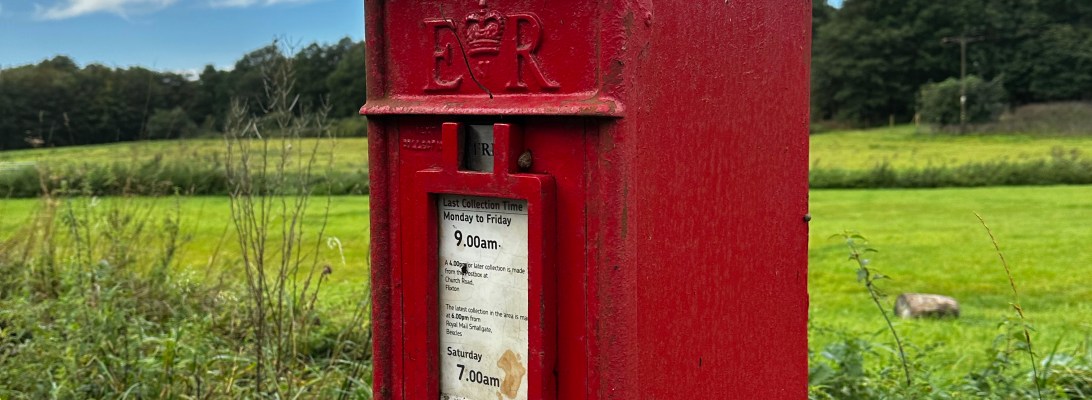
Same postbox taken at the same time from a different angle, makes all the difference

We were starting to think that the time warp of the first few days was back and we were now in the petrol strikes of the 1970’s. I think that’s when we decided it was time to call it a day and go home. We were still a long way from the ferry and I was glad of that because I was looking forward to seeing many more National Trust sites. Maybe if we lowered our expectations for getting the services we thought we needed for the next few days then all would be well.
Coming attractions…

Decision made we headed to Anglesey Abbey, Lode, Cambridgeshire, this National Trust site I mentioned last time had been owned by a family who earned their fortune from sewage systems.

Summary: You can be unlucky with LPG gas supplies. Data coverage isn’t great outside cities. Volunteering continues to flourish. A change of perspective can change everything. Query: Is phone data reliable where you live?

Permission Cards Website: www.permission.cards
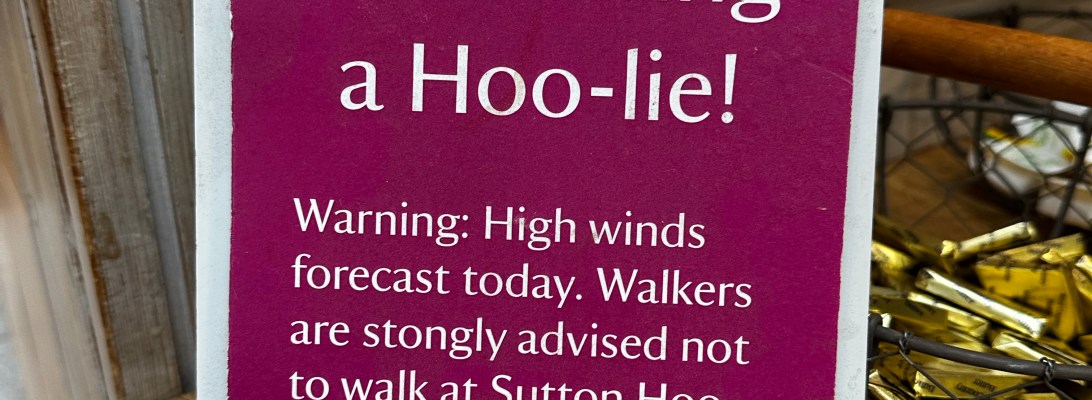
Flushing Waters

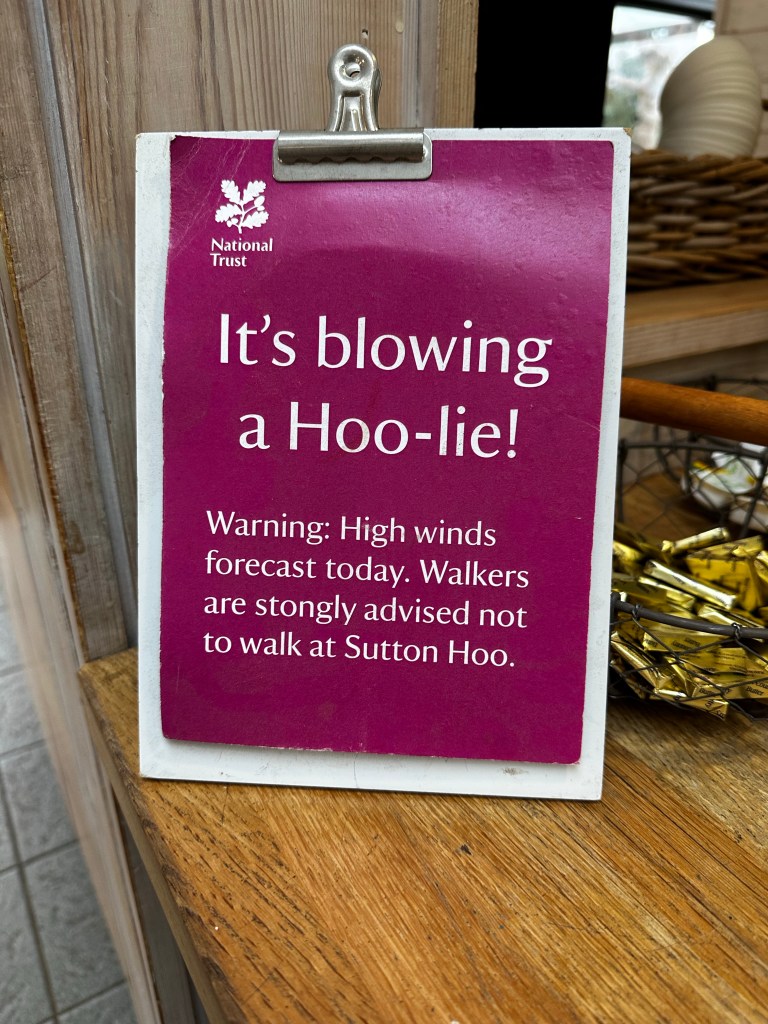
It was a dry, warm and windy day at Sutton Hoo

On Tuesday night we stayed at the campsite in the farm next door to Sutton Hoo. We had been carrying a full tank of grey water and a full cassette (toilet) for too long. We needed to empty everything. We were also running very low on LPG gas and each garage we arrived at had run out. We use gas for heating, for running the fridge, for the oven, the grill and for the essential purpose of making tea. We had stopped using the oven, didn’t even think about the heating and hadn’t seen toast for days. Soon we wouldn’t be able to make tea…

And the Irish connection… this excerpt (in the museum building at Sutton Hoo) is from the exceedingly long poem Beowulf, about this time of Anglo-Saxons, was translated by Seamus Heaney

But first things first we needed to check if there was room in the campsite at the farm next door. We found there were spaces sectioned off by hedges around a medium sized field. All but two of the spaces were taken up with motorhomes and caravans.

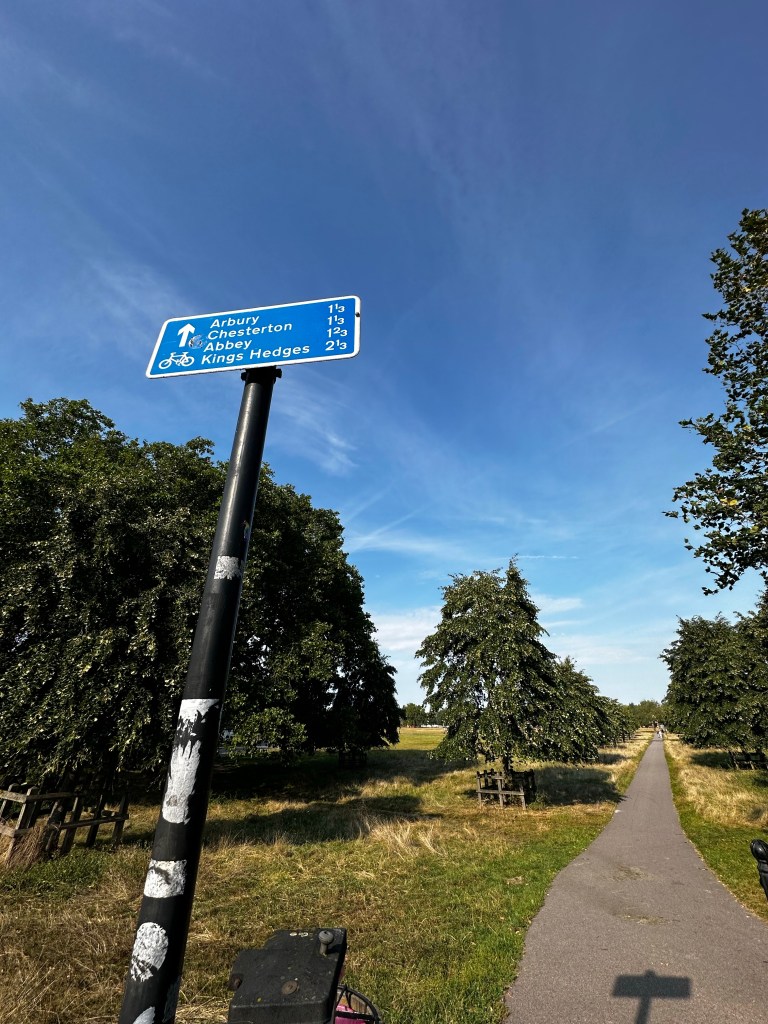
Which way?

There was a little shed with a sign saying Reception and lots of little signs about wifi and dog walking. There was also a block of toilets and showers. Unfortunately, there was no one about. It was after 5pm and this is out of season. Denis went looking in vain for a phone number and returned looking glum, saying we would have to travel on.

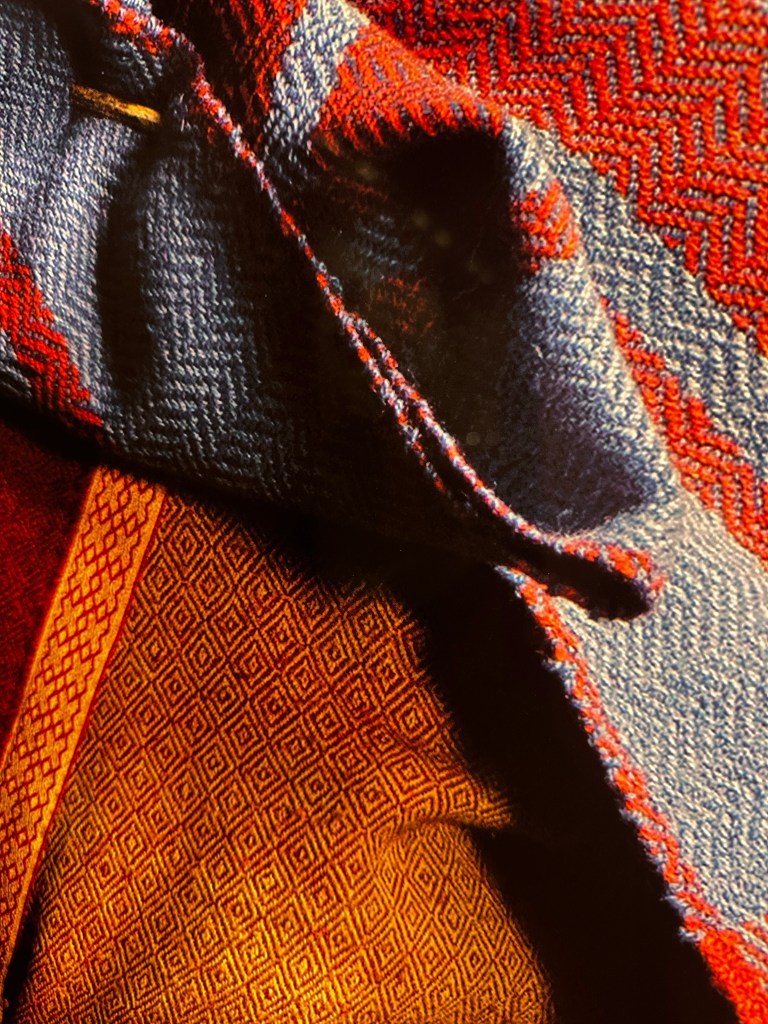
Another exhibits from the museum. I really love the clothing materials

Something you may not know about me is that my automatic instinct is to give up, rather than to persist. I know this and give myself a hard time for it. Denis also knows this and naturally thought I would agree to move on. I didn’t. There was nothing I could do about the gas here but there was no way I was going to accompany that grey and black water another mile. (All distance is in miles in the UK.)

I saw this in Edith Pretty’s house. The human impulse of sharing good news with someone who cares

Ignoring politeness Denis tugged the shed door open and was rewarded with a wall full of more signs, including, a phone number. Helen answered when Denis called and told him she would see us in the morning and to make ourselves comfortable wherever we found a space. Oh and she told him where the empty water points were too. Can you imagine the excitement?

I have to admit I don’t know what this is, I forgot to take a picture of the description but it definitely came from the grave

You might not be able to imagine the excitement if you are more familiar with just the magical flush of a toilet when everything disappears and refills with clean water. Or if you pull the plug and the dish water swirls down the sink. Imagine if it stopped though? I find the whole sewage concept really interesting and as synchronicity would have it, the next National Trust house I visited had been owned by a family who earned their fortune from sewage management. Imagine that!

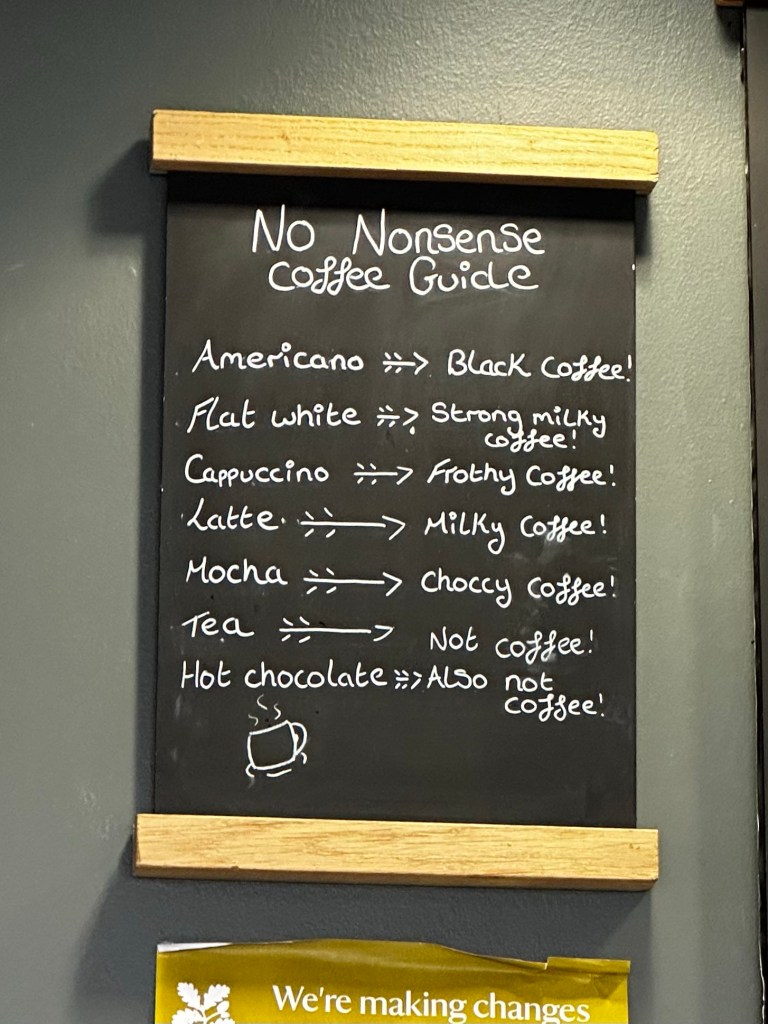
Helpful coffee guide…

Synopsis: Travelling by motorhome on this trip has had its challenges. Eventually finding places to empty water has been very exciting. Which leads me to consider, does more hardship leads to more gratitude? Query: What would you miss most if you lost all modern conveniences?

Sutton Hoo?

Edith Pretty’s house at Sutton Hoo

On Tuesday last we went to Sutton Hoo. You may have heard about it in the 2021 movie called The Dig? It might still be on Netflix. It was based on a book with the same name and it tells a story of finding an Anglo-Saxon grave. Not just any grave, either, the grave of a king with his treasure and his ship in this place called Sutton Hoo near the village of Woodbridge in Suffolk.

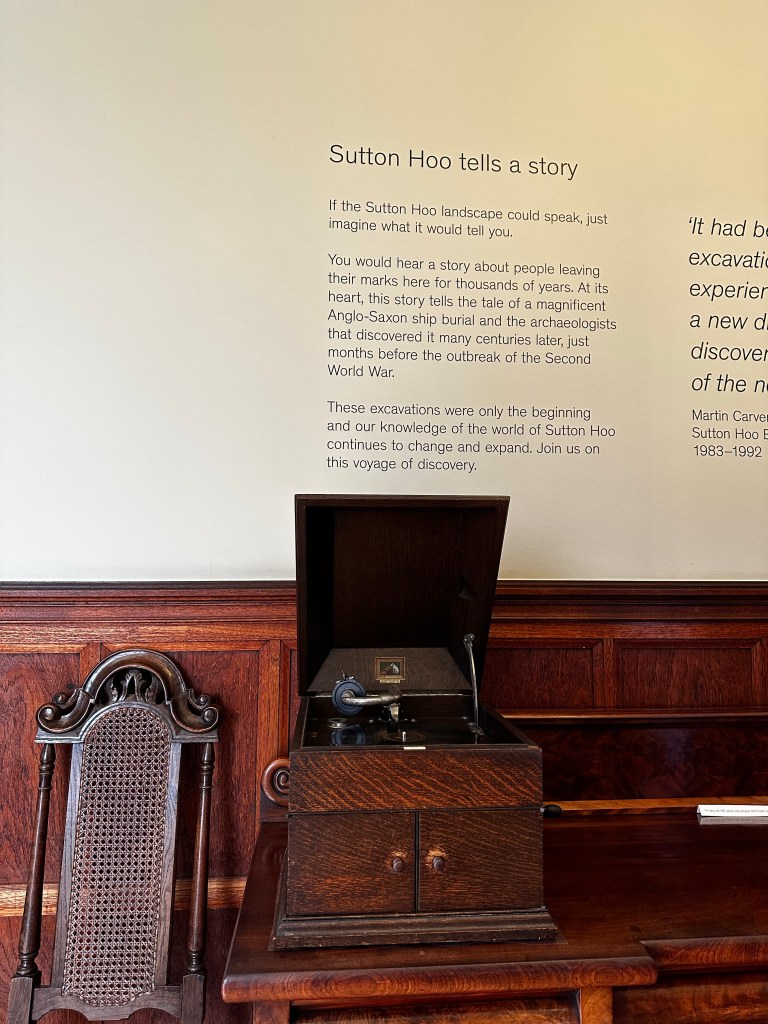
There’s an old record player in the entrance hall

We accidentally drove through the village of Woodbridge (beautiful but narrow) and would not recommend driving through in a motorhome. It was unnecessary as Sutton Hoo is away on its own in the countryside a few miles away. There’s a long drive up to it, parking for motorhomes and even a campsite nearby.

Basil Brown’s measuring tape

Remember I told you I had bought a visitor ticket to the National Trust which meant for the time we are in England (or anywhere within the UK) I can visit any National Trust site for free? This is very cost effective and that’s on purpose I believe. The first question I’m asked at each reception desk is, “Are you a member?” (It’s such a great question because it makes members feel welcome and it tells the unaware non member about the concept of membership!) It seems that most people who live here are members and so they can visit anytime and they do.

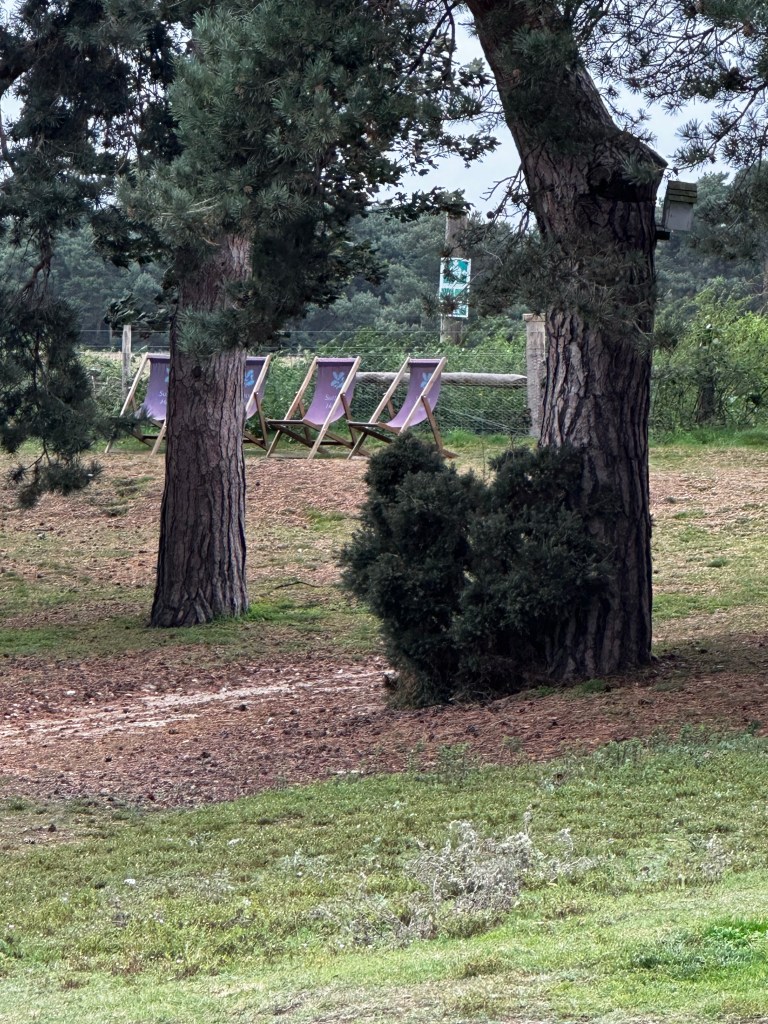
Lonely deck chairs in the wind

Some just walk their dogs or go for a coffee or buy a second hand book – which I did on this occasion. On a less windy day than the day I visited they might sit in the deck chairs and just enjoy the view. Or they might use the services of the many volunteers who are more than happy to answer any questions or tell their favourite story of the place. As most volunteers are here for one day a week you will probably never meet the same volunteer twice so there’s alway a new story to hear.

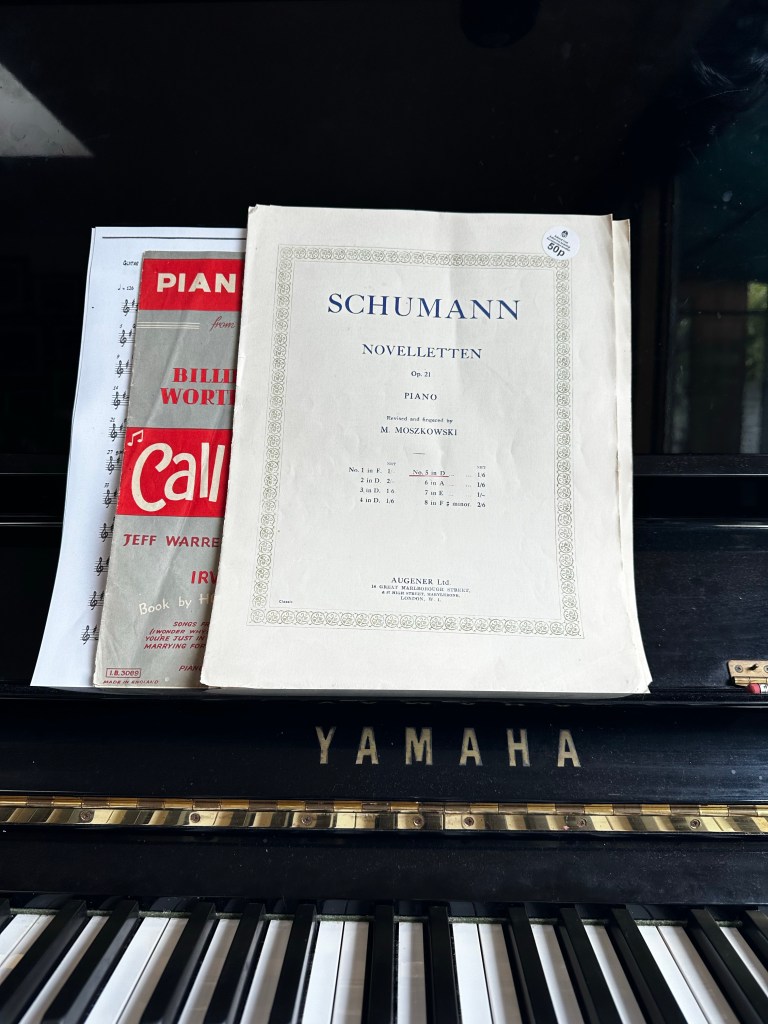
I bought some sheet music in the second hand book shop

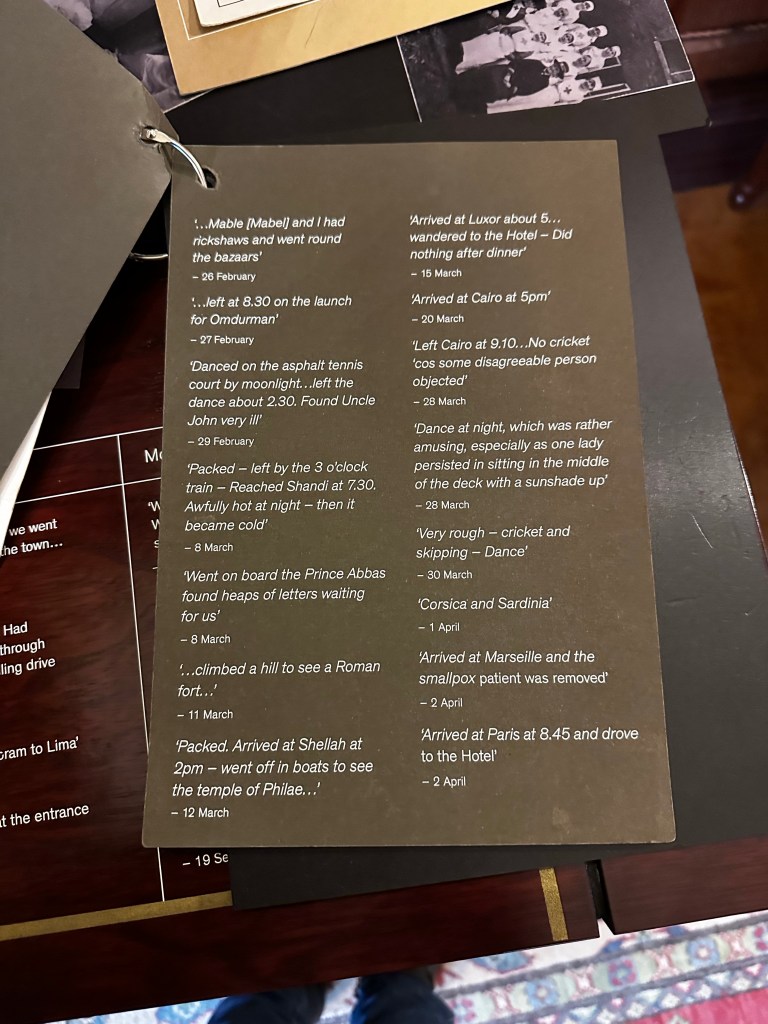
You probably want to hear some of the story of Sutton Hoo, right? Well there’s two big picture stories. The one about the Anglo-Saxons and the one about finding their treasure. We’ll start with finding the treasure. Edith Pretty lived with her family at Sutton Hoo between 1926 and 1942. She loved to travel and as a young woman had travelled to, among other places, Khartoum. She took pictures on her travels and kept a diary… This is important because her interest in archeology was fostered on her travels.

Excerpts from Edith Pretty’s travel diary

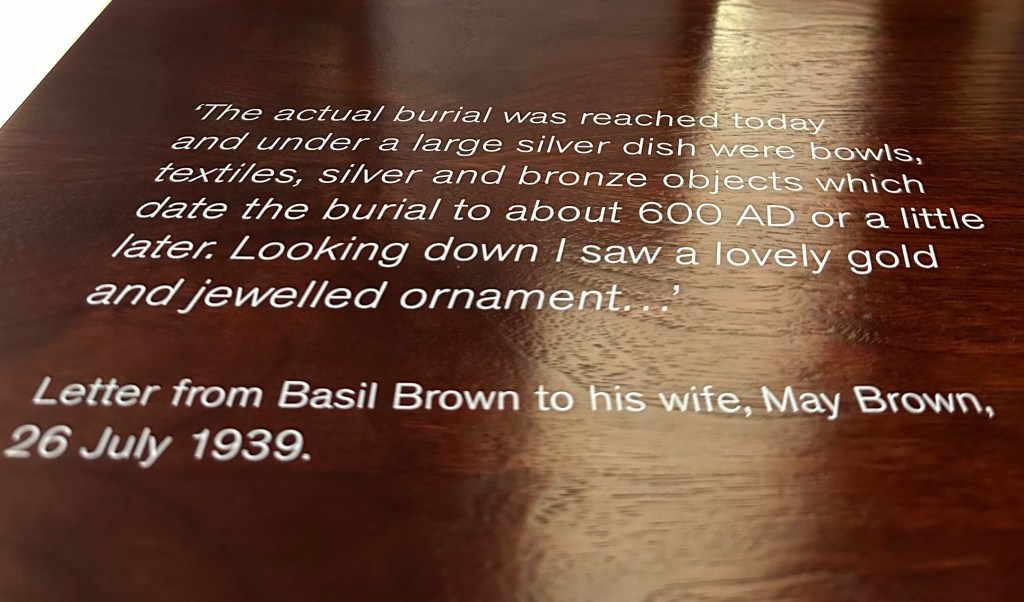
In 1937 (only two years before the Second World War) she was at the Woodbridge flower show where she spoke to a local historian about the earth mounds on her land. She wanted to investigate them. She asked for a recommendation of someone who might help her and was given the name of a local self taught archaeologist, Basil Brown. The story gets a bit more complicated when the British Museum realises there was something good here and replaces Basil with one of their not self taught archaeologists. But for me Edith and Basil are the heroes.

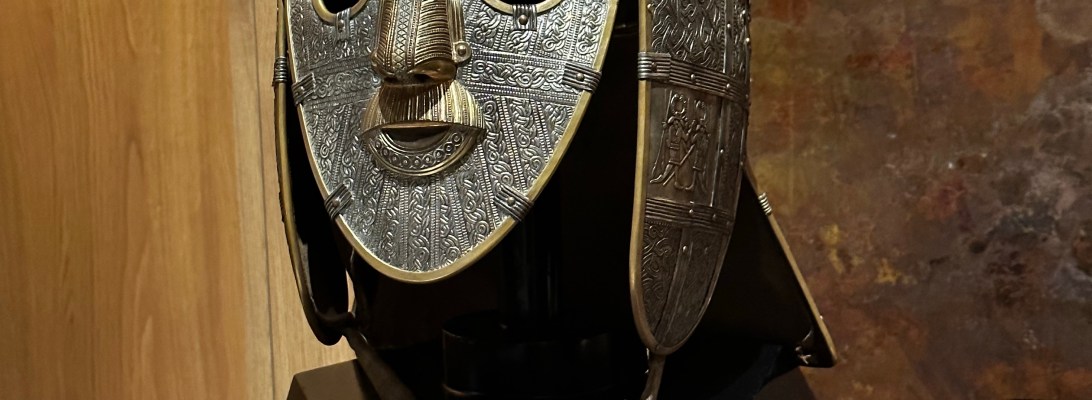
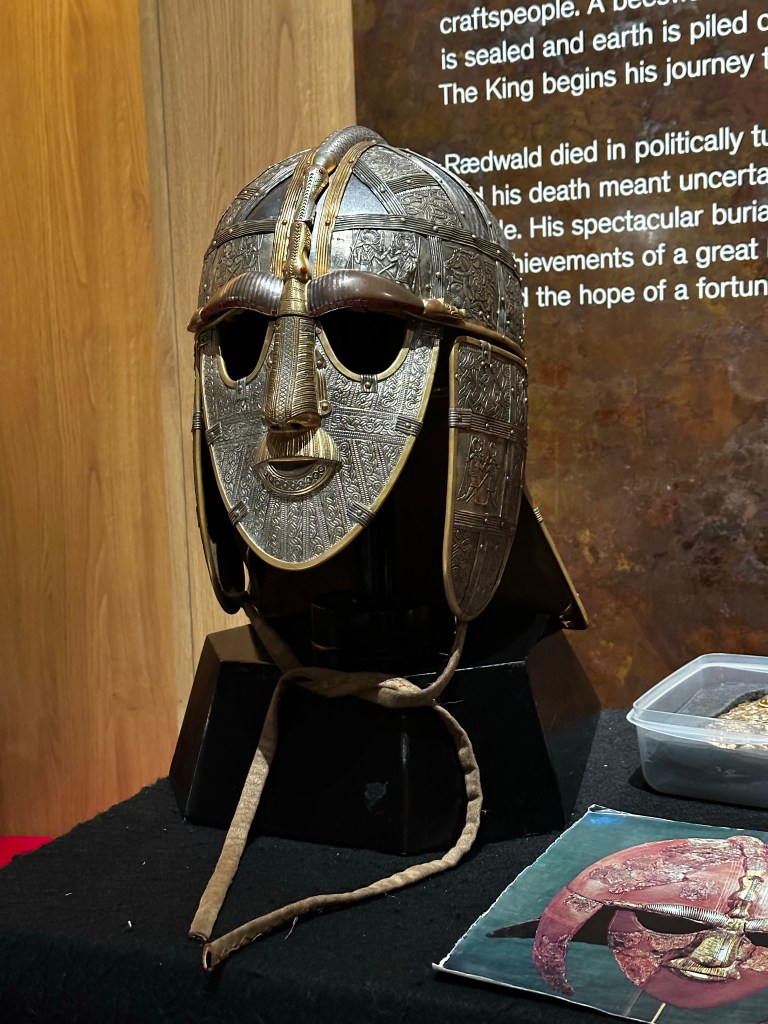
In the museum building this is a replica of King Raedwald’s helmet

And the Anglo-Saxons? Well the history I was missing all along about the Anglo-Saxons – they were in Britain before the Vikings. The information boards and very good at all National Trust sites and Sutton Hoo is no exception.

There are beautiful exhibits of what the Anglo-Saxons might have worn

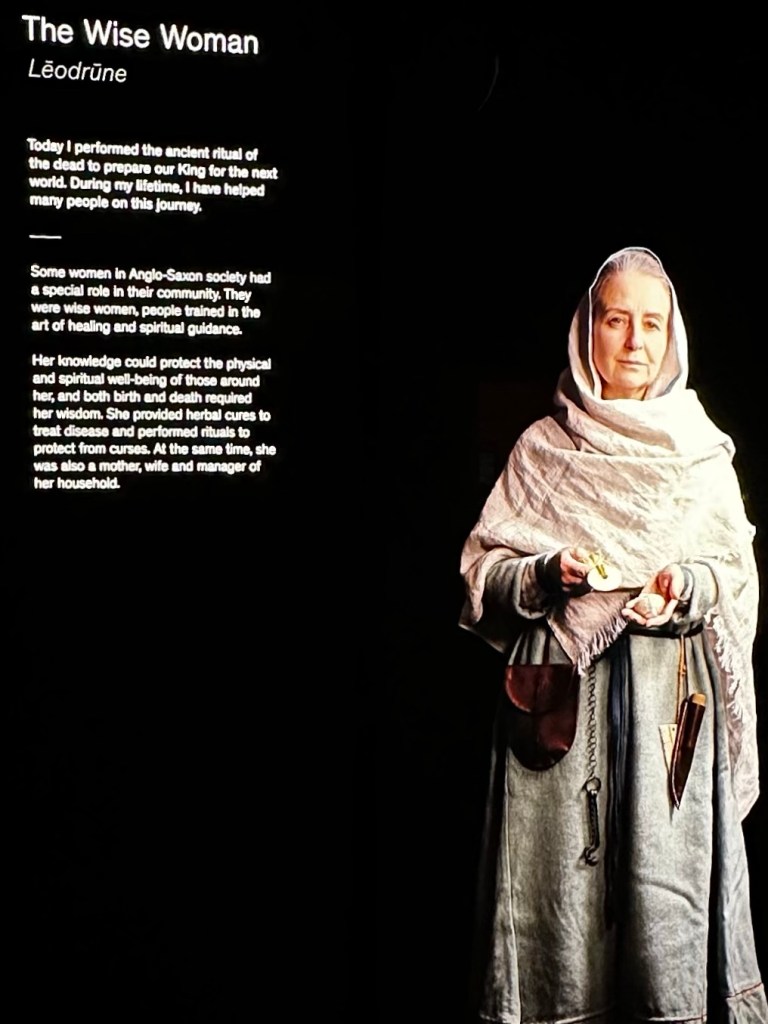
Here’s what I learned: The Romans left Britain in the early 400’s and after that people from Germany (or at least where Germany is now) and the Netherlands and Scandinavia arrived and set up home. They married the locals and they all lived happily. Of course history calls them Anglo-Saxons but they were families who followed traditions and a culture and they belonged. King Raedwald, buried at Sutton Hoo was a member of the Wuffings family and they were rulers of the Kingdom of East Anglia. He died in the early 600’s. The first Viking raid wasn’t until the early 700’s.

East Anglia is the little roundy bit of England that sticks out to the east, north of London. Sutton Hoo is between Ipswich and the sea

Summary: Sutton Hoo is a place where families lived and loved and worked and played and belonged more than one and a half thousand years ago. Two amateurs (from the Latin, to love) self taught in archaeology brought this place to the attention of the world. Query: Do you ever stop yourself from bringing something you are passionate about to the world because you’re “just” an amateur?

King Edmund the Saint

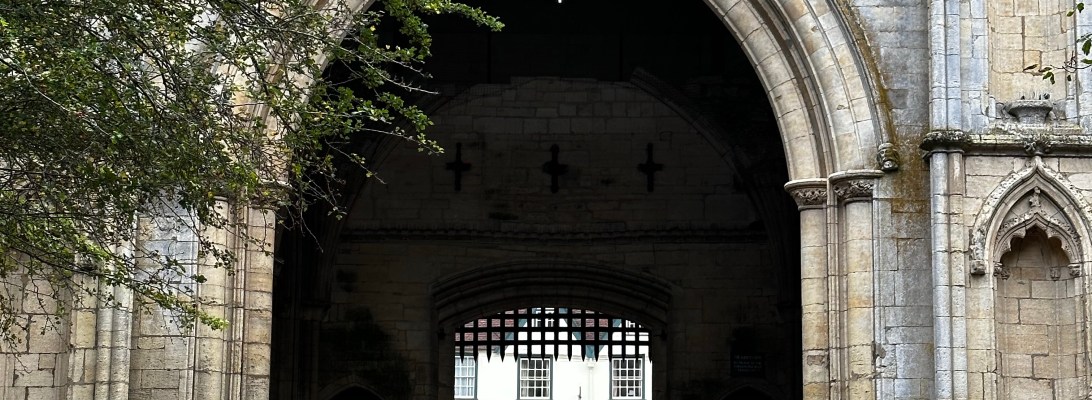
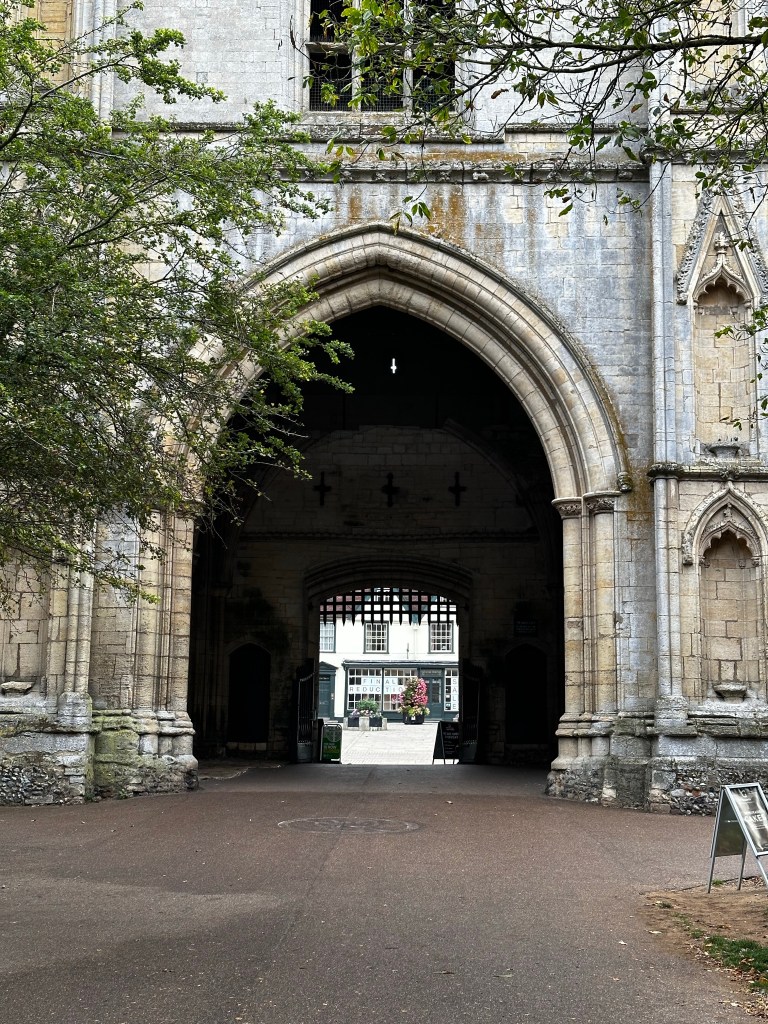
The Abbey Gate (looking towards the town) that led into the monastery which was demolished by King Henry VIII
On Sunday we arrived in the town of Bury St. Edmunds about forty minutes from Cambridge. It’s a very old town that started with a legend about a wolf…
Church Gate leading to the monastery’s church which was also demolished

it was back in 869AD and Edmund was king of East Anglia. He was fighting against the Danish invaders when he was captured and decapitated. When his soldiers came looking for him his head was missing. When they finally found it, it was being protected by a wolf. The wolf allowed the soldiers to take King Edmund’s head and as soon as it came in contact with his body, it fused back on…

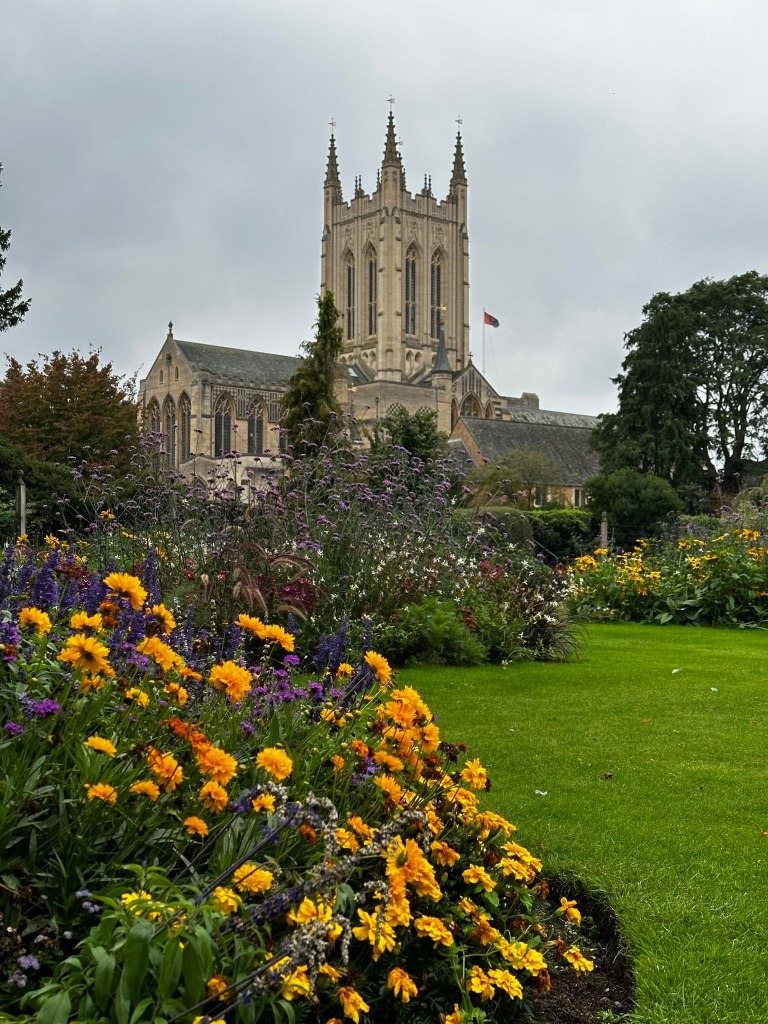
St. Edmundsbury Cathedral, within the walls of the monastery, built in 1964

Well yes of course, that story is hard to believe now but it made a big impression on the people of England back then and was very helpful to the monastery. Monasteries often bought the bones of people who were considered saints so they could promote pilgrimages and special days where they would collect much needed donations on their saint’s behalf.

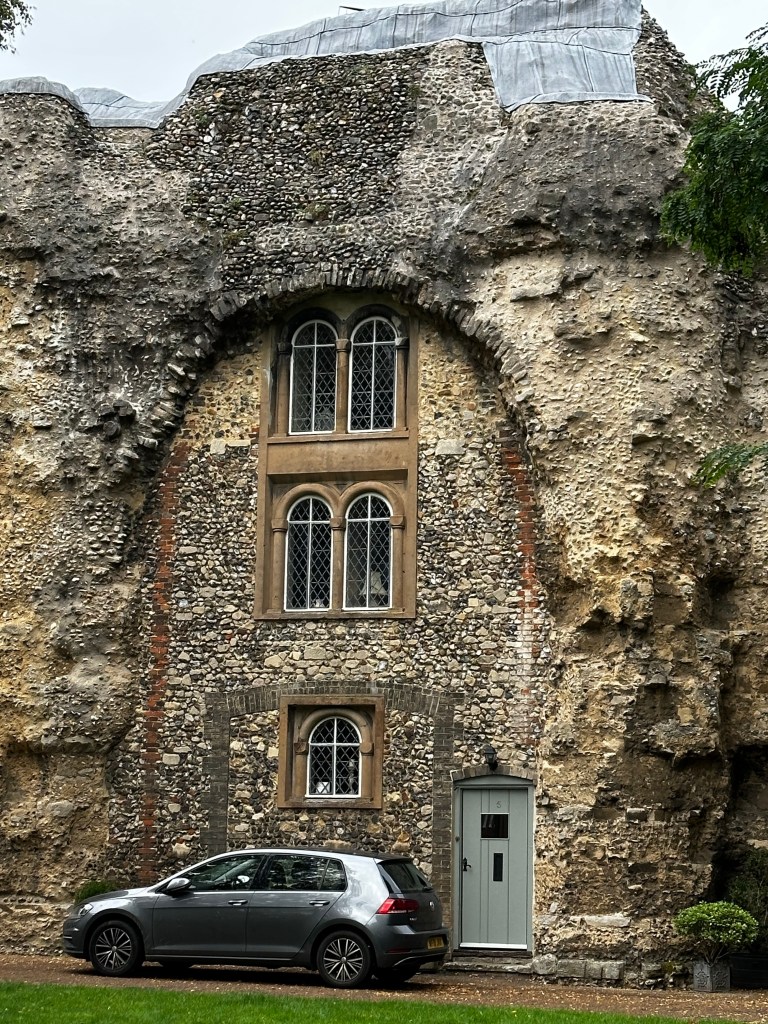
This is one of the houses built with stones from the demolished monastery, the shape is a nod to the original church building

When Bury St. Edmunds Abbey was founded in 1020 they were lucky enough to get King Edmund’s bones. Because of the story of the fusing of his head he was considered a saint and the monastery became one of the most famous and wealthy pilgrimage locations in England. The power of story.

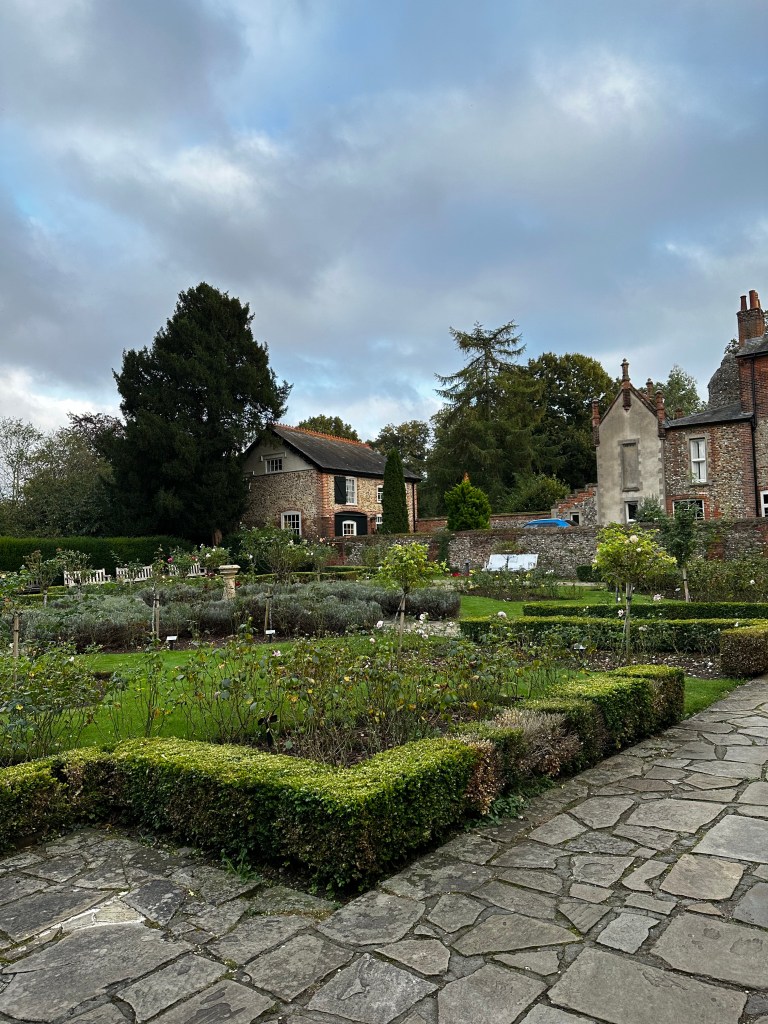
The Rose Garden

The town has very kindly provided overnight parking for motorhomes so we parked up and went on a walk. First stop the Abbey Gardens just minutes away.

Bury St. Edmunds is well used to royalty

You will have heard of King Henry VIII and his six wives but did you also hear about his shutting down the monasteries? All the monasteries, in Ireland too, in the 1500’s. Most of them were demolished and the stone used to construct new buildings. This happened in Bury St. Edmunds and most of the abbey buildings are now just ruins but in spite of that, still beautiful.

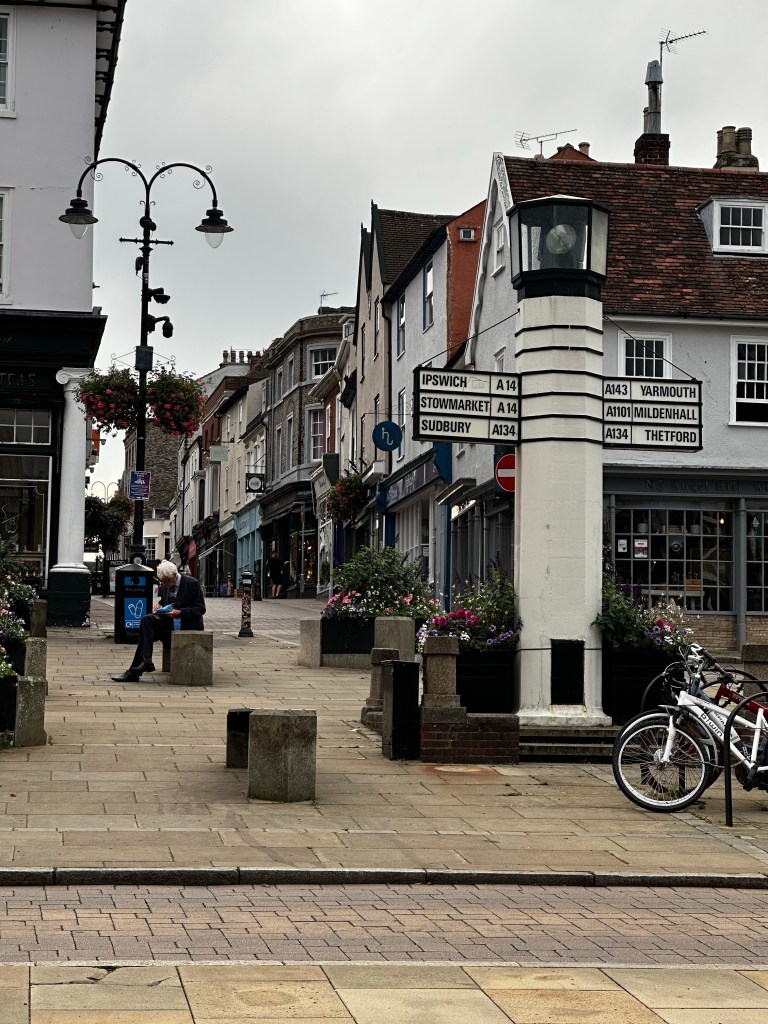
It looks a bit like a lighthouse but this is the first listed road sign in England

There was a contemporary art exhibition in Moyse’s Hall museum in Bury St. Edmund’s this week. Including some original Banksy’s (wall still attached). By the time I walked out the door I was fired up. I would love to have the courage to make some truthful “ugly” art.

Some graffiti from the art exhibition

Summary: A good story can support a monastery. Art doesn’t have to be pretty. Query: What story would you like to tell with your street art?

Dog Watching

One of the many churches in St.Neots from the park

On Friday we arrived in St. Neots, a very old town with market square still looking very like it did more than 100 years ago. We were here to meet up with Ciara (the favourite daughter) and her friend, Flipp. If you’ve joined us on our previous trips you’ll have met them in the Disneyland Paris, June 2022. They found us a parking spot in St. Neots (not an insignificant challenge) and we set off in search of things typically British.

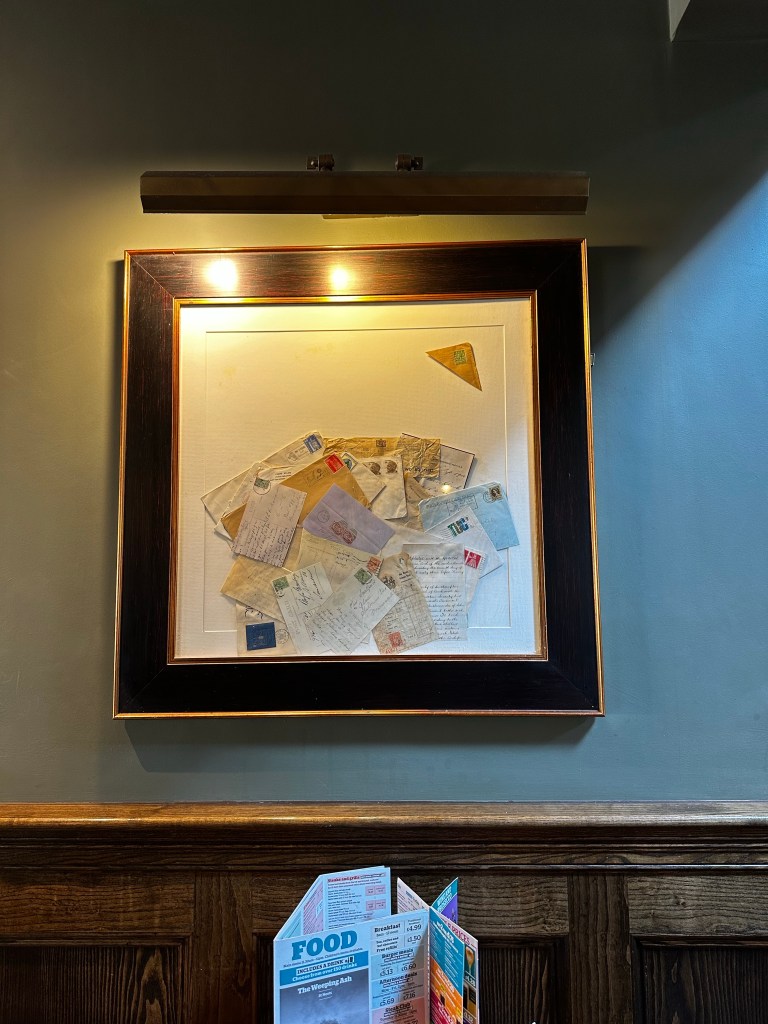
The Wetherspoons in St. Neots used to be the post office and is decorated with post office things including old lost letters

First stop, Wetherspoons, the pub. As it was still only mid morning, I doubted it would be open but it was. And they were serving breakfast with pints of tea and coffee (free refills) and beer (no free refills). And it was quite busy, mainly men, having a quiet drink.

Flipp’s Dad’s parish church

We spent a lovely day visiting, sipping coffee, meeting friends and colleagues of Ciara’s and walking through the parks in the town. Sitting in one park we met an adorable border collie and his owner and were entertained by their party trick. (I cannot remember the dogs’ name so for clarity I’m going to call him Toby.)

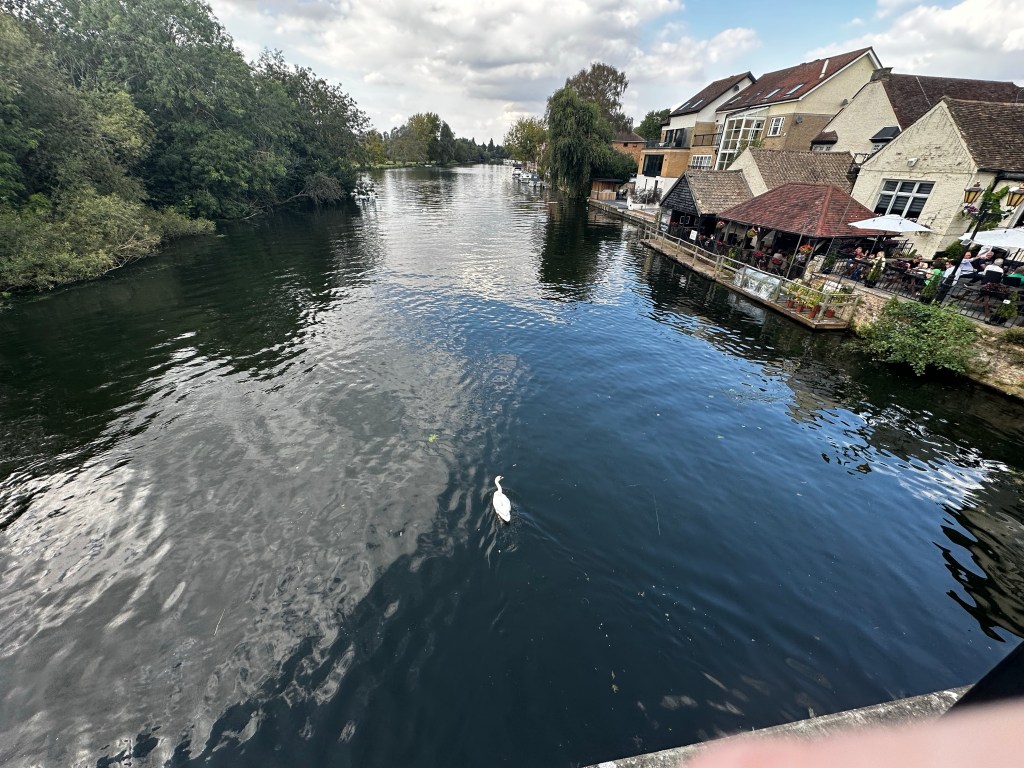
Swans on the Ouse in St. Neots from the bridge

Here’s how it went… the owner would catch Toby’s eye and pause before saying, Right! And off he would run (the dog, not the human) more than 100 meters away to hide behind one of the magnificent oak trees. We could just make out his nose peep around the trunk as he watched for the ball his owner was about to throw. Then he would race towards the ball and race back with it in his mouth for a repeat performance. When I looked around we humans each had a big smile watching Toby doing Toby.

The Round Church in Cambridge

The owner told us Toby’s mother and father were working sheep dogs but Toby hadn’t been trained, he just knew deep in his being what he loved to do. We listened to a story of how Toby and his brother (again let’s call him something for clarity) Jasper, got together for a walk. Jasper’s owner is Toby’s owner’s daughter (if it’s getting complicated, sorry). Anyways, they were all out for a walk and met a little dog who was chasing around the park and without a word from the humans both border collies raced off in different directions and then come around behind the little dog and proceeded to herd him back to his human.

Christ’s College

Next day we set off for Cambridge where there’s a park and ride and surely they’d have a designated place for motorhomes? No, no they wouldn’t but we asked one of the bus drivers and he told us about a little known hack… Trumpington Park and Ride Cambridge have a John Lewis (department store) collection point so they have to have an entrance for over sized delivery trucks.

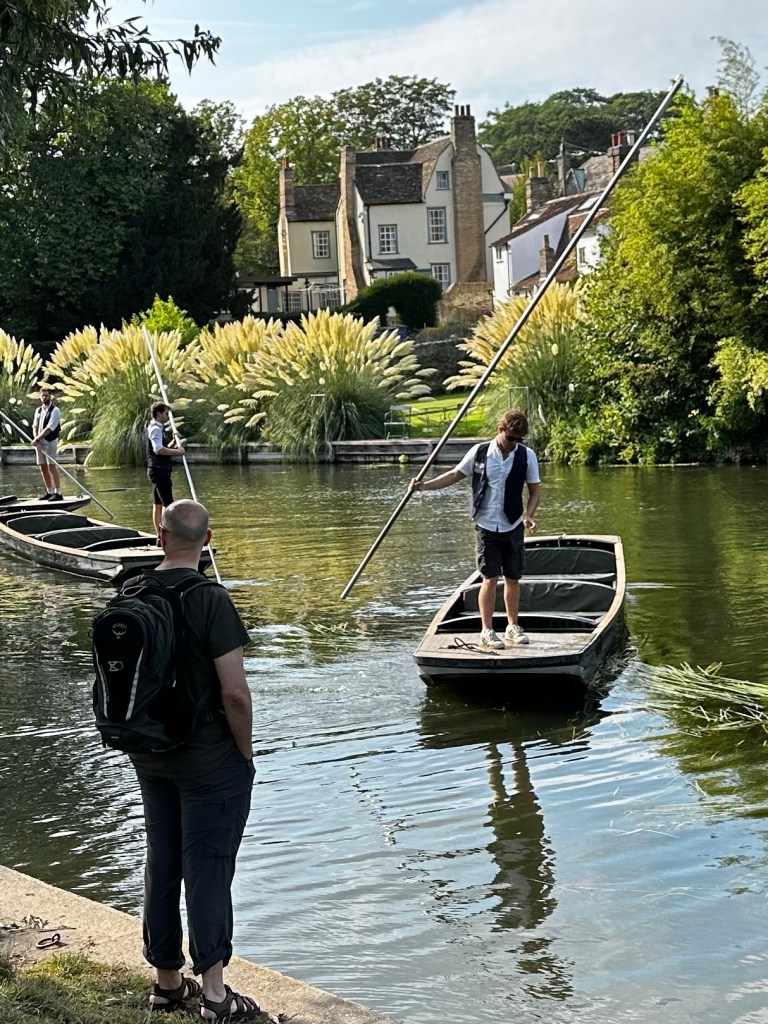
We were tempted by a punt but at £30 per person we resisted

So that’s where we went. Yes, we did have to pass all the signs telling us not to go and we did have to be careful not to follow the guided bus routes but eventually the barrier did rise and there was parking. Parking is free for everyone we just pay for the return bus ride into the centre of Cambridge.

There are lots of churches in Cambridge

It was another hot day as we walked along the old streets and by the river Cam and through the “free to graze your cows” field. There were no cows while we were there but I spotted the telltale signs of recent cow presence. (As I mentioned yesterday I have experience of cows and our street had a lot of cow poo.)

Midsummer Common, where you can graze your cow for free

There are also a lot of bicycles in Cambridge, you have to be more aware of bikes than cars on the streets, especially the walking streets. Happy to say no one was injured during the visit.

On the return journey to the Park and Ride

Summary: Finding parking for a motorhome is difficult sometimes. Dog’s can teach us a lot about being ourselves. Park and Ride have low barriers. Cambridge is a cow friendly, bike friendly city. Query: If you were Toby or Jasper how would you do you?

Thomas Harley is not Thomas Hardy

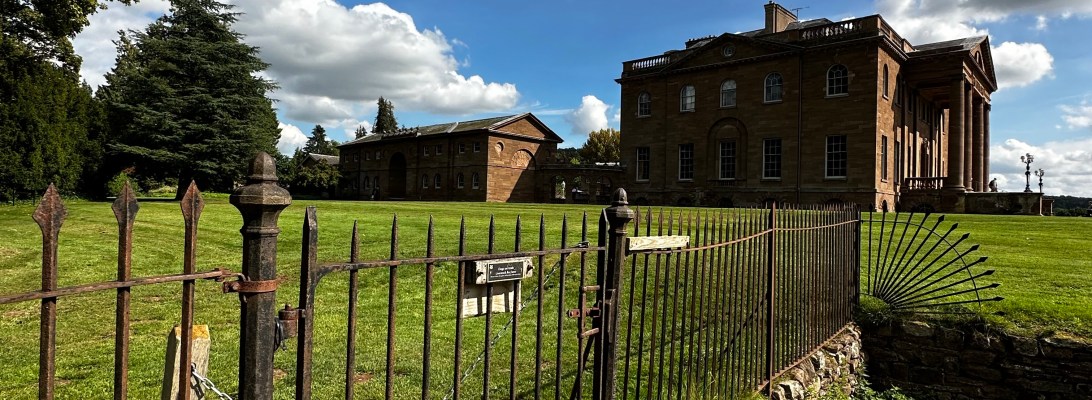
Berrington Hall from the ha-ha

We seem to have fallen into a time warp… five days have passed! After the pub we moved to… Berrington Hall built for Thomas Harley in 1778. NOT Thomas Hardy (who was born in 1840) as I thought the guide was telling me. Inside my head, not out loud, I said – how did he afford to build this house, wasn’t he a poor writer? No, Berrington Hall has nothing to do with Thomas Hardy. History is very interesting to me but also confusing sometimes. There’s so much of it and lots of things repeat over and over like wars, there’s also a lot of men with similar names. I struggle to keep the years and the names clear in my head.

There we are on the National Trust map

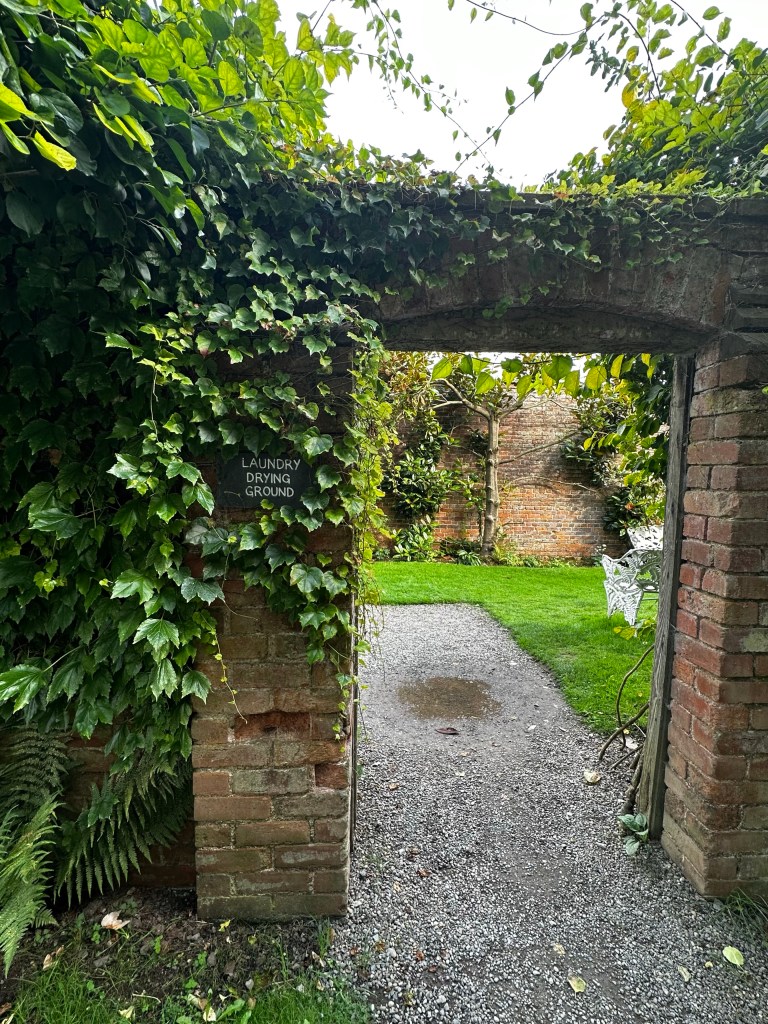
Thomas Harley was a member of the Harley family of whom Harley’s Street in London was named, they made their money from providing uniforms for the army, probably not poor then. He was a Lord Mayor of London and when he gave that up he retired to the country for some peace. It is very peaceful here. It’s in the middle of the countryside surrounded by fields, hundred year old trees, thousands of sheep and a lake. There’s a walled garden too and a laundry garden – where the servants laid out the washed bed linens on the grass to dry.

The Laundry Drying Garden

National Trust houses and gardens are run by volunteers. I didn’t understand this until now. It’s a very different system to the OPW in Ireland. It makes sense now why they charge to go in and also ask for donations, of money and books. They sell the donated second hand books to gather much needed extra finance to keep the houses open to the public. I bought a two week pass so I hope to be going to many more National Trust locations. I’m also going to check out their secondhand books. Also, it was Beatrix Potter (of Peter Rabbit fame) who set up the National Trust.

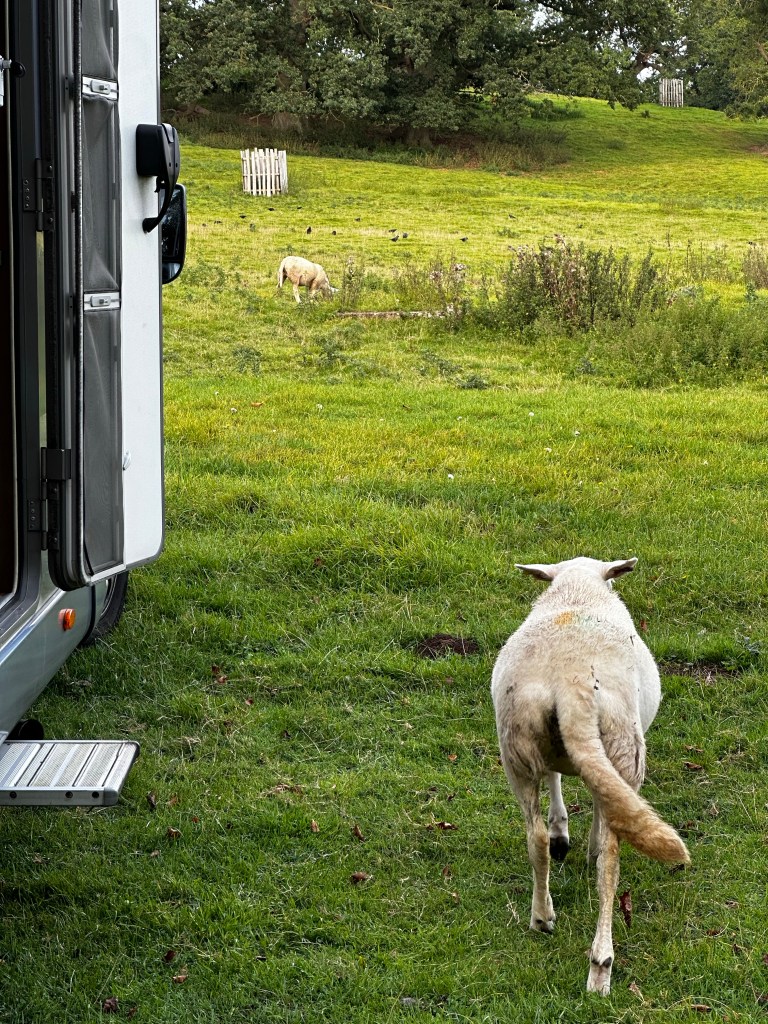
One of the neighbours

Today in Tesco we met a woman in the queue who was very friendly. She chatted to us about the queue and said “I must be bored I’m talking your head off.” So I asked her what she did when she wasn’t bored and she said she loved to read and she loved her garden and she told us about it. This might be one of those times when you had to be there to appreciate how nice this was. We have been noticing how friendly everybody is in Ireland and missing that. It is a much underrated (by me until now, anyway) experience to chat while waiting in a queue.

Interior of Berrington Hall

But I’m skipping ahead, there were five more days lost in the time warp… After Tomas Harley’s house we parked overnight in the trucks car park at the town of Upton on Severn. There was a very good supermarket, called Warners, next door and we stocked up on English pies. Afterwards we dined out at an Indian restaurant. The restaurant was located in an old low ceilinged house with beams and looked out on the narrow high street. It was while we were eating that I spotted a ginormous tractor and combine harvester holding up the traffic. By ginormous I mean the height of a two story house on this street. It reminded me of my childhood. In our town farm life got along with town life. Even though we lived on a street where there was plenty of through traffic going to Dublin or Cork, the cows still had to be milked. Twice a day the farmer (can’t remember his name, was it Mr. Roach?) who lived on this street walked his cows home for milking.

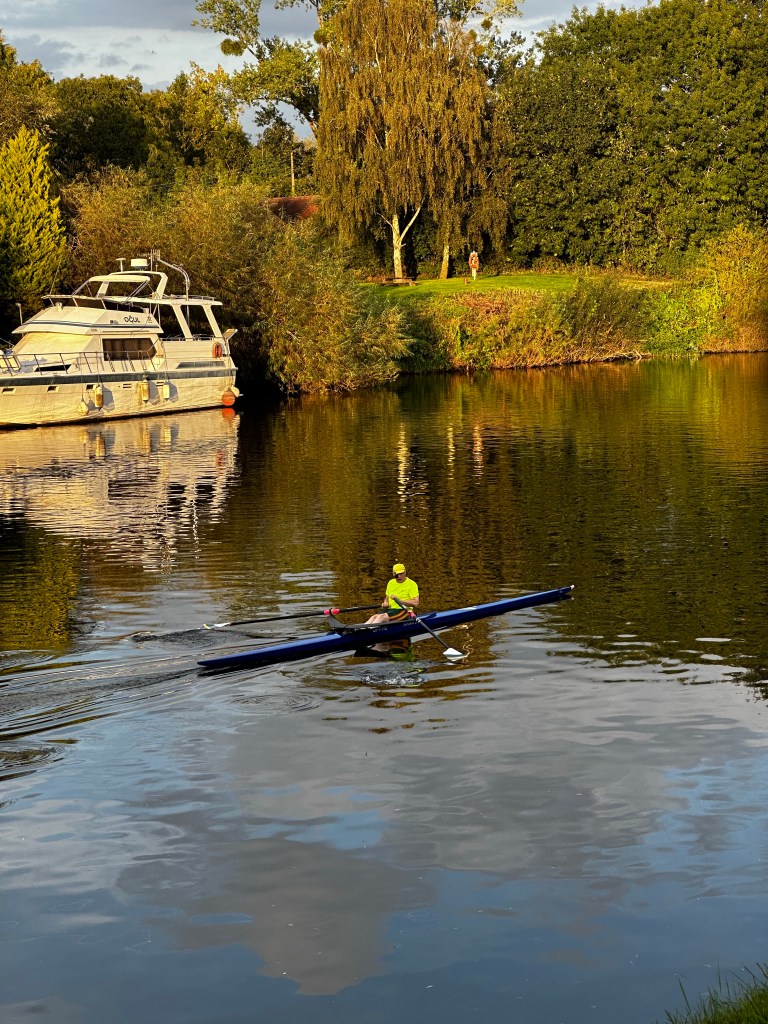
Man on the Severn at Upton-on-Severn

Summary: Thomas Harley is not Thomas Hardy. The countryside has always been very peaceful, unless you were a servant waiting for the linens to dry. Volunteering is alive and well in Britain. Tesco is a great place to meet new people. Farming is big here. Query: Do you have any hacks for remembering dates in history?

Don’t forget the time difference

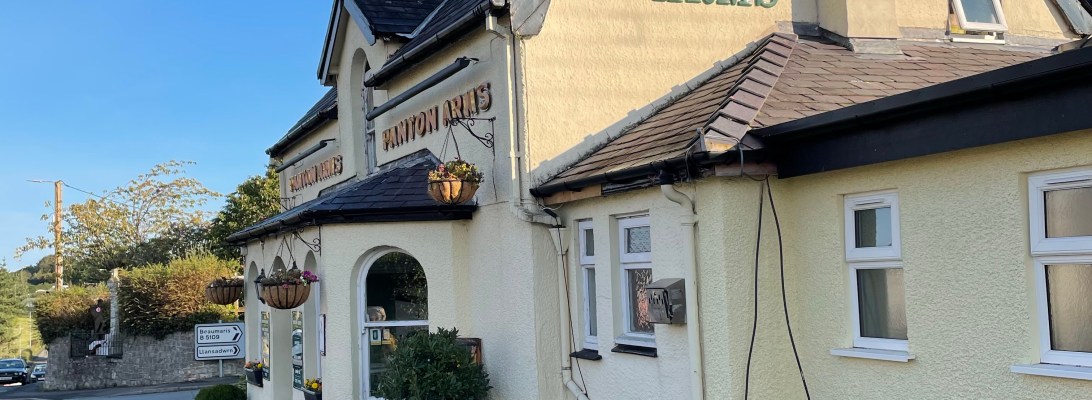
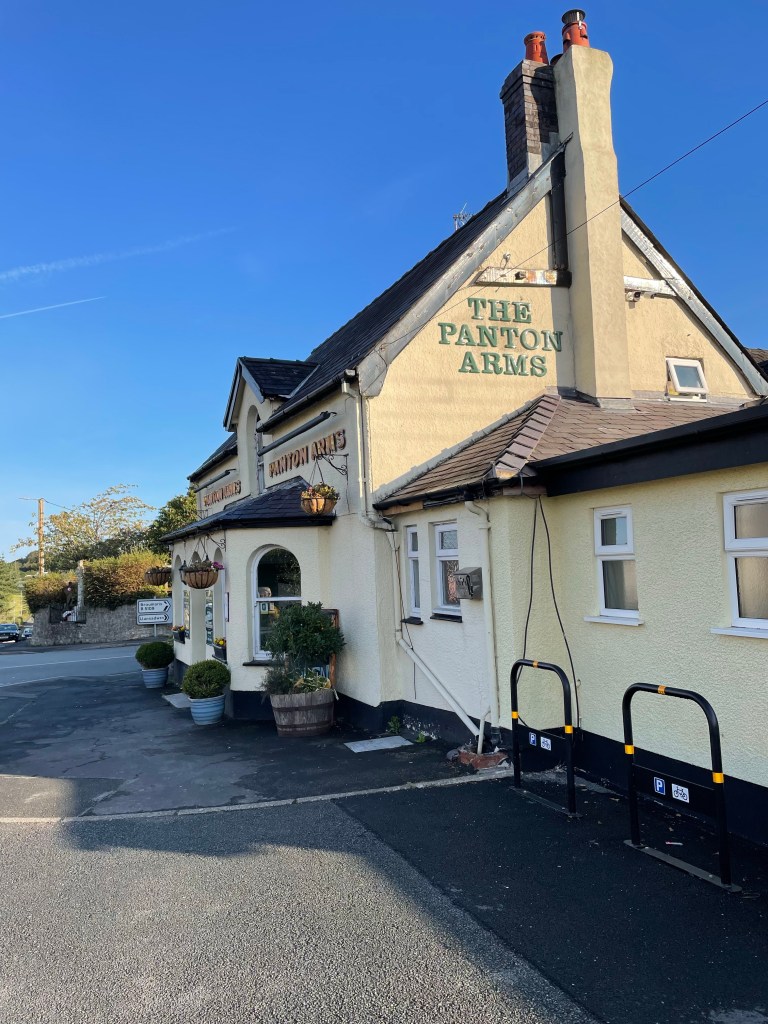
The Panton Arms

We stayed in the car park of a pub in Pentraeth in lashing rain. It was an old pub, they did food and we could park the van overnight if we bought a meal and gave them £5 extra. We had left Dublin Port with sun shining on us just four hours previous but the rain was only temporary. Next morning the sun was back and I went off to the petrol station to buy stamps at the post office.

Right beside the gents toilet at Dublin Port there’s this handy guide to your duty free allowances between Ireland and Britain. The surprising thing is they’re different…

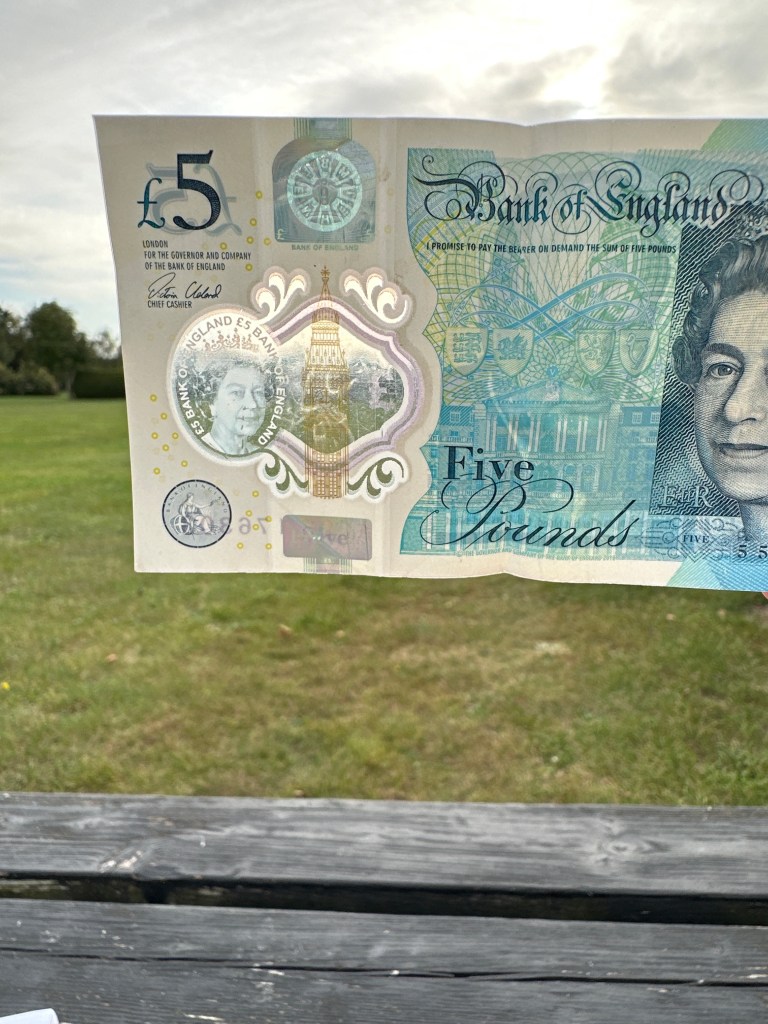
It’s only a few hours away but things are different here. First there’s the money and I don’t just mean that it’s pounds and not euros, the notes are not made of paper. They have a lovely matt springy feel, are very clean and they are see through! Then there’s the time, I know what you’re thinking… I didn’t think there was a time difference either but there is.

Can you see the grass through the £5?

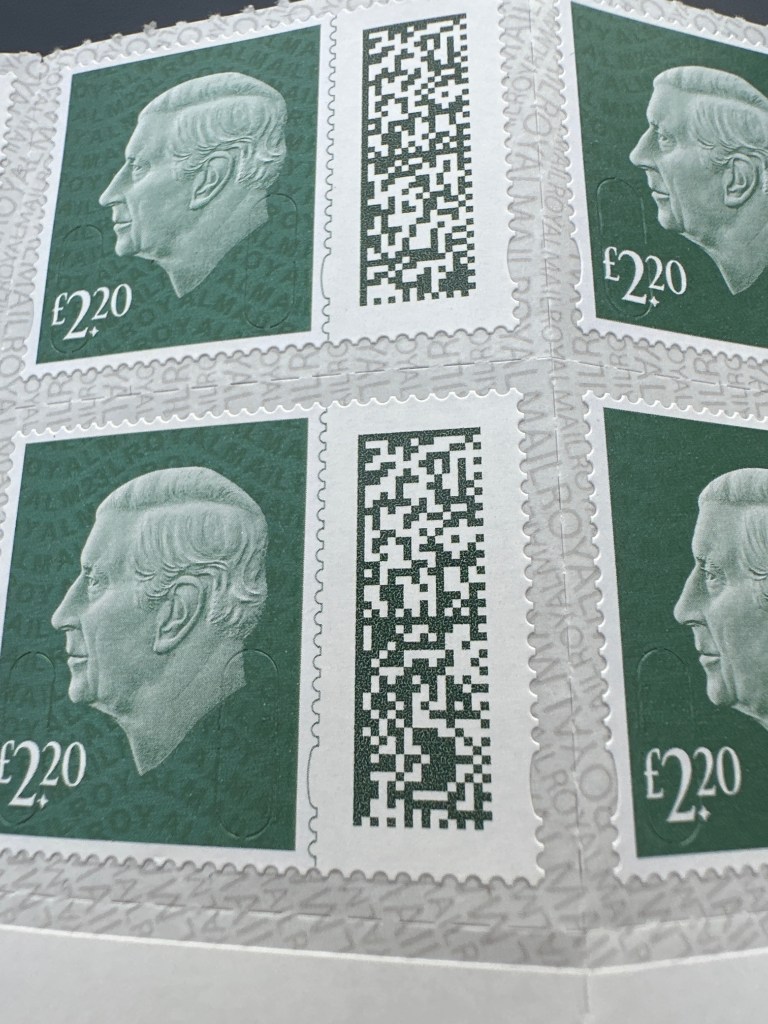
At the petrol station the post office is on the same counter as the groceries but there’s a different cash register. I stood there for a few moments wondering what the procedure might be and then went ahead and asked the grocery cashier if I could buy stamps. He said he didn’t know what time it opened at and called to a lady stacking shelves… she said it opened at 9am.

King Charles is on my stamps

I was delighted, it was exactly 9am – how lucky am I? Unfortunately, the lady stacking shelves didn’t know the time so asked the grocery cashier who said it was five to nine and she replied, it won’t be open until nine and went back to shelf stacking. What? But… I sort of mumbled as I pointed to my phone but my heart wasn’t in it, I stood back to consider my life choices.

All is well

At exactly 9.05am a different customer approached the post office bit of the counter and purchased his stamps. I dashed up after him in case it closed again at 9.06.

My special cat purse for sterling money

Summary: there’s a 5 minute time difference between Ireland and Wales; the money is see through; you can bring 48 litres of beer with you but only 16 litres back. Query: Could anyone help? Neither of us know how to change the time on our phones by five minutes.

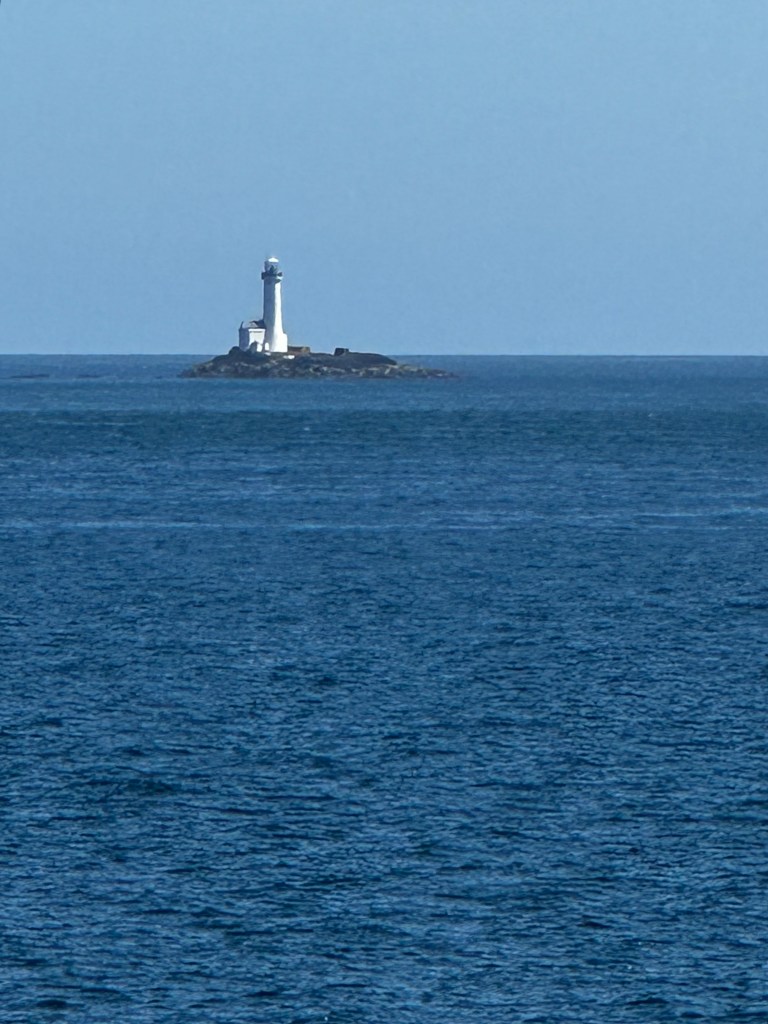
The Lighthouse

Calm seas, plenty sun but can you see the lighthouse?

And now we’re back in Ireland… probably. As I write we’re still on the ferry so I suppose I don’t know for certain that we are back… but it’s probable. It’s the morning after the calmest crossing we’ve ever had. I slept through the night for the first time and am as bright as a button.

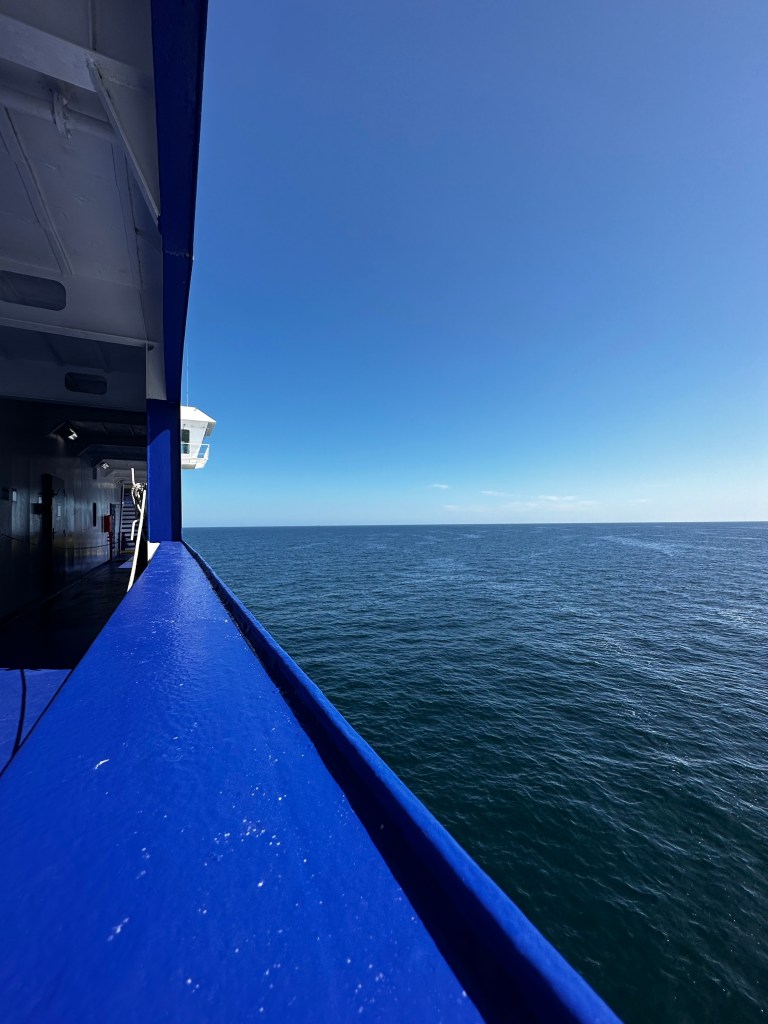
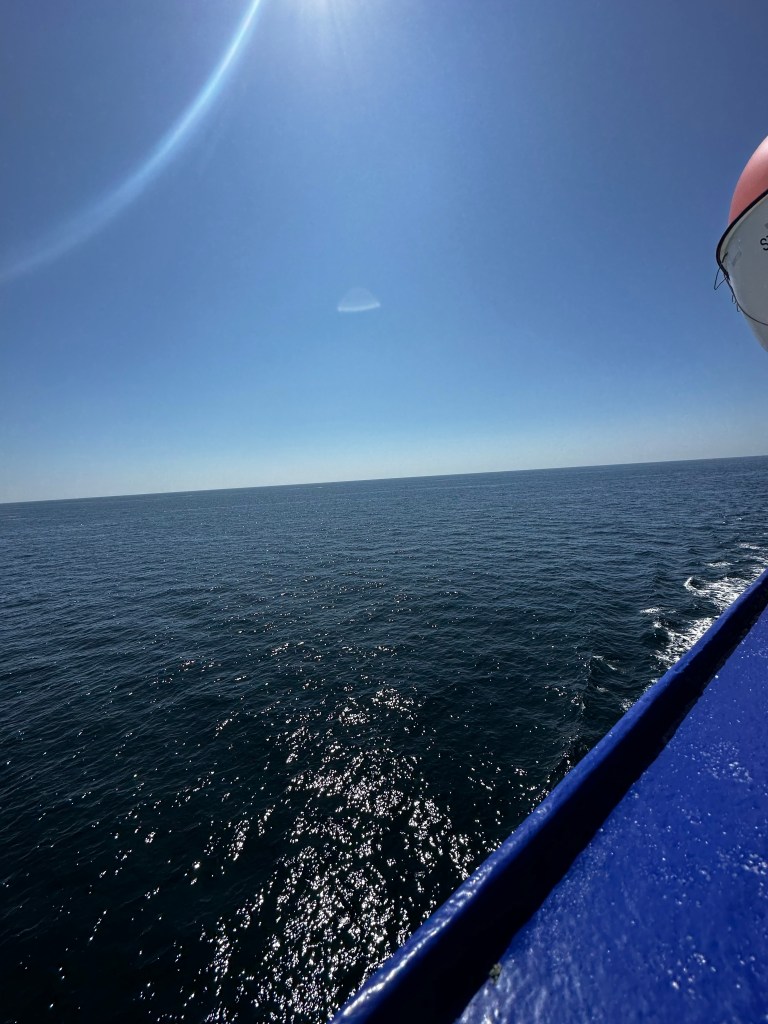
Blue on blue and white and red

The sun is shining on the seas and we are floating towards the Irish Sea. I’ll go get a photo to show you…

Sparkles

By now you’ll have seen the photos! Hopefully they give some sense of what it was like out there. And the lighthouse! It’s the Tusksr Rock lighthouse. I thought we had three more hours on the ferry. We don’t, we’re in the Irish Sea, we’re nearly home!

Way way way in the distance…

Here again is another example of why I need to write to you… you make me go outside and look at what’s there! My friend Linda, yesterday when she realised the forecast was for lots of wind, gently suggested I take my coat and hat on board so I could go outside for a breath of fresh air (=to calm me down, she knows my anxiety.) Of course, what a good idea.

A bit closer

Do I need to tell you – I didn’t bring my coat and hat. There’s no way I’m going outside, I say to myself. But then when I started writing to you and I saw the sun shining on the waves, I thought I’ll just brave the freezing cold for a quick photo!

Almost warm

One photo later I realised it was not cold, it was positively, almost warm. And the breeze wasn’t bitter, it was very pleasant. I took another photo and another and that’s when I saw something in the distance. Another boat? A buoy? A lighthouse? The lighthouse!

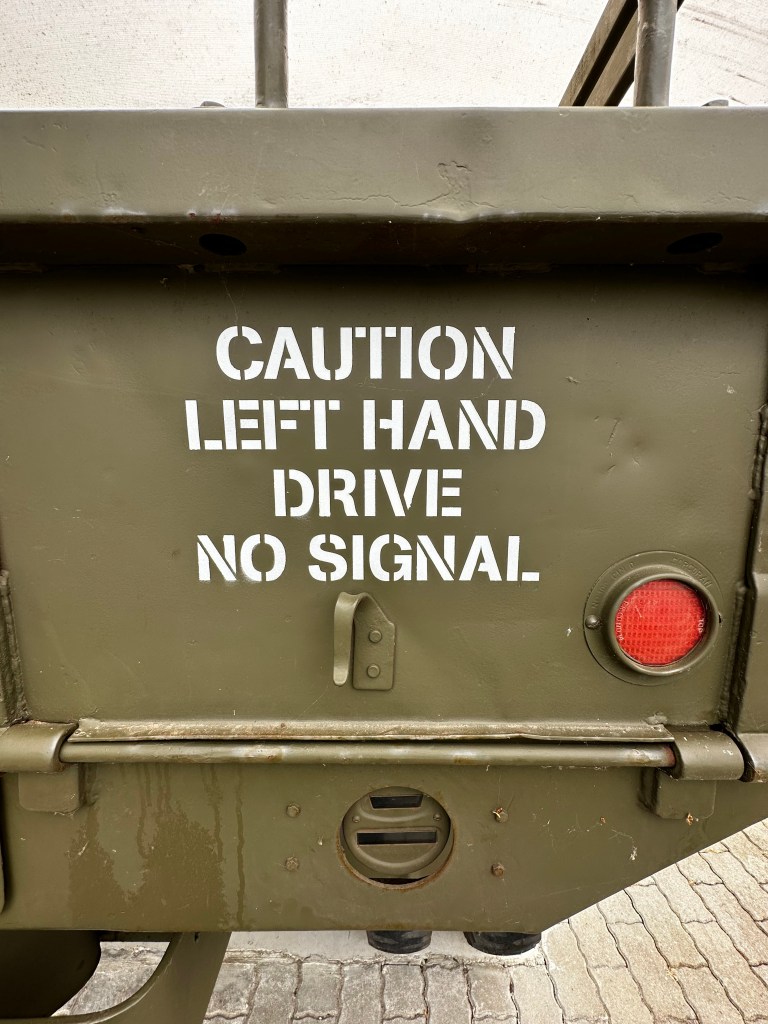
And then it was back to driving on the other side of the road… (We have right hand drive, this picture was of a vintage American army jeep from the museum in Saint Mère Èglise)

A lighthouse to protect us from the rocks, from danger. A lighthouse to keep us safe and on the straight and narrow path home. I just met the Stena hostess who gave each of us muffins on our journey over. Do you remember her? She had to move Denis out of the dining room when it closed and she felt bad for moving him while he was working. She brought each of us a muffin to make it up to him at the time.

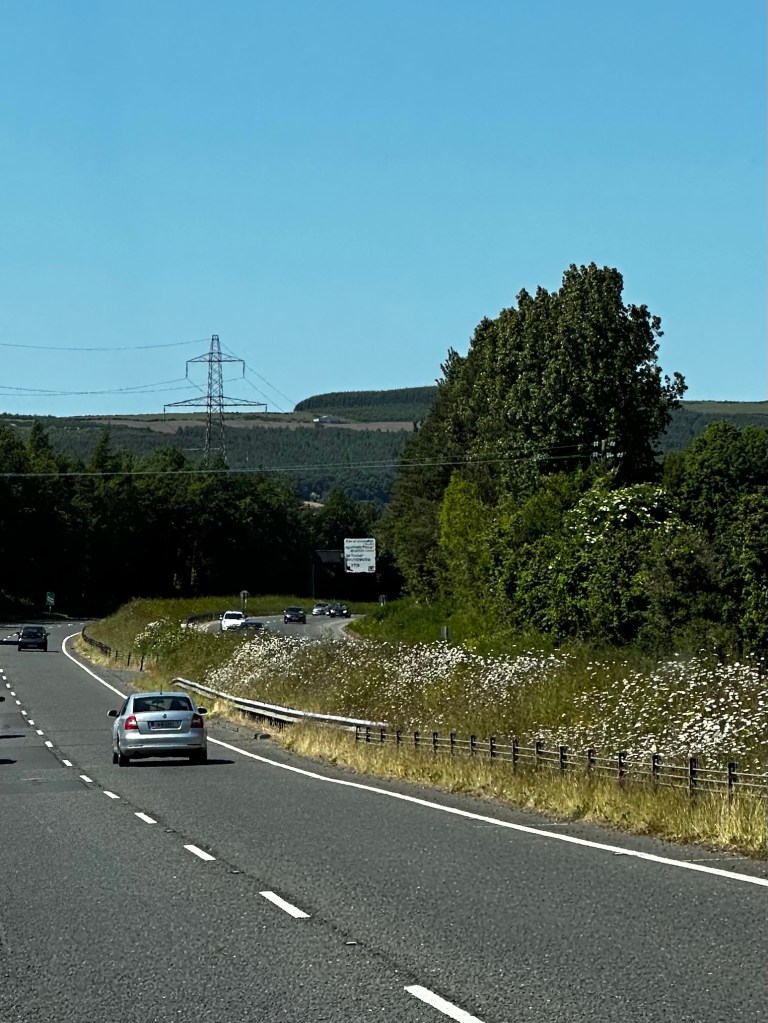
…where the roadsides are covered in daisies…

It struck me that she’s a kindness lighthouse, a kindness lighthouse reminds us of our naturally loving nature, our vibrant connection to others and our absolute necessity in the world. All of us are lighthouses when we do our own thing. Especially when we do it vulnerably, regardless of reward or shame.

…the coffees are ginormous and the skies are blue

I’ll be taking this home with me… Be you. Do you. Give up the shame. Notice the lighthouses. Sending love to you, lighthouse human xxx Mairéad

Calm Down

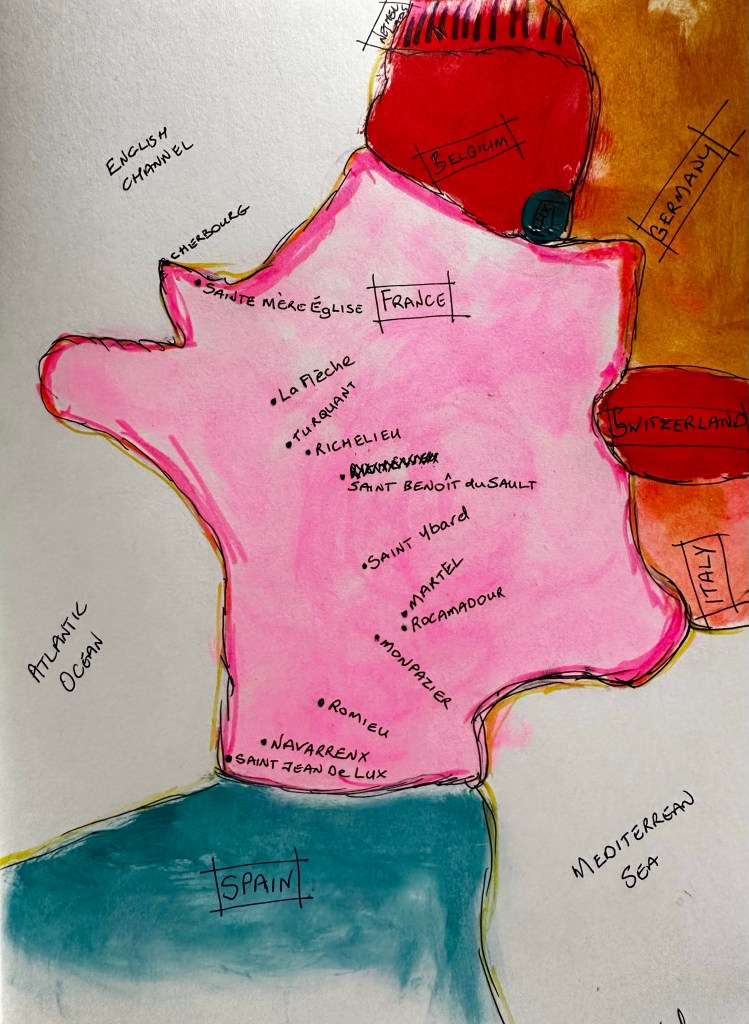
Map 2.1 France and the villages

On Tuesday we left La Flèche on the long drive to the department of Normandy and Saint Mère Èglise. The long drive was made longer by traffic diversions due to a new road or a bridge or something. Suffice to say our sat nav was at a loss to take us anywhere except narrow roads.

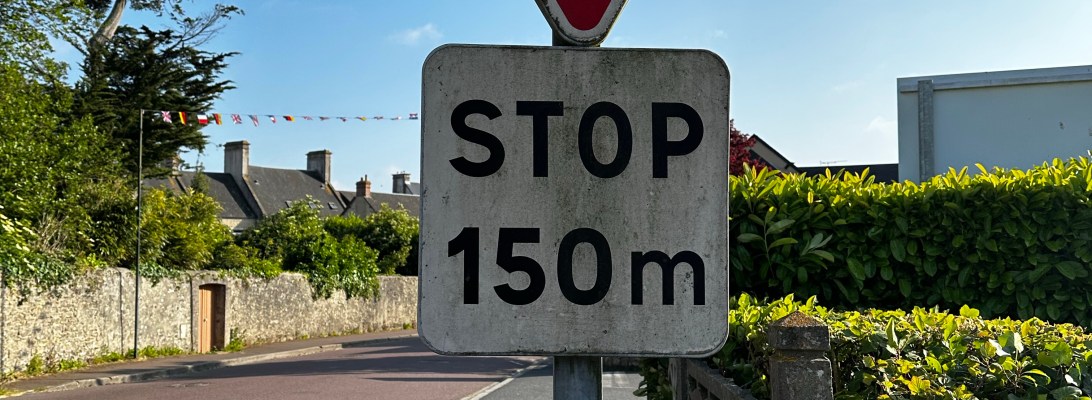
There’s a stop sign up ahead

Very lovely narrow roads with lots of wheat and barley growing in the fields either side. With tractors working in those fields. And sometimes a line of grass growing in the middle of the narrow road.

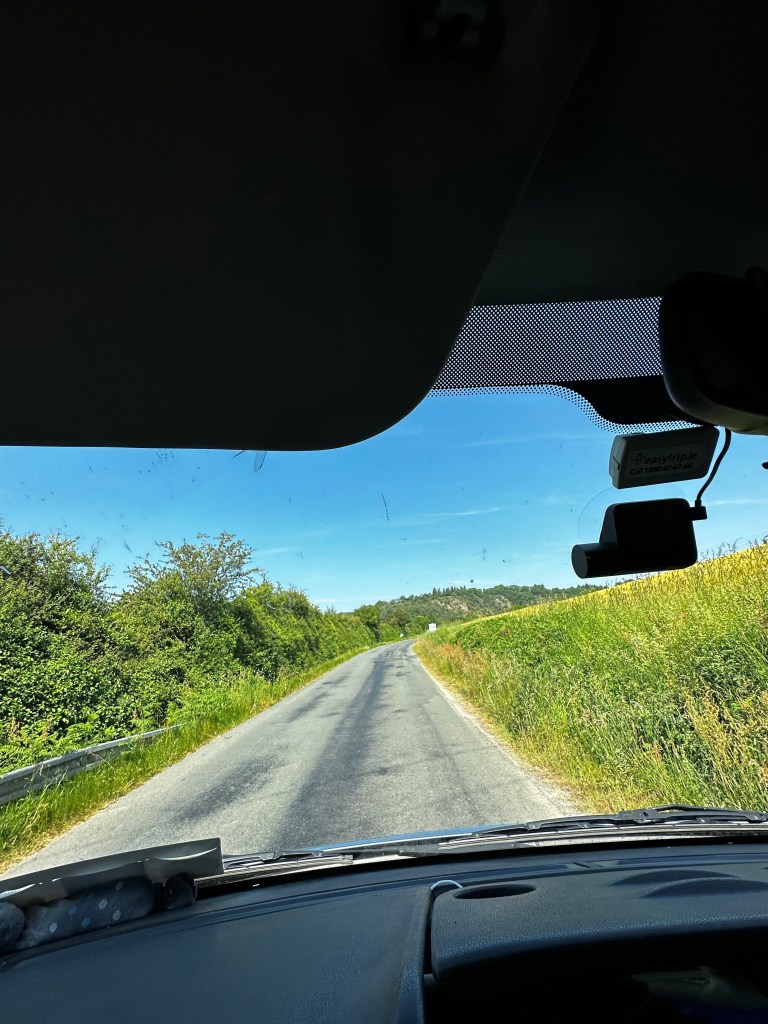
This road seems tilted to me

A road with grass growing down the middle is my definition of a road that is too narrow for Ruby but it is also a road that doesn’t get much traffic. Just as well because by the time we realised we were on said grassy road there were no options for turning back.

Pretty but we are taking up most of it…

We were very lucky, it was lunchtime and as we have found out the French are very strict regarding the time of meals and we met no one. Did not prevent my nervous system going on full alert as we approached every corner.

Waaaay too narrow

I do wonder if I’ll ever completely get rid of the anxiety. But do I want to get rid of it? In the moment it seems the most sane thing to be anxious about moving faster than walking speed down a – lets call it what it is – a farmers laneway when at any moment another vehicle could be travelling as fast or faster towards us. Surely, anxiety is the sanest response? Right?

Still too narrow but look at the three trees…

And yet, when I apply logic to my challenge, I do realise the danger from my habit of repeated self-dosing with adrenaline is probably more dangerous to me than the possibility of meeting a car on a country lane.

Much better…

And now here I am packing a bag for our night on the ferry. The road to the ferry is wide. What could I possibility be anxious about? The forecast. The forecast says there will be wind, in fact it’s already been blowing all day yesterday and again today.

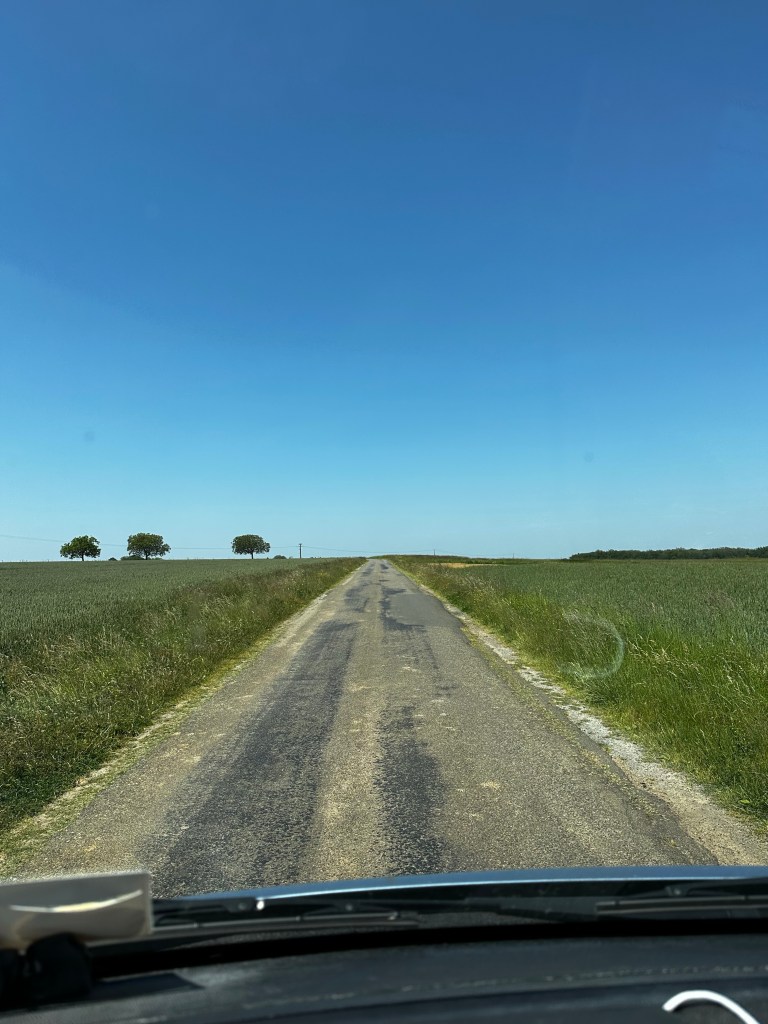
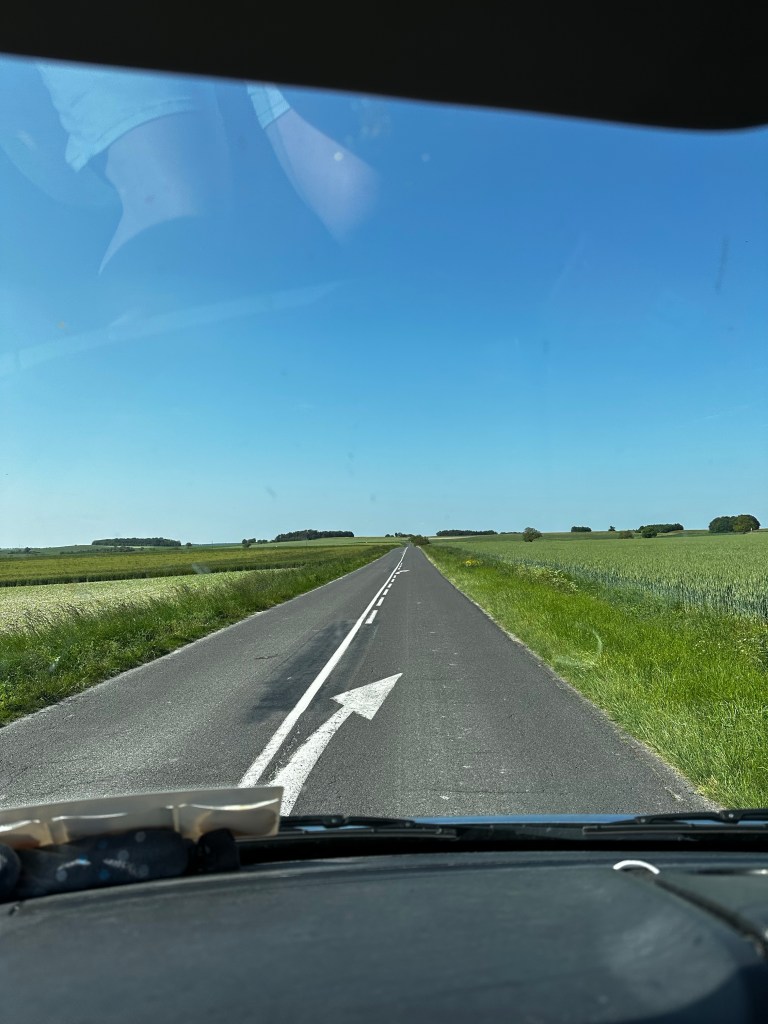
Perfectly straight road off into the distance…

This would be a good time for me to download a book that cures anxiety automatically and without having to read it as I won’t be able to read if the ship is pitching…