Anglesey Abbey continued

This is an apple tree under one of the front windows. Can you see an apple?

Urban Huttleston Rodgers Broughton (also known as Lord Fairhaven) bought Anglesey Abbey with his brother in 1926, he continued to live in the house after his brother had married and moved out. In 1966 when he died he left the house, its contents and the gardens to the National Trust.

The John Constable painting

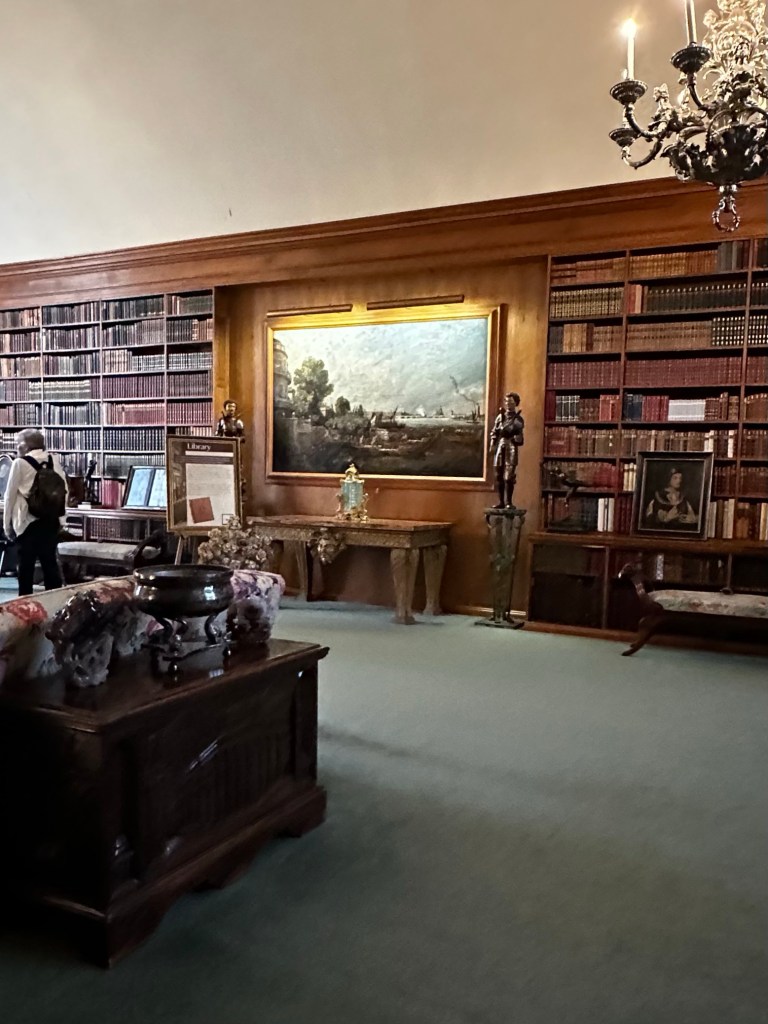
The library is upstairs at the end of a long corridor. It has high ceilings and lots of books but the first thing you see as you enter the door is a huge painting on the wall opposite. It’s a John Constable original called The Opening of Waterloo Bridge, from 1817.

The shelves are recycled wood from Waterloo Bridge

I hadn’t noticed the painting when I first walked in but a volunteer in the Wardrobe Project told me to go back and have a look when I said I found it very interesting that the the wooden shelves with the books are made from salvaged wood… from the Waterloo Bridge. I didn’t check but I’m guessing the bridge needed updating after a hundred years of service and Urban was looking for wood. But maybe he was also interested in recycling? A man ahead of his time? But there’s something else that’s interesting about the library – the window.

This is the window in the library…

A different volunteer asked me if I’d heard about the window, no I hadn’t. So she walked me to one end of the room and pulled back the curtain. Do you see the signatures? No. No way, yes I do… is that…? Urban was very friendly with royalty, the late queen and the present king included. And here scratched on the glass were their signatures.

…and here’s a close up of a section. Can you see the names scratched on the glass?

The Wardrobe Project involves cleaning all 12,000 pieces of Urban’s clothing using a very particular vacuum cleaner that can be set to gentle with a very odd attachment – a goat haired brush. After cleaning each piece of clothing is tagged with a six digit inventory code which is printed on a label and stitched to the piece of clothing. And two of the people involved were vacuuming what looked like plus-four trousers when I walked into the room. I wanted to ask questions but they had more than enough to be doing with the cleaning.

The inventory tag

As I mentioned in the previous post my favourite part of the house was the kitchen because it was full of familiar old things. Like the red melamine table and chairs set – we had one of those when I was little!

Little red melamine table and chair

And the fairy soap? Ok we didn’t have the soap but we had (and I still use) fairy washing up liquid. And the weighing scales with the individual weights? The grocery shop in our street used a weighing scales with weights to weight out biscuits and cheese.

Fairy Soap at the kitchen sink

The kitchen was made up of a few different rooms downstairs and it was the last section of the house visit. Next was out into the gardens. I had already walked by the lawn and forested section but now I was on my way to the Dahlia garden. There seemed to be a lot of interest in the Dahlias, so I considered skipping them but I’m glad I didn’t.

Individual weights on the weighing scales

Visiting the Dahlia Garden reminded me of something long forgotten… I almost bought dahlia bulbs to plant in the garden when I was a young Mum. They were so vibrant and colourful and something about planting an ugly bulb that would surprise me by growing into something beautiful caught my attention. But as soon as I read the bit on the instructions where you have to dig them up at the end of their season and replant the following year I put them back. Knowing I would forget to dig them up and then feel guilty when they died had put me off.

Teatime

The bed of dahlias were first planted in 1952, there are 60 varieties and contain all the colours of the rainbow plus white. They are hidden behind a hedge and set in a curve so that you only see one or two colours at a time as you approach. There’s a quote from Urban on the information board, “The subtle thing about garden design is that no one can resist seeing what happens around a curve.”

Dahlias

I was taking lots of close up photos when I heard a couple chatting… to the flowers? There are full time gardeners employed here at Anglesey Abbey and one of them was in among the flowers, deadheading. The couple were talking to him and asking about taking up the bulbs at the end of the season. There’s no way they dig up the bulbs from all these flowers. Is there? And if they don’t dig up the bulbs then maybe I could give dahlias another chance.

Happy Dahlias!

It turns out they don’t exactly dig up the bulbs… they dig up pots. They plant each new bulb in a pot and plant the pot in the garden. Then at the end of the season they dig up the pots with the bulbs still in and store pot and bulb in the (potting?) shed until next year.

Dahlias and the gardener

Summary: Lord Fairhaven (Urban) was a man before his time. Interested in recycling, garden design, reading and long lasting clothing, he had lots of friends and he let the royal ones graffiti his windows. Query: Will the Dahlias die if I don’t dig them up?

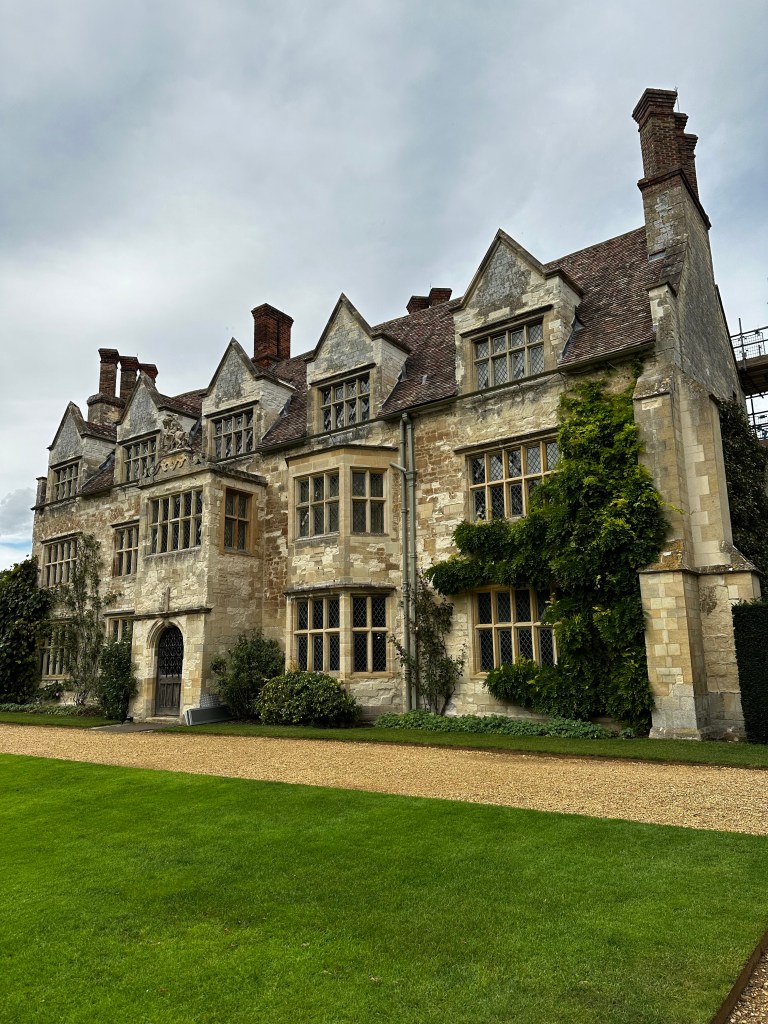
Anglesey Abbey and Gardens, Lode, Cambridgeshire

Anglesey Abbey

The house had originally been an Augustinian priory but was closed by Henry VIII (remember the same happened at Bury St. Edmunds?) and a local farmer had kept his cows in what was now the dining room. It’s the oldest part of the house and remained intact even its vaulted ceiling. Awkward place to have a dining table but I can imagine this room would definitely inspire good conversation.

Entrance hall

We arrived in the car park of Anglesey Abbey at lunchtime and I headed off to walk about half a mile down the drive to call at the house first. It was due to close at 2.30pm and I didn’t want to miss it. The car park had been almost full but on the other side of the visitor centre there was little evidence of a crowd as I passed huge lawns on one side and dark paths through the trees on the other. I may have been in a hurry to begin with but nature conspired to slow me down.

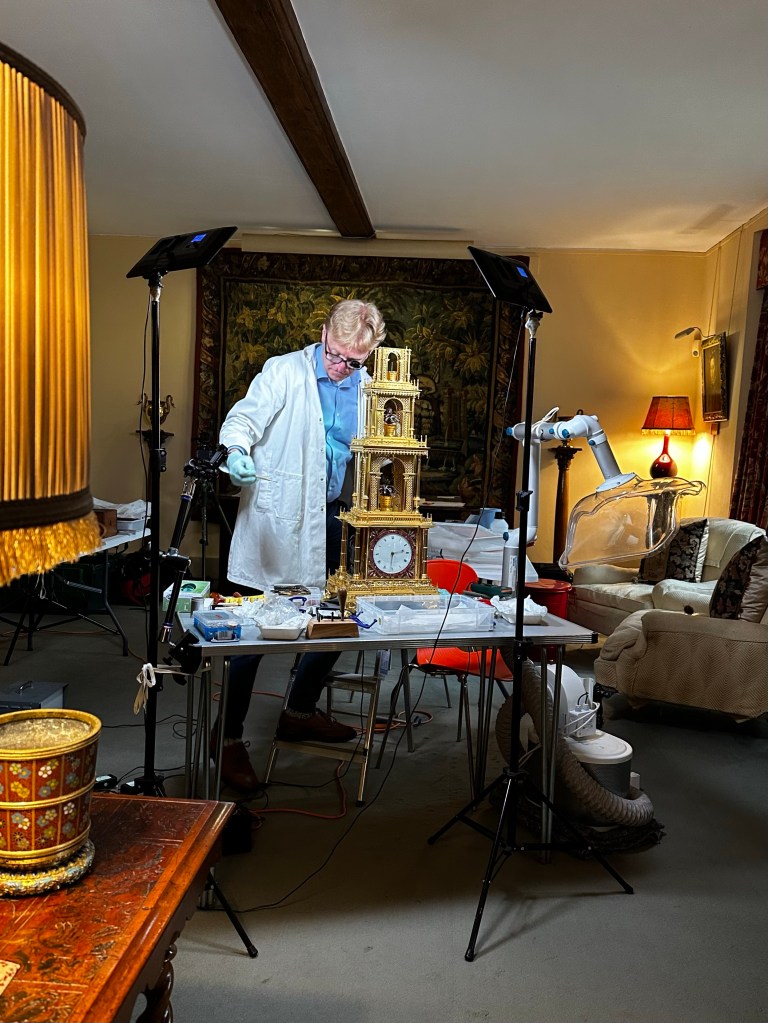
Matthew, the horologist, working on the pineapple clock. Can you see the pineapples?

Have I mentioned that at each house I have visited the first question the volunteer asks at the door is, Have you been round before? The same very specific wording and every time reminds me that this is somewhere people come back to again and again. And I can believe that, particularly about this house. There’s a lot here and it feels very cosy and lived in. My favourite part was the kitchens because they were so familiar. I’ll have to leave them, the Dahlia garden, the library window and the Wardrobe Project for another post.

Next door, the Oak Room, for after dinner drinks and cigars

The first room I walked into was the Living Room where afternoon tea was served at 5pm… unfortunately not today. Mathew, the horologist, was in attendance taking apart and cleaning a huge pineapple twirling clock. He had come all the way from Yorkshire and had already spent hours on this particular piece. I was in time to hear it chiming as he put the last little pineapple section on top. (Note: disappointingly, afternoon tea finished in 1966.)

One of the bathrooms, this one is called Windsor Bathroom.

It was while I was in the Living Room I heard the volunteer mention to another visitor that the family had made their money from sewage. It may not be entirely true but there was sewage involved. It is a love story and a little complicated…

The Library

Urban Huttleston Rodgers Broughton’s father (also called Urban, unfortunately) was a British civil engineer who worked for/with Issac Shone. Issac invented the hydro pneumatic sewage system (installed in the British Houses of Parliament). Urban’s father went over to America to install this same system in the house of the millionaire, Henry Rodgers, who was the Vice President of Standard Oil (remember ESSO?) While there Urban’s dad fell in love with Henry Rodgers’ daughter and they got married. When Urban was 13 his grandfather (the Standard Oil millionaire) died and Urban’s mother inherited $12.5 million and the family moved to the UK.

Ironing Urban’s trousers (the Wardrobe Project)

Urban (the Urban who owned this house) is also know as the 1st Lord Fairhaven and he is responsible for filling Anglesey Abbey and gardens with beauty and interest. In 1926, when he was 30, he and his brother Henry bought the house because it was close to their stud farm and the horse racing track at Newmarket. At the time they made an agreement that when either one of them married the other would buy out his share of the house. And that’s just what they did when Henry married in 1932. Urban remained in the house until he died in 1966. He bequeathed the house and its contents to the National Trust.

Peeping into the dining room, the oldest part of the house

I spent fours hours wandering around listening to stories of visits from the queen who was a friend, reading the information boards and soaking up the gardens. Literally, the moment I got back to the van the heavens opened and the rain lashed down. Such a magical place and I’m so glad I got the opportunity to visit. Thank you, Urban!

Notice board outside the kitchens

Summary: Falling in love with a millionaire’s daughter can make a big difference to the lives of your future children. A guy called Urban who was friends with the late queen and the present King created a beautiful place where anyone can now visit. There’s money in oil and sewage… not sure about the sewage.
Query: Would you give your house and all your treasures for future visitors to wander around in after you’re dead?

Walkway through the Winter Garden

If you enjoyed reading maybe you’ll like my Permission Cards www.permission.cards.