
 (This is where you will see the Bayeux Tapestry)
We’re in Bayeux, an absolutely beautiful town and home to the Bayeux Tapestry. A 70 meter long, 58 panel, linen craft piece housed in the dark in a big house in Bayeux. You cannot take pictures of the tapestry… but fortunately they have replicas and photos they took themselves so I have something to show you.
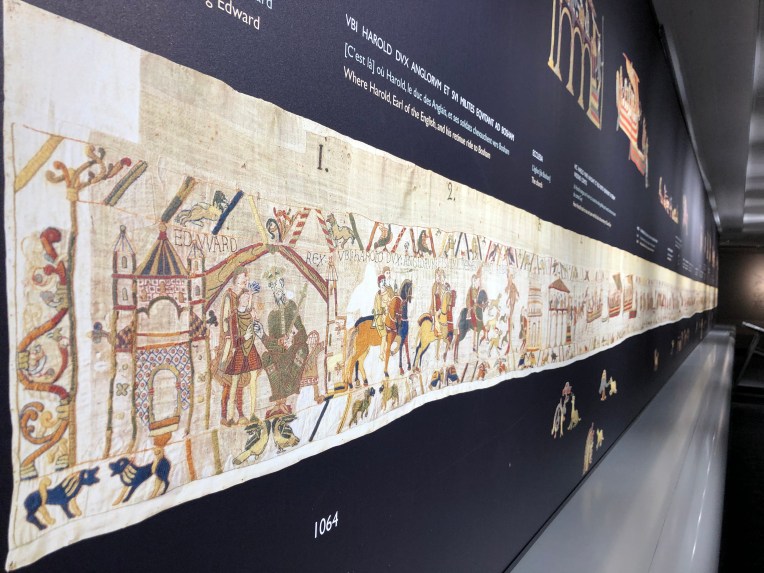 (This will give you some idea of the length of the Bayeux Tapestry, it goes round the corner in the distance and as long again on the other side)
First, a few things you need to know about the Tapestry – it’s not tapestry. No, it’s embroidery. Tapestry is weaving threads. Embroidery is sewing stitches on fabric and I love sewing and embroidery. I mean I love doing it, I love the simple stitches coming together to decorate a piece of fabric. I’m reticent to admit this but… I don’t love the Bayeux Tapestry… I do appreciate all the work and I LOVE that it’s a story (oh yes I forgot to tell you – it’s a story) but it’s mainly horses and soldiers and the colours are verging on dull. Sorry, Bayeux, I love colourful and hearts.
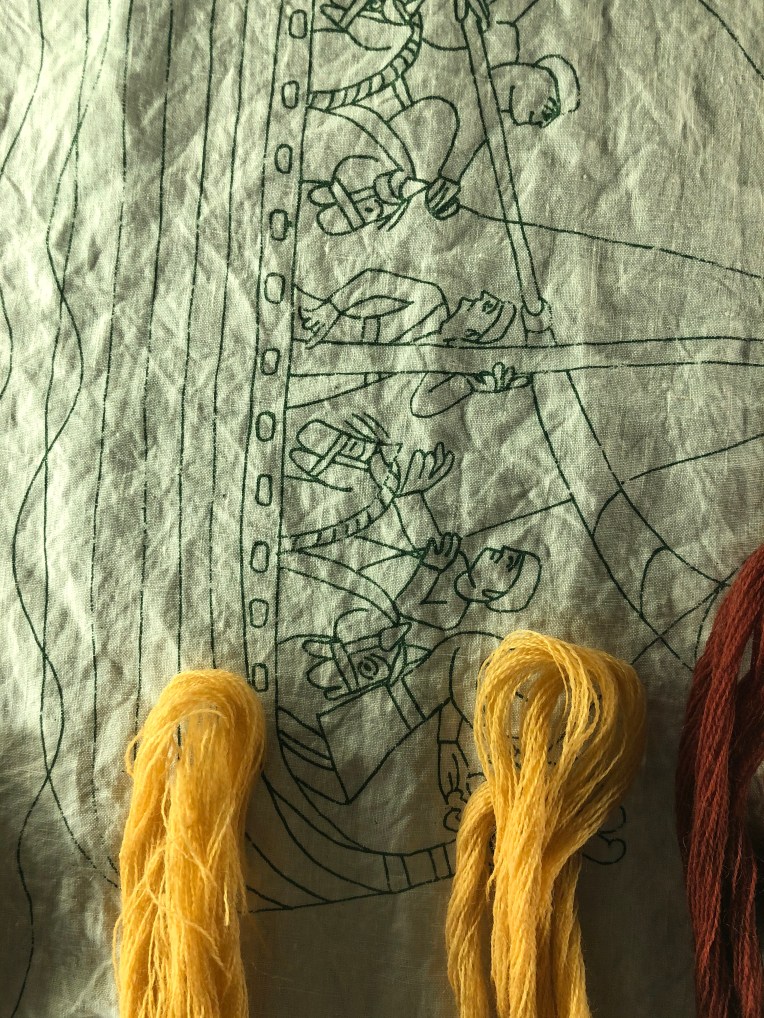 (Here’s the basic ingredients – linen fabric with design drawn on and thread for the stitches)
Leaving aside my crafting preferences it is well worth a visit. They don’t exactly known who made it or where it was made (possibly England) but it was definitely handmade and definitely not long after 1066. Because it tells the story of the Battle of Hastings in 1066. It used to be displayed in the cathedral of Bayeux for two weeks every year in order to tell the story of local history. As most people at the time were illiterate, the Bayeux Tapestry was like a picture book story.
So here’s the story…
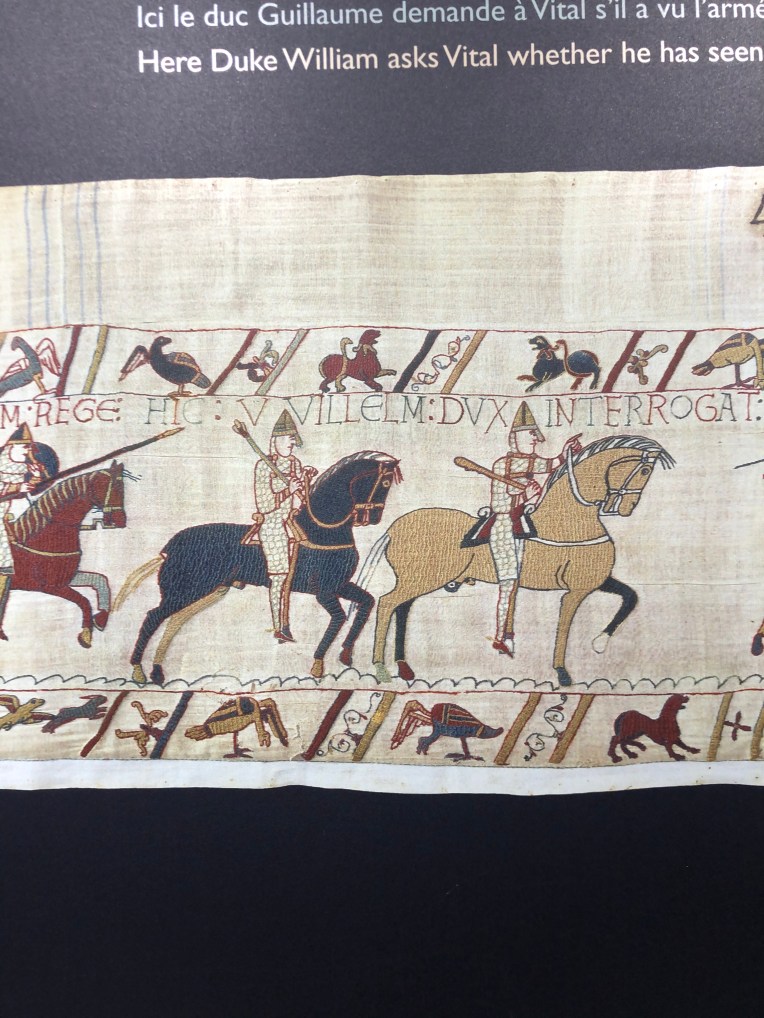 (Like I said, horses and soldiers)
In 1064 King Edward the Confessor (king of England) sent Harold the Severe to visit his cousin William (he was at this point called William the Bastard…) in Normandy. He wanted Harold to pass on a message that William was his choice for king after he himself (Edward) died. Harold passed on the message and even fought a few battles with William while he was in Normandy. Then he went home but before he did he made a solemn oath to William to support him when he became king of England.
 (This bit is Mont St Michel, do you see a green hill with some arches on top?)
Then Edward the Confessor died. Harold, who seemed like such a nice guy until then, decided he wanted to be king and reneged on his promise. He was crowned king of England. Word got back to France and to William in Normandy. He was, as you can imagine, furious. What about the solemn pact? William could not stand idly by. He waited for good winds in the right direction and set off from St. Valery to the coast of England with a huge fleet of boats and soldiers.
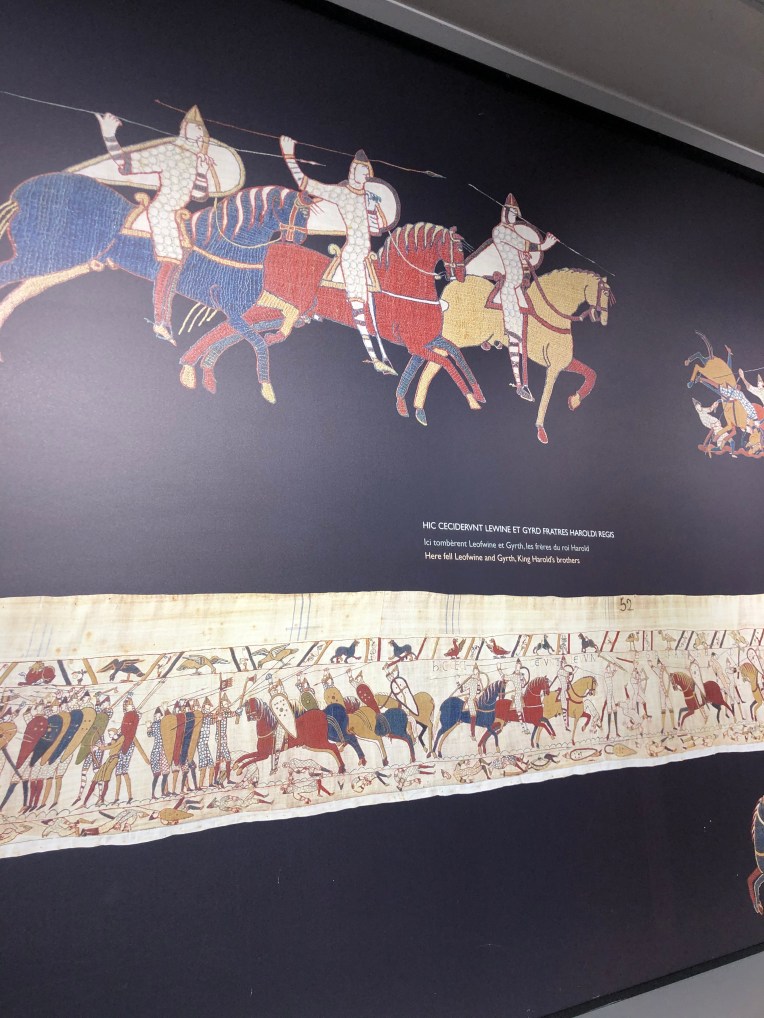 (More horses and soldiers fighting)
Harold the Severe heard the news from way up in Yorkshire, 400 miles away. At the time he was fighting off a different enemy but when he won that battle he raced down to Hastings (near the south coast) to sort out William. It took 58 panels to tell the story and the ending was not good for Harold. He was killed with an arrow through the eye. Willian was the new king of England and they changed his name to William the Conquerer (fortunately). I think he was also king of Normandy. (Here’s a lovely silver brooch all the way from County Wicklow! It was in the museum area to explain some of the brooches seen on the soldier’s clothing)
Anyway, there’s a postscript to this story. Nearly 900 years later, Bayeux was the first town freed in 1944 by the Allies and there’s a huge British graveyard here. On the Bayeux Memorial across the road from the graveyard there’s an inscription in Latin: Nos A Gulielmo Victi Victoris Patriam Liberavimus. It means, We, once conquered by William, have now set free the Conqueror’s native land.
Forgiving and Remembering. Mairead.



 Travel stories