Wide Eyed and sleepy

That’s the bridge to the man-made island

We made it to KIX airport in… (to be precise) the sea, close to Osaka. When they built the airport they also built the island it sits on. And there’s one long road and rail bridge linking this island to the mainland. Looking at these facts before we arrived I did wonder if our most challenging journey might be trying to find the bridge but no like everything else here so far, it was easy. To get to the bridge – go up the escalator and walk outside in a straight line from the door of the terminal, you can’t miss the train station on your right, the ticket office is opposite it, now take the train off the island. Could it be that easy?
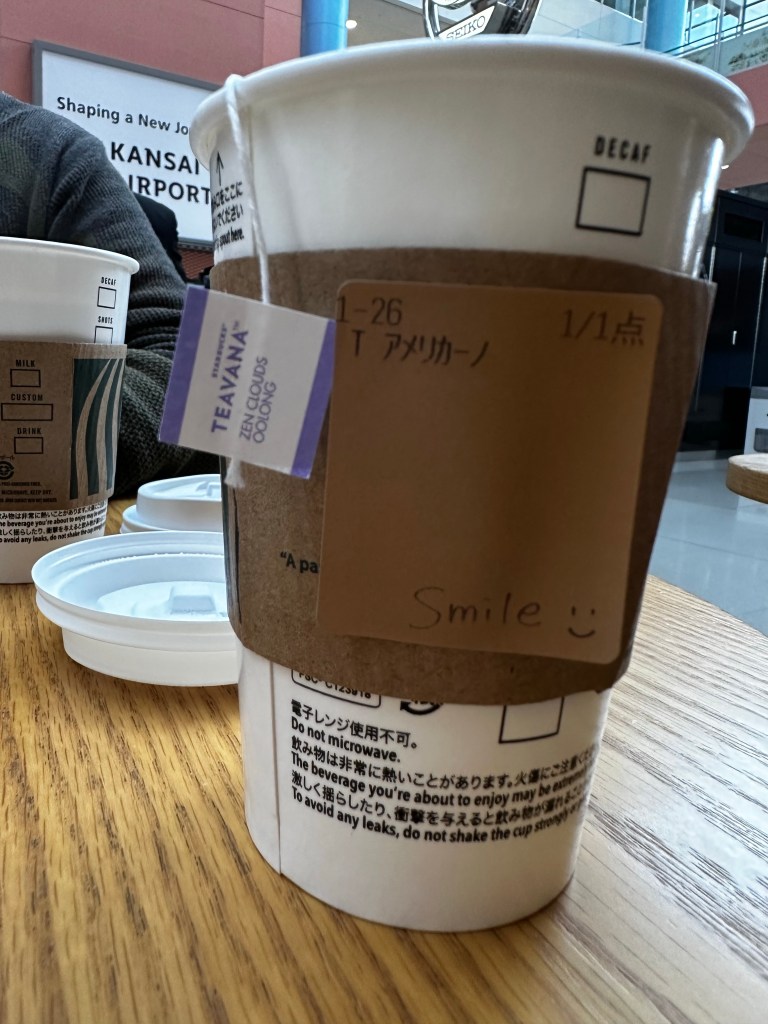
Oolong tea at Starbucks on the island

First, a nice cup of tea. It’s 10am and a sunny 10 degrees (Celsius) but our body clocks think it’s 2am and someone’s left the sun on. It was 2am yesterday when we got out of bed to go to the airport in Dublin. And now 24 hours later we are keeping things simple and familiar and we head to Starbucks. Yes, I know we should be trying a Japanese cafe but hold judgment… it’s Starbucks but with a Japanese flavour.

Route to Japan via The Gobi Desert

Shiori (the daughters-in-law responsible for us being here) introduced me to oolong tea once and I loved it. Now back to today, as I’ve already had coffee for breakfast on the plane somewhere over the Gobi Desert, I asked for tea. Normally, I drink green tea but their green tea was something with milk (and I don’t like milk) but I remembered the oolong and asked if she had that… She did and was very impressed that we (obviously, non Japanese) knew what it was. Taking the chance to chat with an English speaker we told her about Shiori and exchanged addresses (not really) and promised to be back to see her when we are leaving Japan (maybe.) So far the welcome from everyone here is real and very encouraging.
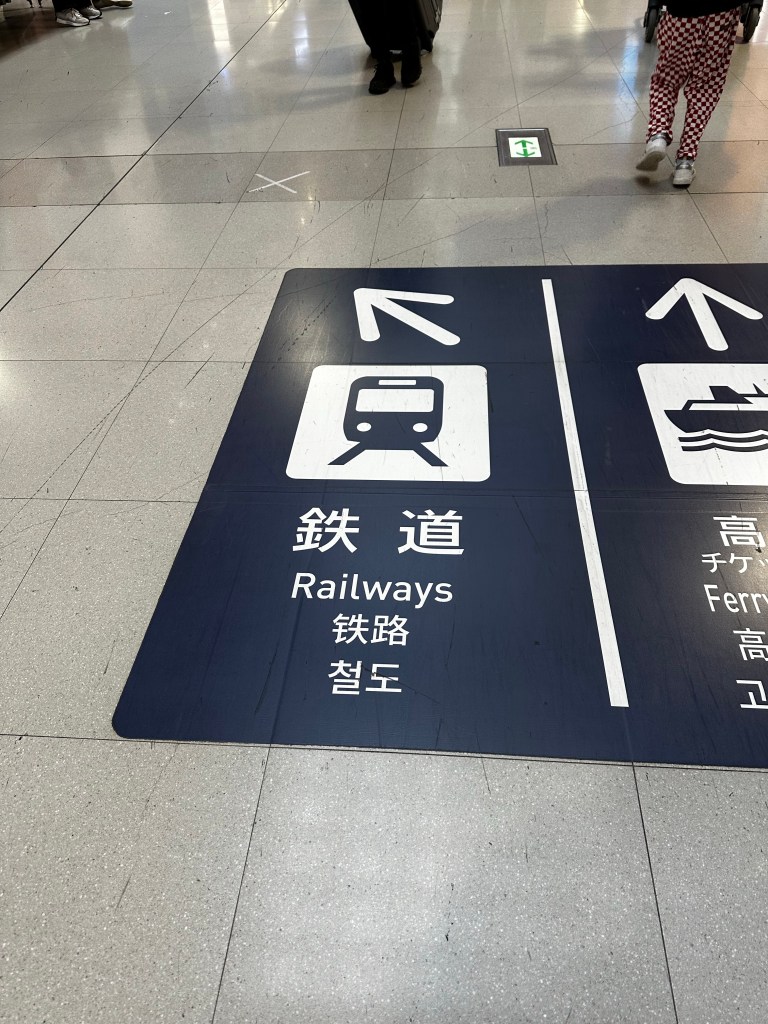
Very helpful signs

As I sat drinking my oolong tea I noticed a woman come in and wheel her bag to a counter, take out her phone and charger and plug it into a socket. Nothing unusual yet. Then she walked off. She left her bag and phone on the counter and queued for her order. In the airport. At a Starbucks in this busy airport it seems to be true that your luggage and your phone are safe on their own.
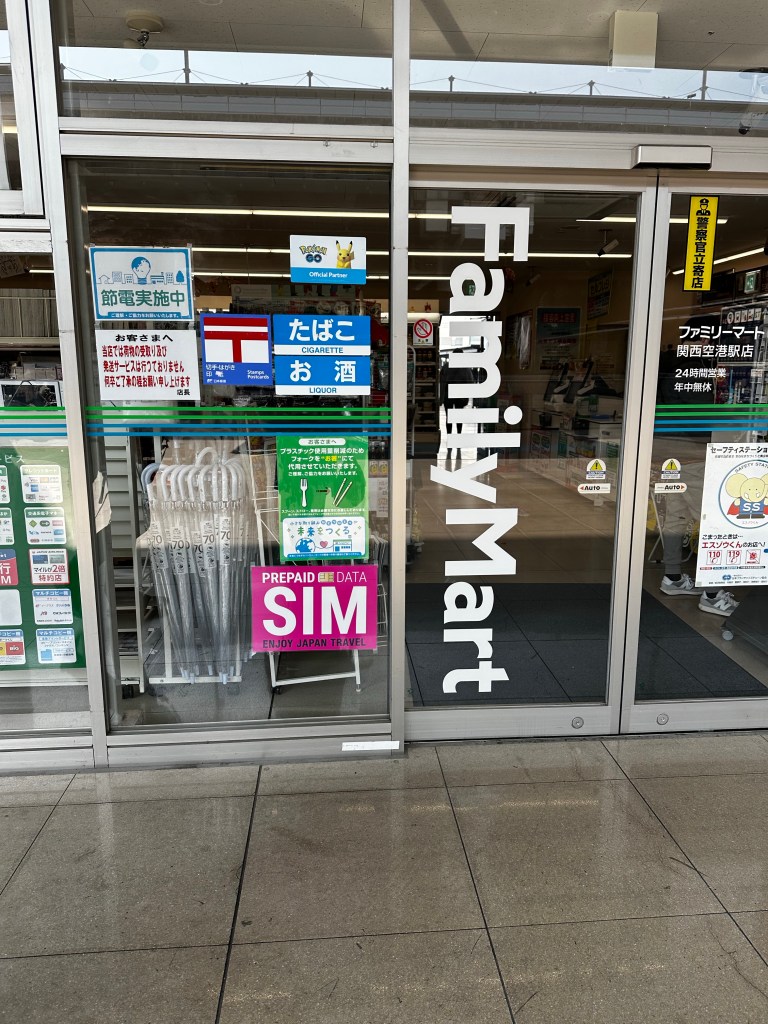
Everything you need in one place

Denis hadn’t notice this because he was busy working out how to get tickets for the train. The one to take us off the man made island. Turns out you can get a card called ICOCA and top it up and then tap as you go into and out of each train station. And it’s tourist friendly. We left Starbucks went up the escalator, walked straight ahead, the ticket office was on the left, we stood in a very orderly queue and when we reached the top we were guided to the next available desk. There a lady with excellent English explained her window was cash only and how much did we want to put in our card. We had one Japanese Yen note, I got in Dublin airport worth 10,000 Yen (about €75) Plenty for a few days train travel. We would have chatted more but the queue guide was directing the next customers so we just asked where the train to Rinku-town was, she sent us across to the station, down the escalator, get on the silver train and stay on board for one stop.

We’re inside the silver train

Tapping our new cards as we went through the barrier, we spotted the escalator and at the bottom there was a silver train waiting. We checked the map above the door, yes this is correct and waited the 4 minutes – exactly- until our train left. We knew it was about to depart when we saw the white gloved conductor check the doors. One stop later we were at our hotel.
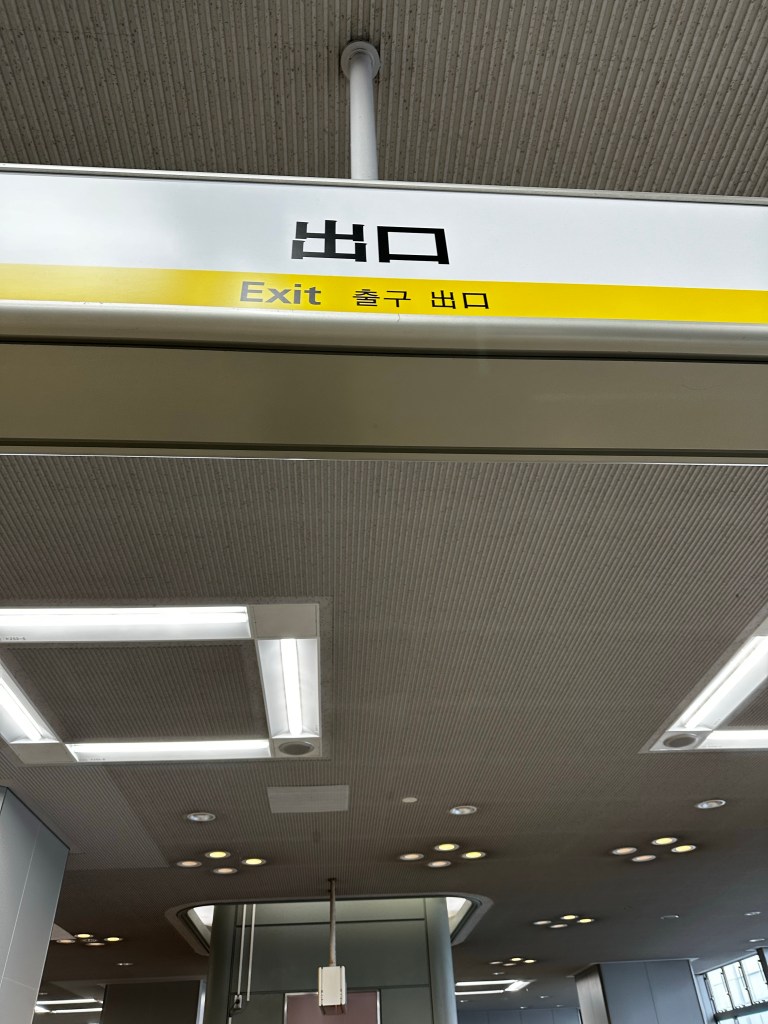
Learning the characters – Exit looks like two fences one on top of the other and a box. One down, a few more to go

We’re here now sitting on a sofa in reception trying to stay awake as we wait for room check in to open. Should we sleep? (Please say yes.) Or should we stay awake until it gets dark and our body clocks line up with time over here in the East? Ok… it doesn’t matter what you say, while I was typing Denis seems to have dropped off. He’s snoring very quietly beside me. Maybe I’ll just close my eyes for a minute…

Our hotel – hard to miss

Anglesey Abbey continued

This is an apple tree under one of the front windows. Can you see an apple?

Urban Huttleston Rodgers Broughton (also known as Lord Fairhaven) bought Anglesey Abbey with his brother in 1926, he continued to live in the house after his brother had married and moved out. In 1966 when he died he left the house, its contents and the gardens to the National Trust.

The John Constable painting

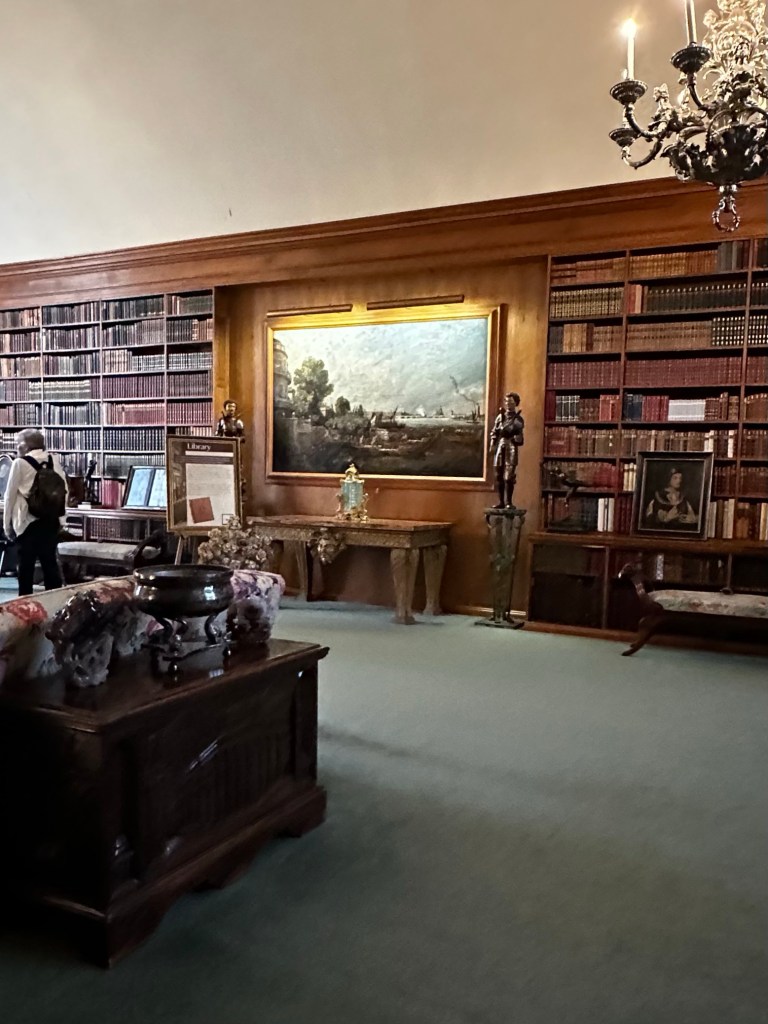
The library is upstairs at the end of a long corridor. It has high ceilings and lots of books but the first thing you see as you enter the door is a huge painting on the wall opposite. It’s a John Constable original called The Opening of Waterloo Bridge, from 1817.

The shelves are recycled wood from Waterloo Bridge

I hadn’t noticed the painting when I first walked in but a volunteer in the Wardrobe Project told me to go back and have a look when I said I found it very interesting that the the wooden shelves with the books are made from salvaged wood… from the Waterloo Bridge. I didn’t check but I’m guessing the bridge needed updating after a hundred years of service and Urban was looking for wood. But maybe he was also interested in recycling? A man ahead of his time? But there’s something else that’s interesting about the library – the window.

This is the window in the library…

A different volunteer asked me if I’d heard about the window, no I hadn’t. So she walked me to one end of the room and pulled back the curtain. Do you see the signatures? No. No way, yes I do… is that…? Urban was very friendly with royalty, the late queen and the present king included. And here scratched on the glass were their signatures.

…and here’s a close up of a section. Can you see the names scratched on the glass?

The Wardrobe Project involves cleaning all 12,000 pieces of Urban’s clothing using a very particular vacuum cleaner that can be set to gentle with a very odd attachment – a goat haired brush. After cleaning each piece of clothing is tagged with a six digit inventory code which is printed on a label and stitched to the piece of clothing. And two of the people involved were vacuuming what looked like plus-four trousers when I walked into the room. I wanted to ask questions but they had more than enough to be doing with the cleaning.

The inventory tag

As I mentioned in the previous post my favourite part of the house was the kitchen because it was full of familiar old things. Like the red melamine table and chairs set – we had one of those when I was little!

Little red melamine table and chair

And the fairy soap? Ok we didn’t have the soap but we had (and I still use) fairy washing up liquid. And the weighing scales with the individual weights? The grocery shop in our street used a weighing scales with weights to weight out biscuits and cheese.

Fairy Soap at the kitchen sink

The kitchen was made up of a few different rooms downstairs and it was the last section of the house visit. Next was out into the gardens. I had already walked by the lawn and forested section but now I was on my way to the Dahlia garden. There seemed to be a lot of interest in the Dahlias, so I considered skipping them but I’m glad I didn’t.

Individual weights on the weighing scales

Visiting the Dahlia Garden reminded me of something long forgotten… I almost bought dahlia bulbs to plant in the garden when I was a young Mum. They were so vibrant and colourful and something about planting an ugly bulb that would surprise me by growing into something beautiful caught my attention. But as soon as I read the bit on the instructions where you have to dig them up at the end of their season and replant the following year I put them back. Knowing I would forget to dig them up and then feel guilty when they died had put me off.

Teatime

The bed of dahlias were first planted in 1952, there are 60 varieties and contain all the colours of the rainbow plus white. They are hidden behind a hedge and set in a curve so that you only see one or two colours at a time as you approach. There’s a quote from Urban on the information board, “The subtle thing about garden design is that no one can resist seeing what happens around a curve.”

Dahlias

I was taking lots of close up photos when I heard a couple chatting… to the flowers? There are full time gardeners employed here at Anglesey Abbey and one of them was in among the flowers, deadheading. The couple were talking to him and asking about taking up the bulbs at the end of the season. There’s no way they dig up the bulbs from all these flowers. Is there? And if they don’t dig up the bulbs then maybe I could give dahlias another chance.

Happy Dahlias!

It turns out they don’t exactly dig up the bulbs… they dig up pots. They plant each new bulb in a pot and plant the pot in the garden. Then at the end of the season they dig up the pots with the bulbs still in and store pot and bulb in the (potting?) shed until next year.

Dahlias and the gardener

Summary: Lord Fairhaven (Urban) was a man before his time. Interested in recycling, garden design, reading and long lasting clothing, he had lots of friends and he let the royal ones graffiti his windows. Query: Will the Dahlias die if I don’t dig them up?

Anglesey Abbey and Gardens, Lode, Cambridgeshire

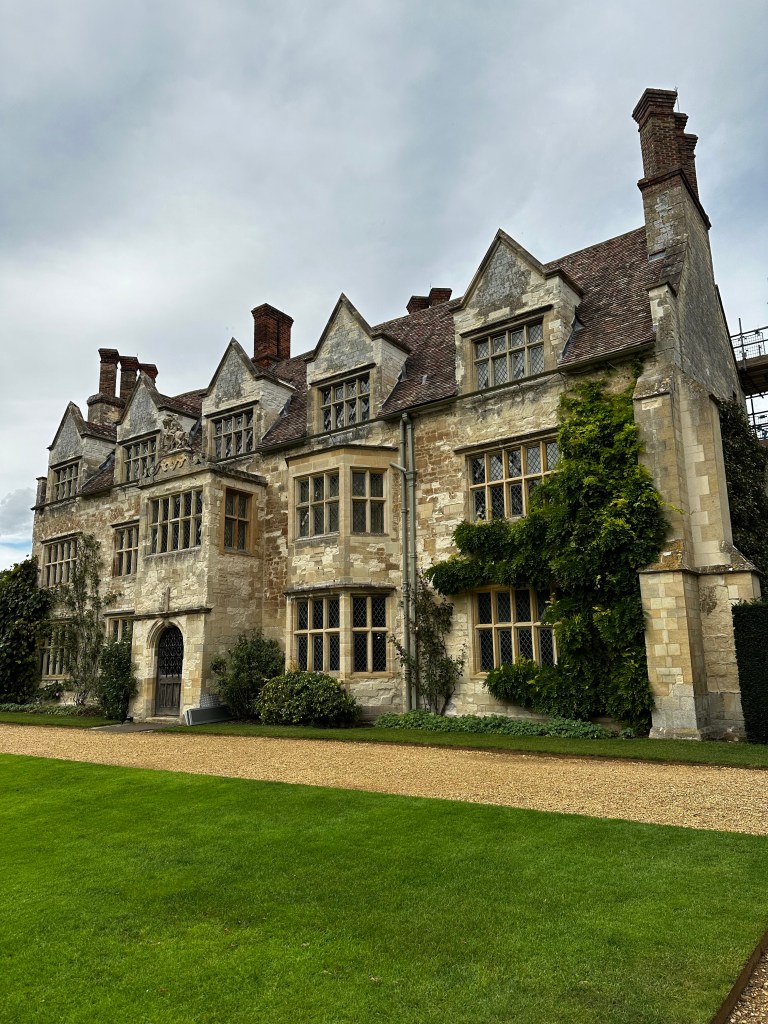
Anglesey Abbey

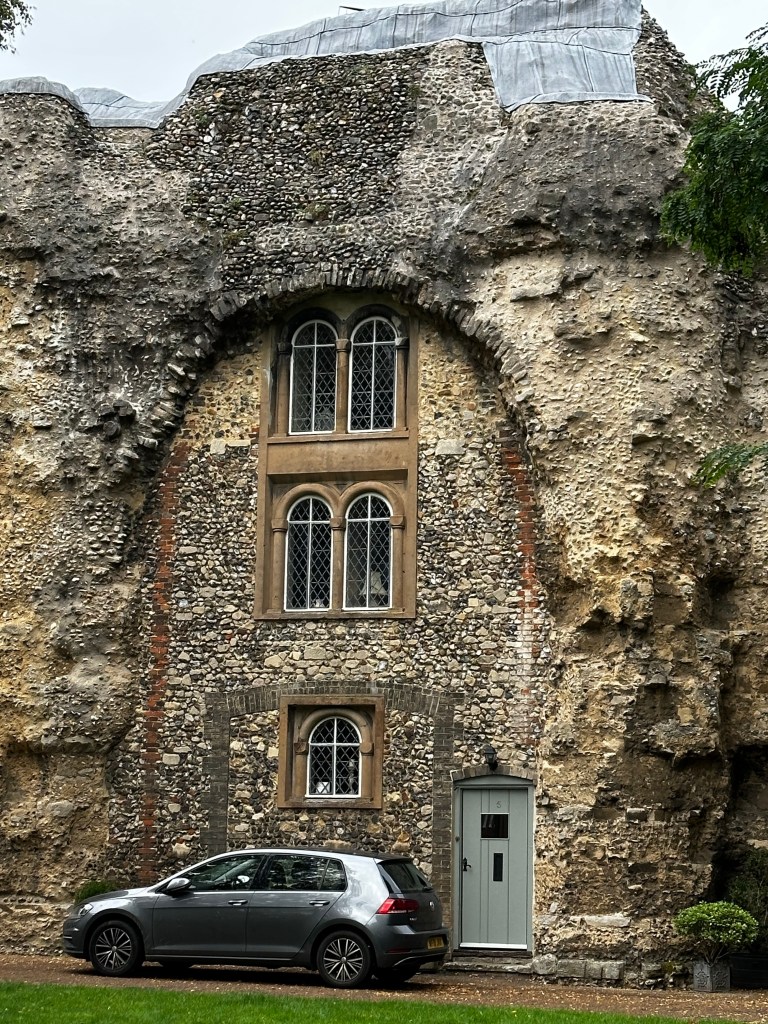
The house had originally been an Augustinian priory but was closed by Henry VIII (remember the same happened at Bury St. Edmunds?) and a local farmer had kept his cows in what was now the dining room. It’s the oldest part of the house and remained intact even its vaulted ceiling. Awkward place to have a dining table but I can imagine this room would definitely inspire good conversation.

Entrance hall

We arrived in the car park of Anglesey Abbey at lunchtime and I headed off to walk about half a mile down the drive to call at the house first. It was due to close at 2.30pm and I didn’t want to miss it. The car park had been almost full but on the other side of the visitor centre there was little evidence of a crowd as I passed huge lawns on one side and dark paths through the trees on the other. I may have been in a hurry to begin with but nature conspired to slow me down.

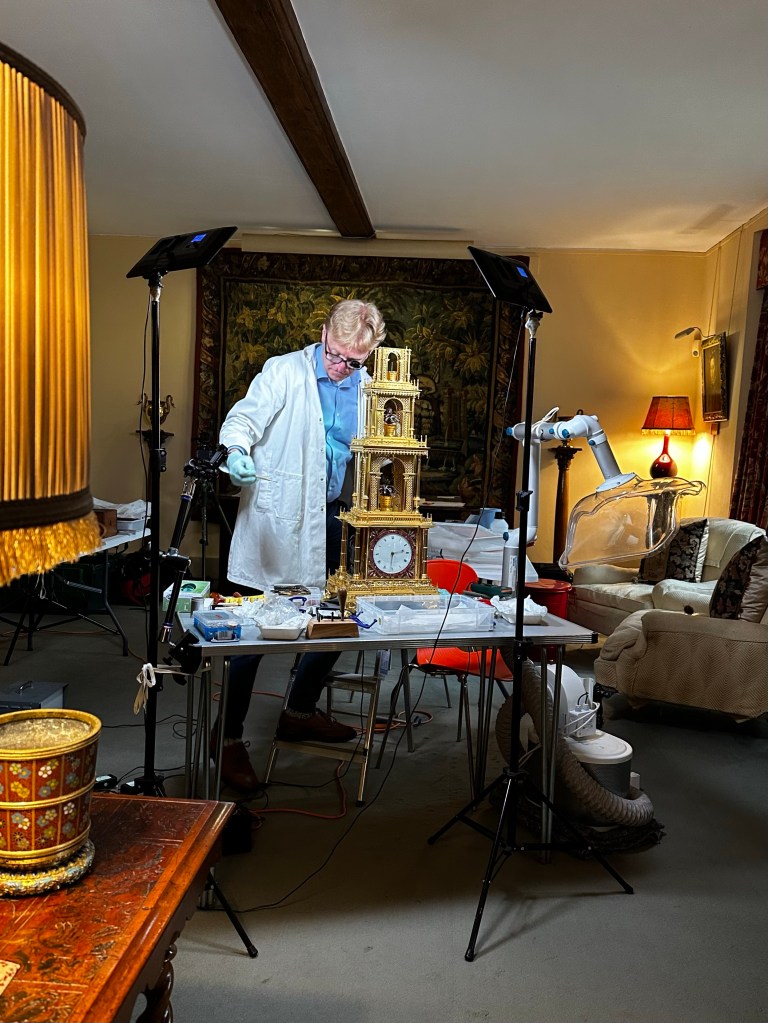
Matthew, the horologist, working on the pineapple clock. Can you see the pineapples?

Have I mentioned that at each house I have visited the first question the volunteer asks at the door is, Have you been round before? The same very specific wording and every time reminds me that this is somewhere people come back to again and again. And I can believe that, particularly about this house. There’s a lot here and it feels very cosy and lived in. My favourite part was the kitchens because they were so familiar. I’ll have to leave them, the Dahlia garden, the library window and the Wardrobe Project for another post.

Next door, the Oak Room, for after dinner drinks and cigars

The first room I walked into was the Living Room where afternoon tea was served at 5pm… unfortunately not today. Mathew, the horologist, was in attendance taking apart and cleaning a huge pineapple twirling clock. He had come all the way from Yorkshire and had already spent hours on this particular piece. I was in time to hear it chiming as he put the last little pineapple section on top. (Note: disappointingly, afternoon tea finished in 1966.)

One of the bathrooms, this one is called Windsor Bathroom.

It was while I was in the Living Room I heard the volunteer mention to another visitor that the family had made their money from sewage. It may not be entirely true but there was sewage involved. It is a love story and a little complicated…

The Library

Urban Huttleston Rodgers Broughton’s father (also called Urban, unfortunately) was a British civil engineer who worked for/with Issac Shone. Issac invented the hydro pneumatic sewage system (installed in the British Houses of Parliament). Urban’s father went over to America to install this same system in the house of the millionaire, Henry Rodgers, who was the Vice President of Standard Oil (remember ESSO?) While there Urban’s dad fell in love with Henry Rodgers’ daughter and they got married. When Urban was 13 his grandfather (the Standard Oil millionaire) died and Urban’s mother inherited $12.5 million and the family moved to the UK.

Ironing Urban’s trousers (the Wardrobe Project)

Urban (the Urban who owned this house) is also know as the 1st Lord Fairhaven and he is responsible for filling Anglesey Abbey and gardens with beauty and interest. In 1926, when he was 30, he and his brother Henry bought the house because it was close to their stud farm and the horse racing track at Newmarket. At the time they made an agreement that when either one of them married the other would buy out his share of the house. And that’s just what they did when Henry married in 1932. Urban remained in the house until he died in 1966. He bequeathed the house and its contents to the National Trust.

Peeping into the dining room, the oldest part of the house

I spent fours hours wandering around listening to stories of visits from the queen who was a friend, reading the information boards and soaking up the gardens. Literally, the moment I got back to the van the heavens opened and the rain lashed down. Such a magical place and I’m so glad I got the opportunity to visit. Thank you, Urban!

Notice board outside the kitchens

Summary: Falling in love with a millionaire’s daughter can make a big difference to the lives of your future children. A guy called Urban who was friends with the late queen and the present King created a beautiful place where anyone can now visit. There’s money in oil and sewage… not sure about the sewage.
Query: Would you give your house and all your treasures for future visitors to wander around in after you’re dead?

Walkway through the Winter Garden

If you enjoyed reading maybe you’ll like my Permission Cards www.permission.cards.

Flushing Waters

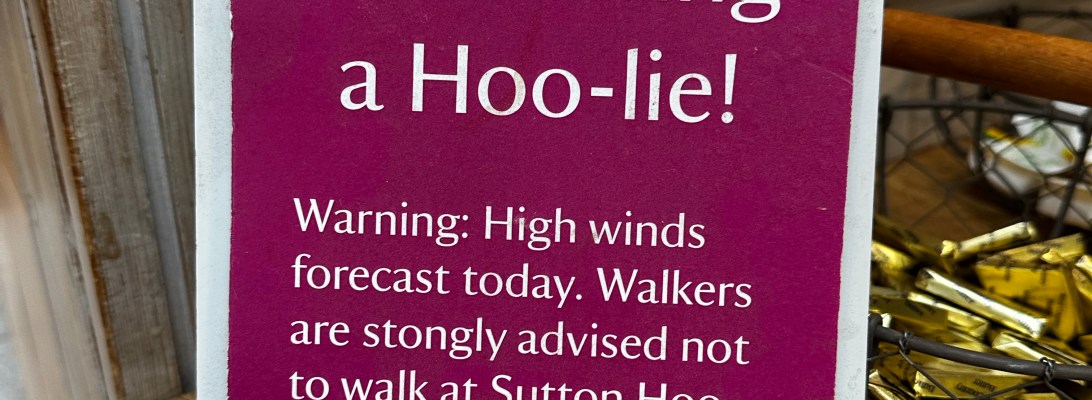
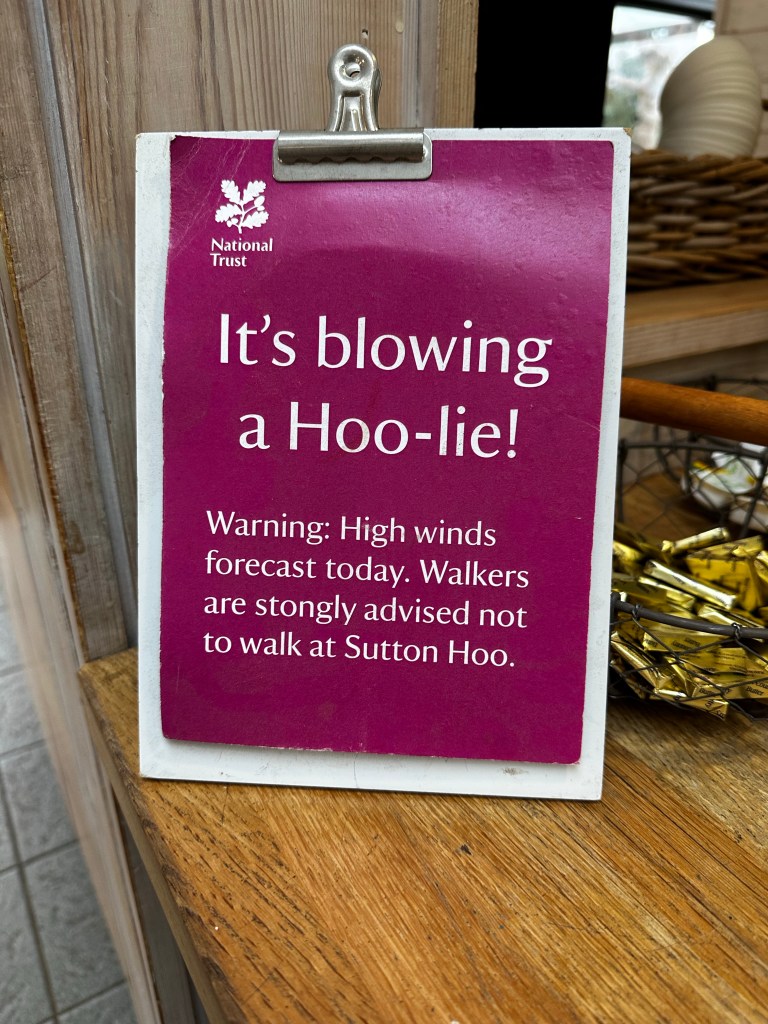
It was a dry, warm and windy day at Sutton Hoo

On Tuesday night we stayed at the campsite in the farm next door to Sutton Hoo. We had been carrying a full tank of grey water and a full cassette (toilet) for too long. We needed to empty everything. We were also running very low on LPG gas and each garage we arrived at had run out. We use gas for heating, for running the fridge, for the oven, the grill and for the essential purpose of making tea. We had stopped using the oven, didn’t even think about the heating and hadn’t seen toast for days. Soon we wouldn’t be able to make tea…
And the Irish connection… this excerpt (in the museum building at Sutton Hoo) is from the exceedingly long poem Beowulf, about this time of Anglo-Saxons, was translated by Seamus Heaney

But first things first we needed to check if there was room in the campsite at the farm next door. We found there were spaces sectioned off by hedges around a medium sized field. All but two of the spaces were taken up with motorhomes and caravans.

Which way?

There was a little shed with a sign saying Reception and lots of little signs about wifi and dog walking. There was also a block of toilets and showers. Unfortunately, there was no one about. It was after 5pm and this is out of season. Denis went looking in vain for a phone number and returned looking glum, saying we would have to travel on.

Another exhibits from the museum. I really love the clothing materials

Something you may not know about me is that my automatic instinct is to give up, rather than to persist. I know this and give myself a hard time for it. Denis also knows this and naturally thought I would agree to move on. I didn’t. There was nothing I could do about the gas here but there was no way I was going to accompany that grey and black water another mile. (All distance is in miles in the UK.)

I saw this in Edith Pretty’s house. The human impulse of sharing good news with someone who cares

Ignoring politeness Denis tugged the shed door open and was rewarded with a wall full of more signs, including, a phone number. Helen answered when Denis called and told him she would see us in the morning and to make ourselves comfortable wherever we found a space. Oh and she told him where the empty water points were too. Can you imagine the excitement?

I have to admit I don’t know what this is, I forgot to take a picture of the description but it definitely came from the grave

You might not be able to imagine the excitement if you are more familiar with just the magical flush of a toilet when everything disappears and refills with clean water. Or if you pull the plug and the dish water swirls down the sink. Imagine if it stopped though? I find the whole sewage concept really interesting and as synchronicity would have it, the next National Trust house I visited had been owned by a family who earned their fortune from sewage management. Imagine that!

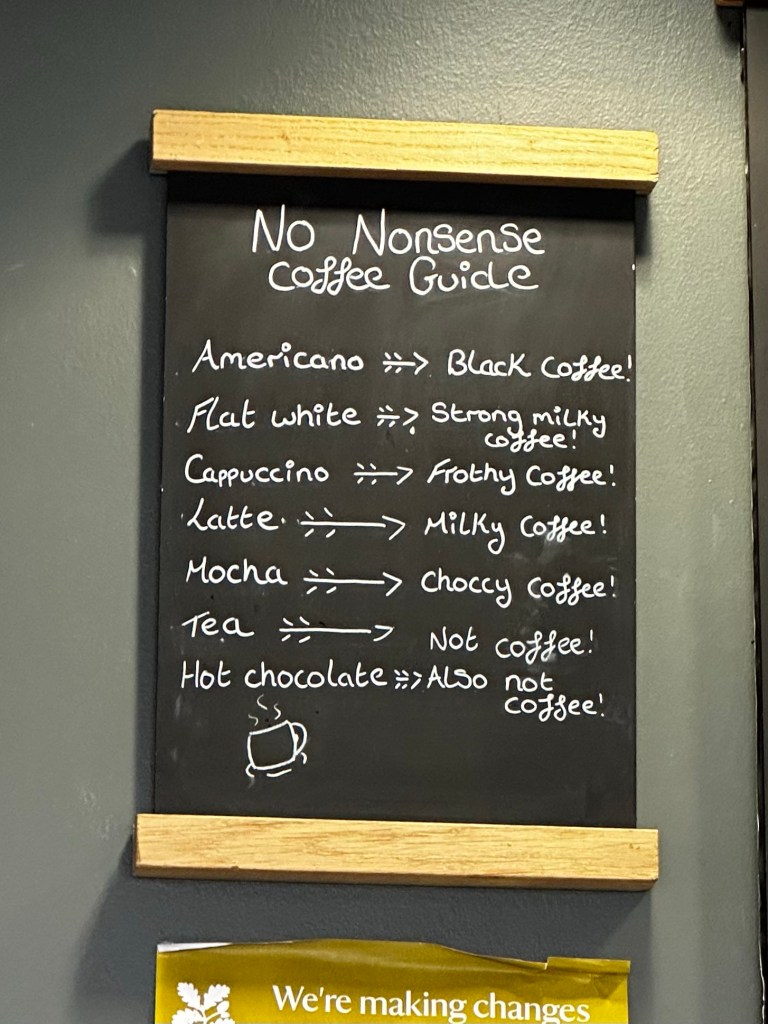
Helpful coffee guide…

Synopsis: Travelling by motorhome on this trip has had its challenges. Eventually finding places to empty water has been very exciting. Which leads me to consider, does more hardship leads to more gratitude? Query: What would you miss most if you lost all modern conveniences?

Sutton Hoo?

Edith Pretty’s house at Sutton Hoo

On Tuesday last we went to Sutton Hoo. You may have heard about it in the 2021 movie called The Dig? It might still be on Netflix. It was based on a book with the same name and it tells a story of finding an Anglo-Saxon grave. Not just any grave, either, the grave of a king with his treasure and his ship in this place called Sutton Hoo near the village of Woodbridge in Suffolk.

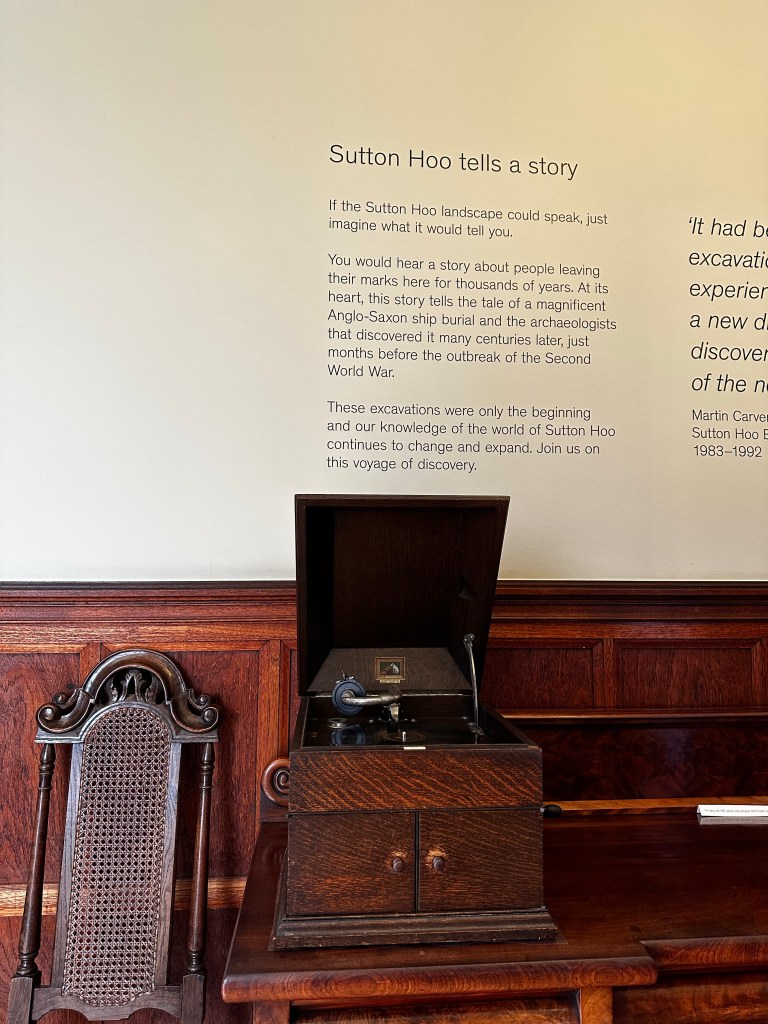
There’s an old record player in the entrance hall

We accidentally drove through the village of Woodbridge (beautiful but narrow) and would not recommend driving through in a motorhome. It was unnecessary as Sutton Hoo is away on its own in the countryside a few miles away. There’s a long drive up to it, parking for motorhomes and even a campsite nearby.

Basil Brown’s measuring tape

Remember I told you I had bought a visitor ticket to the National Trust which meant for the time we are in England (or anywhere within the UK) I can visit any National Trust site for free? This is very cost effective and that’s on purpose I believe. The first question I’m asked at each reception desk is, “Are you a member?” (It’s such a great question because it makes members feel welcome and it tells the unaware non member about the concept of membership!) It seems that most people who live here are members and so they can visit anytime and they do.

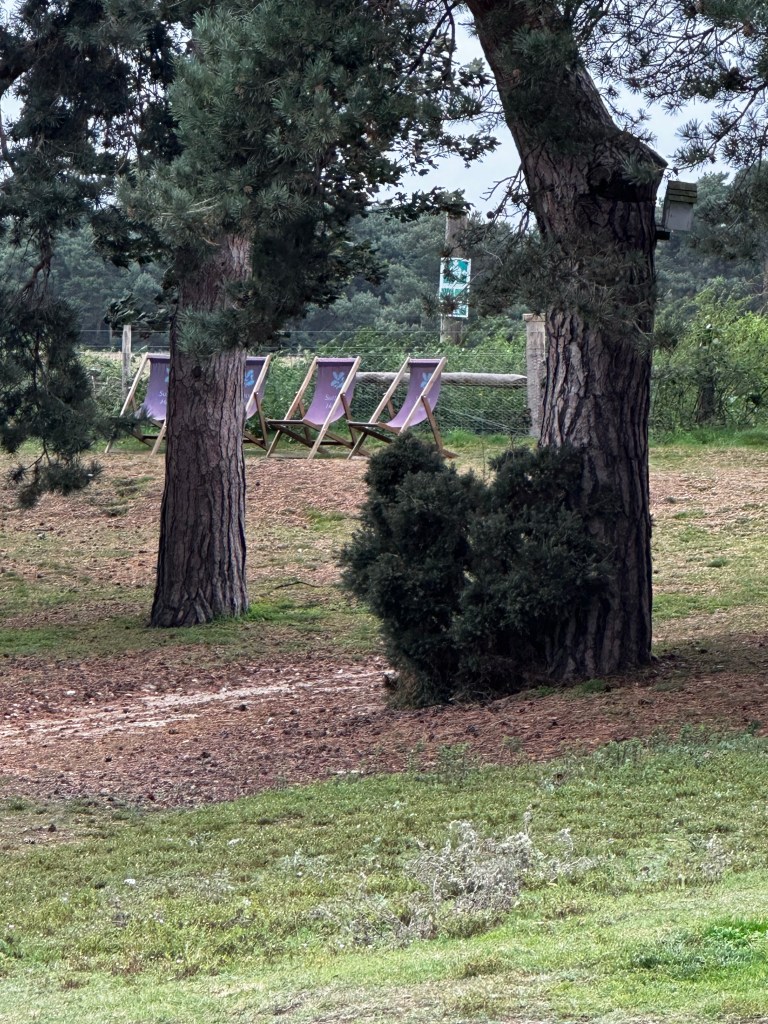
Lonely deck chairs in the wind

Some just walk their dogs or go for a coffee or buy a second hand book – which I did on this occasion. On a less windy day than the day I visited they might sit in the deck chairs and just enjoy the view. Or they might use the services of the many volunteers who are more than happy to answer any questions or tell their favourite story of the place. As most volunteers are here for one day a week you will probably never meet the same volunteer twice so there’s alway a new story to hear.

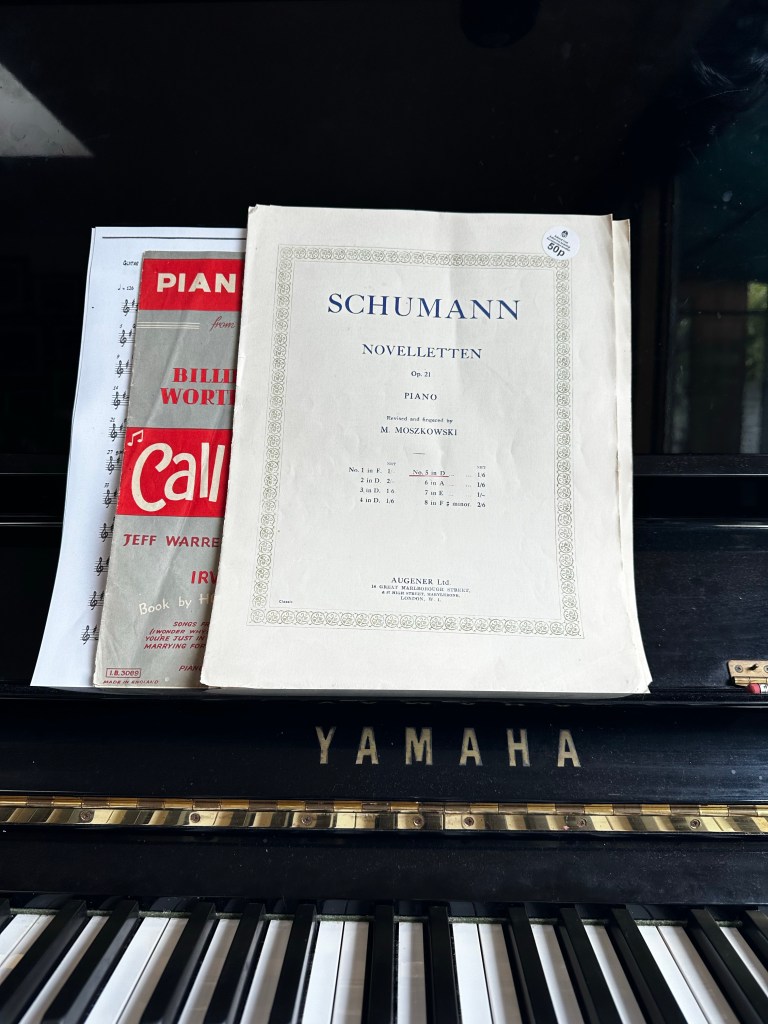
I bought some sheet music in the second hand book shop

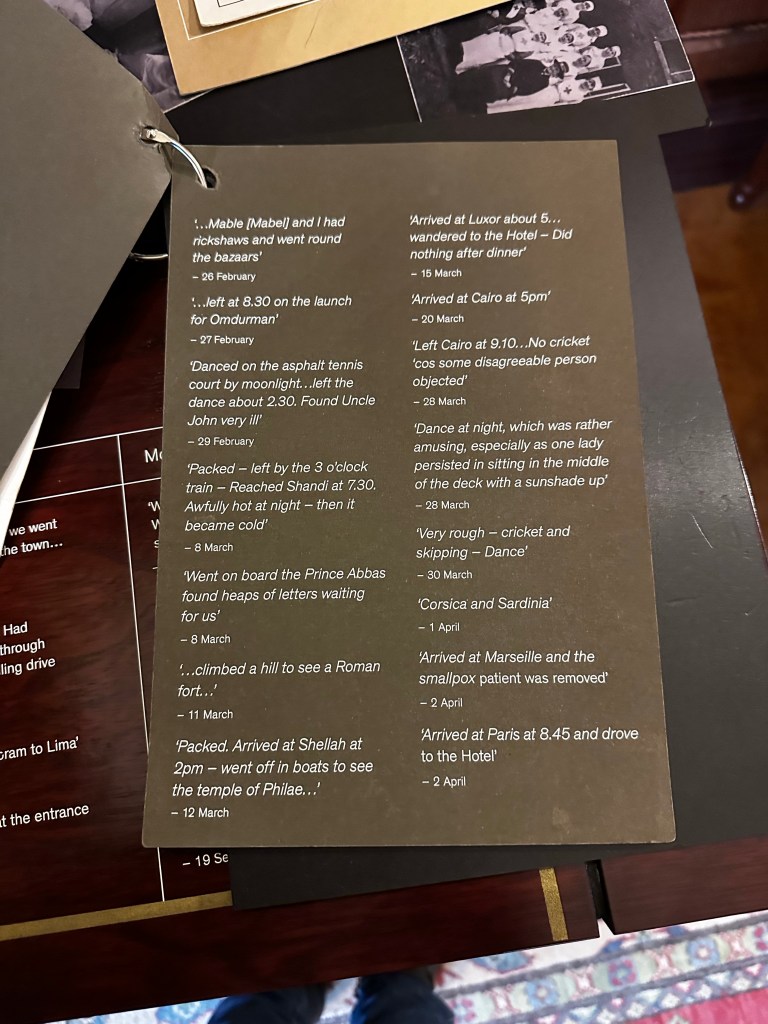
You probably want to hear some of the story of Sutton Hoo, right? Well there’s two big picture stories. The one about the Anglo-Saxons and the one about finding their treasure. We’ll start with finding the treasure. Edith Pretty lived with her family at Sutton Hoo between 1926 and 1942. She loved to travel and as a young woman had travelled to, among other places, Khartoum. She took pictures on her travels and kept a diary… This is important because her interest in archeology was fostered on her travels.

Excerpts from Edith Pretty’s travel diary

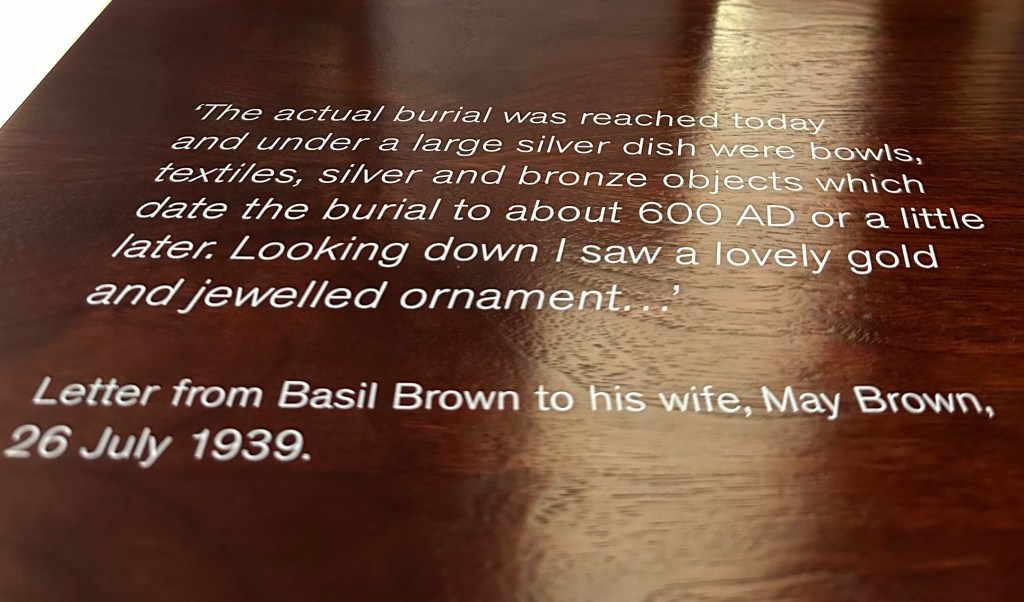
In 1937 (only two years before the Second World War) she was at the Woodbridge flower show where she spoke to a local historian about the earth mounds on her land. She wanted to investigate them. She asked for a recommendation of someone who might help her and was given the name of a local self taught archaeologist, Basil Brown. The story gets a bit more complicated when the British Museum realises there was something good here and replaces Basil with one of their not self taught archaeologists. But for me Edith and Basil are the heroes.

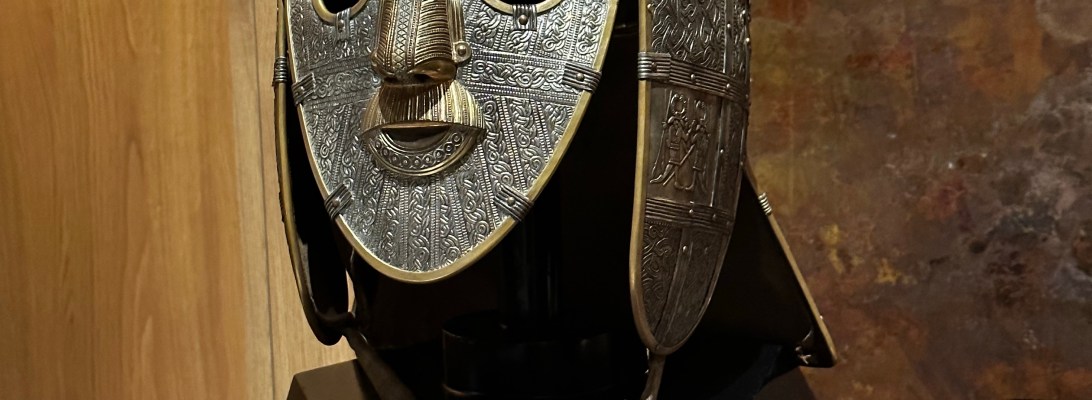
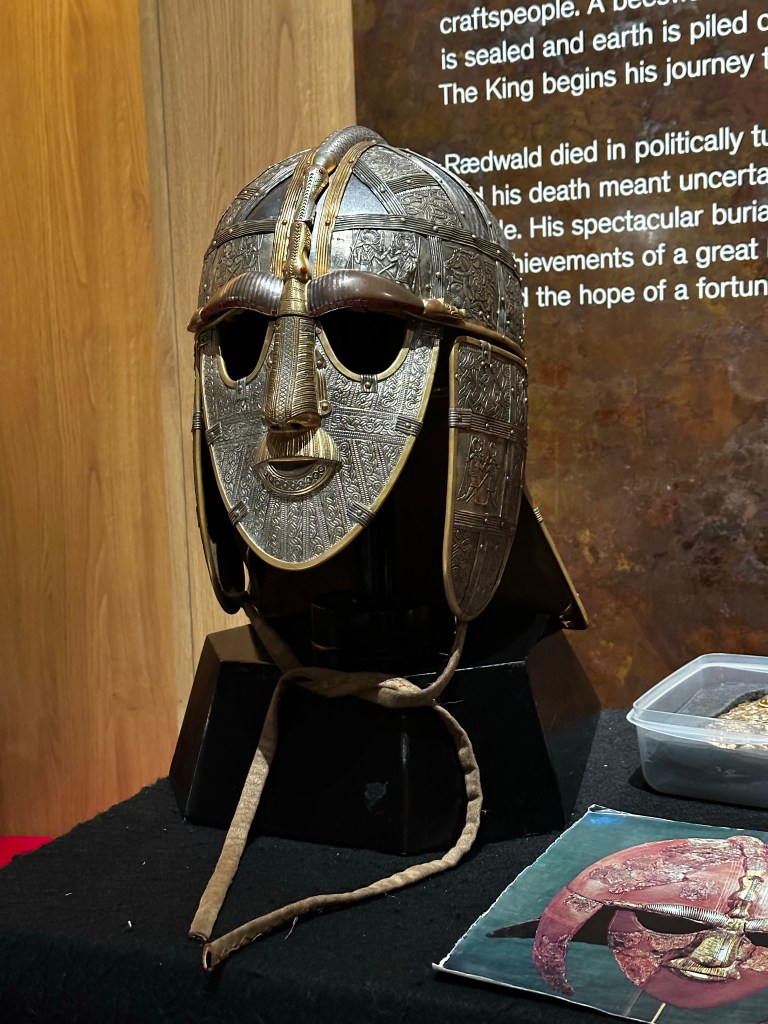
In the museum building this is a replica of King Raedwald’s helmet

And the Anglo-Saxons? Well the history I was missing all along about the Anglo-Saxons – they were in Britain before the Vikings. The information boards and very good at all National Trust sites and Sutton Hoo is no exception.

There are beautiful exhibits of what the Anglo-Saxons might have worn

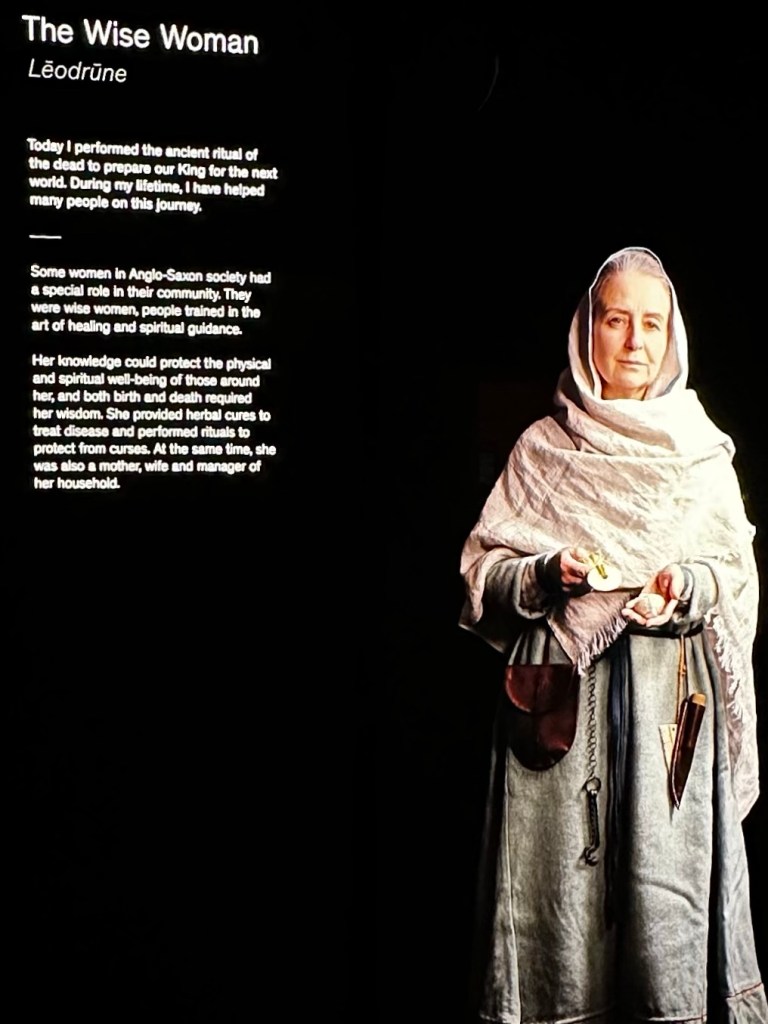
Here’s what I learned: The Romans left Britain in the early 400’s and after that people from Germany (or at least where Germany is now) and the Netherlands and Scandinavia arrived and set up home. They married the locals and they all lived happily. Of course history calls them Anglo-Saxons but they were families who followed traditions and a culture and they belonged. King Raedwald, buried at Sutton Hoo was a member of the Wuffings family and they were rulers of the Kingdom of East Anglia. He died in the early 600’s. The first Viking raid wasn’t until the early 700’s.

East Anglia is the little roundy bit of England that sticks out to the east, north of London. Sutton Hoo is between Ipswich and the sea

Summary: Sutton Hoo is a place where families lived and loved and worked and played and belonged more than one and a half thousand years ago. Two amateurs (from the Latin, to love) self taught in archaeology brought this place to the attention of the world. Query: Do you ever stop yourself from bringing something you are passionate about to the world because you’re “just” an amateur?

King Edmund the Saint

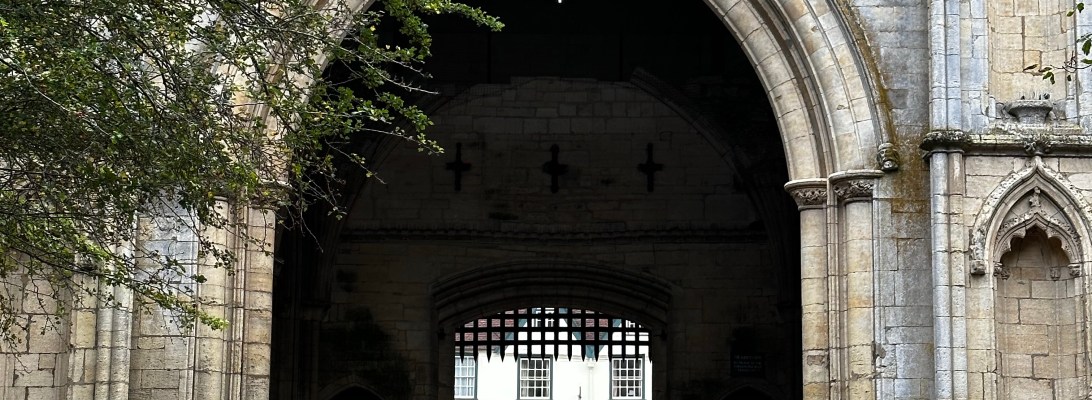
The Abbey Gate (looking towards the town) that led into the monastery which was demolished by King Henry VIII

On Sunday we arrived in the town of Bury St. Edmunds about forty minutes from Cambridge. It’s a very old town that started with a legend about a wolf…

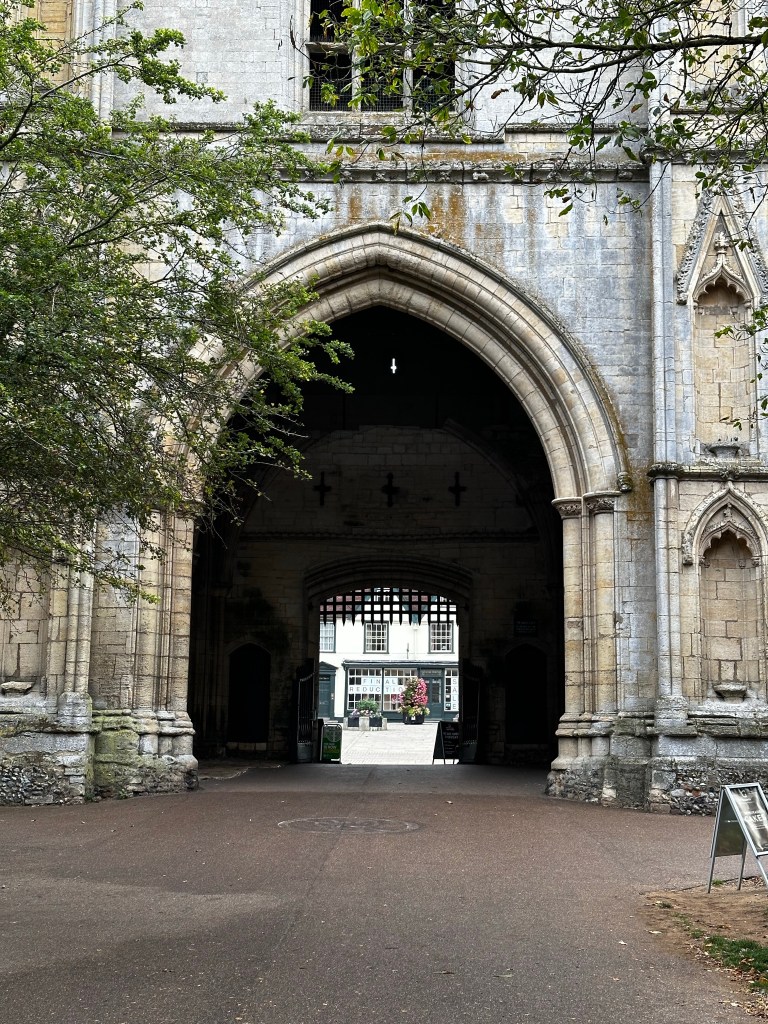
Church Gate leading to the monastery’s church which was also demolished

it was back in 869AD and Edmund was king of East Anglia. He was fighting against the Danish invaders when he was captured and decapitated. When his soldiers came looking for him his head was missing. When they finally found it, it was being protected by a wolf. The wolf allowed the soldiers to take King Edmund’s head and as soon as it came in contact with his body, it fused back on…

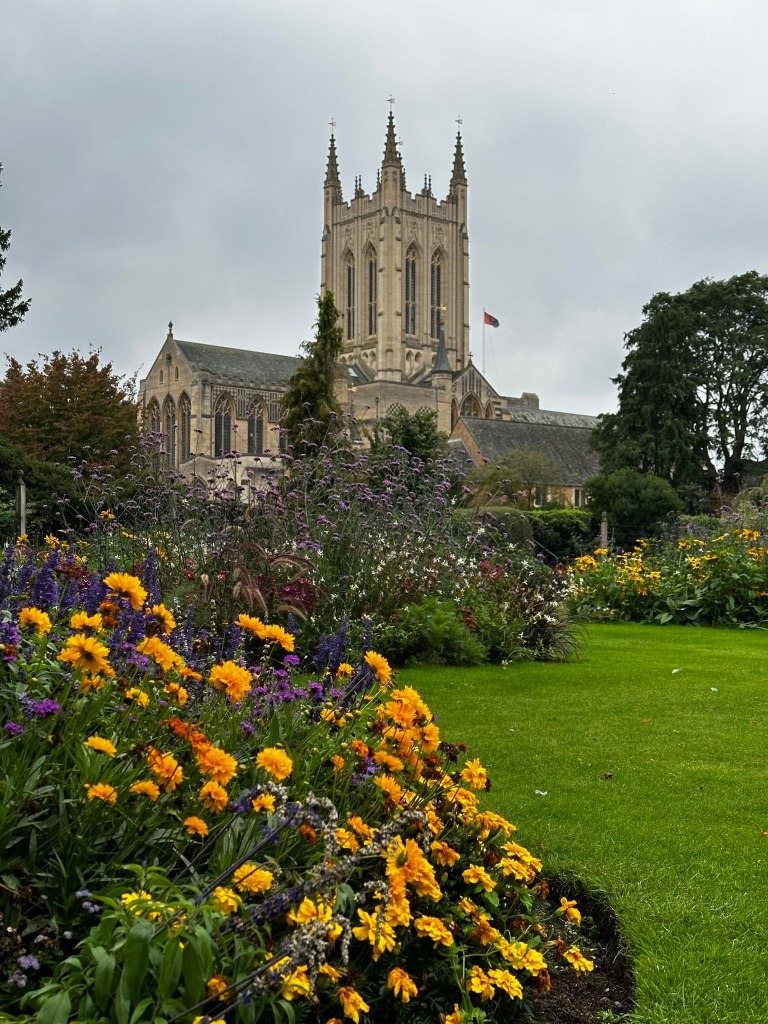
St. Edmundsbury Cathedral, within the walls of the monastery, built in 1964

Well yes of course, that story is hard to believe now but it made a big impression on the people of England back then and was very helpful to the monastery. Monasteries often bought the bones of people who were considered saints so they could promote pilgrimages and special days where they would collect much needed donations on their saint’s behalf.

This is one of the houses built with stones from the demolished monastery, the shape is a nod to the original church building

When Bury St. Edmunds Abbey was founded in 1020 they were lucky enough to get King Edmund’s bones. Because of the story of the fusing of his head he was considered a saint and the monastery became one of the most famous and wealthy pilgrimage locations in England. The power of story.

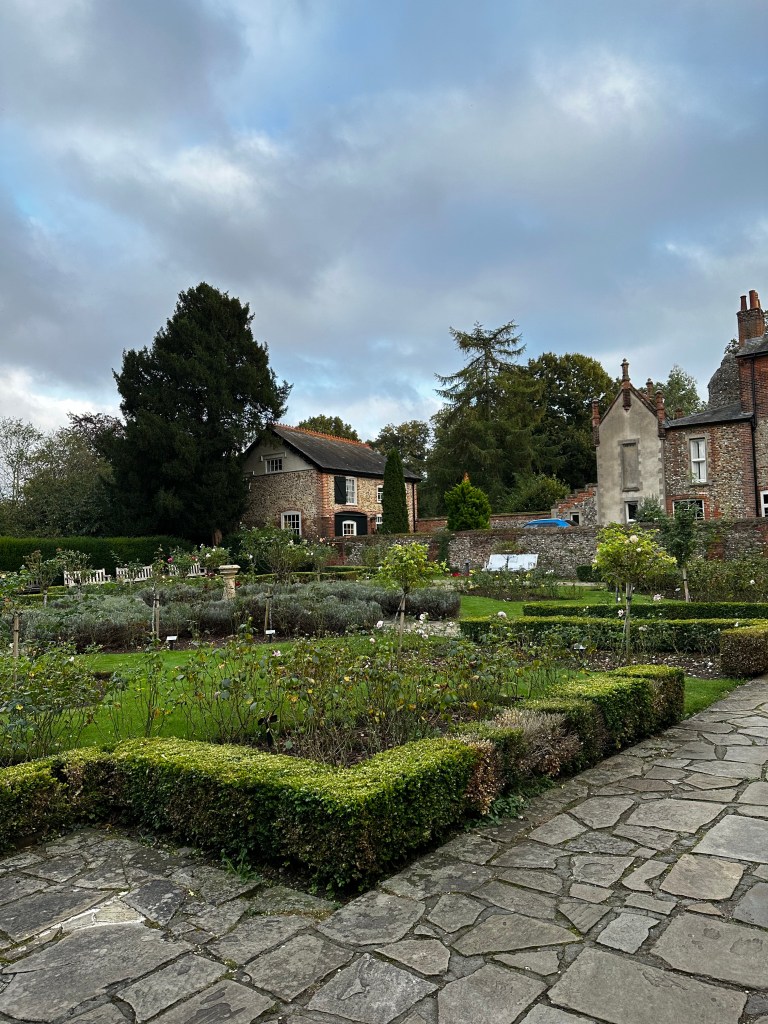
The Rose Garden

The town has very kindly provided overnight parking for motorhomes so we parked up and went on a walk. First stop the Abbey Gardens just minutes away.

Bury St. Edmunds is well used to royalty

You will have heard of King Henry VIII and his six wives but did you also hear about his shutting down the monasteries? All the monasteries, in Ireland too, in the 1500’s. Most of them were demolished and the stone used to construct new buildings. This happened in Bury St. Edmunds and most of the abbey buildings are now just ruins but in spite of that, still beautiful.

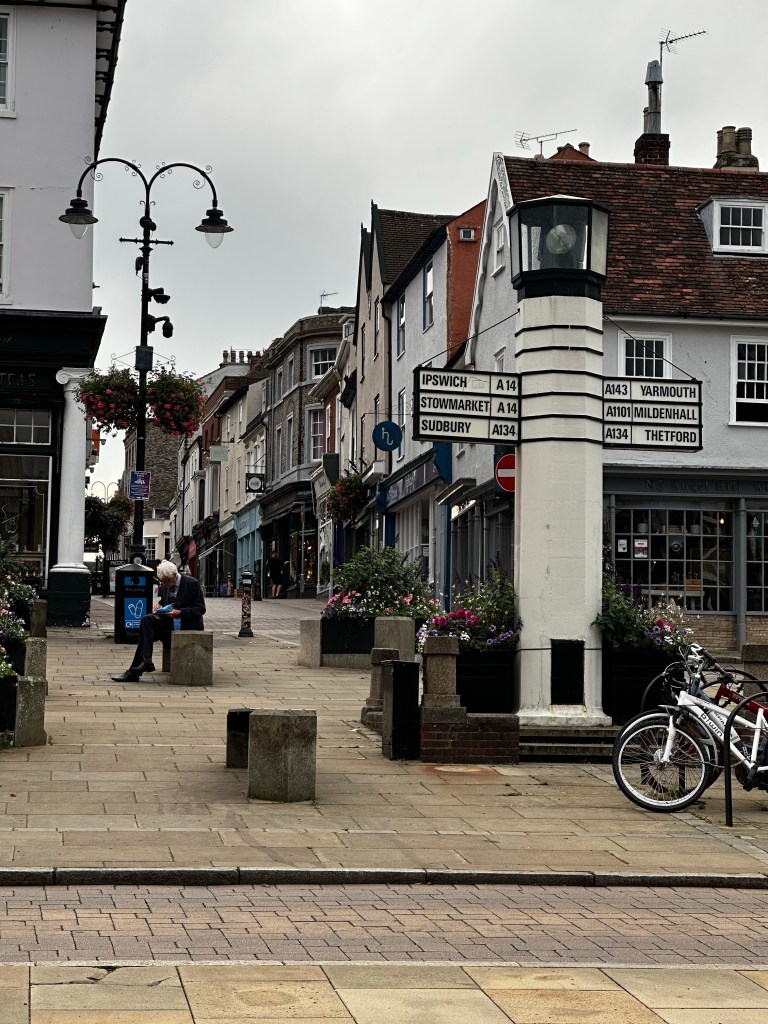
It looks a bit like a lighthouse but this is the first listed road sign in England

There was a contemporary art exhibition in Moyse’s Hall museum in Bury St. Edmund’s this week. Including some original Banksy’s (wall still attached). By the time I walked out the door I was fired up. I would love to have the courage to make some truthful “ugly” art.

Some graffiti from the art exhibition

Summary: A good story can support a monastery. Art doesn’t have to be pretty. Query: What story would you like to tell with your street art?

Dog Watching

One of the many churches in St.Neots from the park

On Friday we arrived in St. Neots, a very old town with market square still looking very like it did more than 100 years ago. We were here to meet up with Ciara (the favourite daughter) and her friend, Flipp. If you’ve joined us on our previous trips you’ll have met them in the Disneyland Paris, June 2022. They found us a parking spot in St. Neots (not an insignificant challenge) and we set off in search of things typically British.

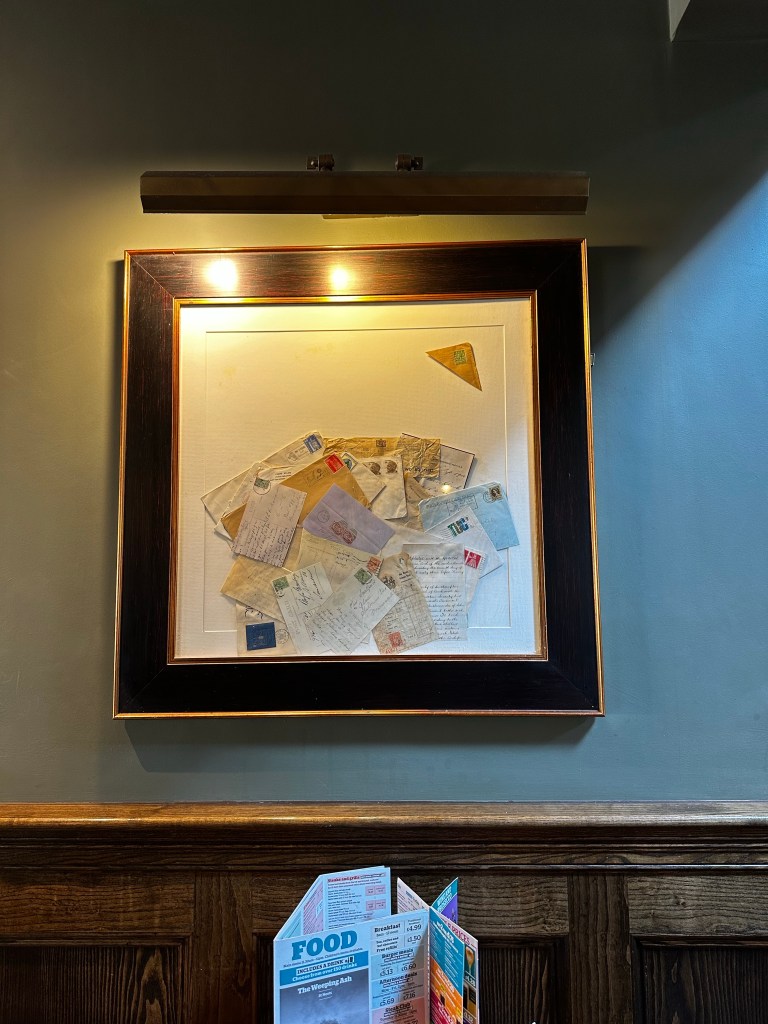
The Wetherspoons in St. Neots used to be the post office and is decorated with post office things including old lost letters

First stop, Wetherspoons, the pub. As it was still only mid morning, I doubted it would be open but it was. And they were serving breakfast with pints of tea and coffee (free refills) and beer (no free refills). And it was quite busy, mainly men, having a quiet drink.

Flipp’s Dad’s parish church

We spent a lovely day visiting, sipping coffee, meeting friends and colleagues of Ciara’s and walking through the parks in the town. Sitting in one park we met an adorable border collie and his owner and were entertained by their party trick. (I cannot remember the dogs’ name so for clarity I’m going to call him Toby.)

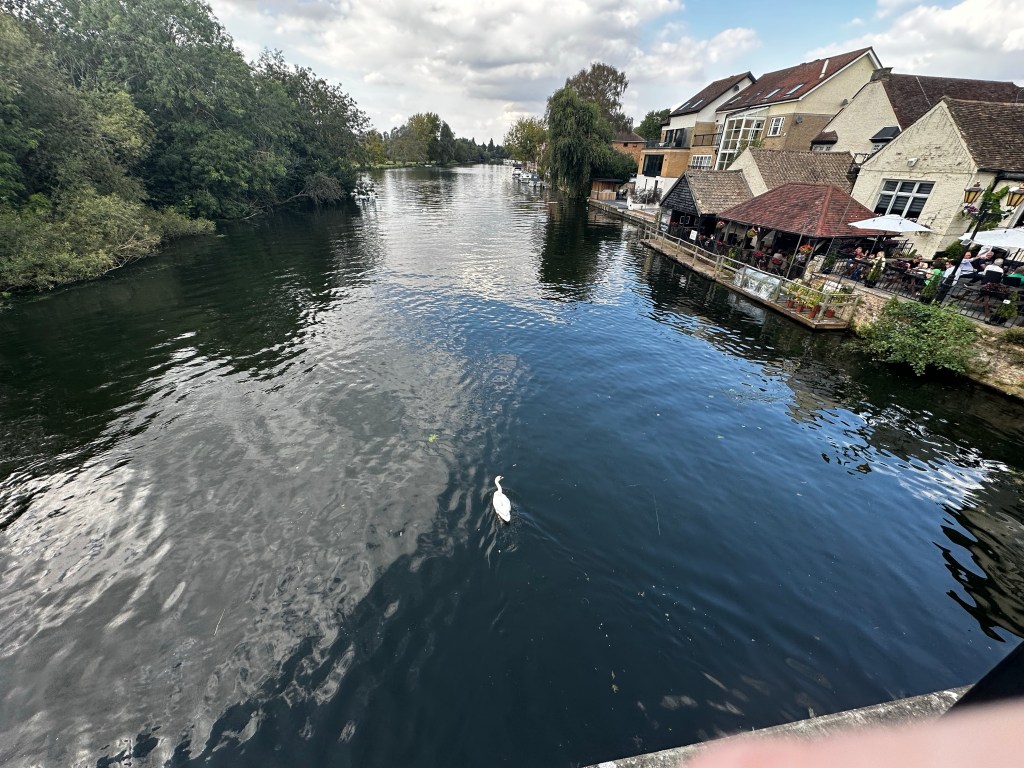
Swans on the Ouse in St. Neots from the bridge

Here’s how it went… the owner would catch Toby’s eye and pause before saying, Right! And off he would run (the dog, not the human) more than 100 meters away to hide behind one of the magnificent oak trees. We could just make out his nose peep around the trunk as he watched for the ball his owner was about to throw. Then he would race towards the ball and race back with it in his mouth for a repeat performance. When I looked around we humans each had a big smile watching Toby doing Toby.

The Round Church in Cambridge

The owner told us Toby’s mother and father were working sheep dogs but Toby hadn’t been trained, he just knew deep in his being what he loved to do. We listened to a story of how Toby and his brother (again let’s call him something for clarity) Jasper, got together for a walk. Jasper’s owner is Toby’s owner’s daughter (if it’s getting complicated, sorry). Anyways, they were all out for a walk and met a little dog who was chasing around the park and without a word from the humans both border collies raced off in different directions and then come around behind the little dog and proceeded to herd him back to his human.

Christ’s College

Next day we set off for Cambridge where there’s a park and ride and surely they’d have a designated place for motorhomes? No, no they wouldn’t but we asked one of the bus drivers and he told us about a little known hack… Trumpington Park and Ride Cambridge have a John Lewis (department store) collection point so they have to have an entrance for over sized delivery trucks.

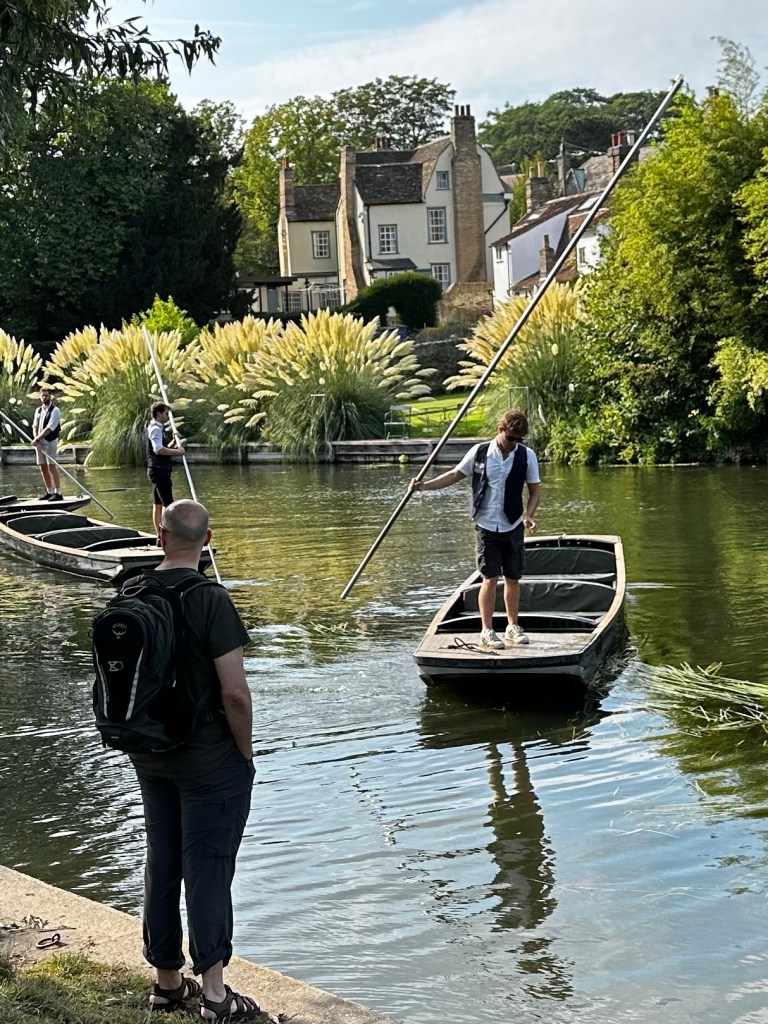
We were tempted by a punt but at £30 per person we resisted

So that’s where we went. Yes, we did have to pass all the signs telling us not to go and we did have to be careful not to follow the guided bus routes but eventually the barrier did rise and there was parking. Parking is free for everyone we just pay for the return bus ride into the centre of Cambridge.

There are lots of churches in Cambridge

It was another hot day as we walked along the old streets and by the river Cam and through the “free to graze your cows” field. There were no cows while we were there but I spotted the telltale signs of recent cow presence. (As I mentioned yesterday I have experience of cows and our street had a lot of cow poo.)

Midsummer Common, where you can graze your cow for free

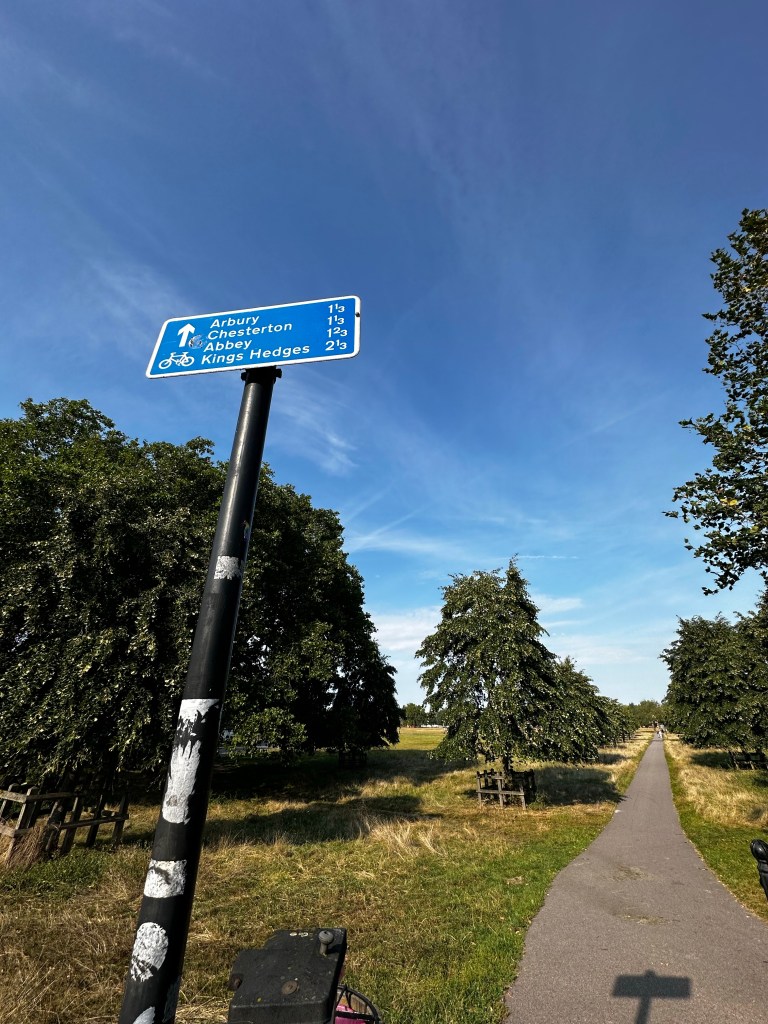
There are also a lot of bicycles in Cambridge, you have to be more aware of bikes than cars on the streets, especially the walking streets. Happy to say no one was injured during the visit.

On the return journey to the Park and Ride

Summary: Finding parking for a motorhome is difficult sometimes. Dog’s can teach us a lot about being ourselves. Park and Ride have low barriers. Cambridge is a cow friendly, bike friendly city. Query: If you were Toby or Jasper how would you do you?

Thomas Harley is not Thomas Hardy

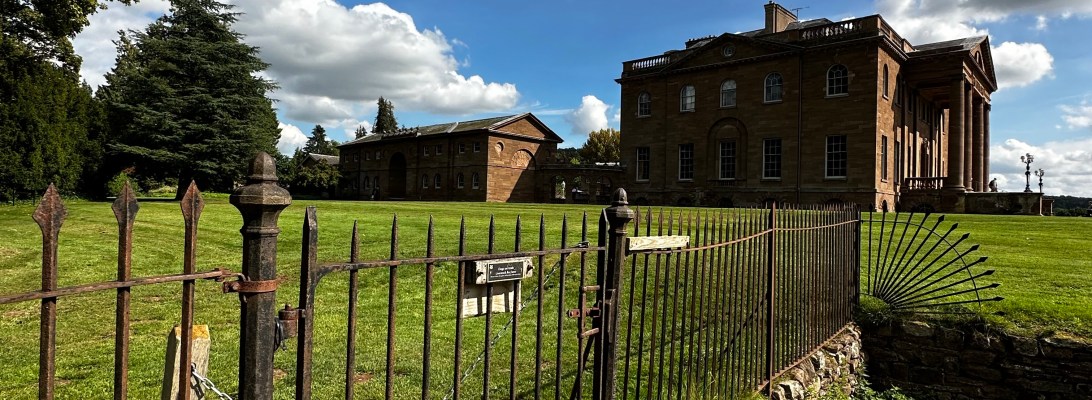
Berrington Hall from the ha-ha

We seem to have fallen into a time warp… five days have passed! After the pub we moved to… Berrington Hall built for Thomas Harley in 1778. NOT Thomas Hardy (who was born in 1840) as I thought the guide was telling me. Inside my head, not out loud, I said – how did he afford to build this house, wasn’t he a poor writer? No, Berrington Hall has nothing to do with Thomas Hardy. History is very interesting to me but also confusing sometimes. There’s so much of it and lots of things repeat over and over like wars, there’s also a lot of men with similar names. I struggle to keep the years and the names clear in my head.

There we are on the National Trust map

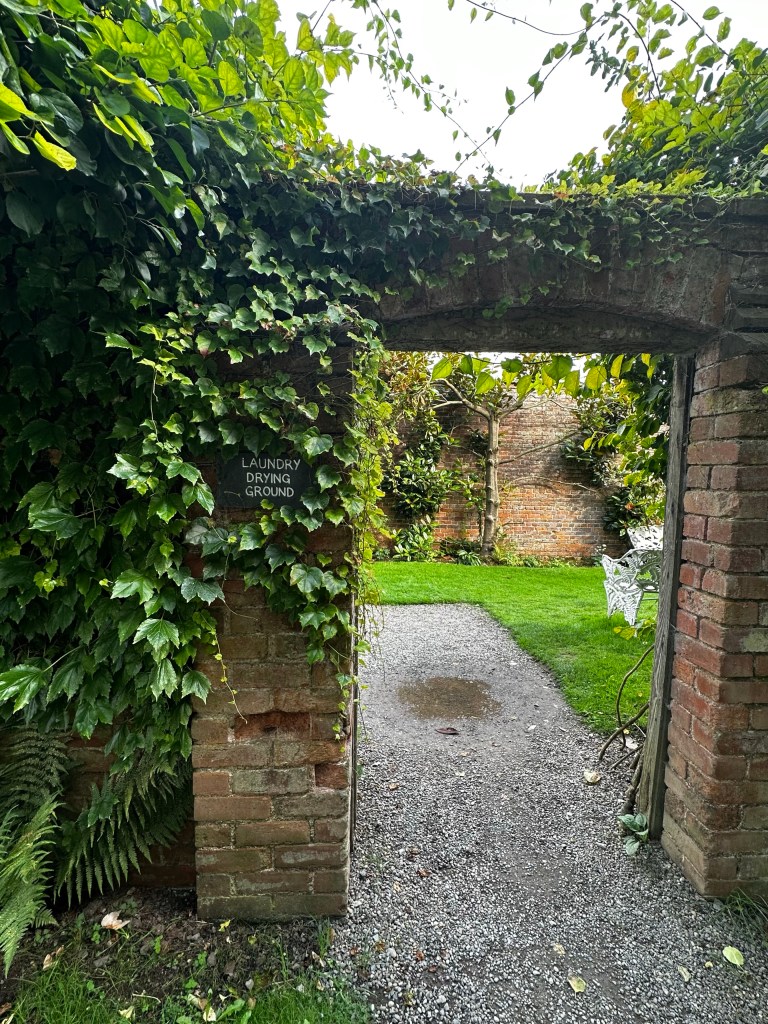
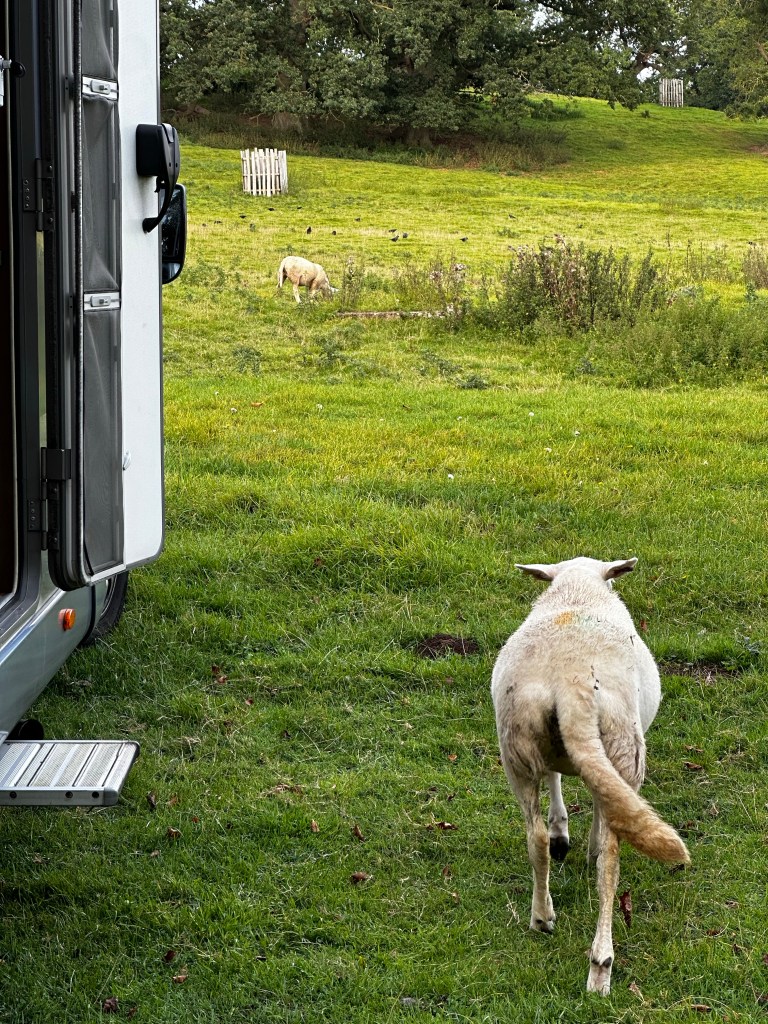
Thomas Harley was a member of the Harley family of whom Harley’s Street in London was named, they made their money from providing uniforms for the army, probably not poor then. He was a Lord Mayor of London and when he gave that up he retired to the country for some peace. It is very peaceful here. It’s in the middle of the countryside surrounded by fields, hundred year old trees, thousands of sheep and a lake. There’s a walled garden too and a laundry garden – where the servants laid out the washed bed linens on the grass to dry.

The Laundry Drying Garden

National Trust houses and gardens are run by volunteers. I didn’t understand this until now. It’s a very different system to the OPW in Ireland. It makes sense now why they charge to go in and also ask for donations, of money and books. They sell the donated second hand books to gather much needed extra finance to keep the houses open to the public. I bought a two week pass so I hope to be going to many more National Trust locations. I’m also going to check out their secondhand books. Also, it was Beatrix Potter (of Peter Rabbit fame) who set up the National Trust.

One of the neighbours

Today in Tesco we met a woman in the queue who was very friendly. She chatted to us about the queue and said “I must be bored I’m talking your head off.” So I asked her what she did when she wasn’t bored and she said she loved to read and she loved her garden and she told us about it. This might be one of those times when you had to be there to appreciate how nice this was. We have been noticing how friendly everybody is in Ireland and missing that. It is a much underrated (by me until now, anyway) experience to chat while waiting in a queue.

Interior of Berrington Hall

But I’m skipping ahead, there were five more days lost in the time warp… After Tomas Harley’s house we parked overnight in the trucks car park at the town of Upton on Severn. There was a very good supermarket, called Warners, next door and we stocked up on English pies. Afterwards we dined out at an Indian restaurant. The restaurant was located in an old low ceilinged house with beams and looked out on the narrow high street. It was while we were eating that I spotted a ginormous tractor and combine harvester holding up the traffic. By ginormous I mean the height of a two story house on this street. It reminded me of my childhood. In our town farm life got along with town life. Even though we lived on a street where there was plenty of through traffic going to Dublin or Cork, the cows still had to be milked. Twice a day the farmer (can’t remember his name, was it Mr. Roach?) who lived on this street walked his cows home for milking.

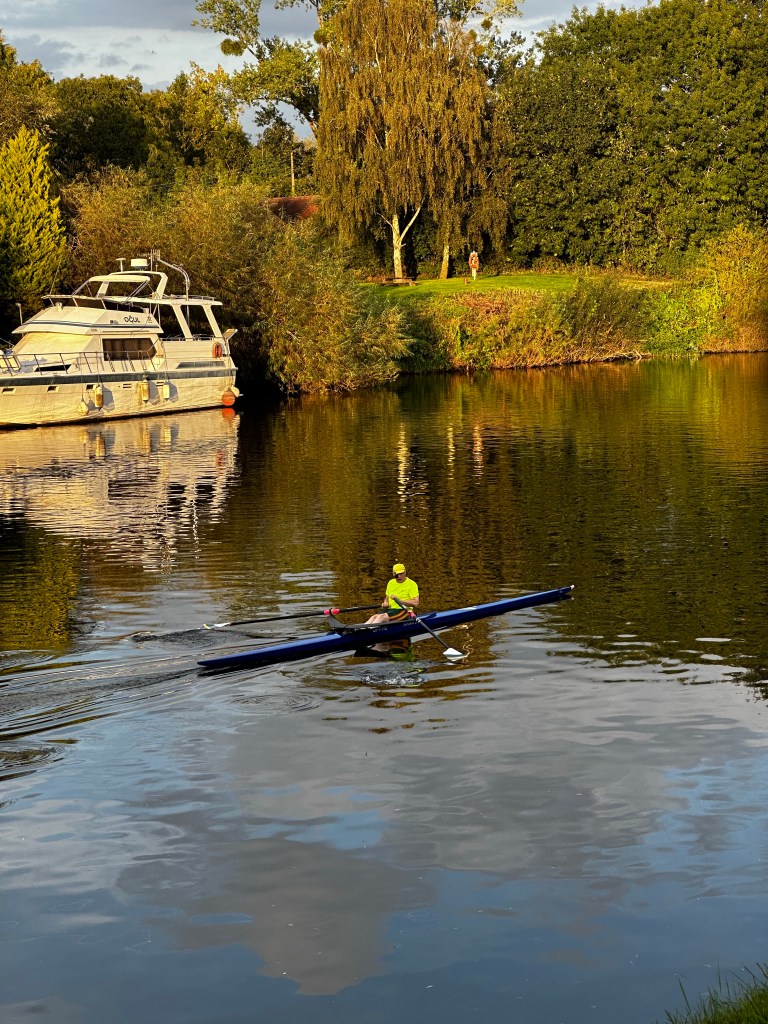
Man on the Severn at Upton-on-Severn

Summary: Thomas Harley is not Thomas Hardy. The countryside has always been very peaceful, unless you were a servant waiting for the linens to dry. Volunteering is alive and well in Britain. Tesco is a great place to meet new people. Farming is big here. Query: Do you have any hacks for remembering dates in history?

Don’t forget the time difference

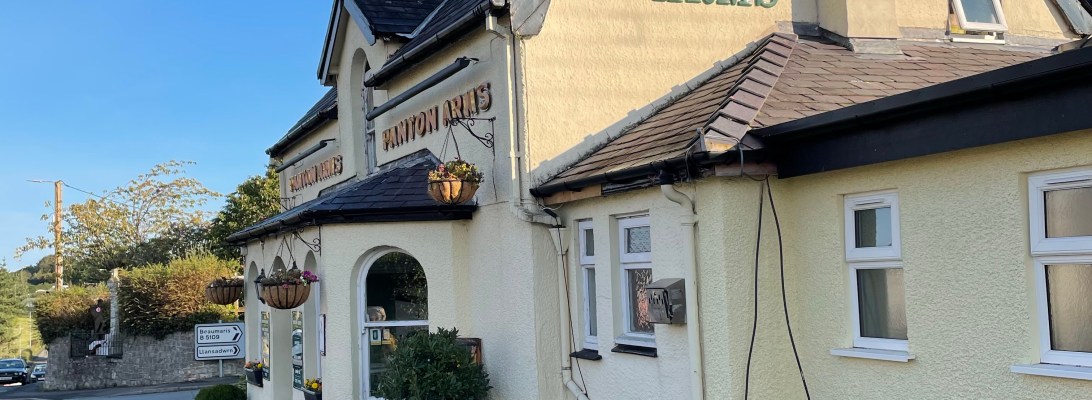
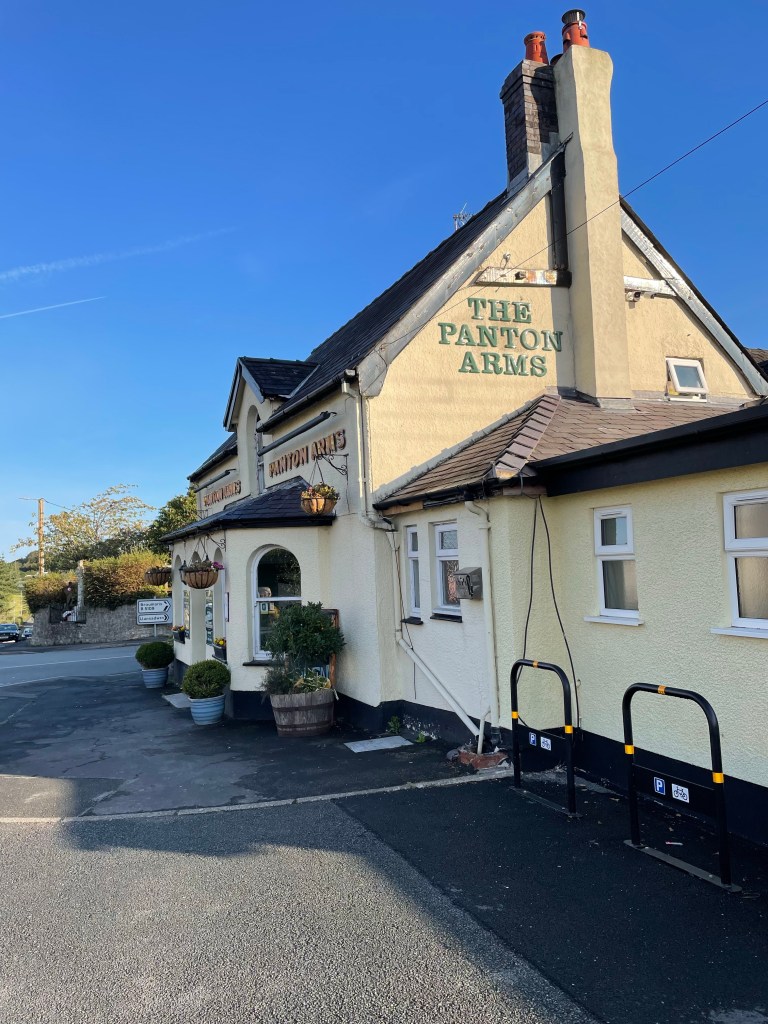
The Panton Arms

We stayed in the car park of a pub in Pentraeth in lashing rain. It was an old pub, they did food and we could park the van overnight if we bought a meal and gave them £5 extra. We had left Dublin Port with sun shining on us just four hours previous but the rain was only temporary. Next morning the sun was back and I went off to the petrol station to buy stamps at the post office.

Right beside the gents toilet at Dublin Port there’s this handy guide to your duty free allowances between Ireland and Britain. The surprising thing is they’re different…

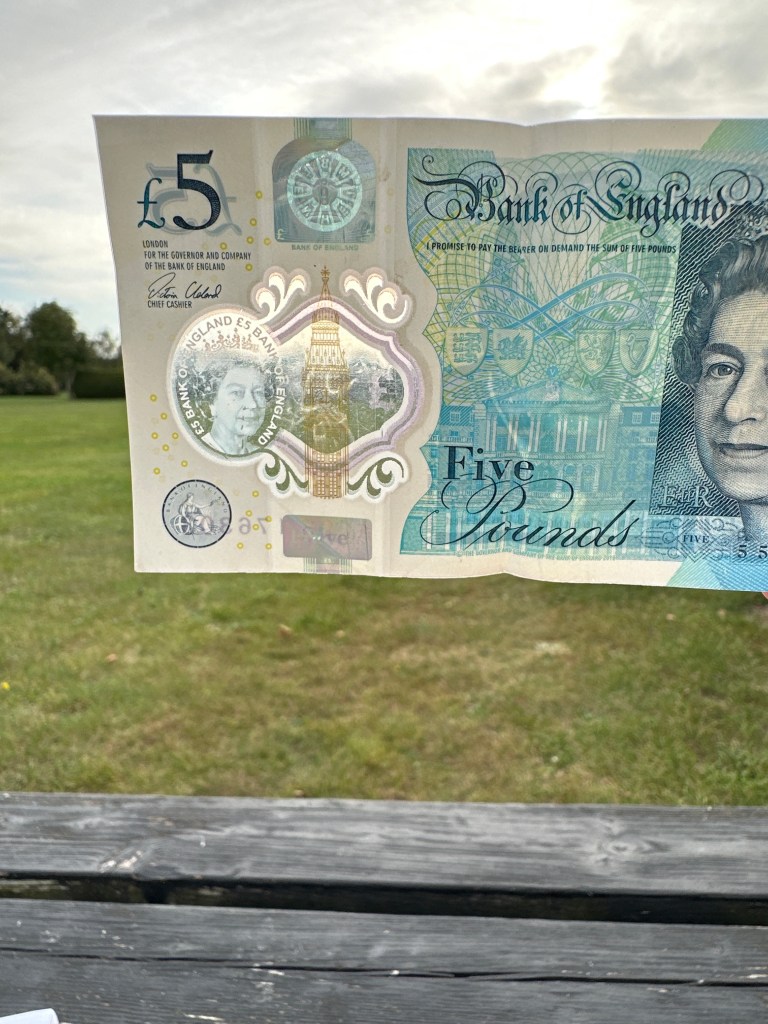
It’s only a few hours away but things are different here. First there’s the money and I don’t just mean that it’s pounds and not euros, the notes are not made of paper. They have a lovely matt springy feel, are very clean and they are see through! Then there’s the time, I know what you’re thinking… I didn’t think there was a time difference either but there is.

Can you see the grass through the £5?

At the petrol station the post office is on the same counter as the groceries but there’s a different cash register. I stood there for a few moments wondering what the procedure might be and then went ahead and asked the grocery cashier if I could buy stamps. He said he didn’t know what time it opened at and called to a lady stacking shelves… she said it opened at 9am.

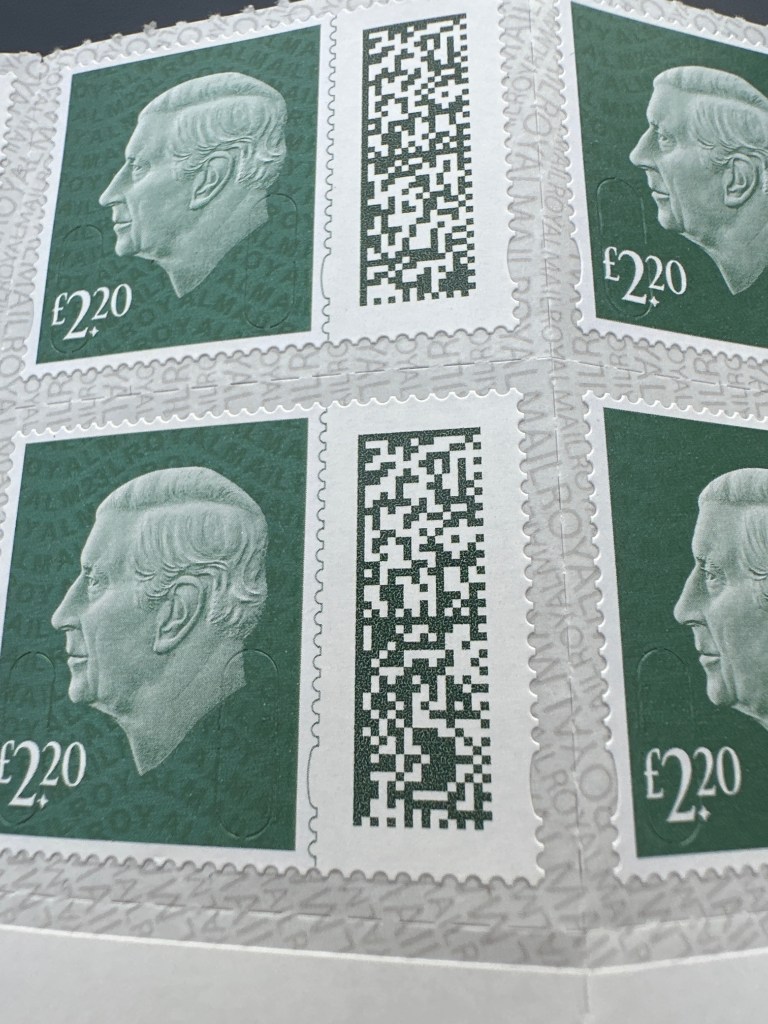
King Charles is on my stamps

I was delighted, it was exactly 9am – how lucky am I? Unfortunately, the lady stacking shelves didn’t know the time so asked the grocery cashier who said it was five to nine and she replied, it won’t be open until nine and went back to shelf stacking. What? But… I sort of mumbled as I pointed to my phone but my heart wasn’t in it, I stood back to consider my life choices.

All is well

At exactly 9.05am a different customer approached the post office bit of the counter and purchased his stamps. I dashed up after him in case it closed again at 9.06.

My special cat purse for sterling money

Summary: there’s a 5 minute time difference between Ireland and Wales; the money is see through; you can bring 48 litres of beer with you but only 16 litres back. Query: Could anyone help? Neither of us know how to change the time on our phones by five minutes.