On our way home…

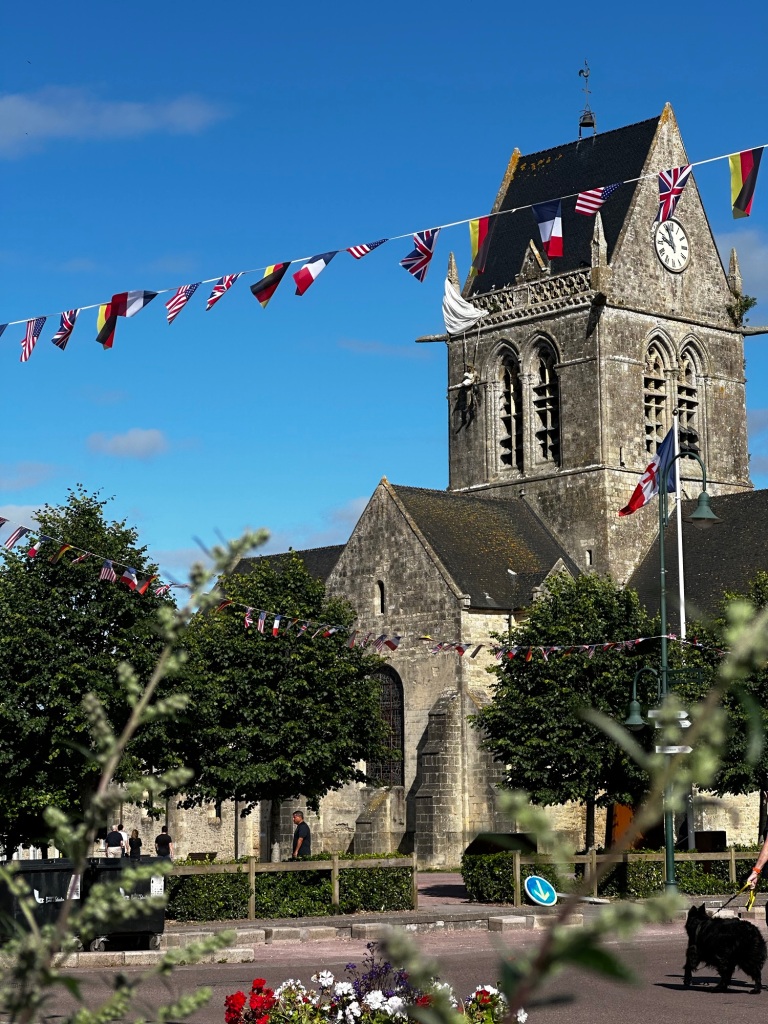
Sainte Mère Èglise church with model of John Steele and his parachute hanging on the pinnacle

By the time you read this we will be on the ferry home. Everything that begins also ends and our trip has ended. No doubt there will be more journeys, this year or next but for now we are beginning the ending part of the journey.
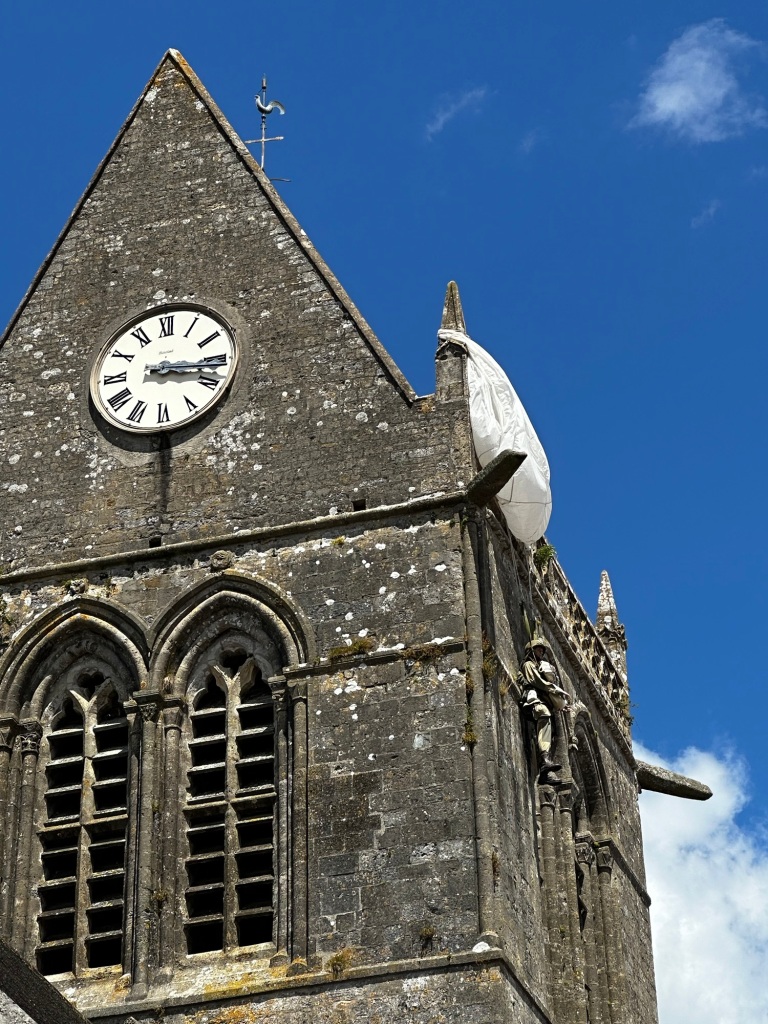
Close up of parachute model

We spent the last few days doing very little at a campsite just an hour from Cherbourg ferry port. The town is called Sainte Mère Èglise. We have stayed here many times and you may remember, from previous trips, it was the first town liberated in the D-Day invasion in 1945.
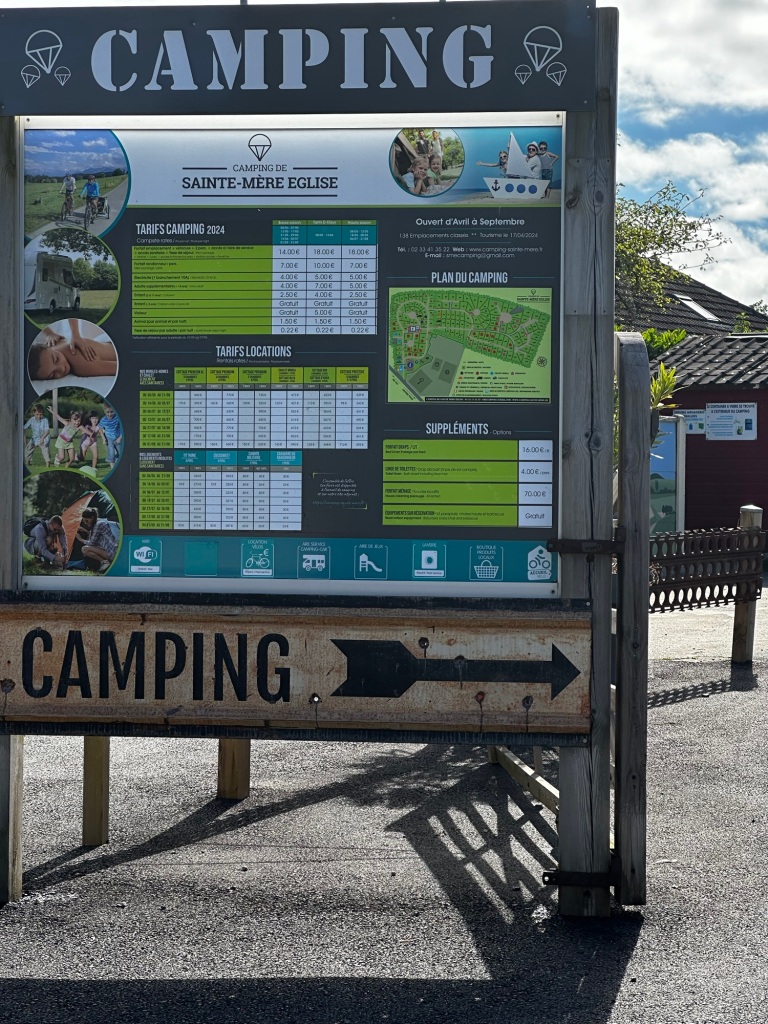
Sainte Mère Èglise camping

It was American Airborne Division soldiers who landed here and one of them, a paratrooper, hung for hours when his parachute caught on a pinnacle of the church. He was taken as a prisoner of war, he escaped and continued to fight until the town was finally liberated. His name was John Steele. He was 33 years old. He died only 23 years later of throat cancer.
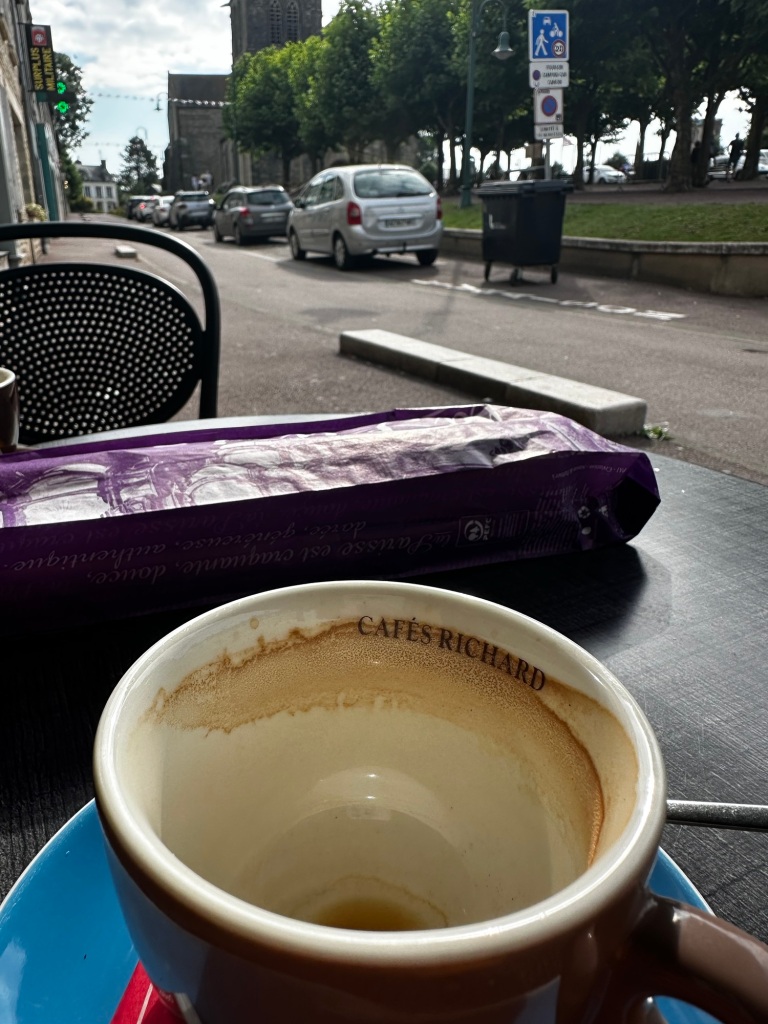
Coffee break

There’s a war museum in the town and we visited it again this year. I wasn’t looking forward to a visit – it’s always very sad. I did consider not going but instead I went looking for happier stories instead of the usual sad stories.
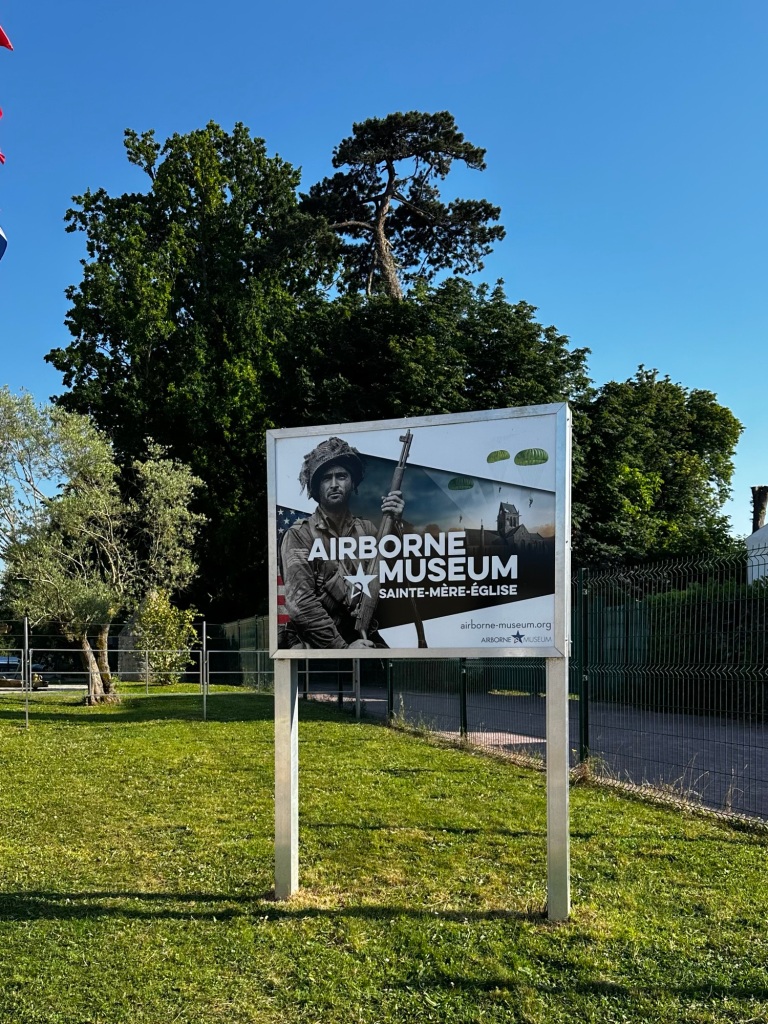
The Airborne Museum

Along with all the usual exhibits and information plaques there were posters lower down for smaller children to read… I took the children’s tour. The first one was introduced by 10 year old Albert who told us he’d been seeing German solders in the town since July 1940. And that he and his family were forbidden to leave their house between 10pm and 6am. He mentions queuing outside the shops for small amounts of food in exchange for a ticket. He says he overheard his mother talking to a friend about the resistance fighters waiting for the D-Day.
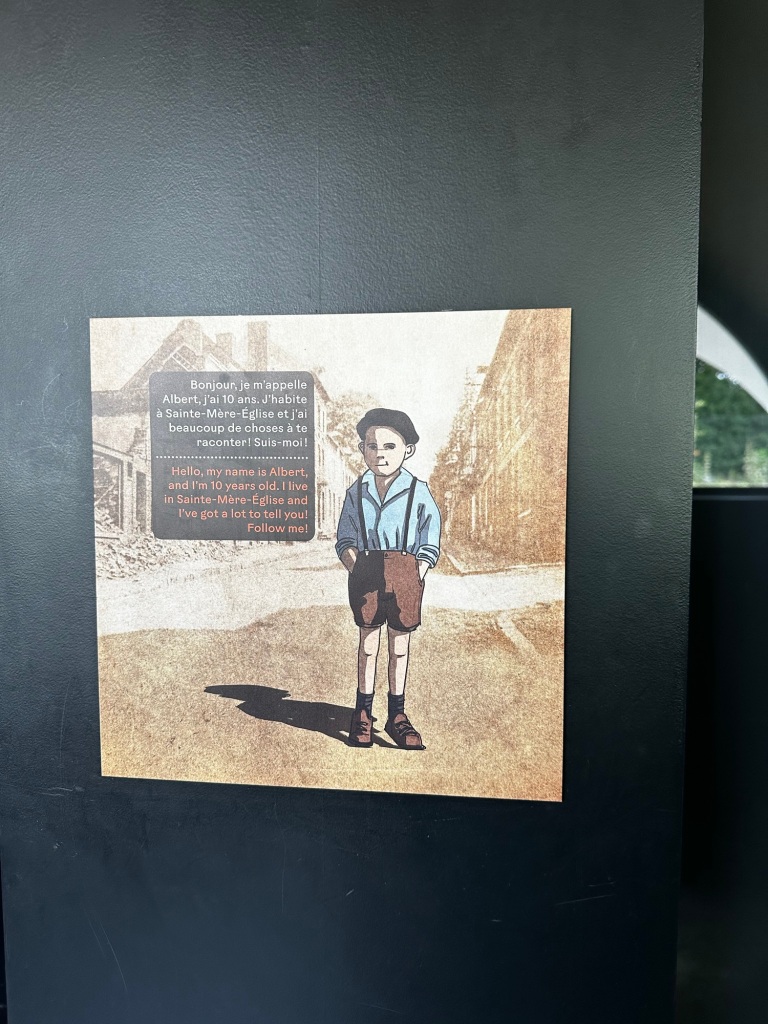
Here’s Albert

Then there was the double agent. Juan Pujol Garcia from Barcelona wanted to be a British spy but he failed the interview. But he was successful in his German spy interview. (I’m really not making this up!) So he went ahead and set up a pretend German spy ring and moved to Portugal (like Ireland, Portugal was neutral during the war) to oversee his spies.

Here’s Juan Pujol the double agent

When the British discovered the ring, they thought it was real and became very interested in Juan. Instead of punishing him they offered him a spot as double agent. He had to confess that his spy ring was fake but that seemed to make him all the more spy-worthy.
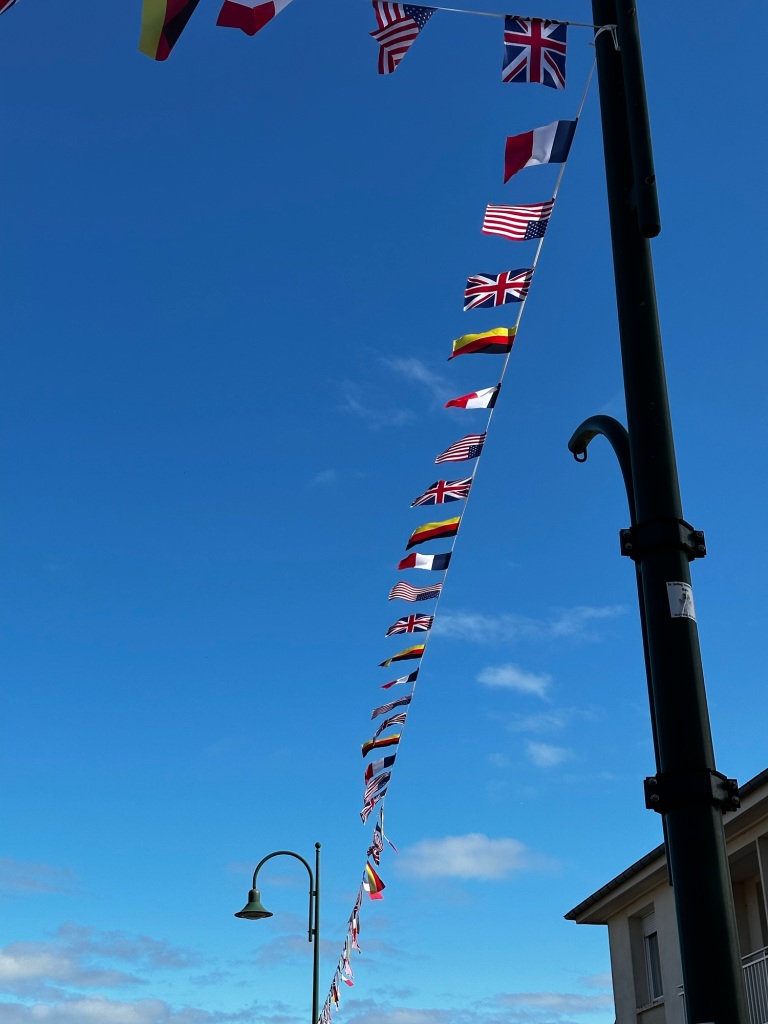
Bunting on every street

His big success was telling the Germans that whatever they heard about a D-Day mission in Normandy was fake and the real mission would be at Calais – nearly 500km from Normandy. For that reason (and other army efforts with fake reports and troop movements) the Germans were caught unprepared for the landings in Normandy. After the war Juan faked his own death and went to Venezuela. He died in 1988… or did he?
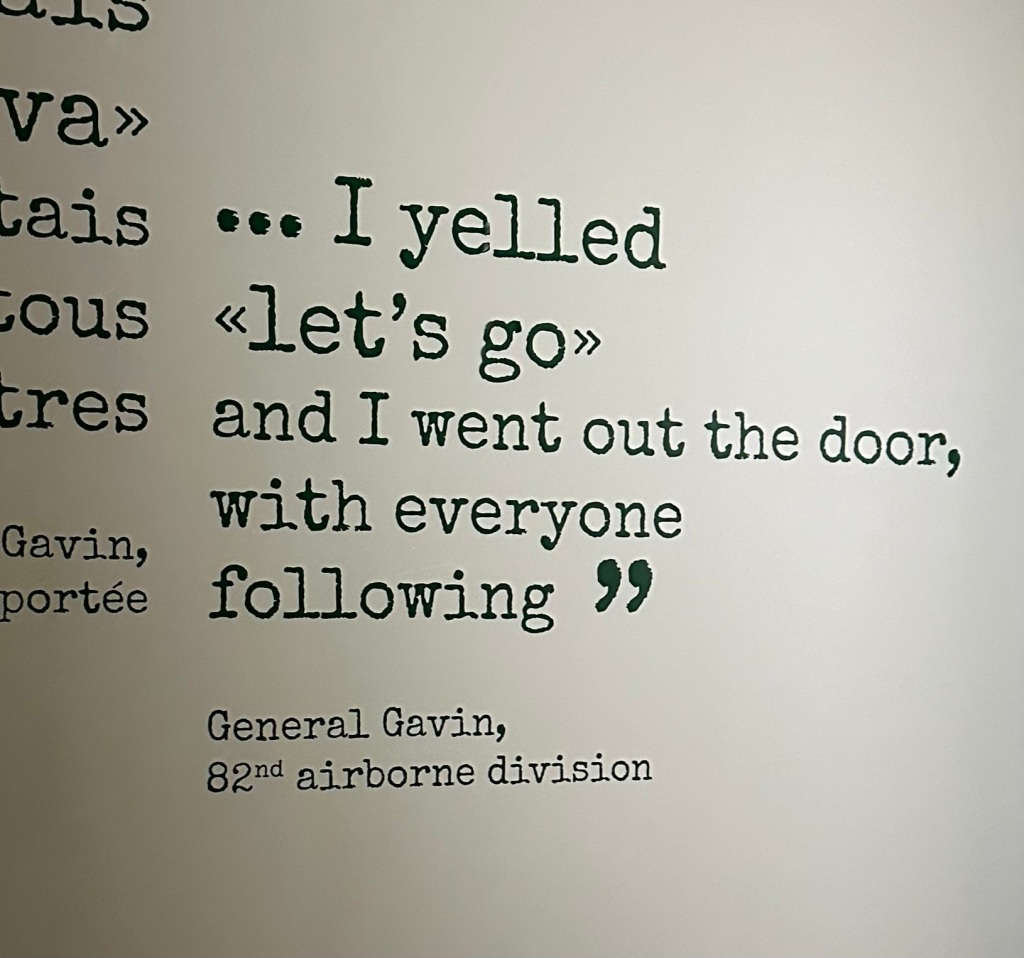
How hard can it be to jump out of a plane into enemy territory…?

There was one story I was drawn into before I realised it was sad. The day before D-Day three friends from the Airborne Division made a pact. Ralph Busson, Bill Farmer and Dan Furlong tore a dollar bill into three pieces and promised they would reassemble the pieces after the war.
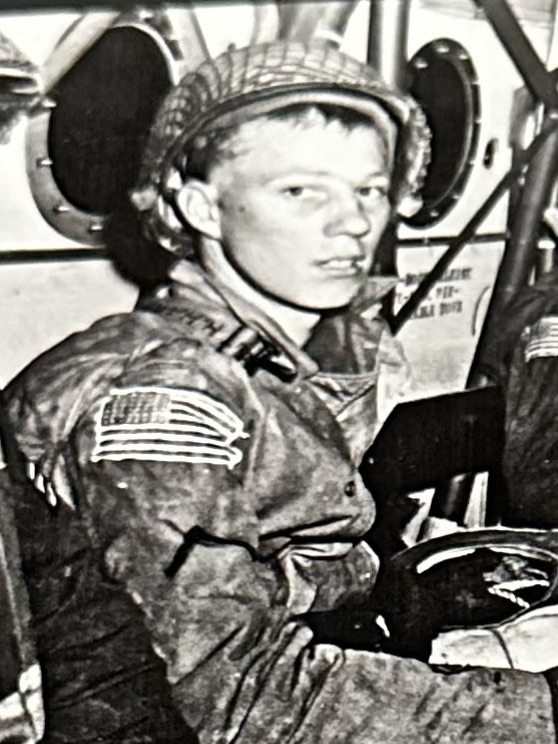
This was a photo from inside a WACO glider plane before it landed (badly)… doesn’t this soldier look no more than 14 years old?

Bill never made it to the reassembly of the dollar bill. He died in battle on the 8th of July 1944. Ralph and Dan met again at a veteran’s meeting in the US in 1983 and in 1998 Dan brought their story and their pieces of the dollar back to Normandy to the museum.
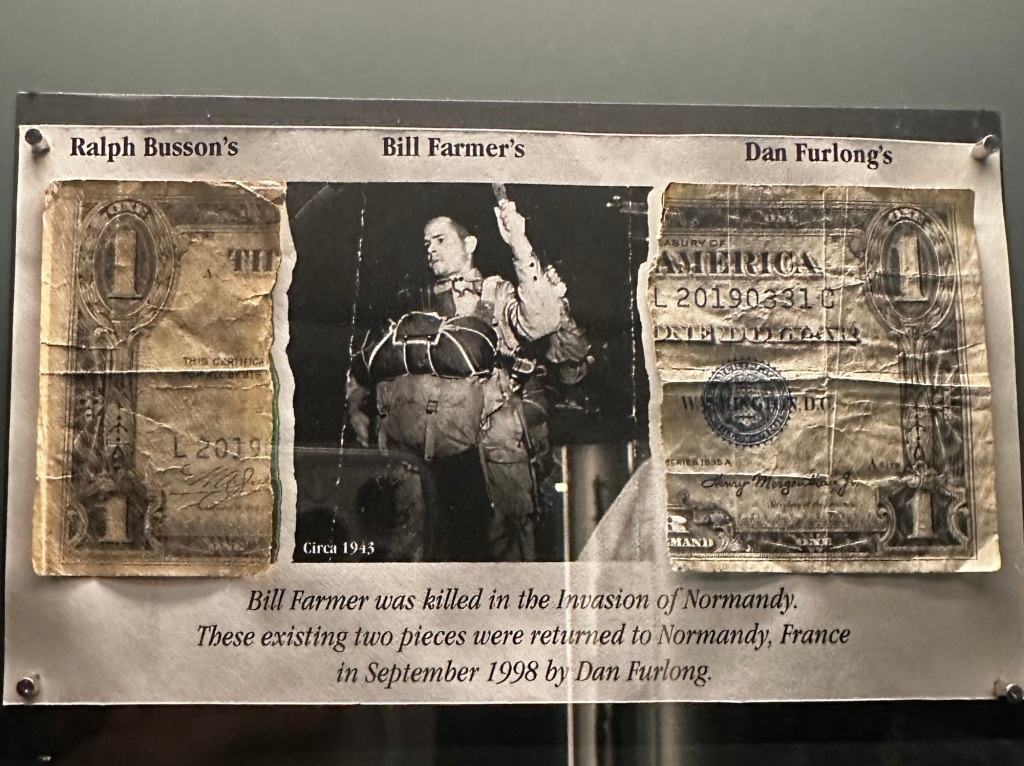
The story of the three friends and the dollar bill

The bit that got me was the display of these pieces along with a picture of Bill… Both Ralph and Dan’s pieces were the edge sections of the dollar bill and were creased and worn. Bill’s section would have been in the middle and was missing, replaced with his photo. And it made me think they were supporting their dead friend, one on either side…
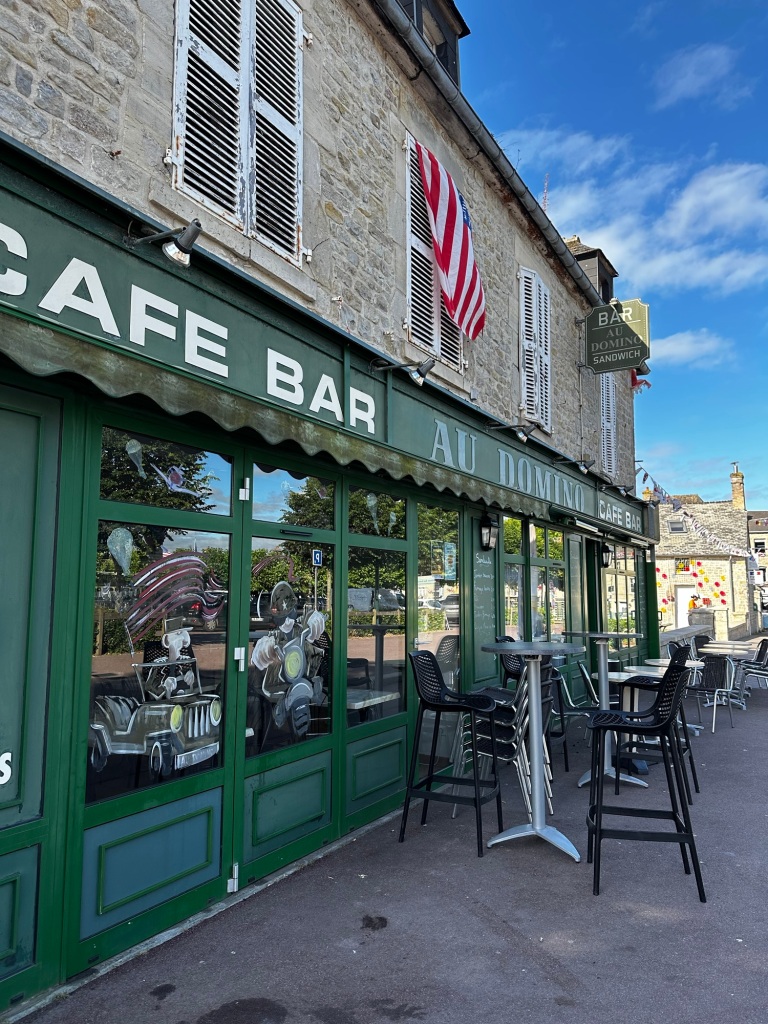
Be needing another coffee after that…

And that’s it! Thank you for supporting our journey up and down the roads and lanes of France, Spain and Portugal through sun, rain and cloud. It’s been a different kind of journey and I suppose no journey is exactly the same. See you next time, in person or on the blog. Big hugs, Mairead.
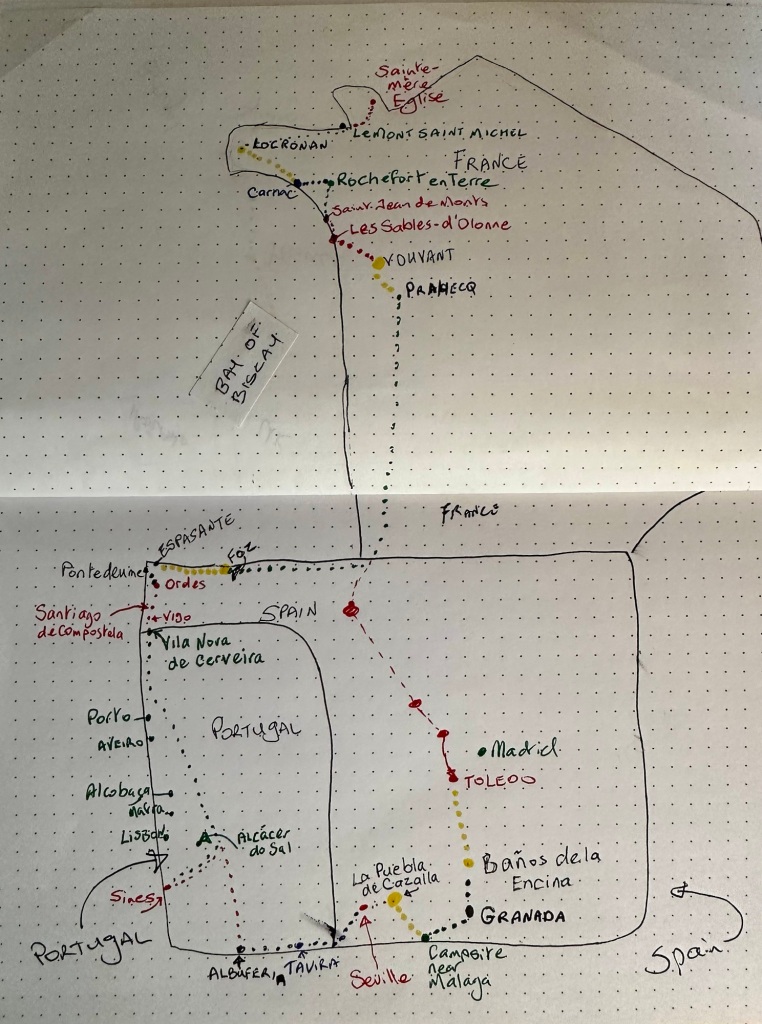
Le Mont Saint Michel – Part 3

Next morning’s goodbye to Le Mont Saint Michel

At the end of the Abbey tour I walked back through the gift shop and through the turnstiles and down the steps and out through the town and onto the bus. When I got off the bus I was hungry.

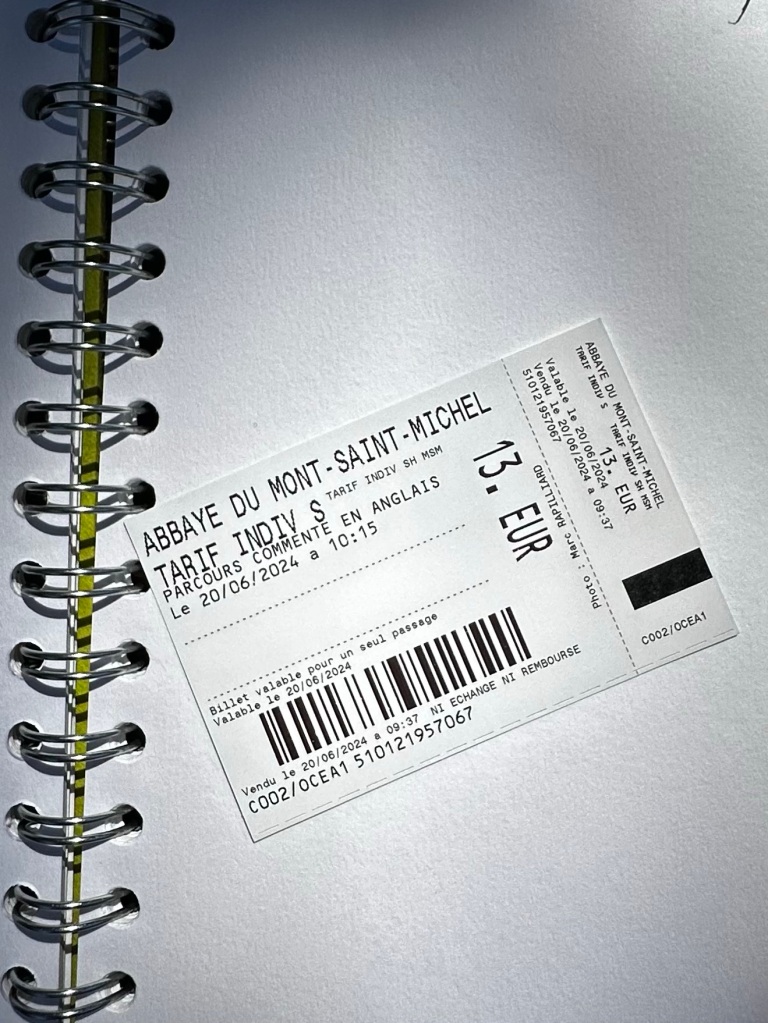
My ticket to visit the Abbey

On the mainland side of the Mont Saint Michel bridge there are hotels and restaurants and gift shops and parking and a very expensive campsite. I decided to get a jambon roll and coffee and ponder my next step. If I started walking I could just make it back in time to the van for checkout. But was that what I really wanted to do?

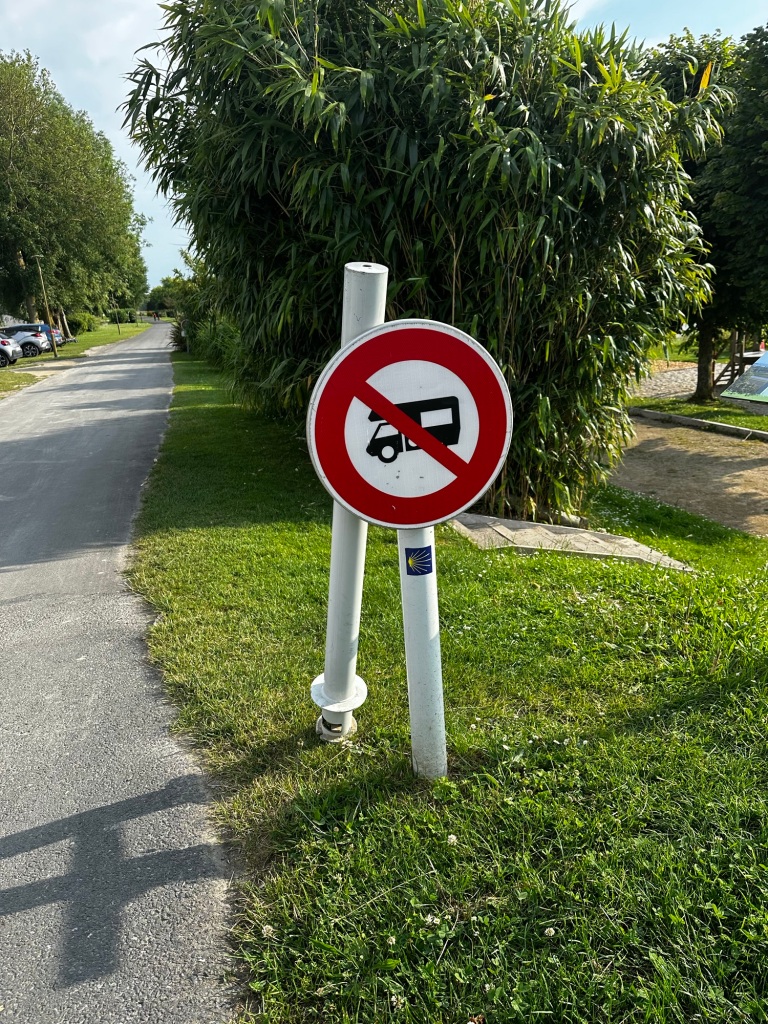
No van parking

I was all alone, no one to consult (by phone) no one who expected me to return (Denis knew I would stay as long as I needed). So I sat down took out my journal and talked to myself about the lovely day I was having. As I wrote, people passed doing their thing. The busses passed going to the Mont, coming from the Mont. I ate my roll and drank my coffee.

Blue skies overhead

At some point I realised I could go back to the Mont again. Today. I could go there without a good reason. I could just go there for the pure joy of seeing something beautiful on an island out in the bay topped with a gold statue of Saint Michel (who by the way might possibly have been a little passive aggressive – when the bishop was long dead, someone discovered the skull of the bishop had a hole in it at the very spot the angel had placed his thumb…)

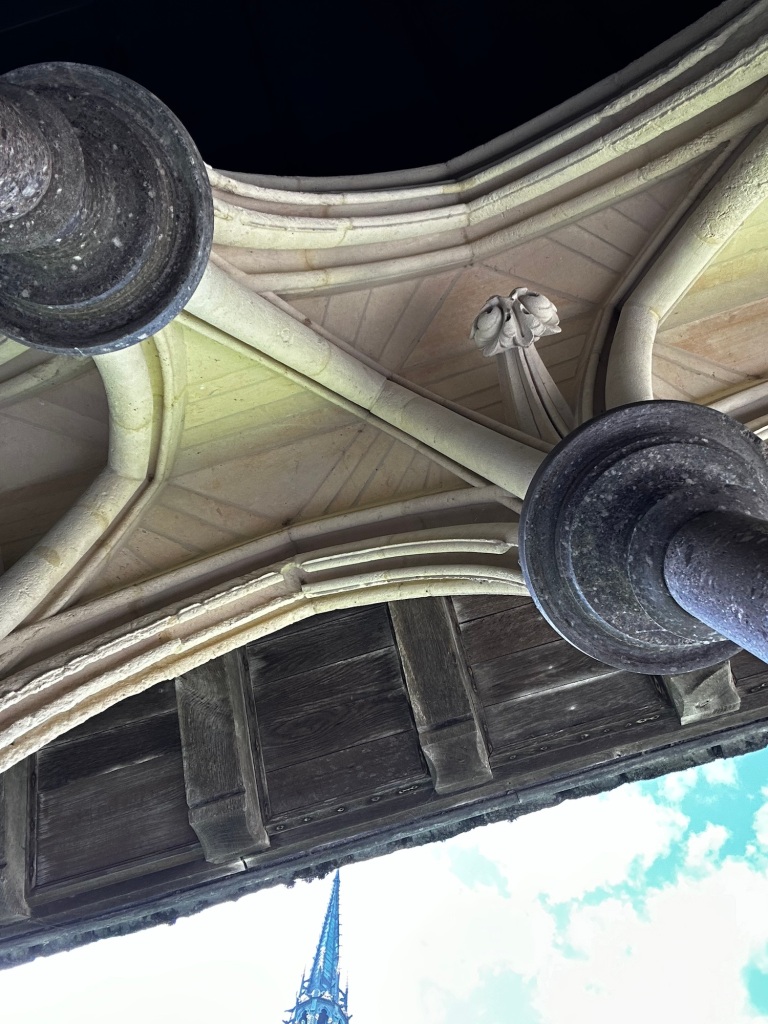
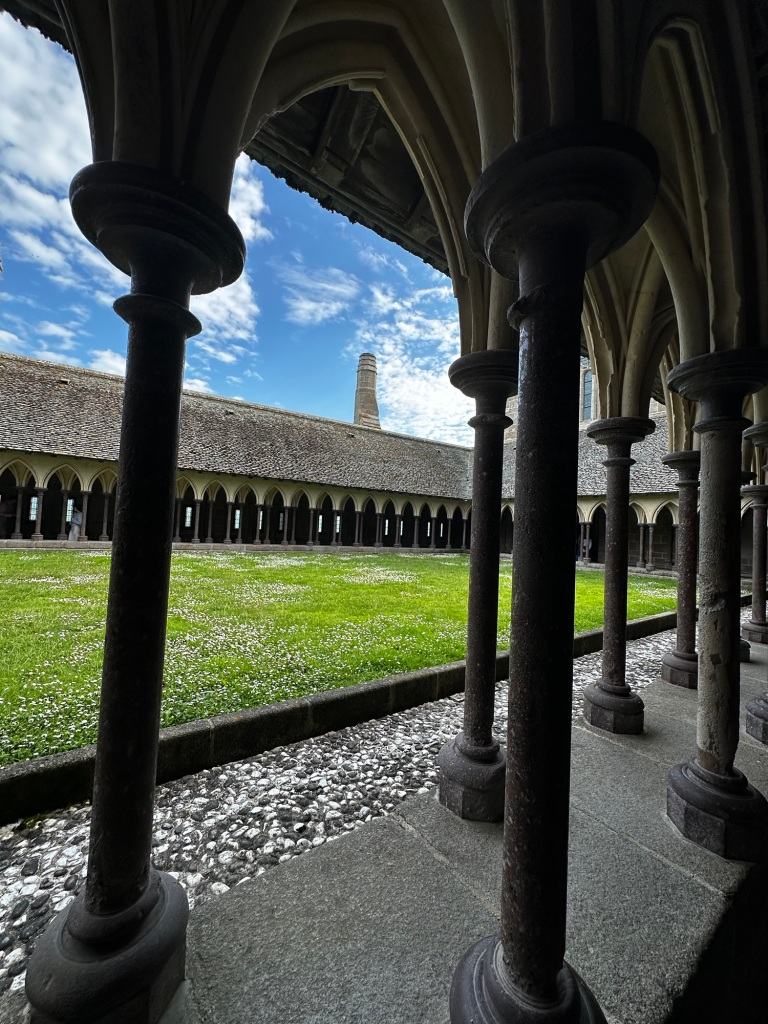
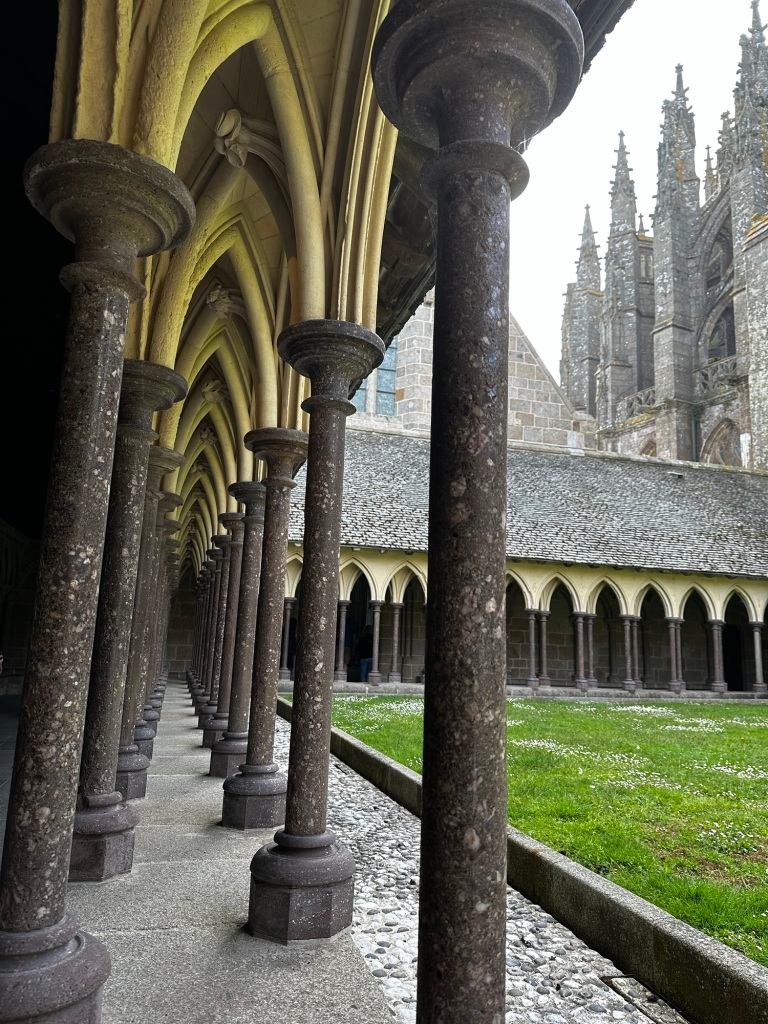
Looking up to the ceiling over the columns in the cloister you can see the spire of the Abbey

I got the bus again. I stood looking at the Mont for as long as I would have to take pictures but standing looking is different. Standing taking pictures means you have a big picture impression of what you’re taking a picture of and you don’t have to pay any detailed attention because the picture of the thing you’re standing in front of will be saved forever on your phone. Without a phone I pay more attention.

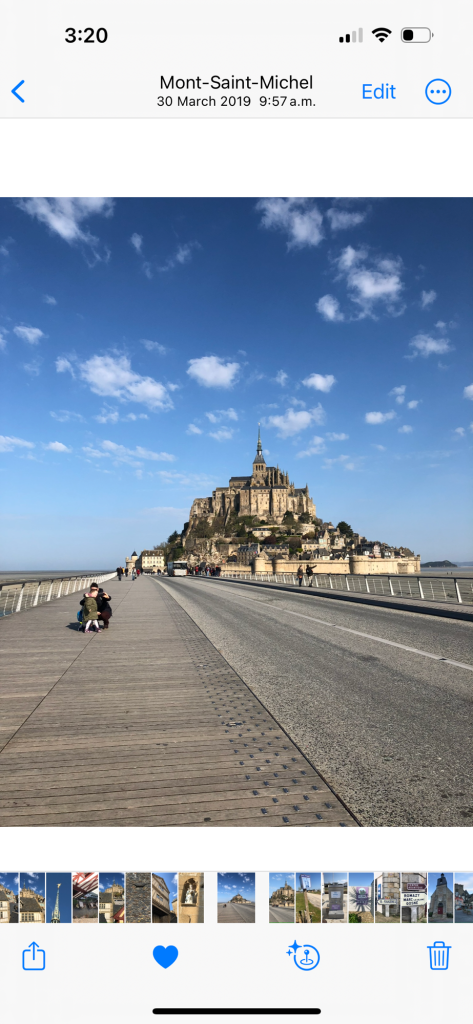
Photo from 2019, can you see the town houses tucked in over on the right of the island?

And with the very recent experience of the tour what I was looking at made more sense. I could see the church on top. I could see the town huddled to one side. I could see the opening to the big wheel where goods were winched up. I could see the buttresses supporting everything and I could see the ramparts going around the wall.

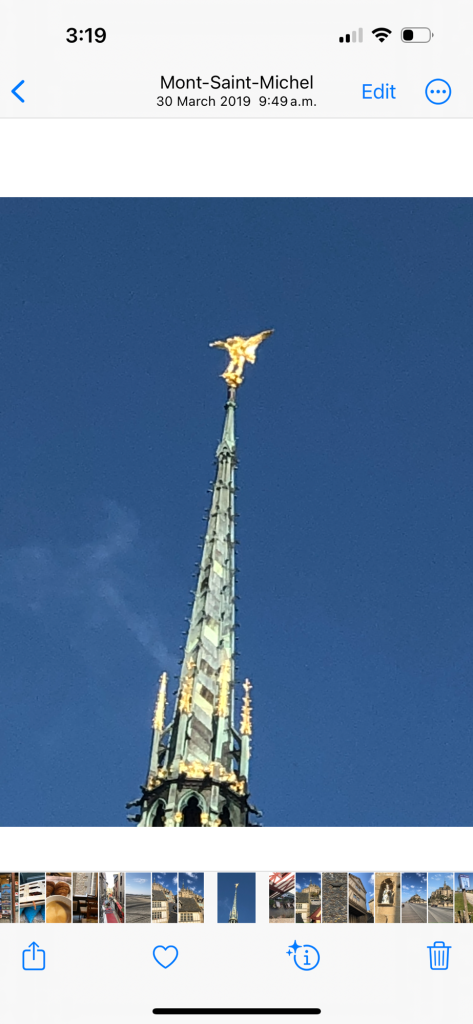
Gold plated statue of Sant Michel on top of the spire of the Abbey

That’s where I went next. And there were less people on the ramparts , in no time I was back at the entrance to the Abbey where I could buy another ticket and do another tour… I didn’t. I looked out to the bay and imagined all the pilgrims who walking the dangerous route across this bay. The fog, the quicksand and the tides rising at 1000m a second (possibly the guide said different numbers but her tone and her eyes suggested the tide rose shockingly fast!)

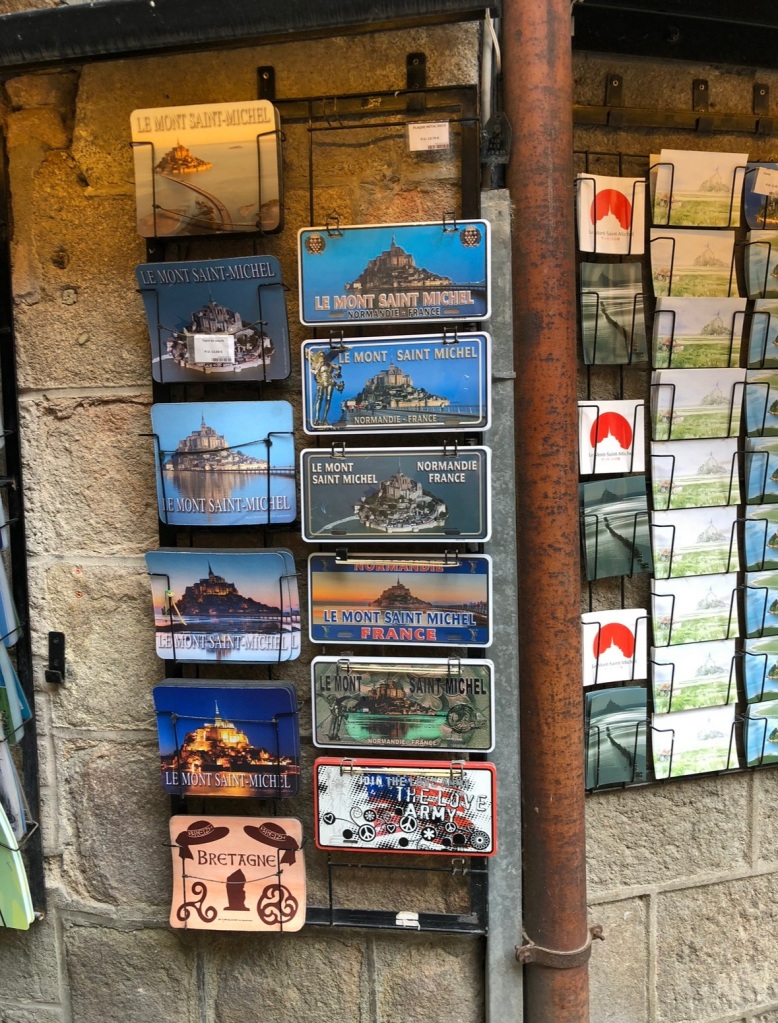
Postcards

When I came down from the ramparts I went to the post office and (with cash instead of phone) I bought stamps and postcards (which I couldn’t post in the very handy postbox on the mont because the addresses were on my dead phone, oh well). And after that I took the bus again and walked home.

Best day ever.

Le Mont Saint Michel – Part 2

On the path to Le Mont Saint Michel

Yes, something very scary… My phone was almost out of battery (5%)

View from the top towards the path

I couldn’t believed it. Why had I not taken the time last night to charge it? How had I forgotten to bring the extra charger? What an idiot? Hmm…I use my phone for taking pictures, for looking up information, for finding my way, for paying for food, museums, stamps! For light when it’s dark. I was in a dark room under the abbey when I realised my phone would soon die. I sent a text to Denis to tell him and that was it, the screen went black. No more phone.

View of the bay from the entrance to the ticket area

Should I go back to the van and charge it? Or do the tour? I walked on trying to decide what to do next and found myself in the gift shop. In my walking around taking pictures I had gone through the whole route. I hadn’t meant to do that, now how do I get back to the tour? My ticket was only for a one time entry. I suppose this was a sign I should go back. I would be there in time for check out and forget about this nonsense of visiting the Mont again.

Last picture before my phone died…

Yes it was a sign alright. But instead of going through the gift shop I took the opposite door back into the ticket hall. There was a big group of schools children queuing for headphones. I found my way through them and back to the entrance of the abbey.

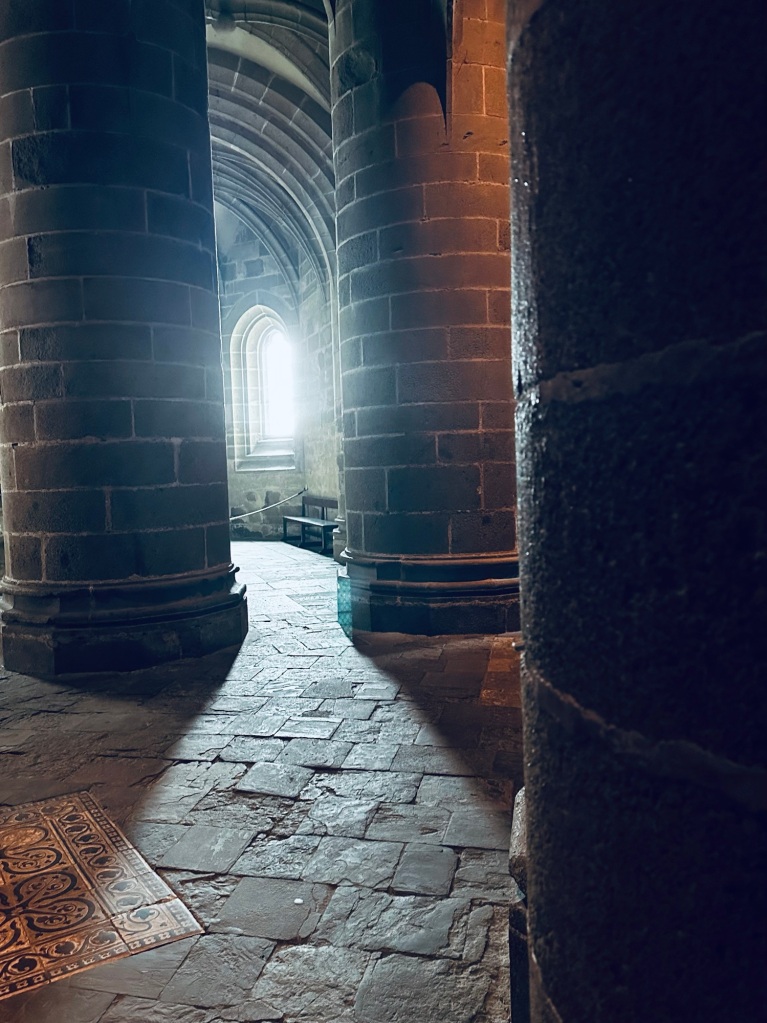
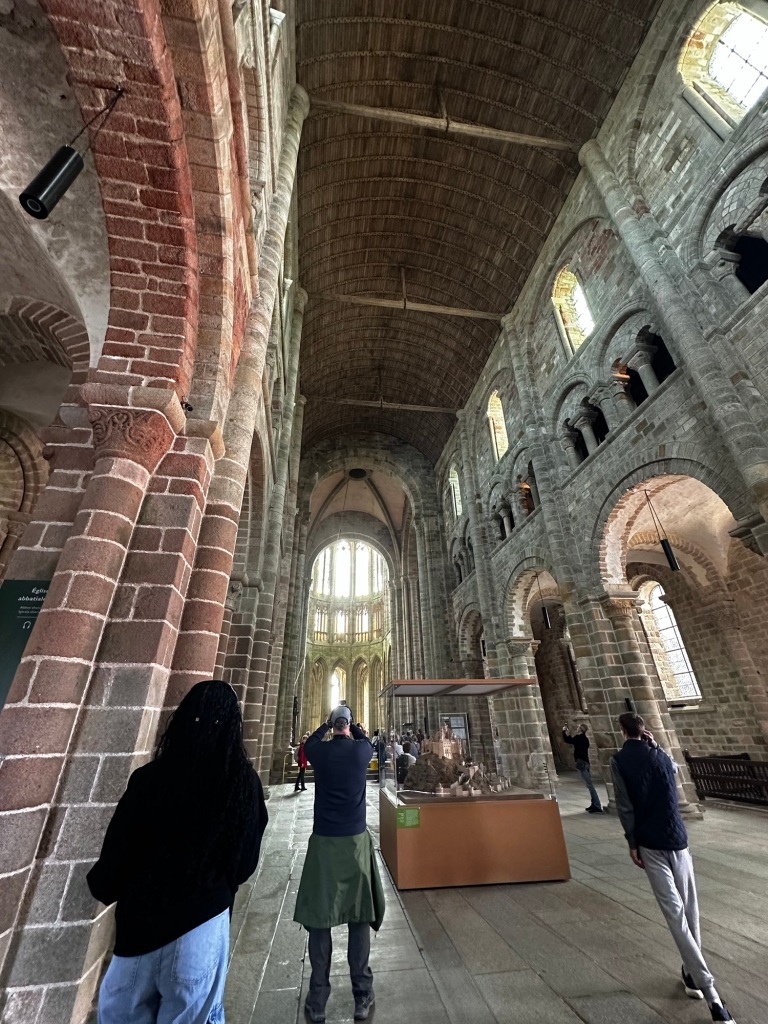
Inside the abbey church

There was a queue at the ticket validation point where a young woman was scanning tickets. She’d already scanned my ticket the first time. What would I do if her scanner beeped when she scanned it again?

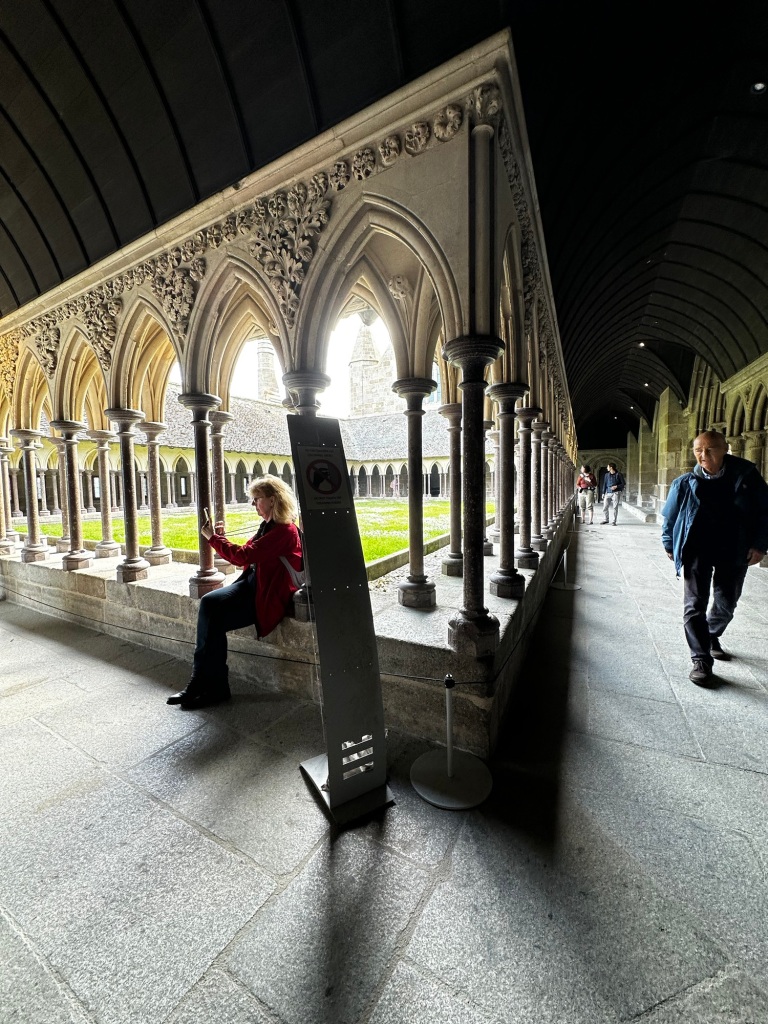
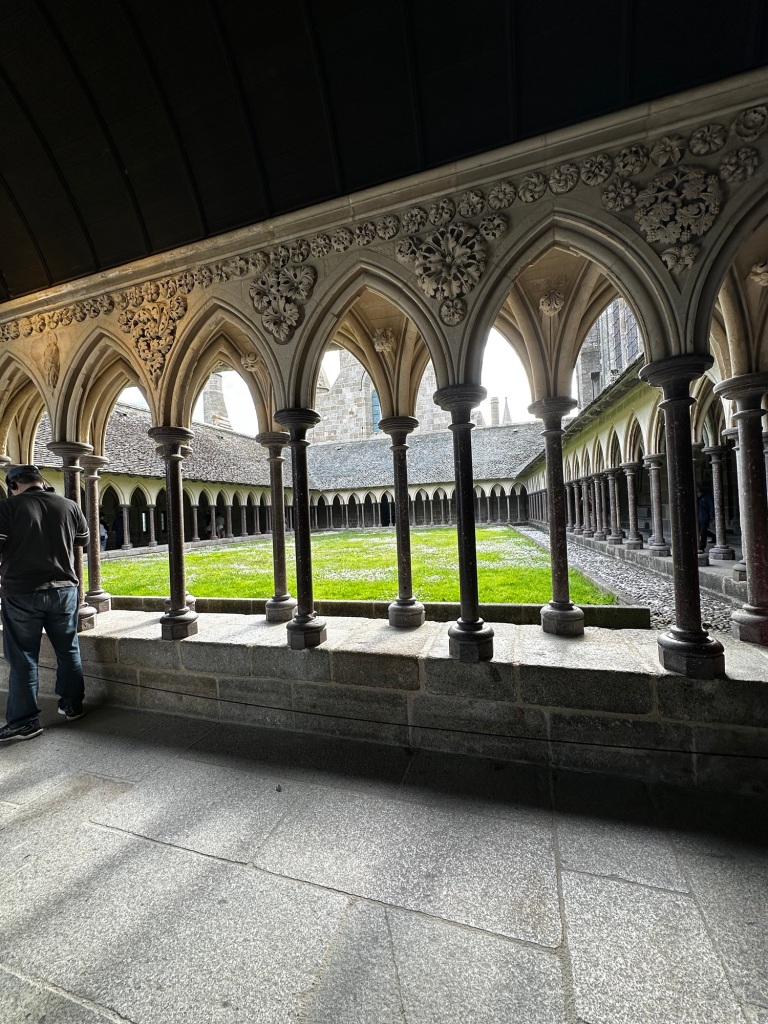
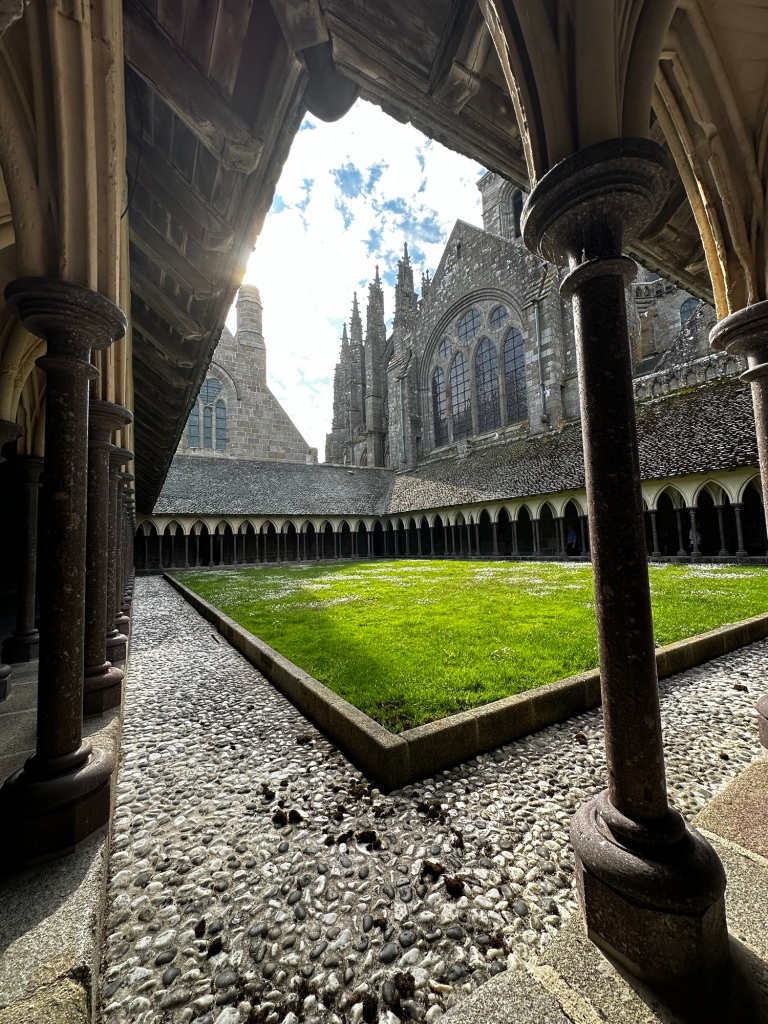
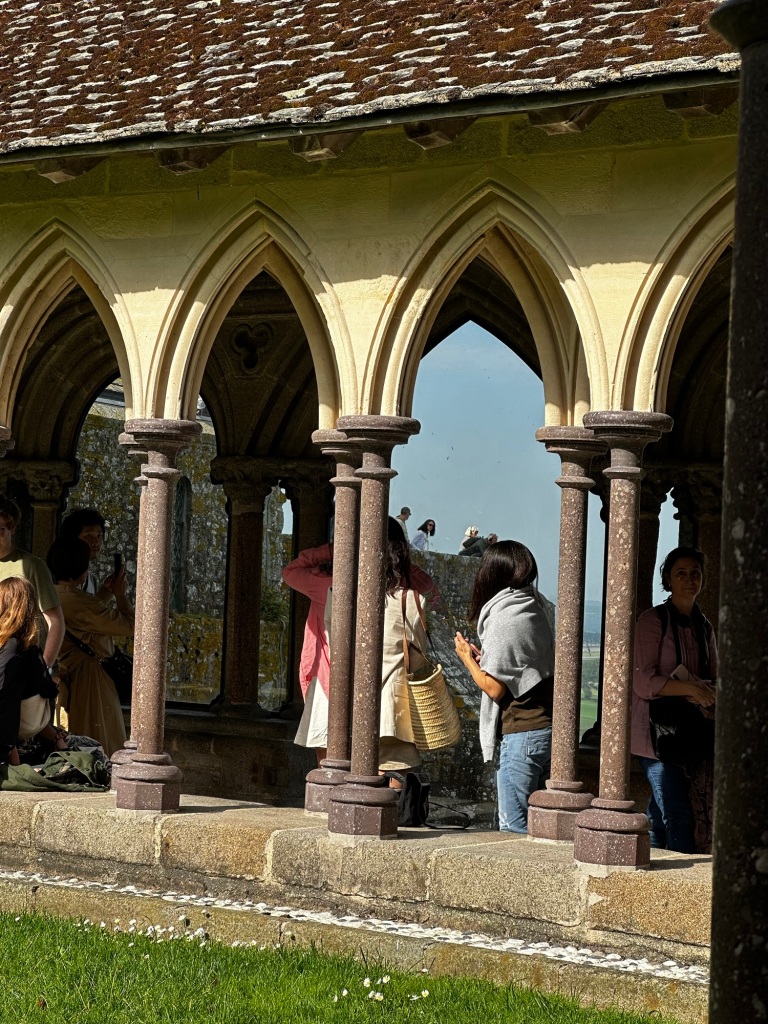
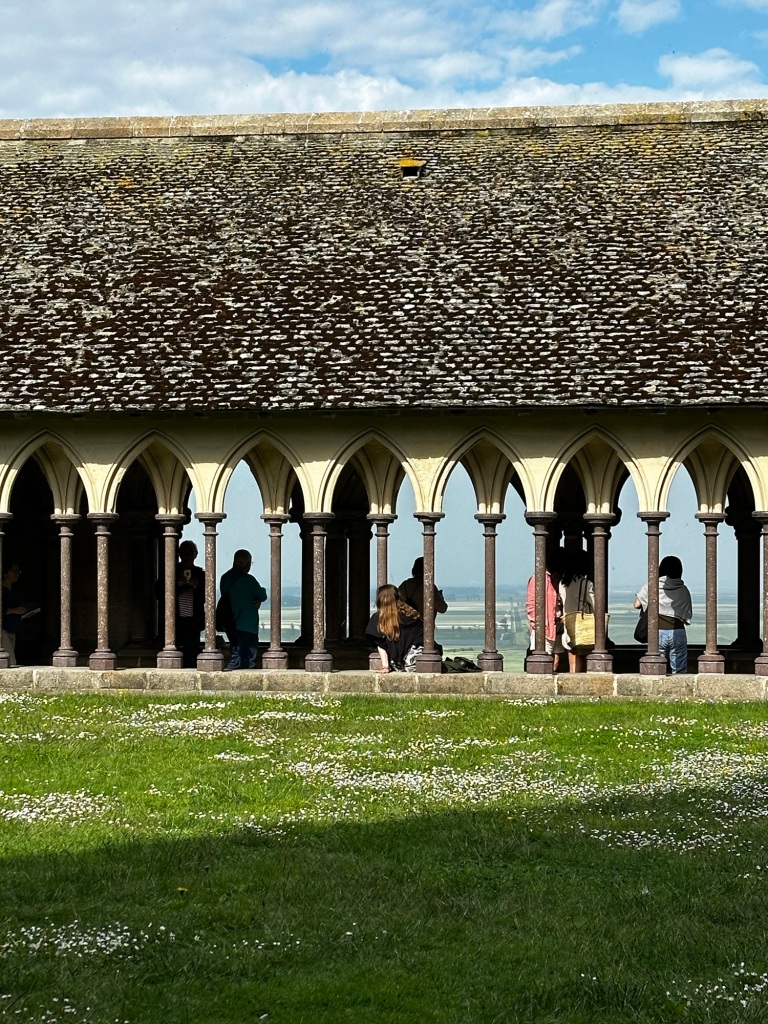
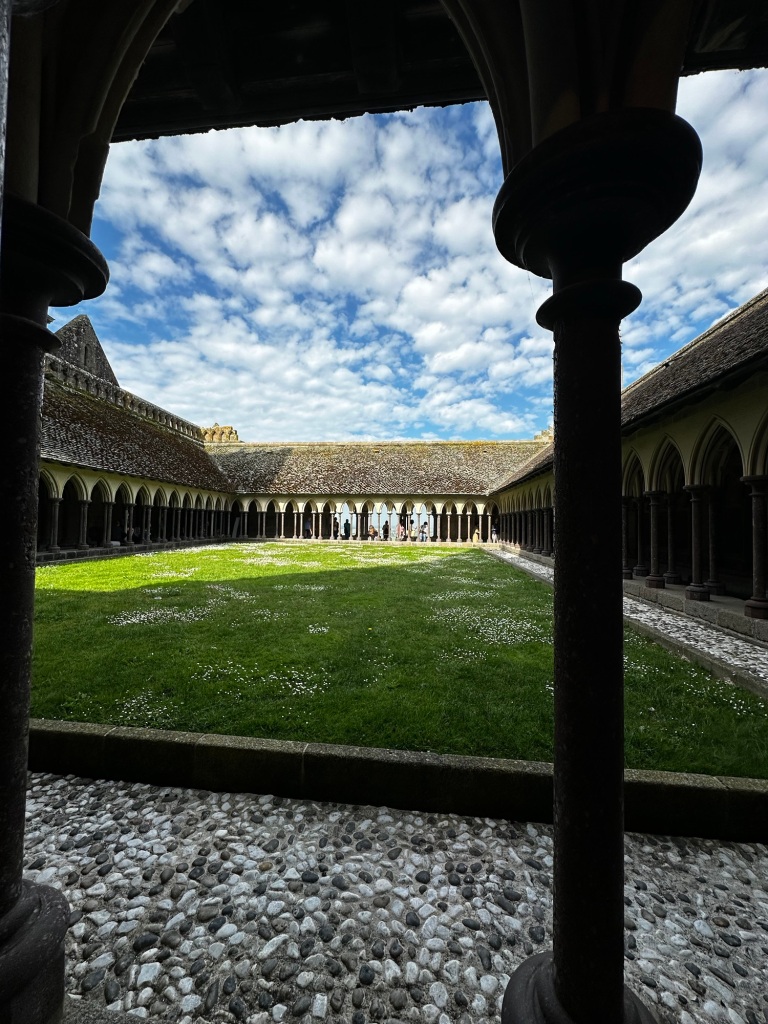
The cloister at Le Mont Saint Michel

It didn’t beep. I was back climbing the stone steps up to the abbey church. And everything had changed. I had just been here but now I was here without a phone… No photos. No checking historic facts. No looking up the weather. No taking notes to share with you later. Just being here, taking only what I can remember.

View of a corner of the cloister

I hadn’t found the meeting point for the 10.15am English guided tour – and I had no phone to find it now… Yet, here I was walking towards a woman who had welcomed us as we puffed up the fourth set of steps on the outside.

Another view of the cloister

She was now the English speaking guide. I was in the right place at the right time. Another sign, maybe? And the tour began. I listened. I took no photos… I took no notes… When she said it was a Benedictine Abbey I made up a story in my head about Benny the Monk to remember and distinguish between the other monk orders it might have been.

A view through the pillars towards the abbey church

So here’s what I remembered… A bishop had a dream that Saint Michel came and told him to build an abbey for pilgrims on the Mont Tomb (I think that’s the original name of the island. It was already a pilgrimage route where you came to pray for your dead). The bishop (who’s name I can remember…) ignored the first dream and also the second dream but by the third dream Saint Michel got a little aggressive. When placing his thumb on the bishop’s forehead, he left a dent. After that the bishop began the work of fundraising and engaging builders.

People queuing to take pictures

What I hadn’t understood (and I’m still not sure about) is what is required to build an abbey that won’t fall down. Where its chapels and dormitories and refectories for monks and pilgrims are piled on top of each other and have to fit on a small island, while leaving the town intact.

View through the cloister and out to the bay on the other side

The guide did a great job of describing where we stood in each room, what was above or below us, what needed to be built first to support the rest. Of course I can’t remember those details. I love maps (if they weren’t copyright protected I’d be including a real map with each of my posts) and as I was listening I was trying to imagine a map of this island – side on, not from above like road maps. If I could cut a slice off and look into where we stood and could see what was above and below.

You guessed… the cloister

The guide said lots more that I now forget but I had a great time just listening, not taking photos, not taking notes. My favourite “room” of the abbey was near the top – the cloister. A square of grass (by the way far above the ground where grass normally grows…) open to the sky and surrounded on each side by half pillar corrridors where the monks walked, prayed and meditated.

The double row of columns is unusual for a cloister

(Most of my pictures were of the cloisters and because my phone died and there’s no other photos, you’re seeing them all.)

Le Mont Saint Michel – Part 1

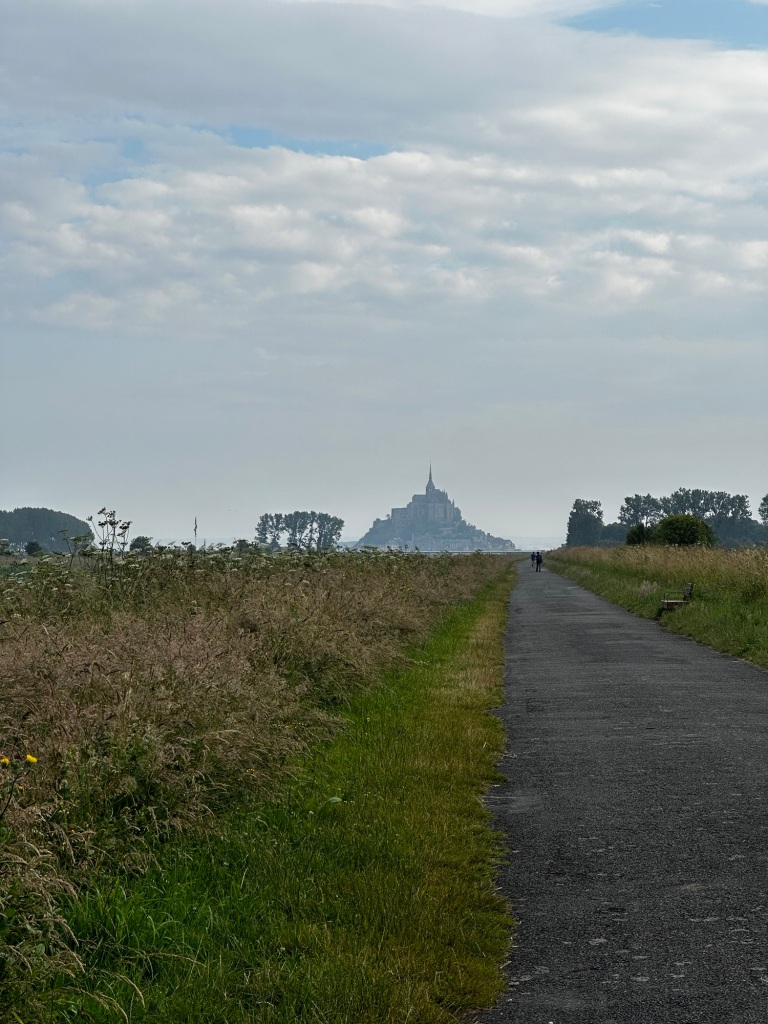
First view of the Mont – 30 minutes walk away

We had almost a week left on this journey when I started to consider if there was something I wanted to see or do in these last few days. A French To Do List, if you like. We were way over on the west side of Brittany at the time and the rain was falling, better weather expected.

Closer to the Mont – the river dividing Brittany and Normandy to the left

Even thought I’ve been many times I put Le Mont Saint Michel on top of the List. I’m not sure why it draws me in each time. I was very willing to be drawn in again. And that’s where we went on Wednesday morning last. It was another rainy day when we arrived, the sky fully grey with added purple clouds. Rainstorms forecast.

Free bus every 8 minutes early in the morning (frequency increases during the day) Do you notice the barrier behind? Only the busses, delivery trucks and official vehicles allowed… but you can walk.

There’s a really good camper stop 30 minutes walk to the Mont where we stayed. We had enough water, electricity and internet to spend the day. You pay for 24 hours in advance and we had until 12.20pm Thursday until we had to pay for 24 hours more or checkout. Maybe I wouldn’t get a chance to visit today but possibly in the morning?

View after exiting the bus

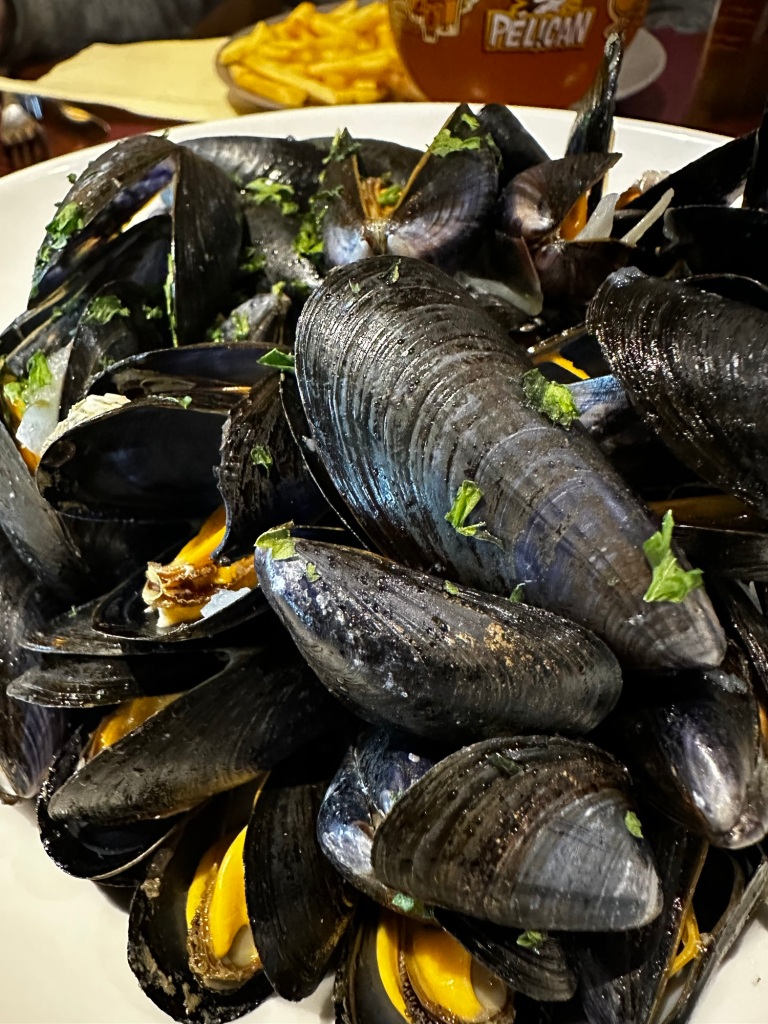
The rain eased towards evening and we donned rain coats and rain trousers and walked into the village of Beauvoir. One of the other things on my French List was Moules and frites (Mussels and chips) and that’s what I ordered.

Modules et frites

Checking the forecast again before bed I realised the following day was to be dry and sunny. I would head off early to the Mont and be back by checkout time. The Mont is not on Denis’ French List so he was happy to stay behind and work.

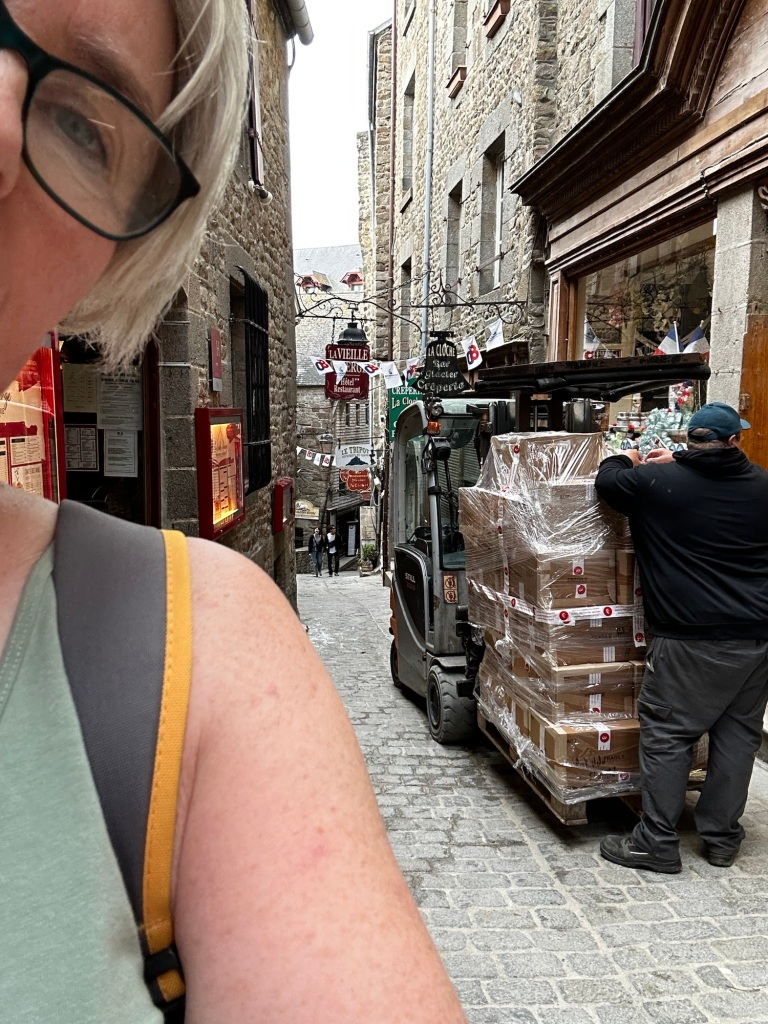
Deliveries inside the town require narrow vehicles

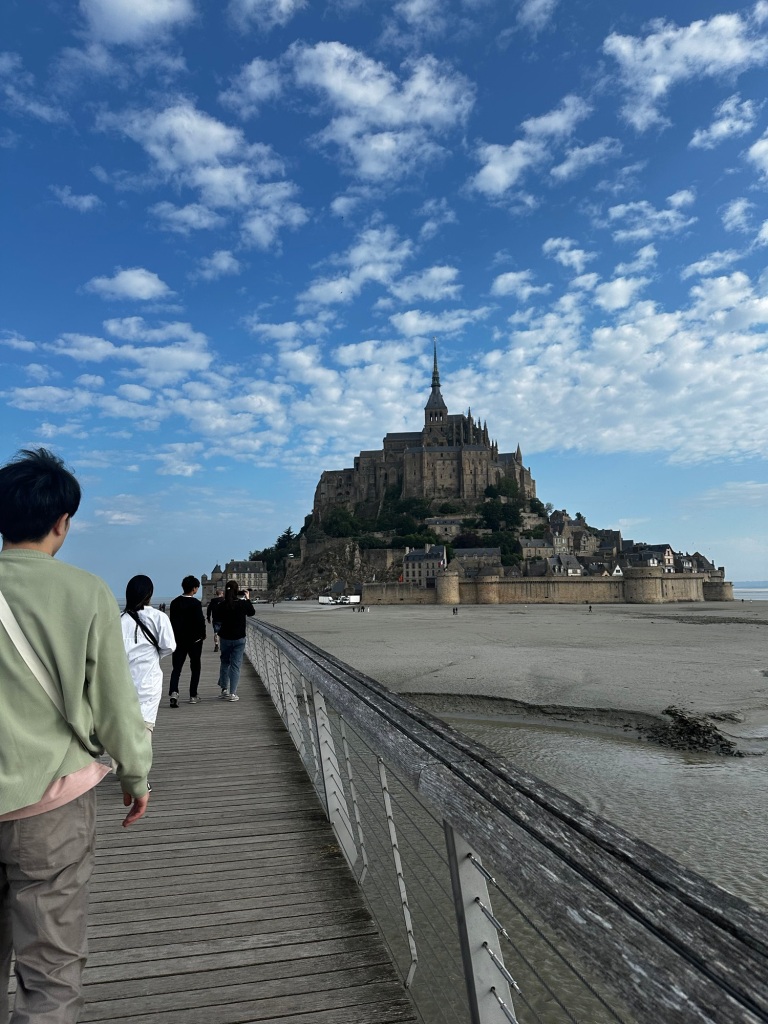
The Mont is an island and when we visited almost thirty years ago you could only get onto the island at low tide. Now, there’s a bridge and a bus to carry you along the bridge.

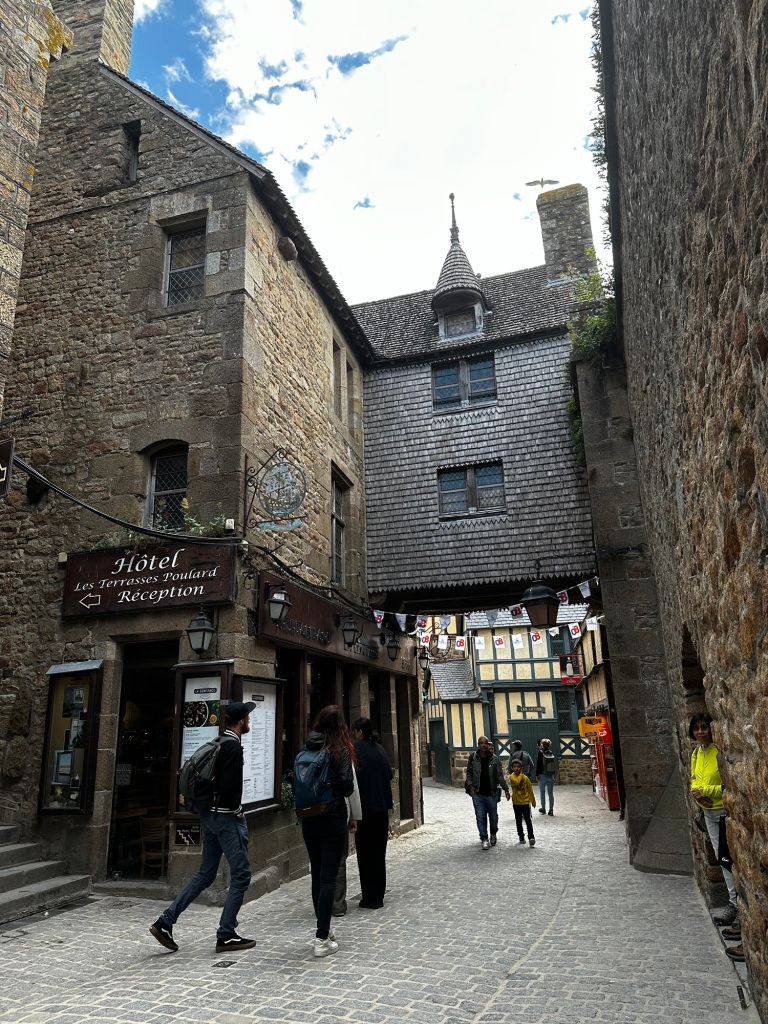
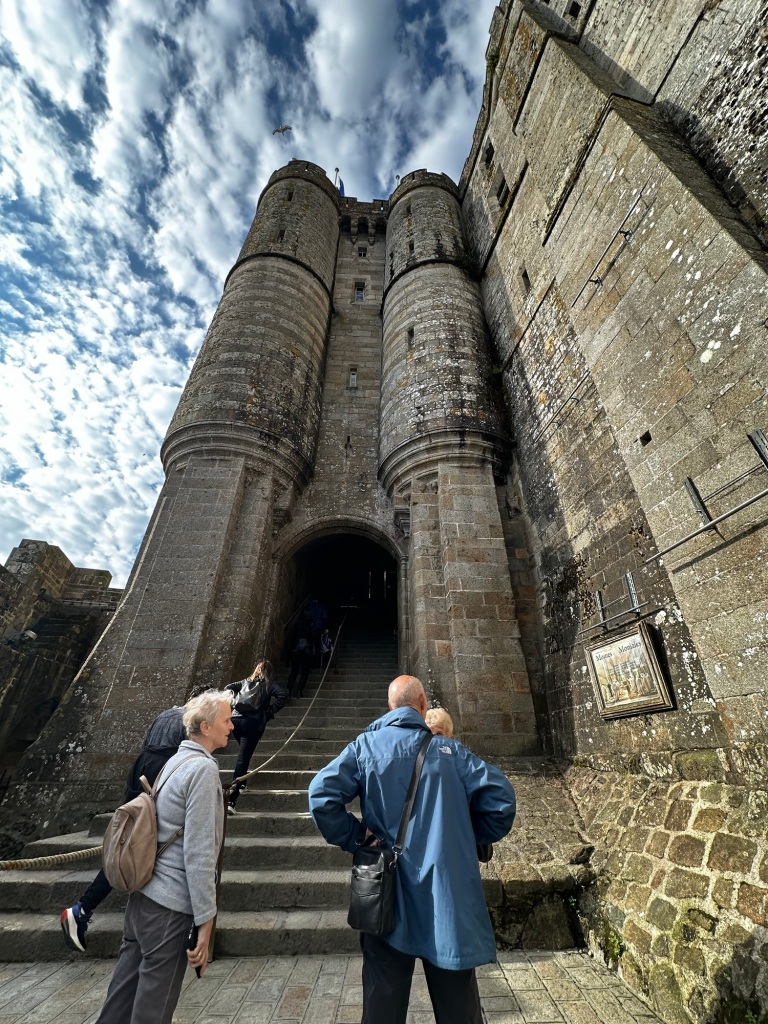
This way to the top

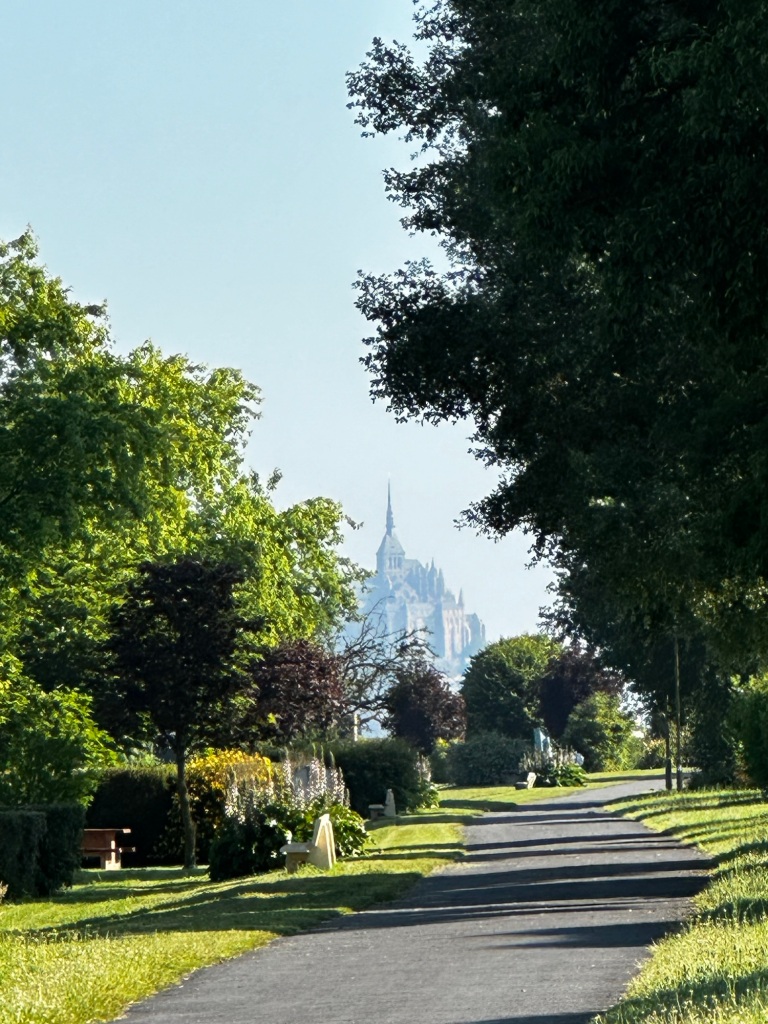
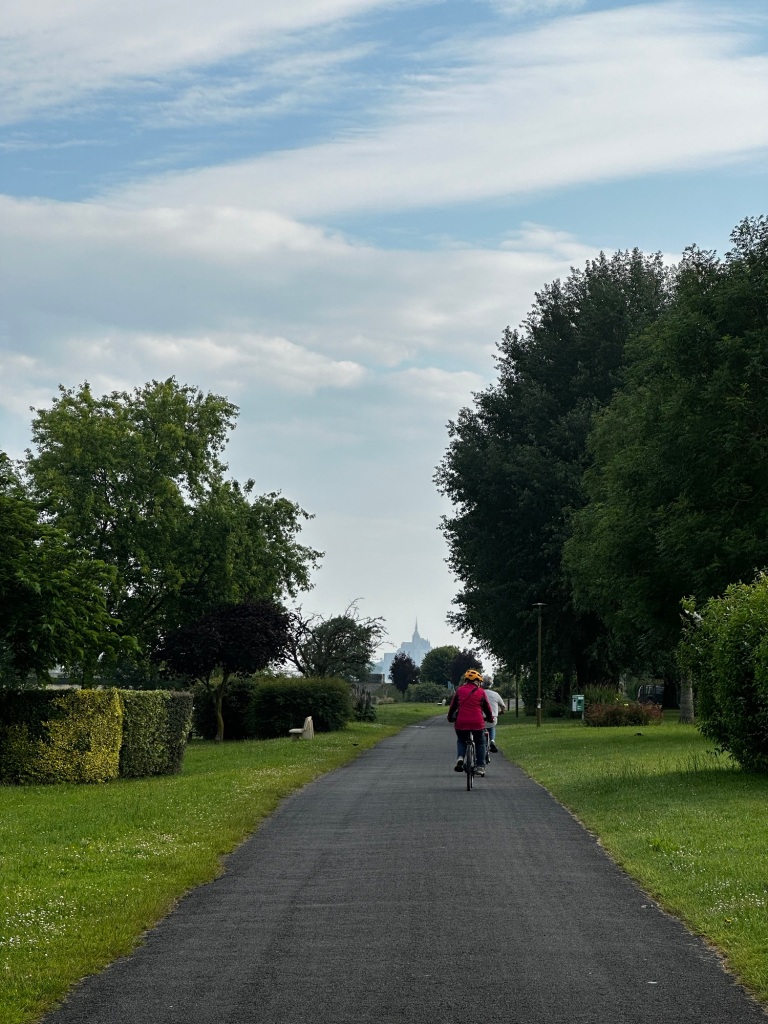
At 8.30am I set out walking on the cycle/walk path behind the camper stop. Almost immediately you get a view of the Mont in the distance and it’s hard to describe what seeing it feels like. For me it’s so pretty, a neat triangle with an angel on top. Like a cake, maybe. Or a pyramid. I don’t think if I will ever grow tired of visiting it.

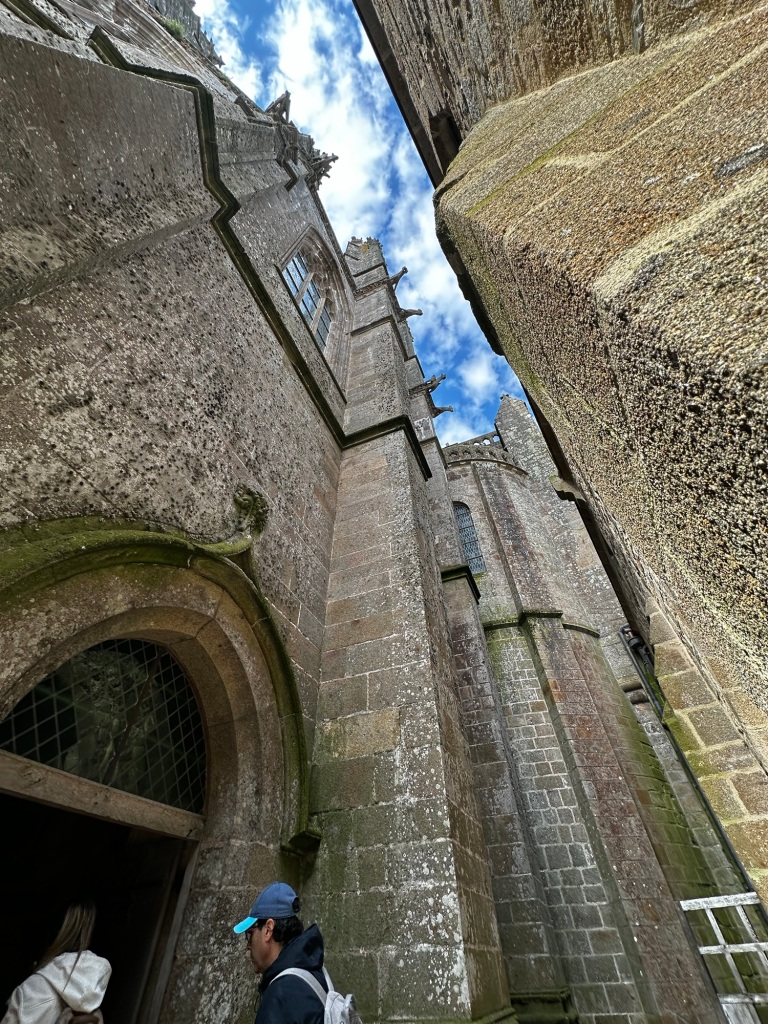
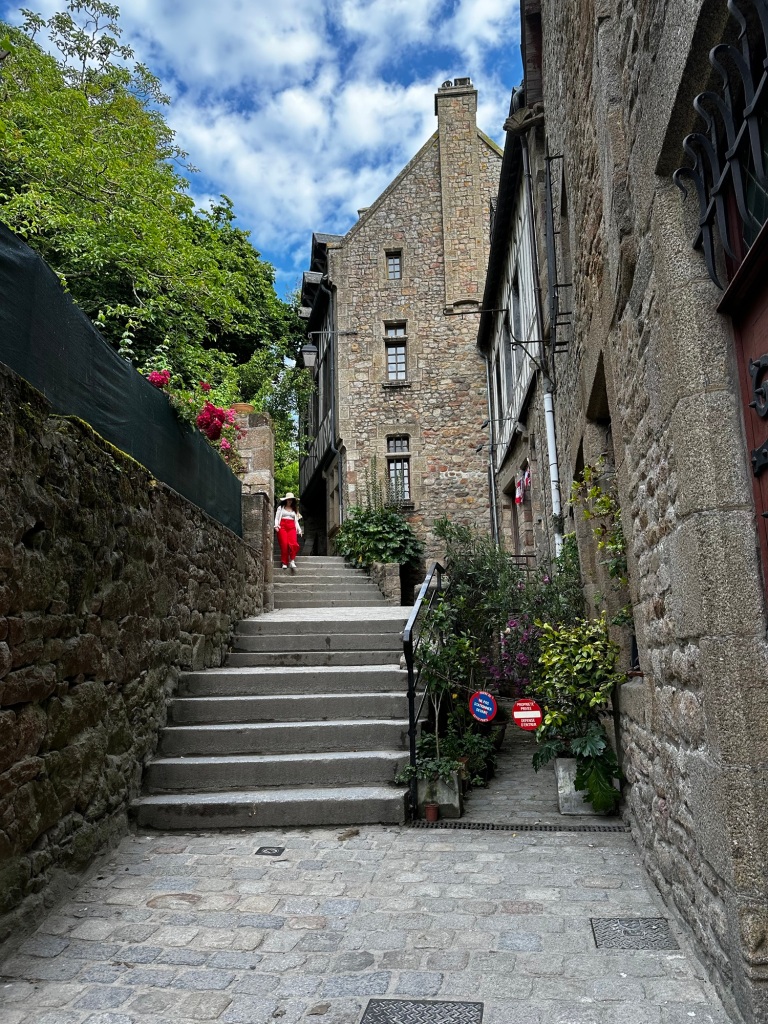
First set of steps before entrance to Abbey

For some reason in order to give myself permission to visit the Mont again I had told myself I would take a tour of the Abbey on top. I had never done that so that was a valid reason to waste time going to an island I’d been to many times before. Even as I write this it occurs to me the strangeness of that thinking. Anyway there I was off to do a tour, to learn something new to not waste my time.

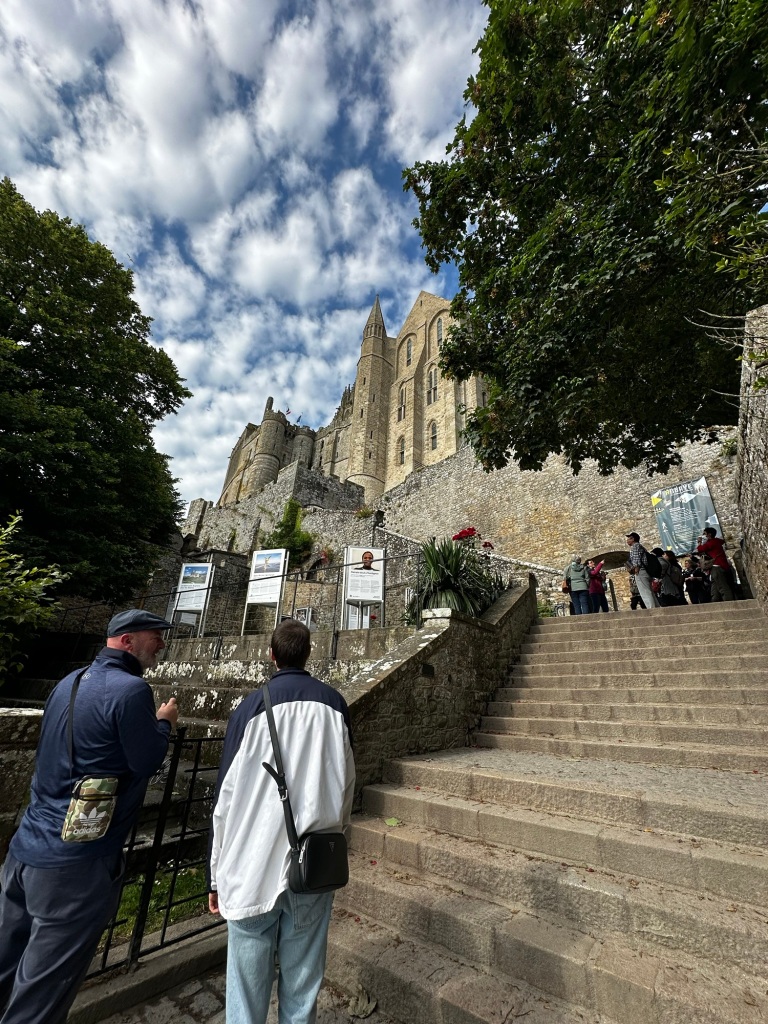
Second set of steps before entrance

The bus, when I arrived, was full of other people and most seemed to be visiting for the first time as there were gasps and smiles as we got closer. I got out and took some photos from the bridge. There’s a post office just inside the gates, good place to buy and stamps and post cards! It would open at 10am, I’d sort that out on the way back.

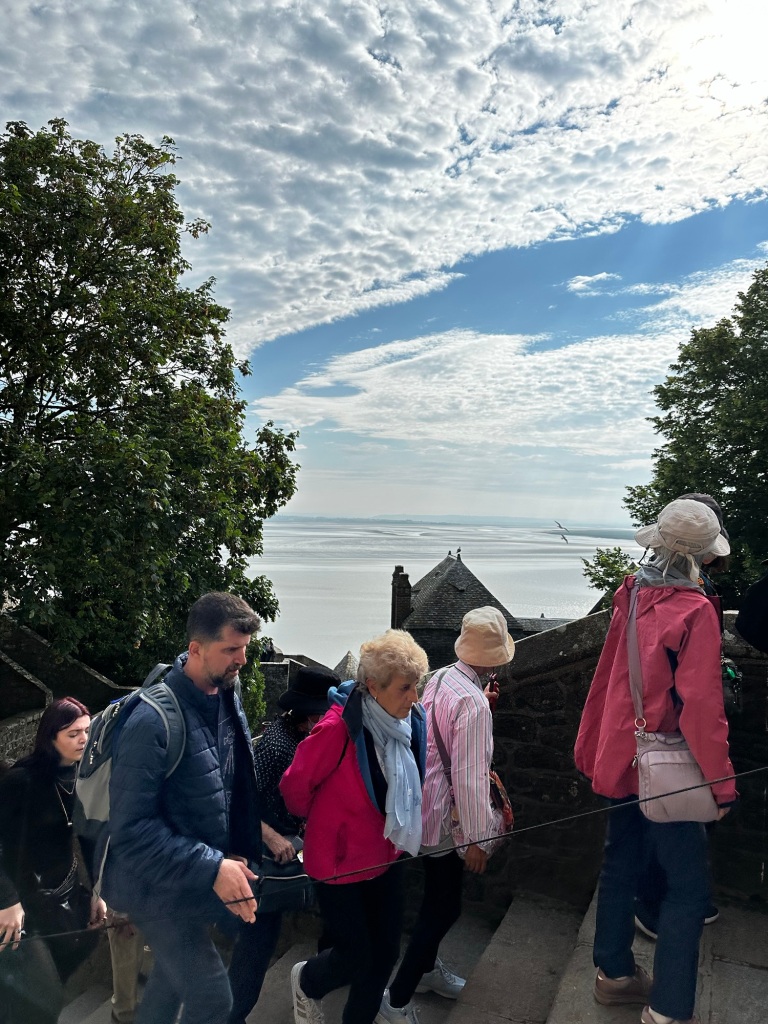
View from the third set of steps before the entrance

The buildings on top of the Mont are a Benedictine Abbey and to reach them you have to walk through the increasingly steep street of shops and restaurants until you arrive at the first set of steps. I wish I had counted the steps, hundreds of steps to the door at the top is not an exaggeration.

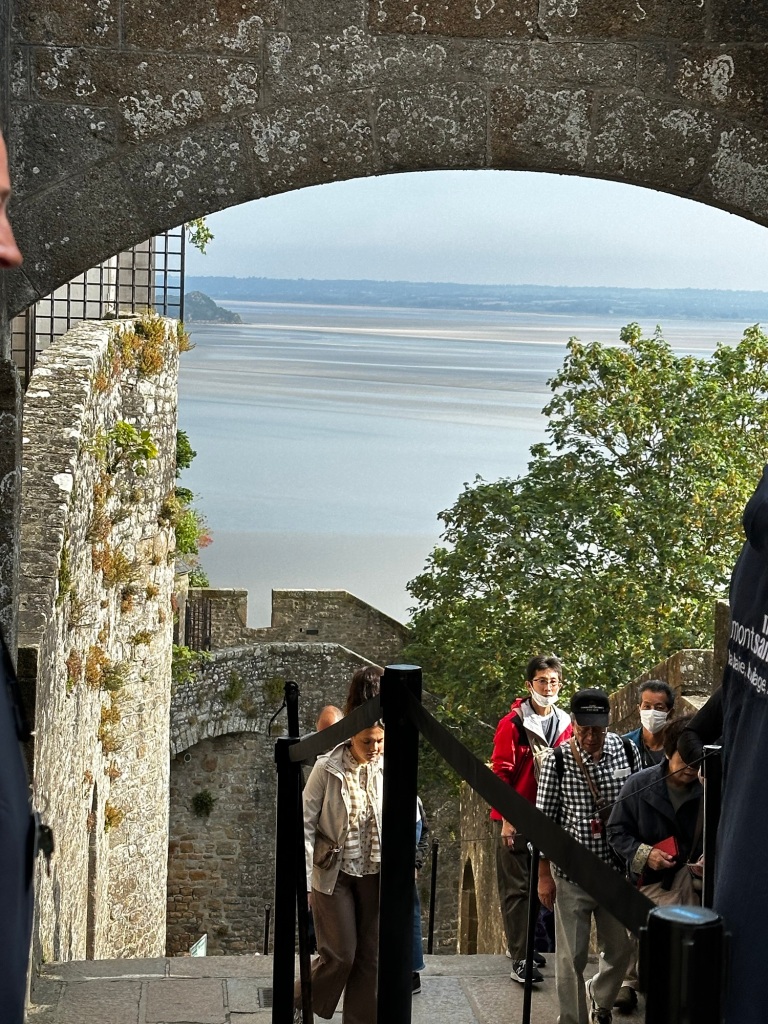
Fourth set of steps leading to the entrance…

I had purchase a ticket and a tour which would start at 10.15am, in thirty minutes. Meaning I had time to wander through the site. I took photos and read plaques and generally had a lovely time. And then I noticed something very scary…

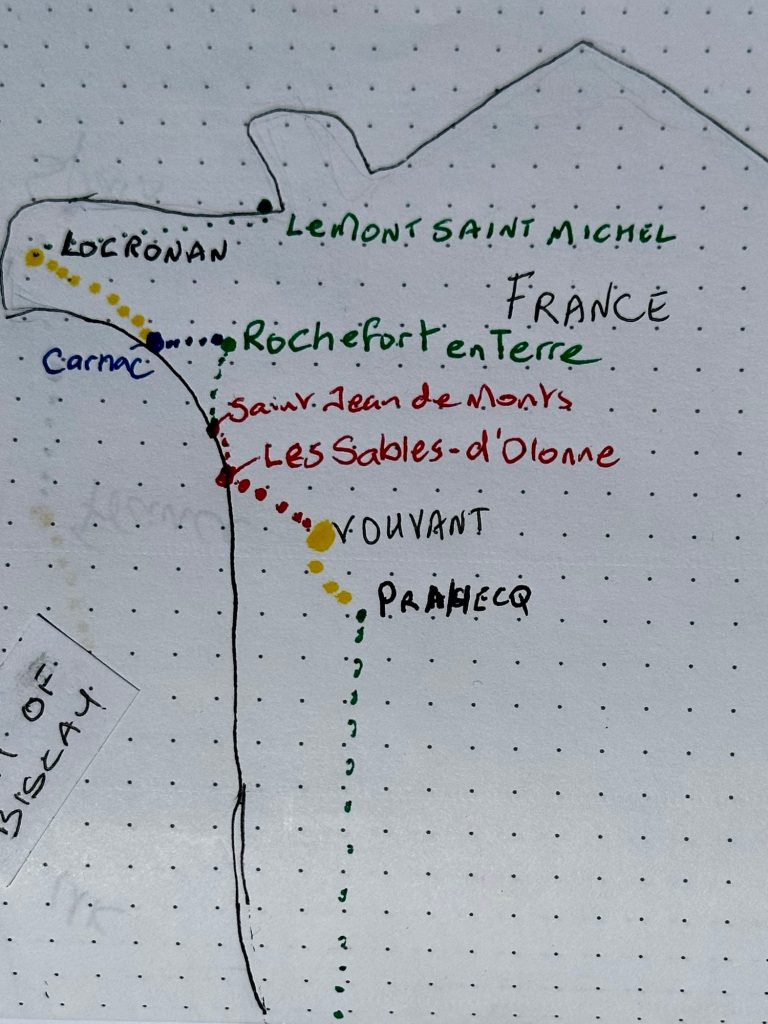
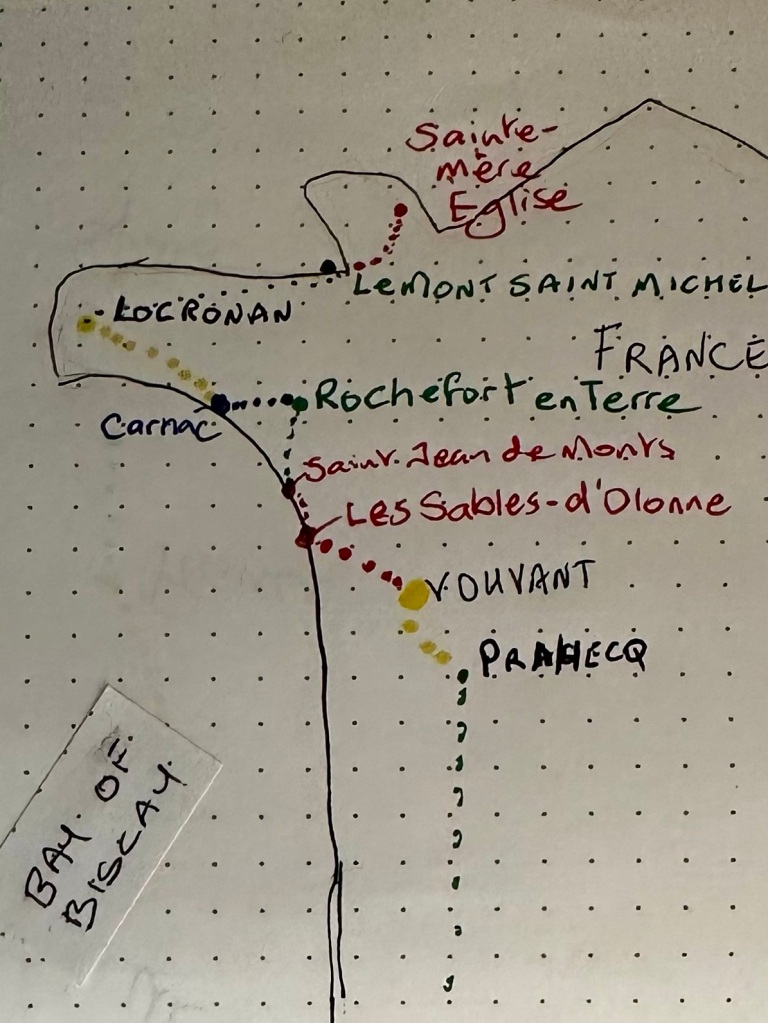
Green dots to Le Mont Saint Michel

Saint Ronan’s Town

Locronan church

On Sunday we visited another beaux village, Locronan. We had been here about 30 years ago with Denis’ Mum and our two small (at the time) children. And it hasn’t changed in all those years. It probably hasn’t changed in 1000 years but I can only vouch for the last thirty.

Stone houses containing shops, restaurants and artists

It’s a town full of stone buildings. As in Carnac, stone is a plentiful here as salt and so they used what they had. And stone lasts. Just a little smattering of green or white lichen to colour things up but otherwise unchanged since they were built. It was Sunday so lots of visitors and more camper vans than cars. It was an overcast day but we had no rain as we walked around taking picture after picture.

Little laneway leading to nature

I hadn’t remembered or maybe I never knew but the saint the church and town is named after is Saint Ronan, an Irish saint and hermit who lived in Brittany. The village’s name Locronan means place of Ronan. Ronan was a well educated Irishman who became a bishop and was known for ho good works. But at that time being a bishop was a career path (maybe it still is?) and he got fed up with it and wanted to go back to basics.

Spotted high up over the door of the painter’s house

So he went into voluntary exile and travelled to France and set up a hermitage (secluded residence or private retreat from google) in the woods which would later become Locronan. He lived a prayerful quiet life but people were drawn to him. There was some drama, some miracles and some cures both before and after he died. But eventually, the former bishop and hermit Ronan was proclaimed a saint.

Taking a break outside the draper’s shop

It was only fair really, St. Patrick came to Ireland from Brittany (although it might have been Wales) and Saint Ronan came to Brittany from Ireland.

Stone floor in the church

Like exchange saints.

Yellow dots to Locronan

Carnac and the stones

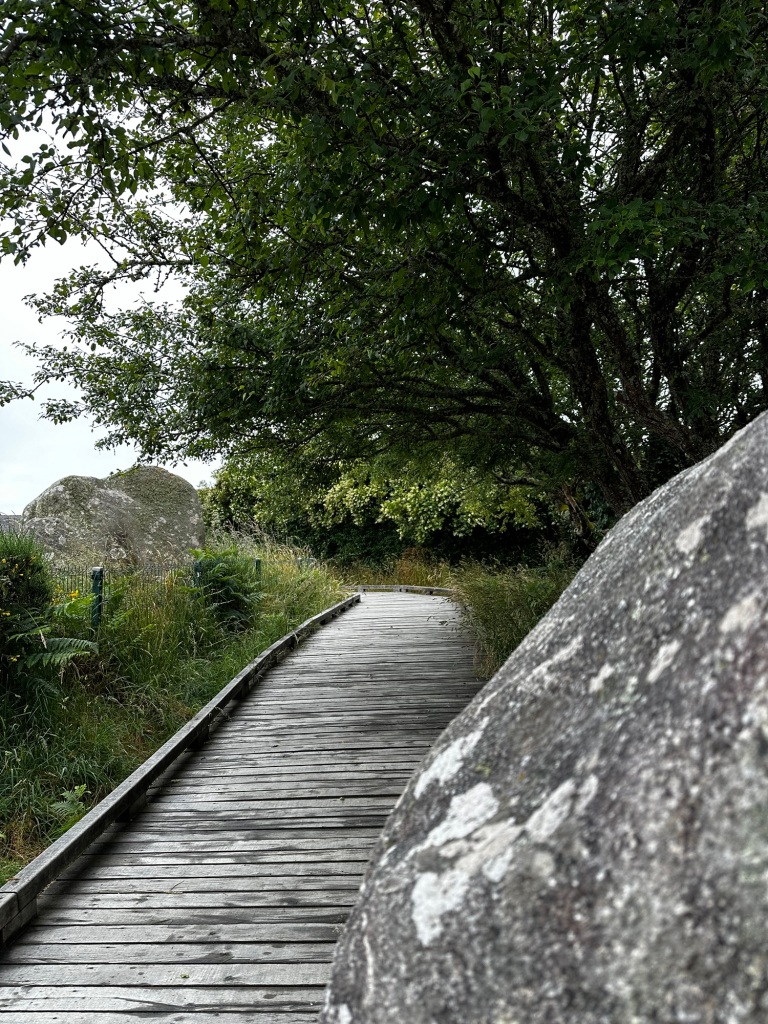
One of the stones seems to have escaped the fencing…

We’d been looking forward to visiting Carnac since we started this journey. The 3,000 big stones called Menhirs laid out in rows across a 4km long site outside the town is a mystery we thought they had solved and if they had we wanted to find out what it was all about.

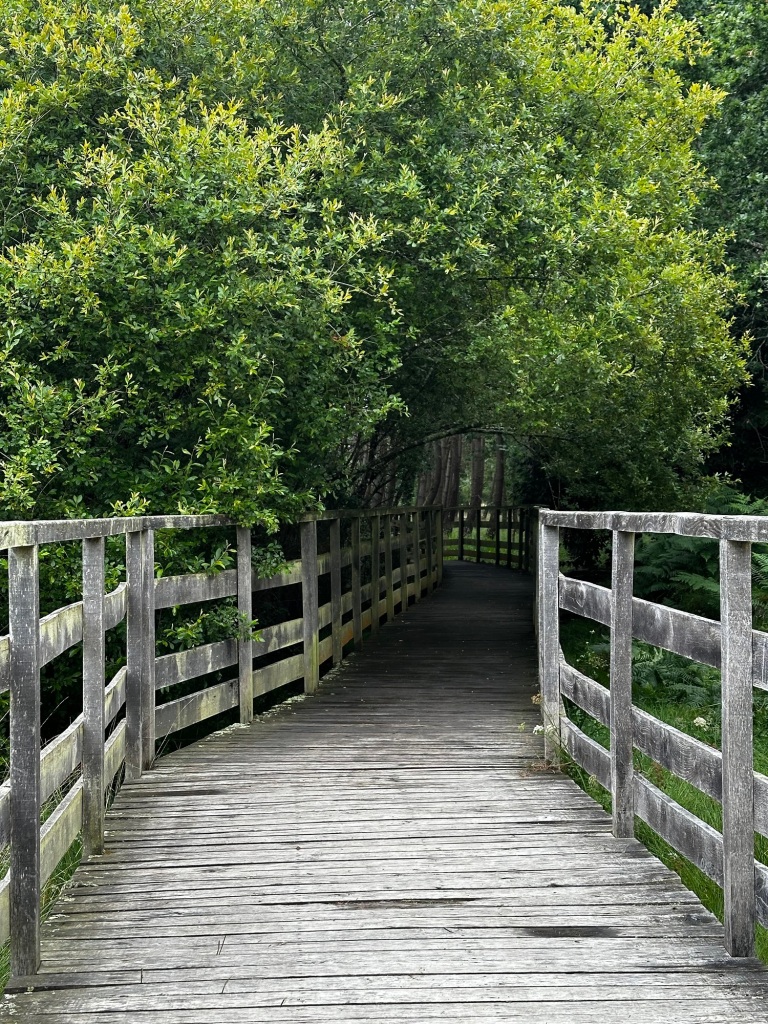
Shady path through the trees

There was a free car park where motorhomes were allowed to stay overnight near one of the sections of stones. We parked and took a walk along the path. This section comprised of about a quarter of the standing stones and was surrounded by fences. We saw an exhibition of photos from visitors to the stones, some as far back as the 1940’s, at the Maison des Mégalithes (interpretive centre). The pictures were from a time before the fences were in place and people were climbing on, picnicking at and hugging, the stones.

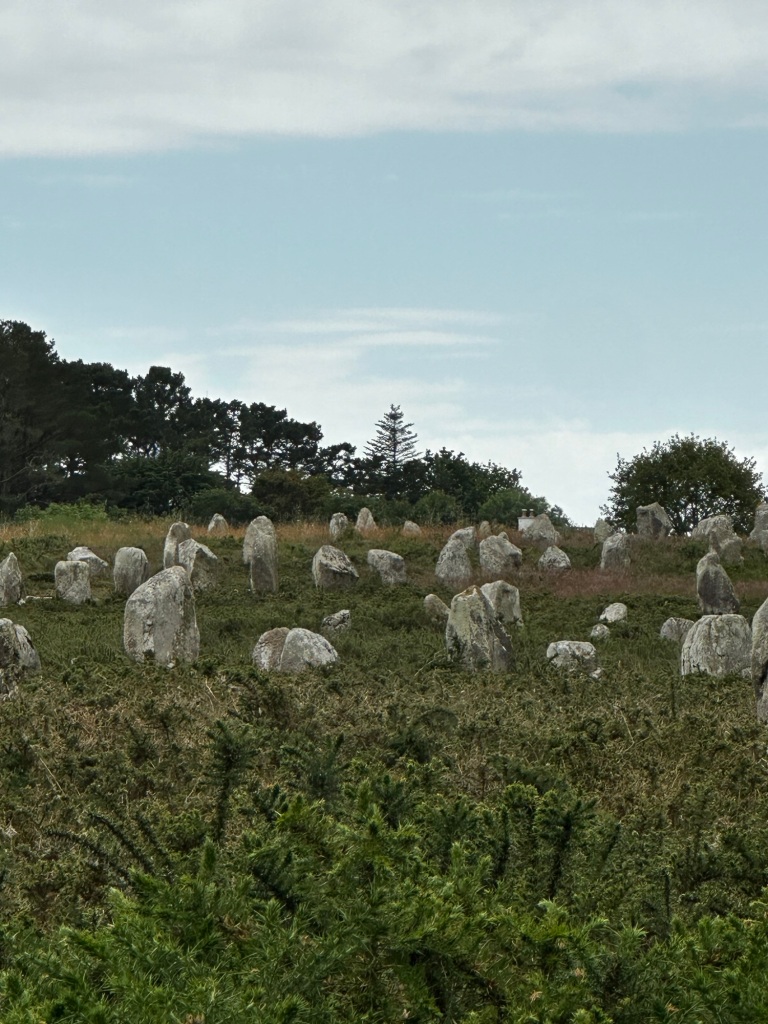
Field of stones. Not easy to see but they are lined up in rows

The stones were placed into position between 4,500 and 3,500 BC so at least 5,500 years ago… that’s for 250 generations they’ve been standing here. How did Neolithic man move the rocks and position them? They look very heavy. And why did they do it? No one is entirely sure why but the how is interesting. Our – if we were French – our grand, grand, grand, grand (246 times more) parents were just as creative and intelligent as we are. They had devised a system of rolling the stones along the ground on poles. Then positioning the stone into a hollow and with ropes tied around pulled the stone upright. And their best guess as to why… it might be a place for funeral ceremonies for important elders.

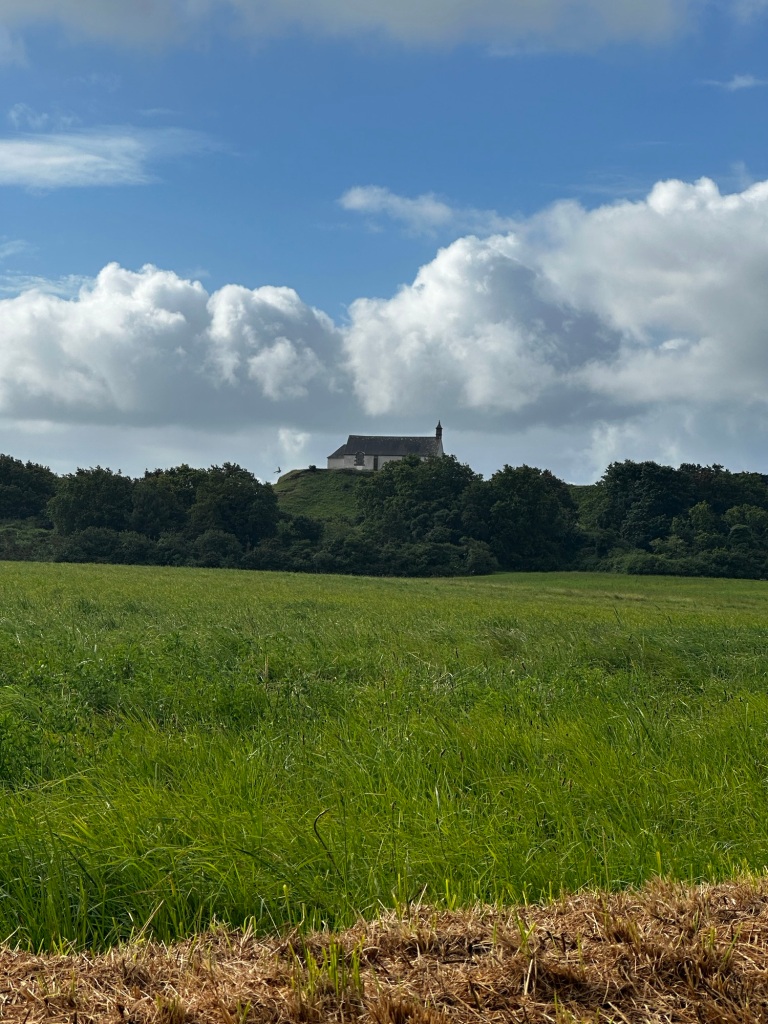
Neolithic burial mound near the town (the church was added much later)

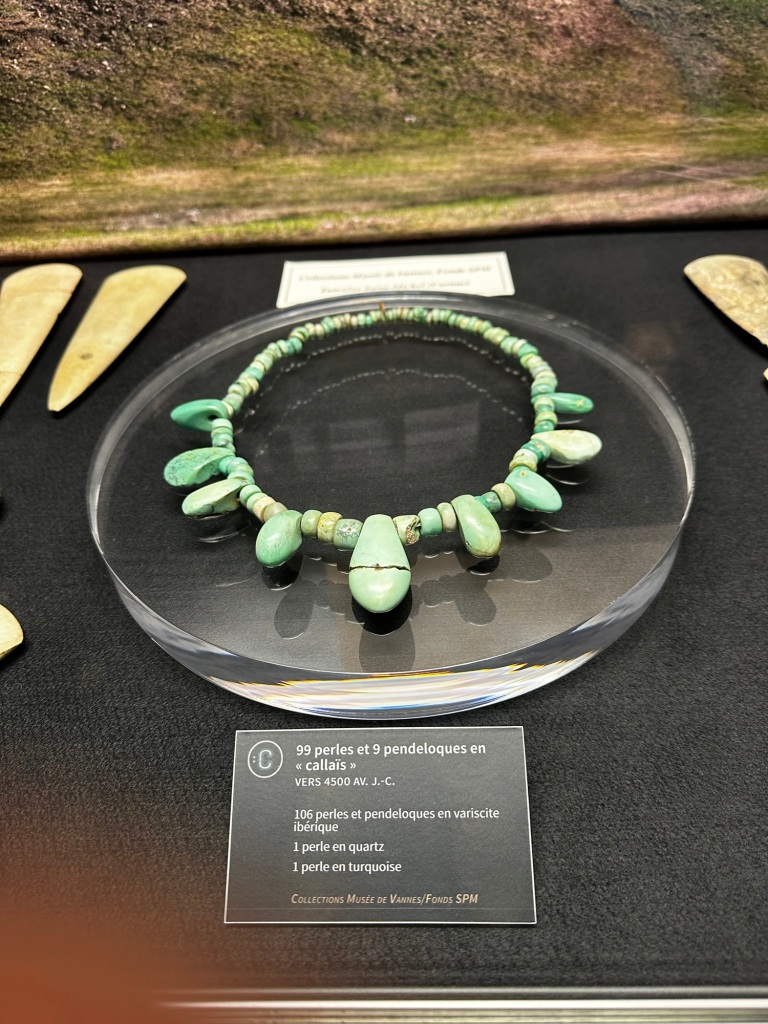
People have lived in this place for at least 5,500 years. The area was rich in something we take for granted – salt – and that meant the locals were rich too. The salt meant they could trade. And they did trade, including with people as far away as southern Spain (it took us weeks to get here from there so I can’t imagine how long it took back then). We also visited the Prehistoric Museum in Carnac and saw an interesting video about how they used the green stone called variscite, which came from Andalusia, to make jewellery. Variscite jewellery was found in the mound graves in this area from 5,000 years ago. Granada and Seville are in Andalusia, remembering how hot it was there I can understand why they might want salt from Carnac.

Variscite necklace at museum

Another interesting thing I learned at the museum was that global warming began about 10,000 years ago. There are standing stones in the sea near Carnac that can be seen at low tide – they were on dry land 5,500 years ago.

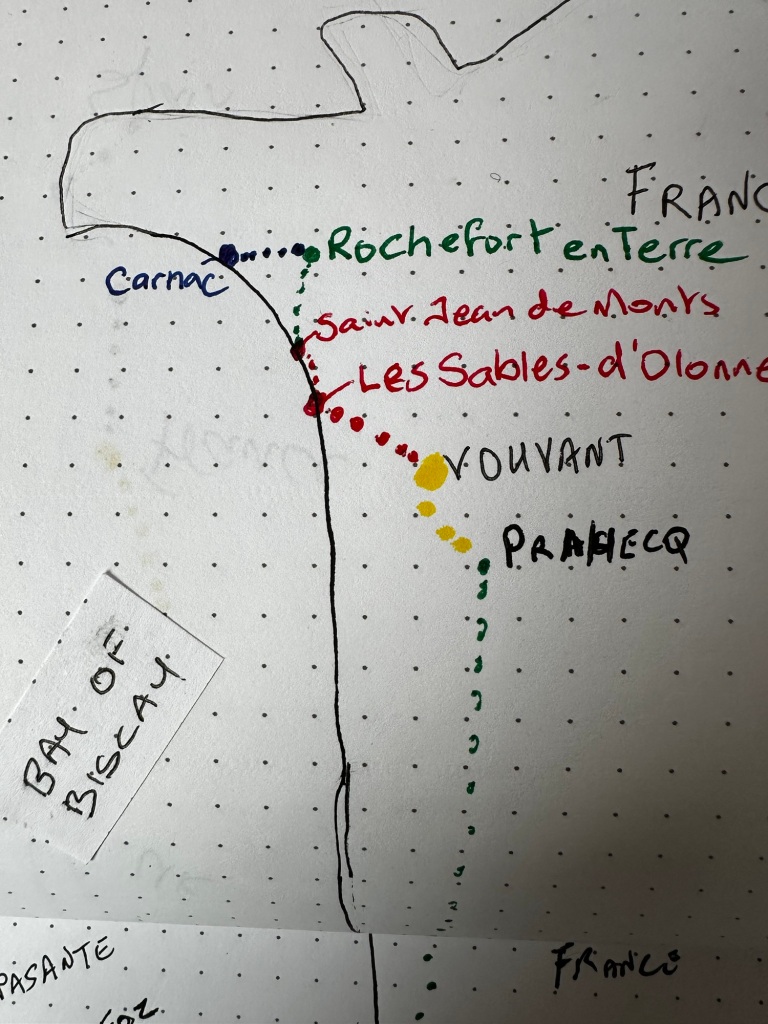
Blue dots to Carnac

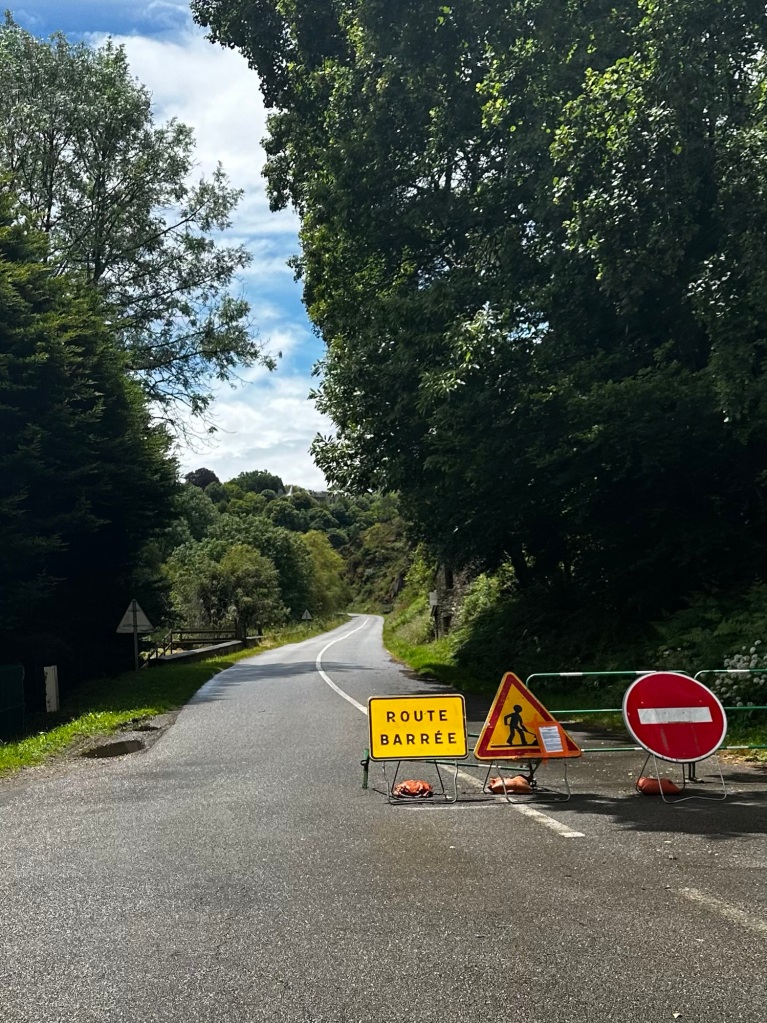
Route Barrée

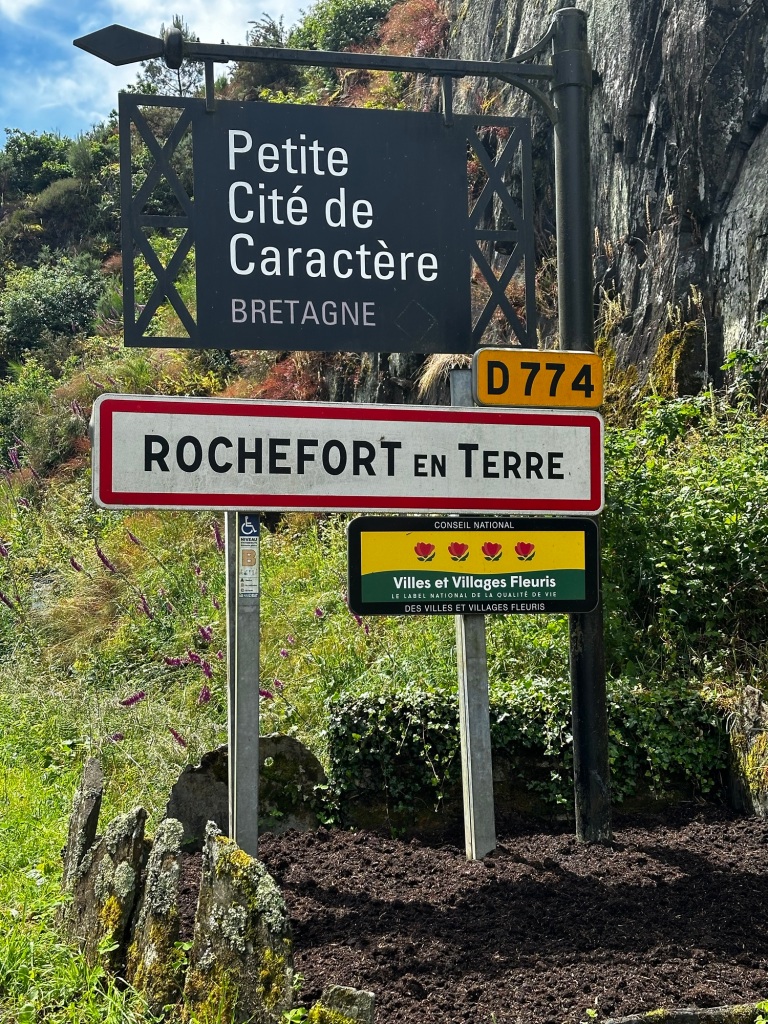
And then we were heading for another Beaux Village, Rochefort en Terre. Usually it’s fairly straightforward getting into these villages but not this one. We were due to arrive at lunchtime and as we were in Brittany now I was looking forward to my first galette – a savoury pancake from Brittany. But it was not to be.

Hmmm… what could this mean?

Following some less than perfect navigation we found ourselves at the place no motorhome wants to be… rising barriers. You know those barriers that lower to let certain vehicles pass into a street but rises up when others who don’t have permission come along? Well, here we were about to drive forward onto a rising barrier. Would it stay down or would it rise up as we passed? And if it rose up would it mess up the underside of the van? The grey water tank? Or something worse? We would need to turn back.

The rising barriers – can you just make two of them in the middle of the road?

Not an easy thing to do, as mentioned previously. Added to that we were on a hairpin bend and there was a car behind. Denis reversed a little and the car did too. Then he proceeded steeply up to the left along the hairpin bend. Only then did we see the sign prohibiting motorhomes… we kept going anyway.

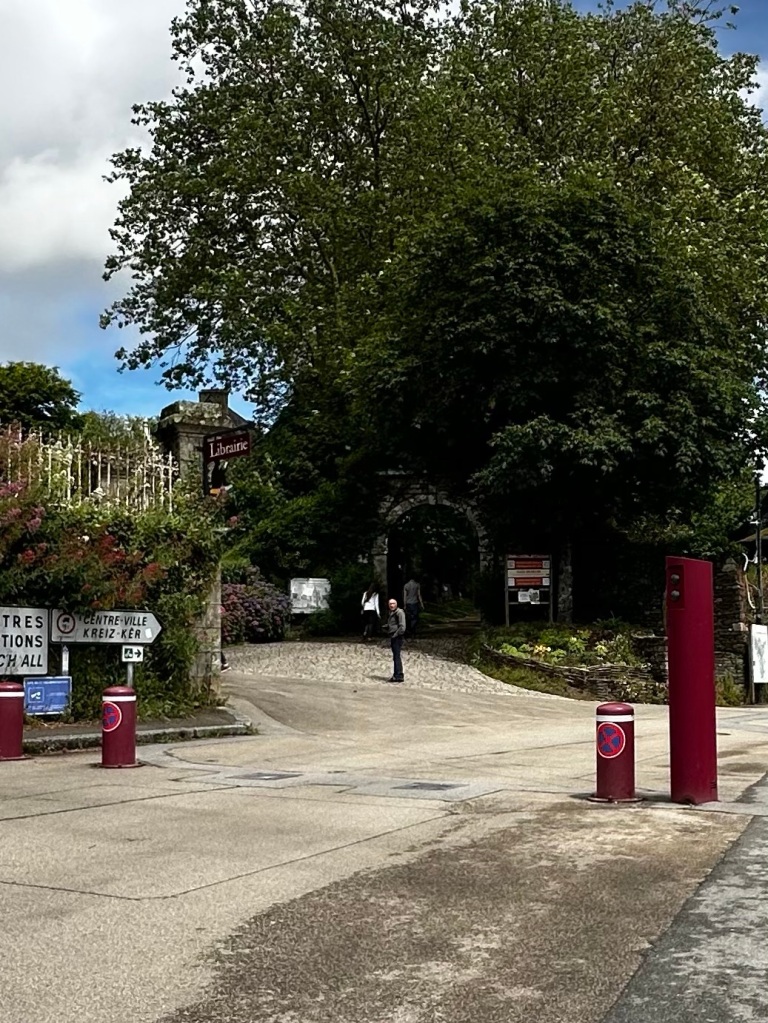
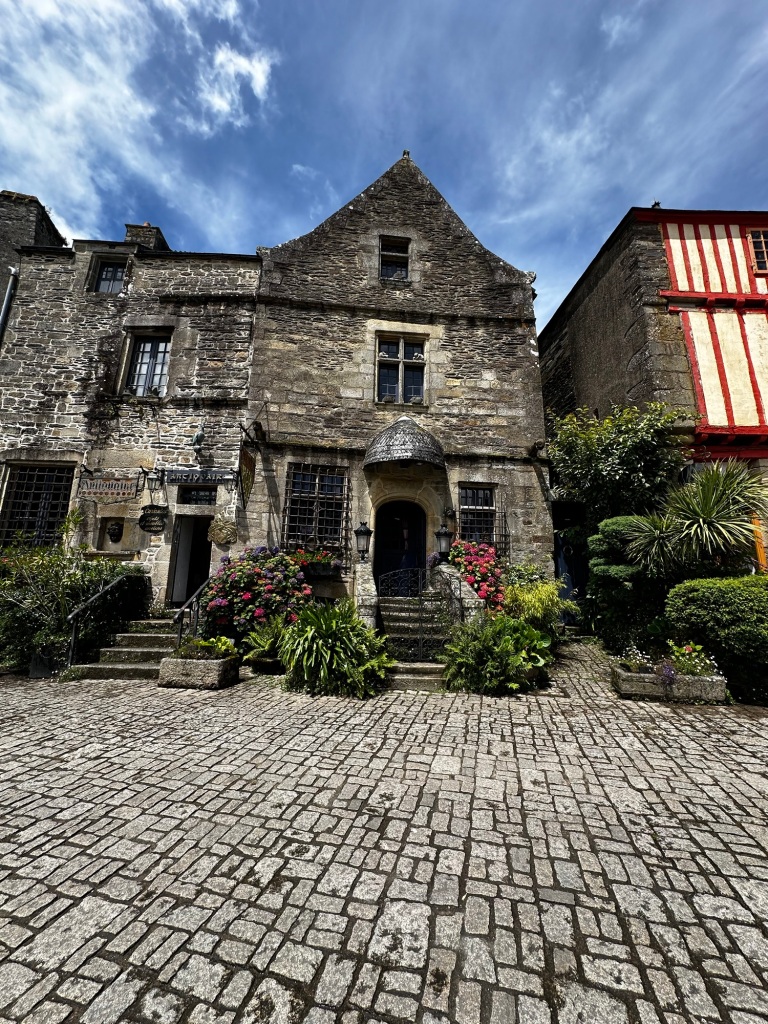
The Beaux Village, Rochefort-en-Terre

Here we passed a lot of parking for cars but none for motorhomes. Eventually the road widened and Denis noticed a huge parking area on the left. There were some busses and one other motorhome, we drove in. It started to rain, we gave up on the galettes and made our own lunch.

Going up…

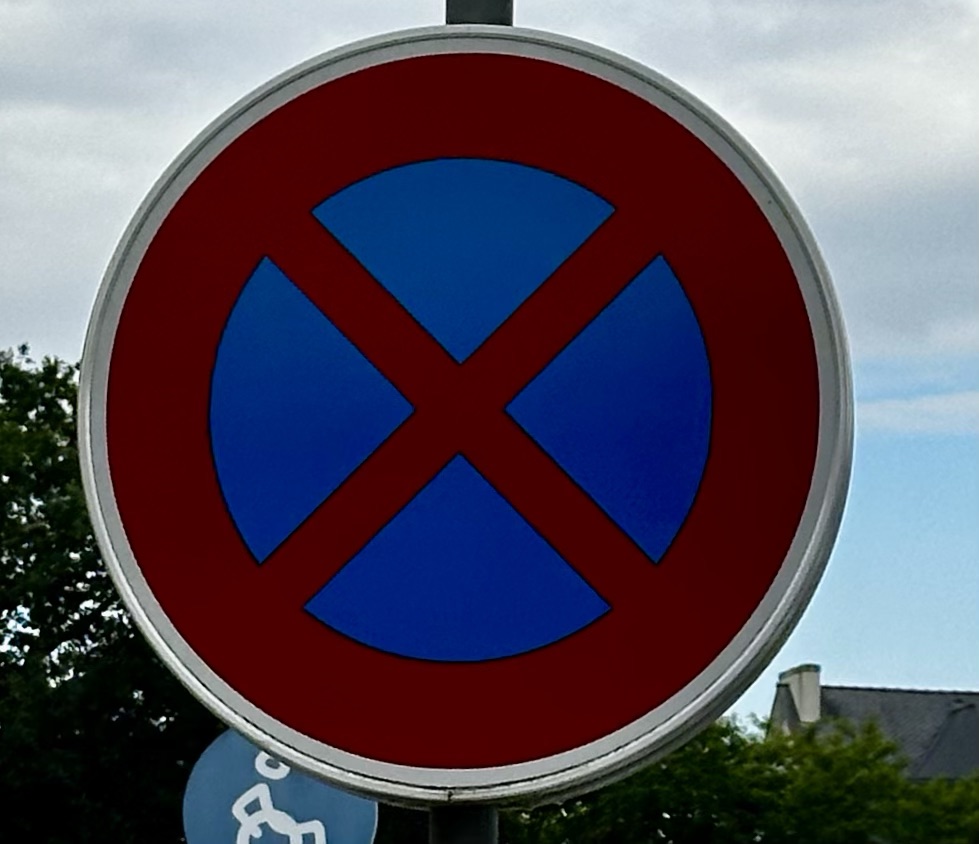
Lunch done, we locked up the van but we had hardly taken three steps when an official car (council possibly, bus company probably) drove in and stopped beside us. The French man got out and directed us with hand gestures to follow him. With more hand gestures he pointed to a sign at the entrance. It was a no parking sign… now, to be fair to us it didn’t say – No Parking – it was a symbol for no parking which is basically an X on a blue background with a red ring around it. But as we’re driving on French roads we are kinda supposed to know all the signs…

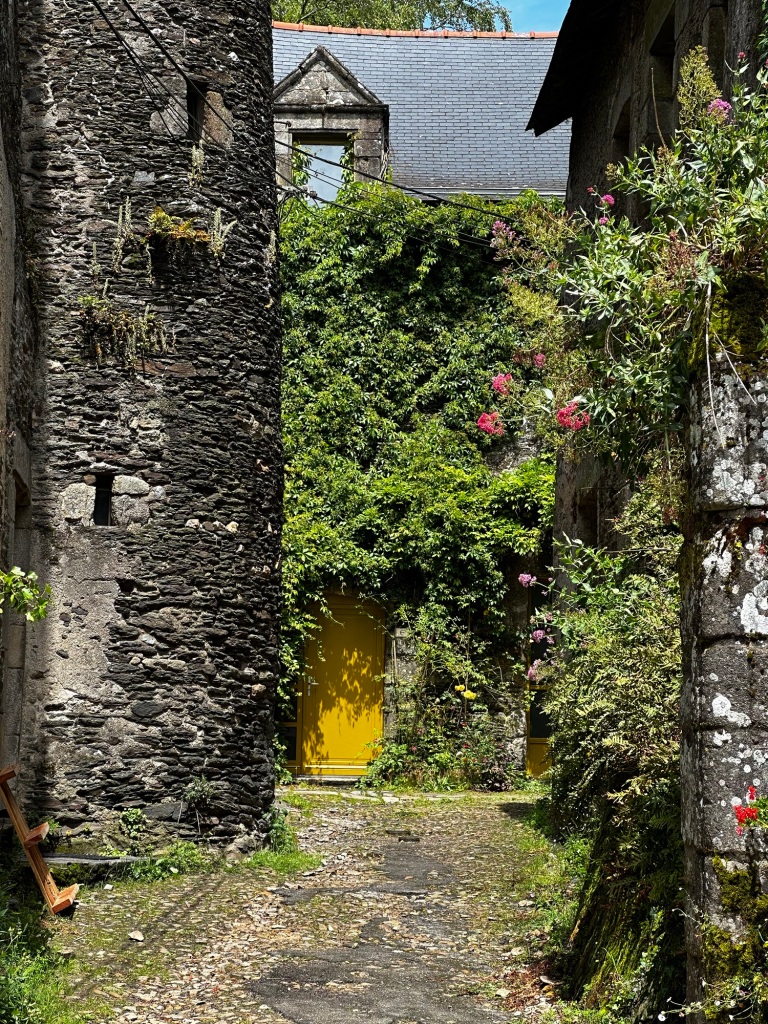
Pretty doorway

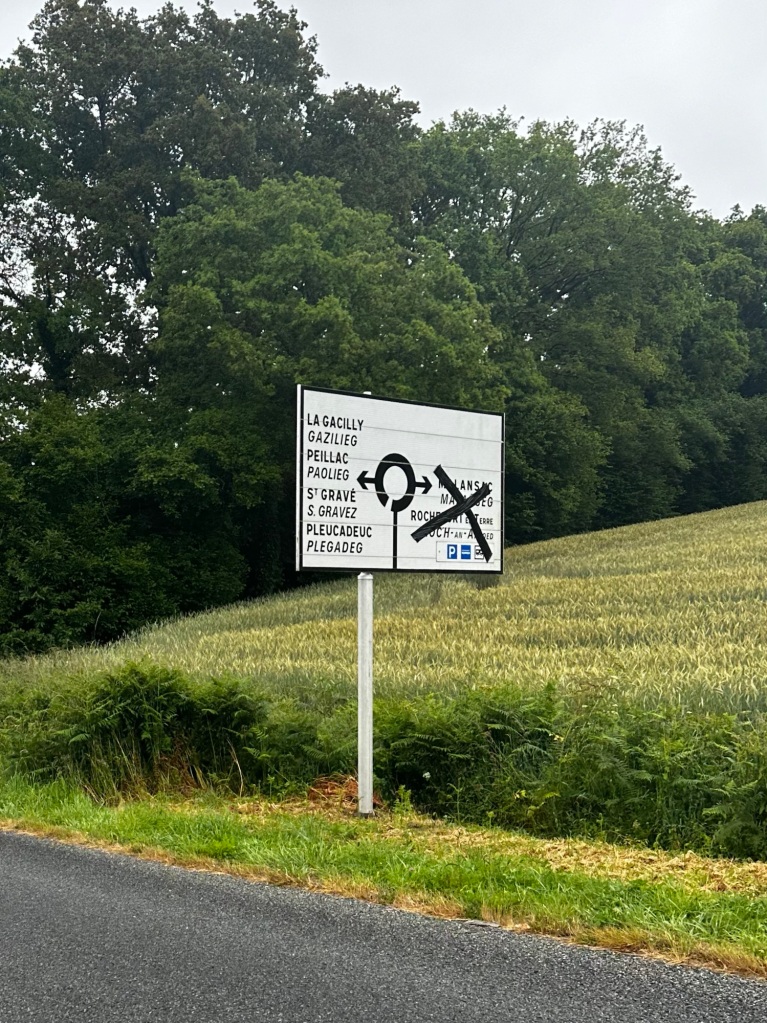
We looked at each other mystified but it was slowly dawning on us that he was annoyed and wanted us gone. He did a lot more gesturing, this time to his eye and to a motorway sign that had a motorhome parking symbol at the first exit. Ok… so that’s where the parking is and not here? We returned to the van and undid everything we had done to lock up. Meanwhile two more motorhomes (French) had spotted us and were coming in. He went off to give them the gestures. We still hadn’t moved (it takes a while…) and he was back to us, saying stuff and pointing at the now disappearing French motorhomes. Possibly he was saying, Hurry up follow them! These are not words I thought to learn in French… must expand my vocabulary.

Beautiful

We followed, for miles out of town. And it struck us that we would probably never see this beautiful village… especially when at last the French motorhomes stopped… at a Route Baree sign – road closed. Right. The French motorhomes used a handy side road to do a u-turn. We considered our options. I wanted to go back to the man with all the pointing and show him pictures of the Route Barre signs but Denis said he didn’t think that would be as satisfying as I thought it would be…

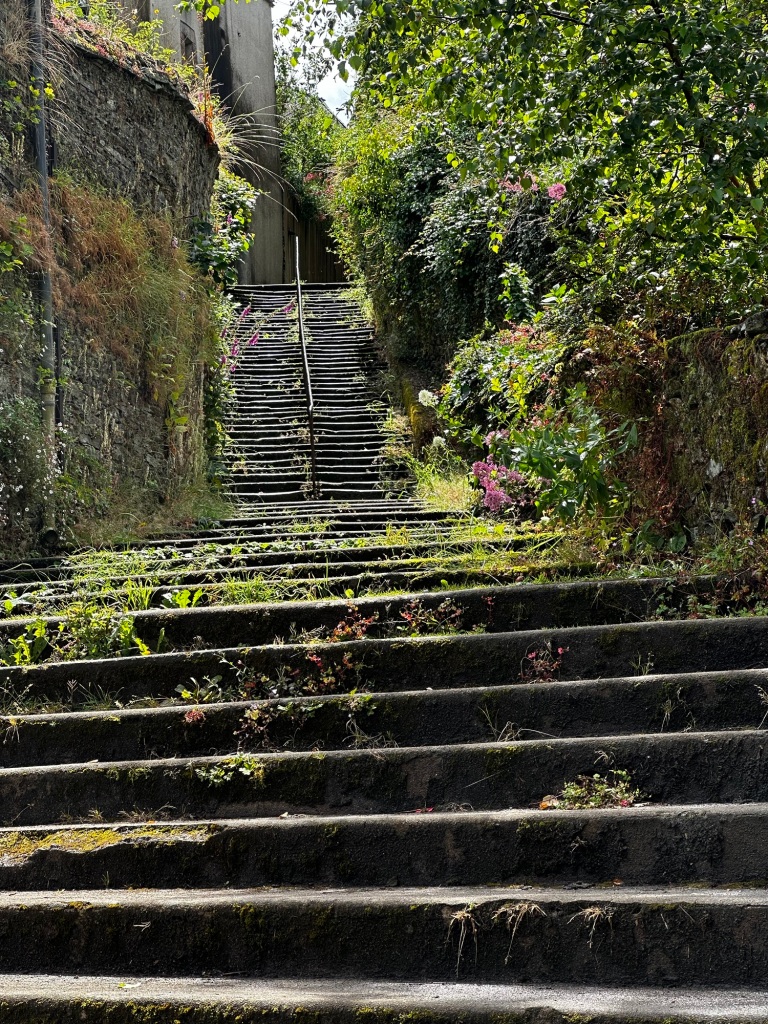
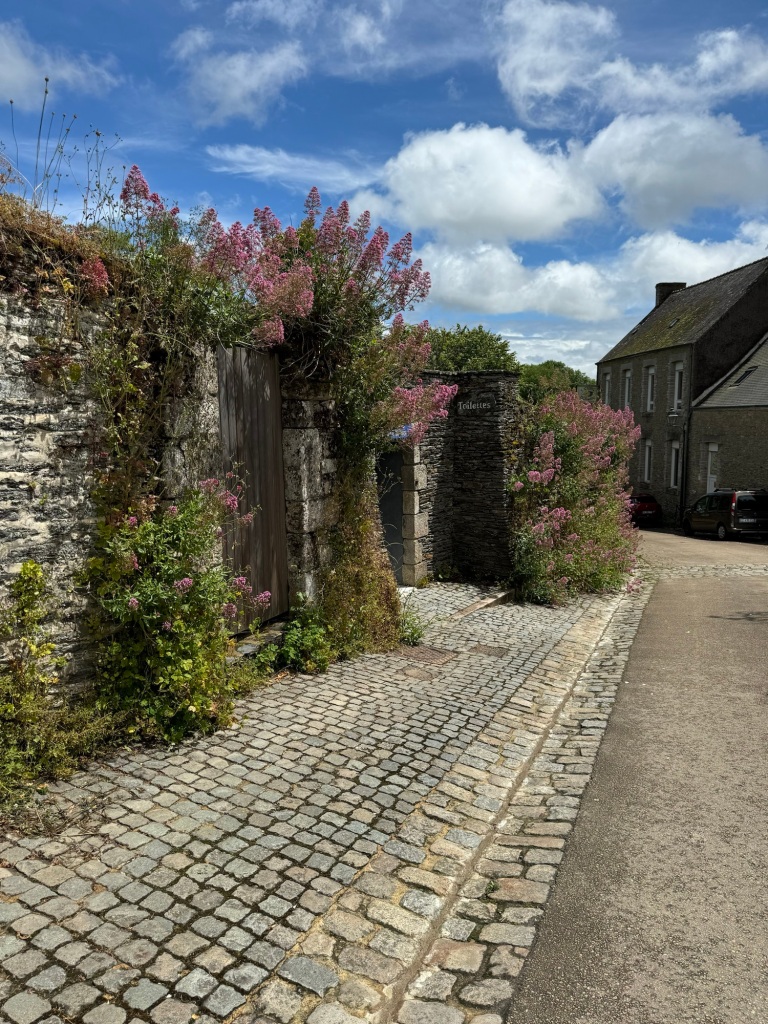
Even the toilets were pretty

We’d seen a lot of Beaux Villages, it wasn’t the end of the world to miss one, we could just move on to the next town and all would be well. But I wanted to see this one, especially as it was proving so difficult to get into. We went back to following the French motorhomes and wouldn’t you know it they had found a sliver of space on the side of the road not far from the route barre. There was just enough space for us to park there too and we did.

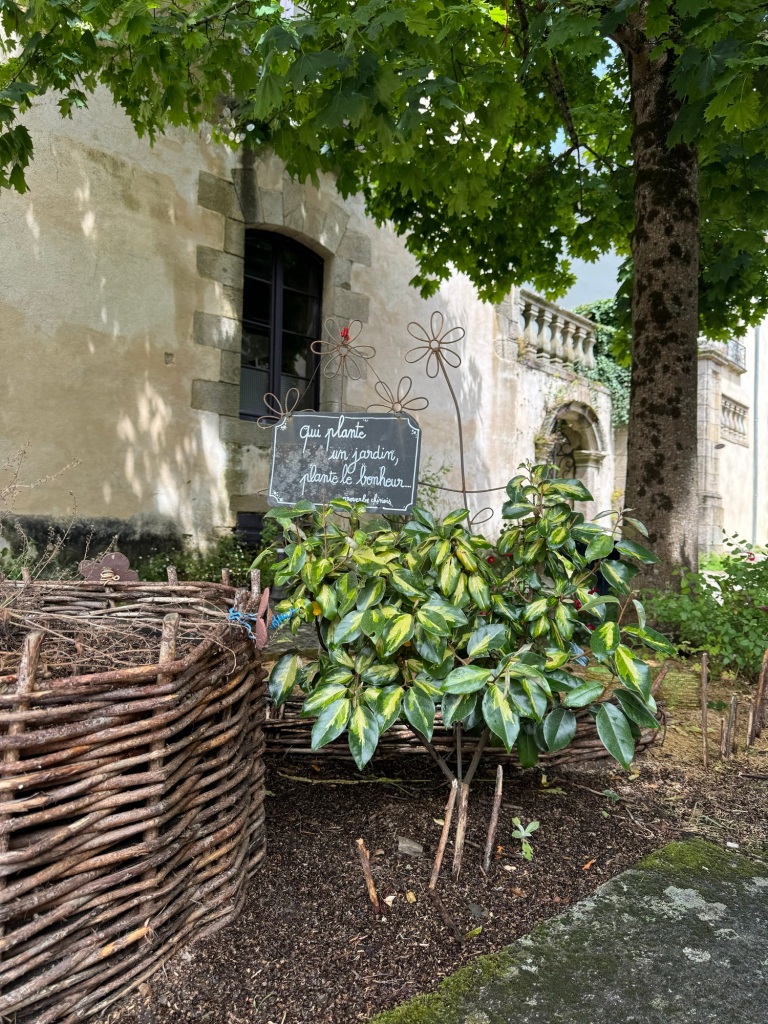
He who plants a garden plants happiness. Chinese Proverb

An update on the barrier – because the road we were supposed to use was closed they were letting vans and cars through the village and the barrier wouldn’t have risen up as we passed. Having said that, it was a very narrow village with the motorhome parking was at the far end and I can only imagine the stress of driving through when there was no way to turn around and undo that decision.

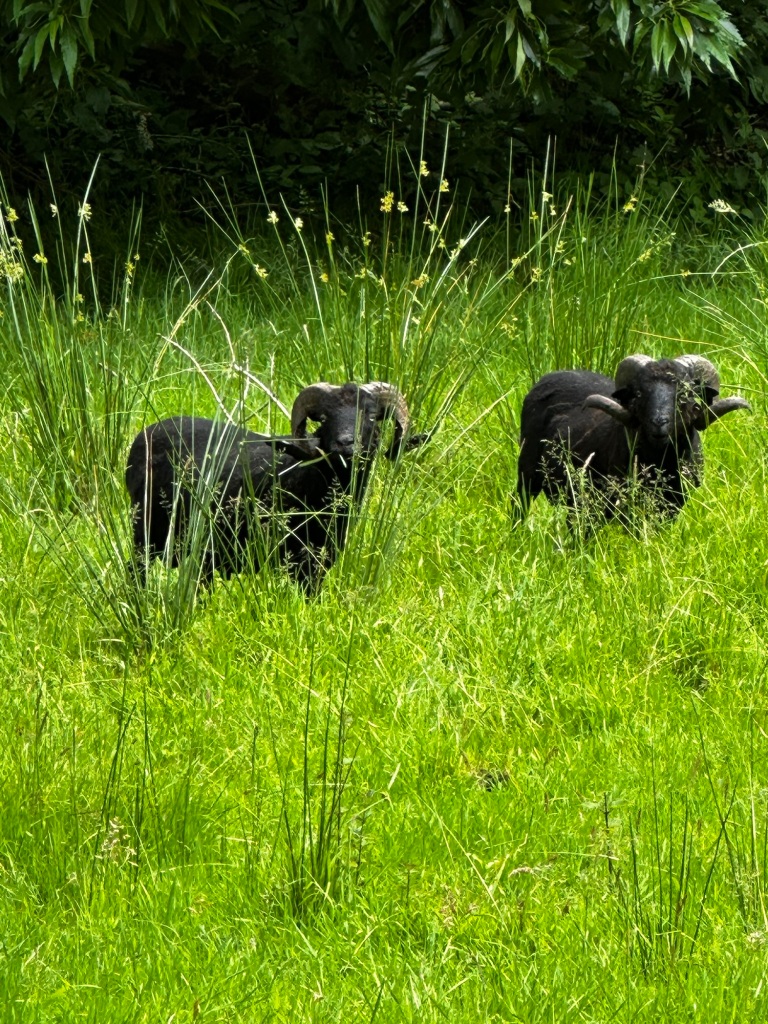
The black sheep…

It was a beautiful village, well of course it was, they all are.

French No Parking sign
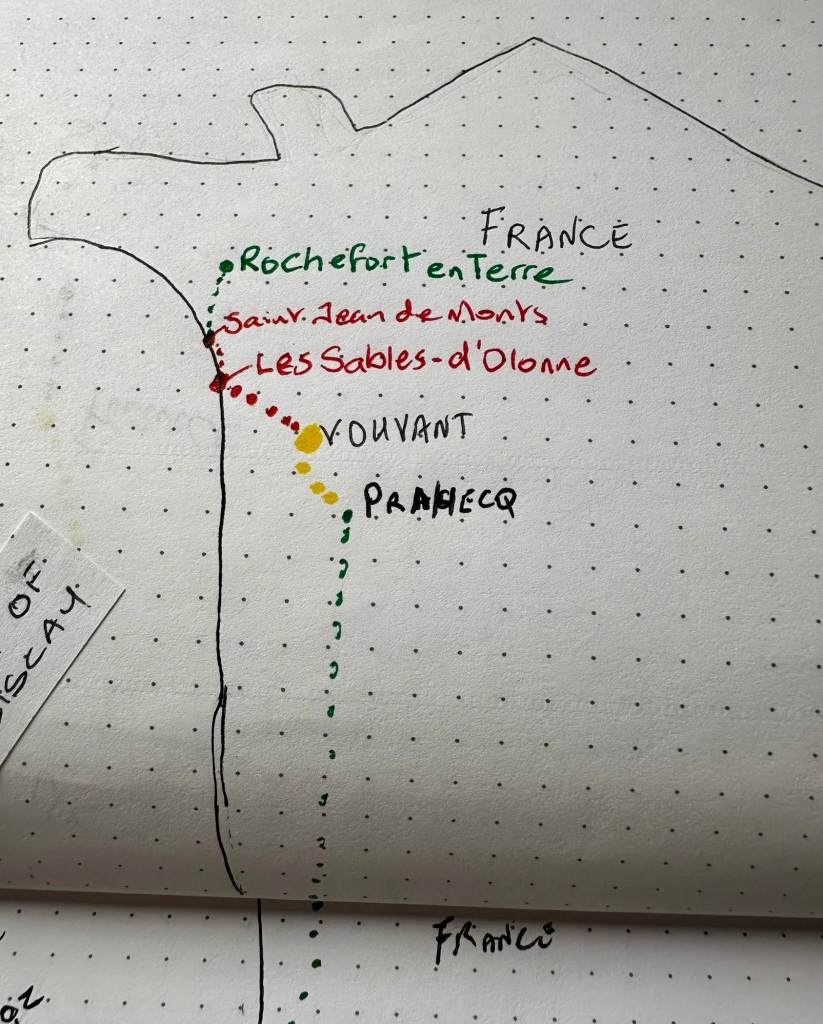
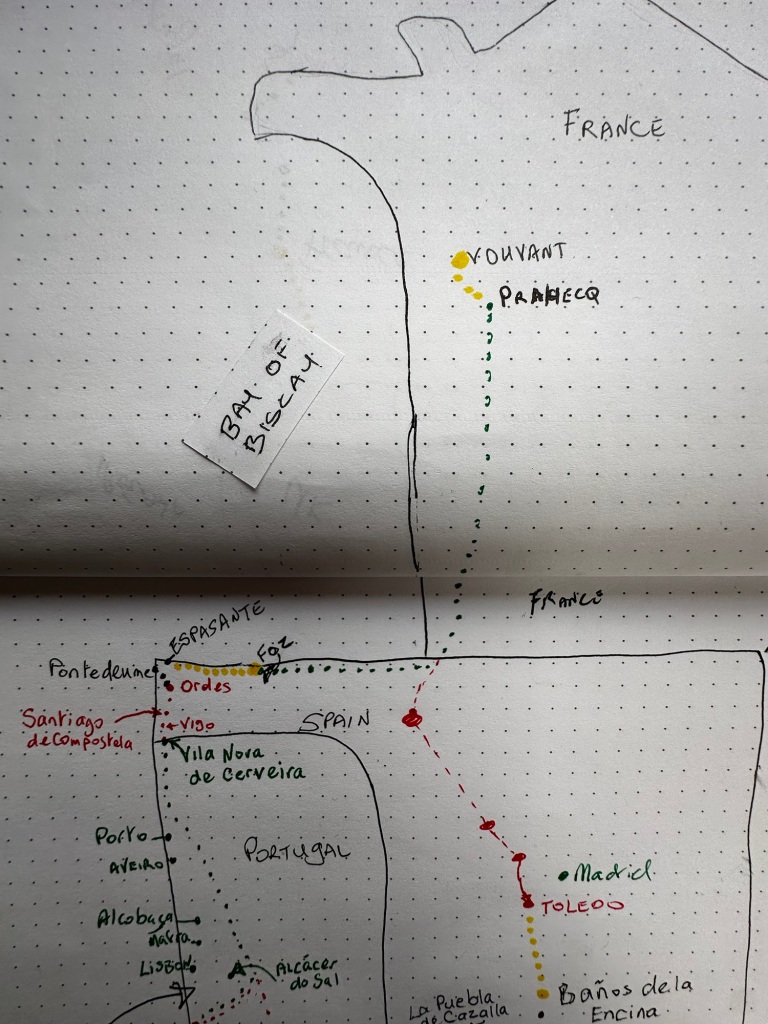
The green dots to Rochefort-en-Terre

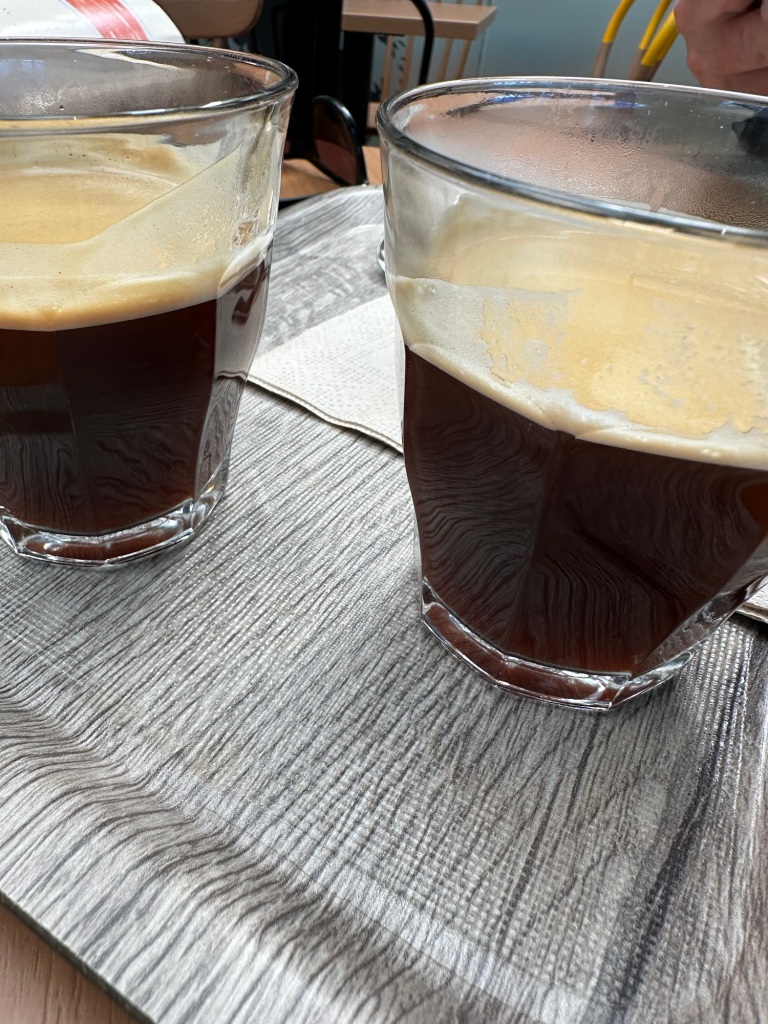
Coffee also tricky

Coffee success

We enjoyed two nights in Vouvant before moving on to the coast. On our way I bought some more postcards. I had already bought extra stamps at the post office in Vouvant so I was just a couple of steps away from successful Postcard-ing.

View in the Pressé

Stopping along the journey for a coffee is one of our favourite things to do but it’s almost as difficult as postcard-ing. Unless you are on the motorway (where coffee stops are regular and well signposted with room to park) spotting an open cafe with parking as you pass through French towns is fraught with disappointment.

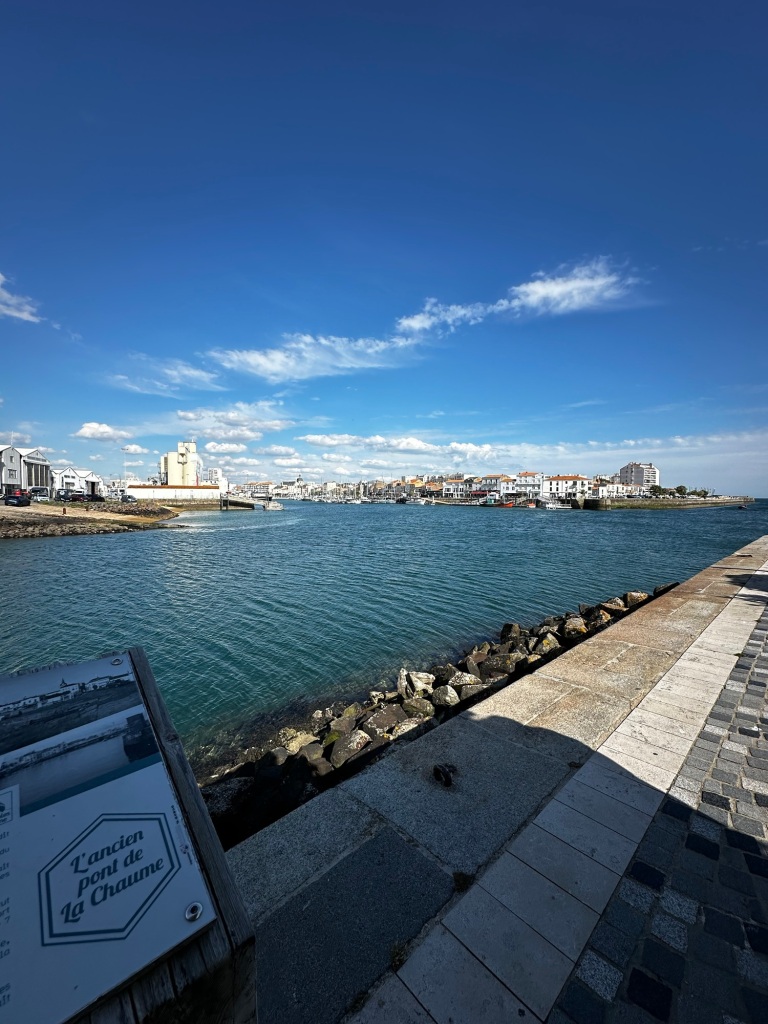
Les Sables-d’Olonne

I was on cafe duty when we left Vouvant and as I had not had breakfast my focus was razor sharp. I spotted one but it was too late we had passed – it’s tricky doing a u-turn in a motorhome. The second one was closed and we drove past two more noticing them too late. And then we spotted a supermarket, all supermarkets have parking, yes. And cafes, right? No. No, they do not. We made our own coffee that day. Huge disappointment… I’m joking, haha.

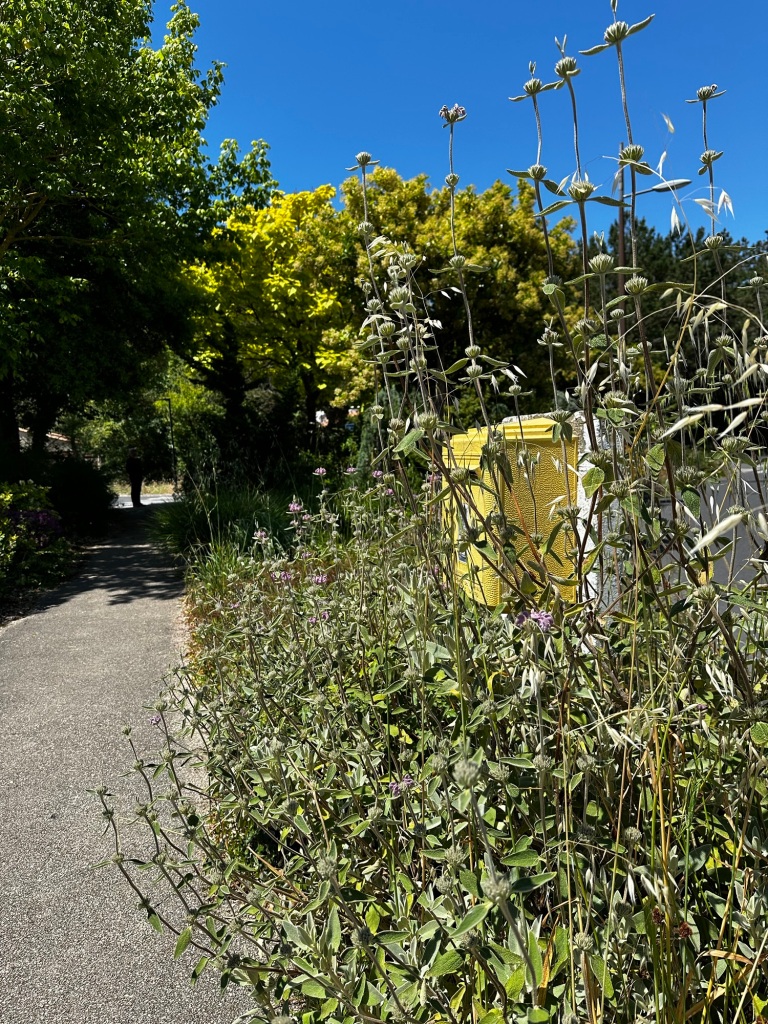
Could that be a post box in Saint-Jean-de-Monts?

Next day we moved on to a second costal spot. I had had my breakfast so not as focused but would not be as disappointed if we didn’t find someone to make us coffee. We spotted a huge shopping centre/supermarket ahead at the next roundabout. Unfortunately the signage for parking was less than clear and we found ourselves driving past. Noooo. Fortunately, up ahead was another roundabout. I know what you’re thinking… you think we went around the roundabout and back the way we had come just for a coffee? Yes, yes we did.

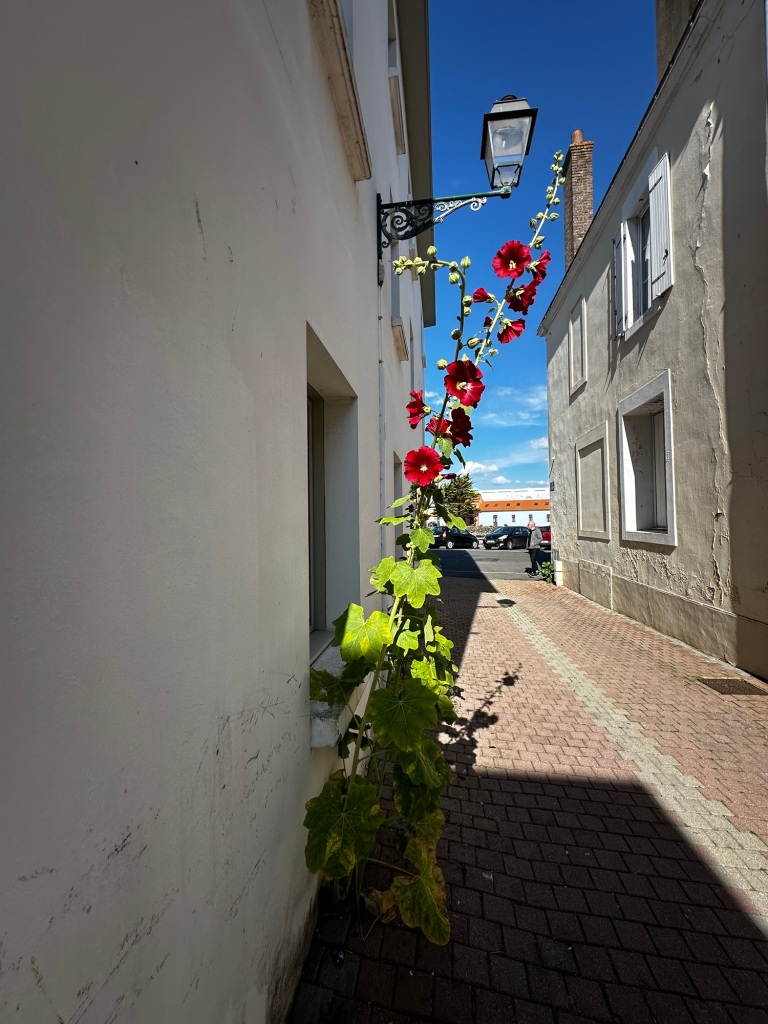
Wild flowers are safe on French streets

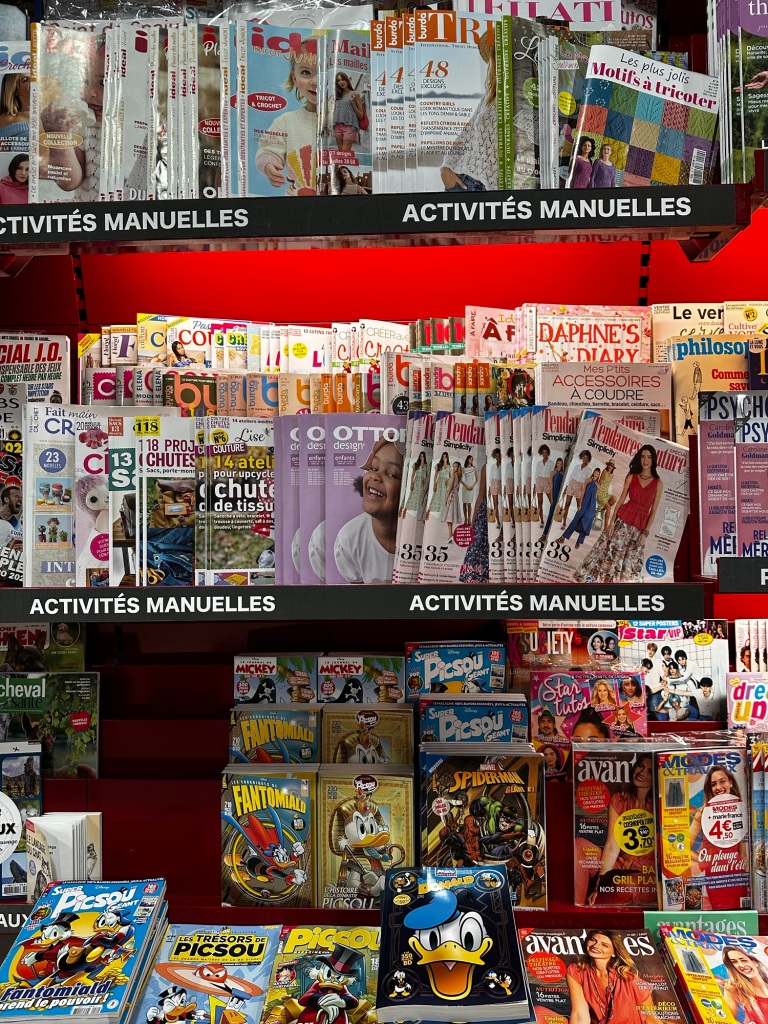
We came back to the first roundabout. Had to go round it a couple of dizzying times but we found the entrance and there was plenty space to park. While we were in there I discovered something I had previously completely missed… Pressé, (a type of shop found in every French town) is a newsagents and it’s where you can buy magazines, postcards… and stamps!!! My world view had just exploded.

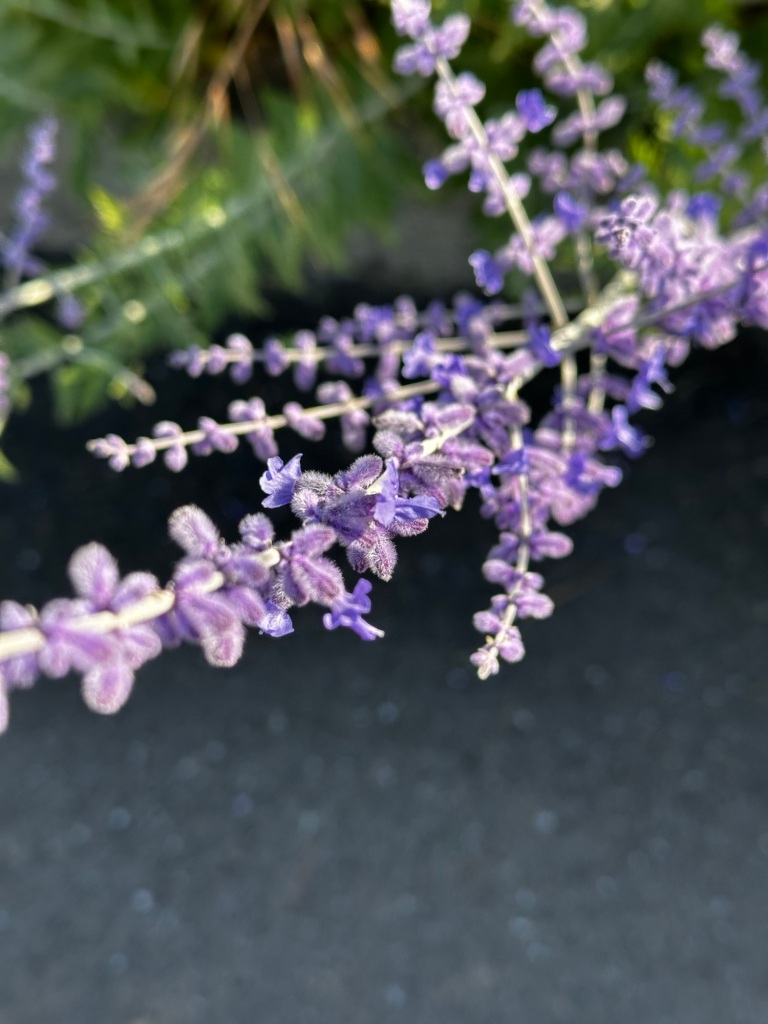
More wildflowers

I didn’t need more stamps but I bought magazines and more postcards.

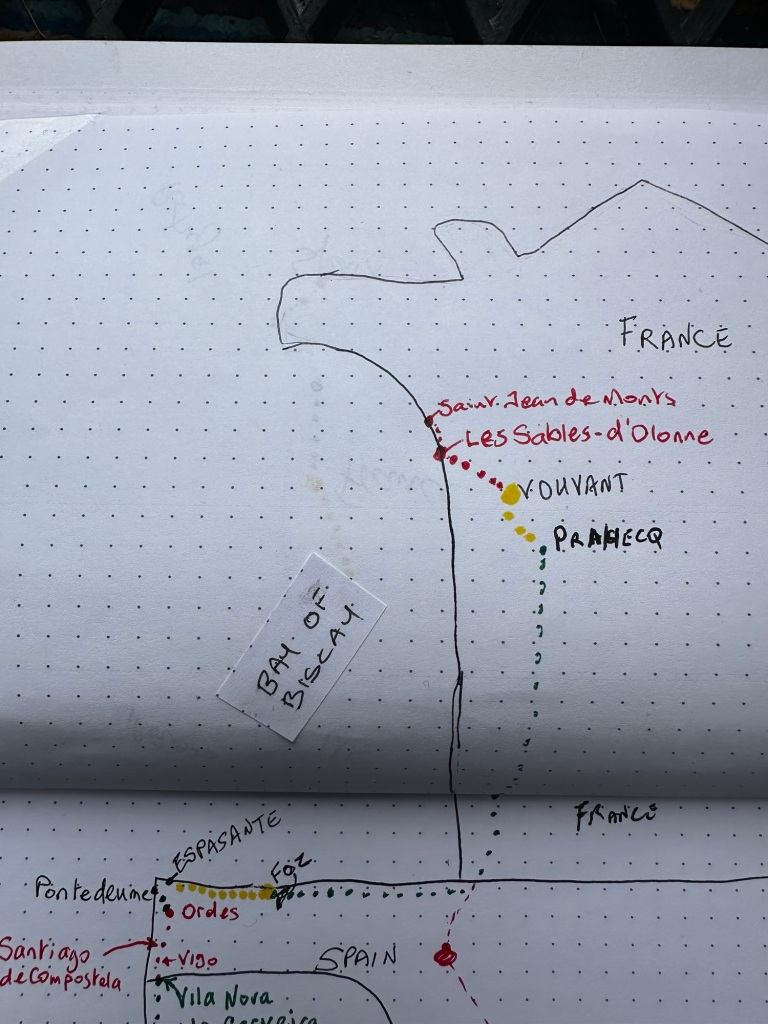
Red dots along the coast to Les Sables-d’Olonne and Saint-Jean-de-Monts

Postcards are Tricky

Tiny ice creams in Vouvant. (Quick, take a photo before it’s all gone!)

Do you remember last year we bought a map of all the Beaux Village de France? And we visited many, many beautiful villages? We decided for our first week back in France we’d start with the beaux village of Vouvant. With less than an hour’s drive and an indoor picnic on route we arrived at the camper parking. All the services we needed and the village just a short walk away. We paid for the night and walked to the village.

Indoor picnic on the way to Vouvant

The sun was shining and it was 20 degrees, perfect. The village was bustling with people as is the usual for the beaux villages on a Sunday, every shop was open. We treated ourselves to ice creams and wandered around with everyone else. Something we’ve noticed about these beautiful villages, they are almost like film sets, it’s hard to think of them as real. It seems no one actually lives here, well certainly not in the most beautiful centre section. But Vouvant seems different, although the central area is mainly shops and cafes and restaurants, there is also a substantial area surrounding it with pretty houses and gardens.

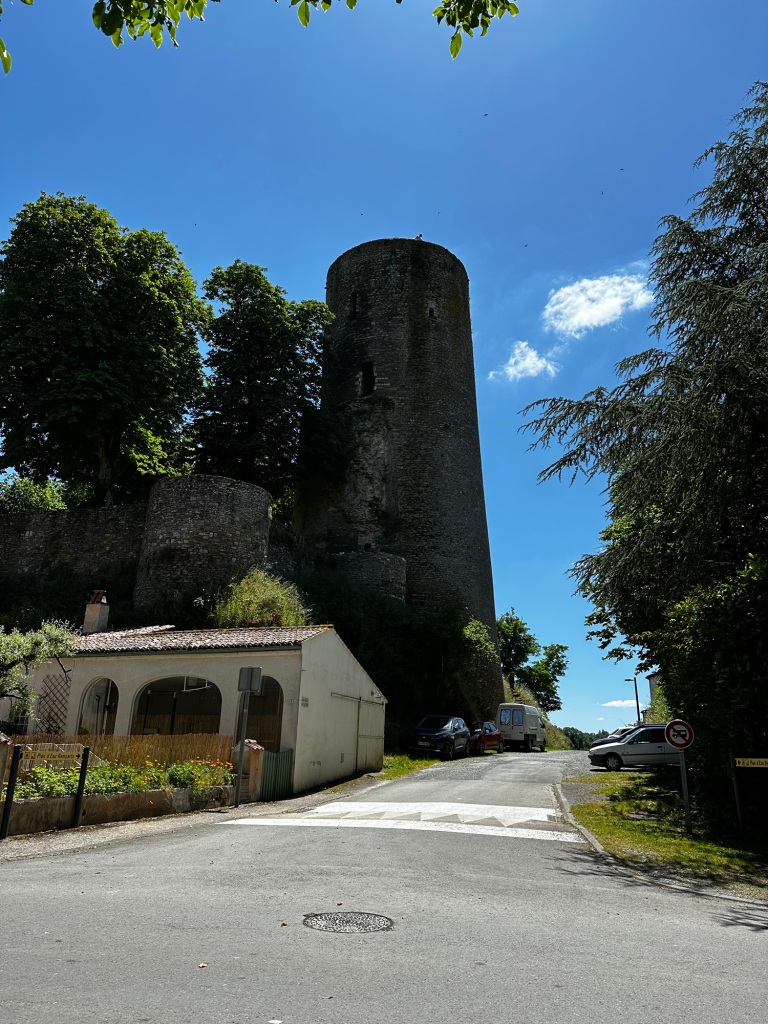
You can climb to the top of the tower in Vouvant

Next morning I went back to the village on a mission. I had a few postcards from Spain that I had never been in the right place at the right time to post. I love sending postcards but they can be tricky. First you need to find a place that sells postcards and they almost never sell stamps or not international stamps anyway. Then you must find a post office to buy international stamps. Then you need to post them after writing a message. And when you have written on them you will need to find a post box…

Relaxation spot – garden in Vouvant

At each of these postcard stages I was so excited to successfully complete the stage, I never moved onto the next stage promptly enough. The ideal would be to buy the postcards, write the message, look up and write the address, go to a post office, buy the stamps, put the correct stamp on the correct postcard and pop the postcards into a post box! And do all that on the same day in the same town or at least the same country.

Pretty front gate – Vouvant

Instead, I bought postcards in Spain. A few days later I found a post office and bought stamps for Ireland. Days later I wrote the message and the addresses but never found a post box… in Spain. I know that sounds strange, there was that one time I found a postbox but didn’t have the cards with me. And then we were in Portugal.

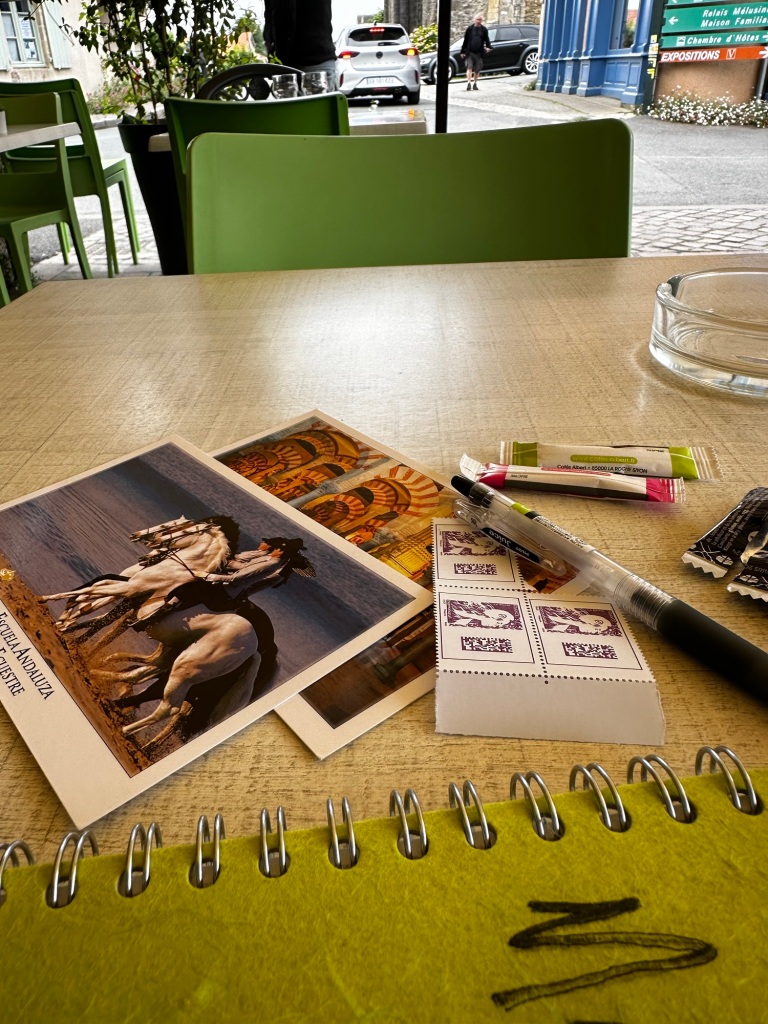
Perfect cafe for postcard writing in Vouvant

Now the Spanish postcards were written and stamped, with Spanish stamps – so I couldn’t post them in Portuguese postboxes… I would need to find a Portuguese stamp but we were never near a post office – we were travelling more than we were stopping. And then we were back in Spain. I did get to post two postcards in the village of Espasante when two guys stopped painting the pride pedestrian crossing to help me find a postbox.

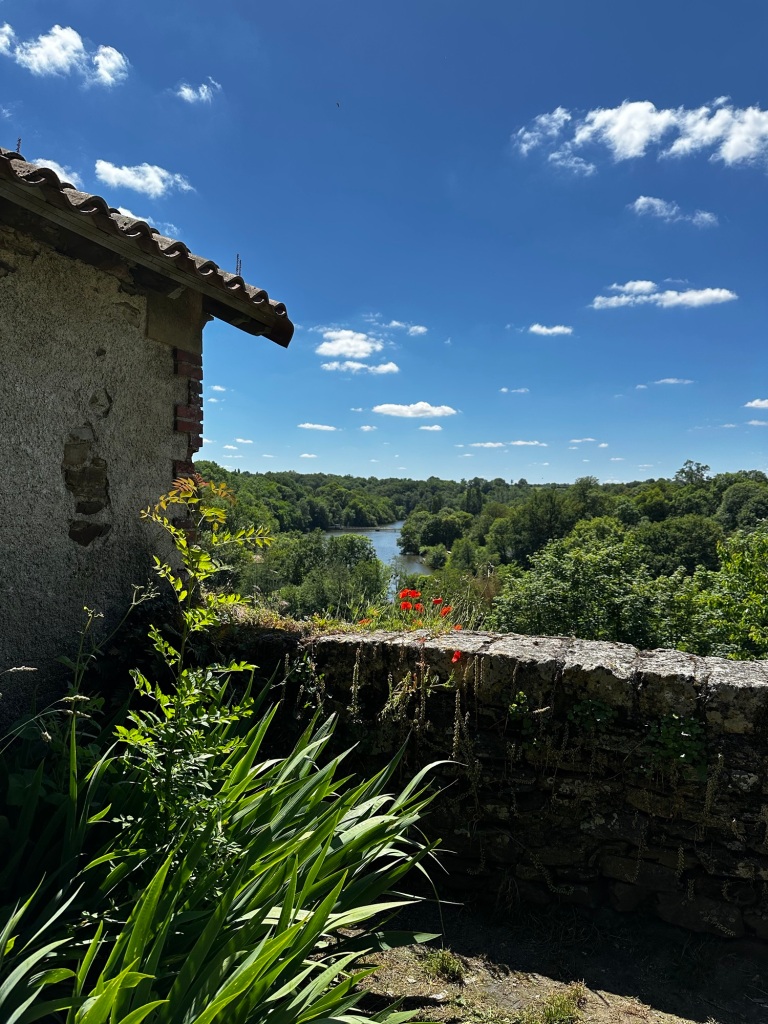
View from Vouvant over the river Mère

In Vouvant almost everything came together. I had a couple of postcards, I found the post office, bought the stamps. Then bought a coffee, sat to write and address them and returned to the post office to post them. What I didn’t have was enough postcards… and now it was Monday and beautiful villages are quiet on a Monday – all the shops where you might buy postcards are closed!

Spanish postcards, French stamps

And now I wonder, even with French stamps on, will the French post office deliver my Spanish postcards?

Yellow dots to Vouvant