Lisbon by Train, Boat, Tram and Scooter – Part 1

(Love the colours. Cafe near the train station at Cais Sodré)

We went to Lisbon on Saturday. If you remember I was to be the tour guide and Denis the tourist. We set off at 8.30am to get the metro train (tram) from Corroios. Corroios turned out to be a bit of a hub for transport. There was a train north to Lisbon or south to Setúbal (also worth going to, tell you soon). There was also the metro tram train that went to Cacilhas and the ferry port. Also a bus just across the road from our parking spot going into central Lisbon. Then more busses within a twenty minutes walk.

(From the ferry, see the bridge?)

We were taking the ferry! It’s a passenger ferry that takes commuters from the south side of the estuary to the Lisbon side. Plus there’s a bonus – it’s two minutes walk from the port to the Time Out Market. Denis loves this place so it was to be our first stop. It’s an old food market with a new section with restaurants. It’s like an upmarket food court for good food from Portugal. We arrived about 9.45am but it wasn’t open yet.
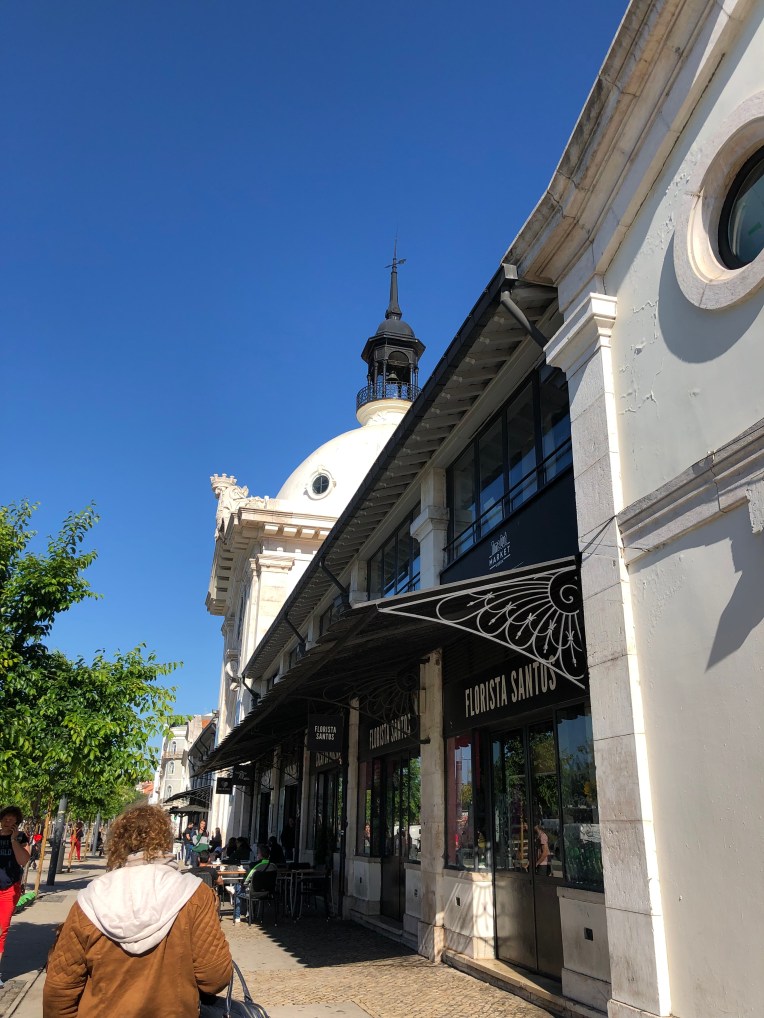
(The outside of Time Out)

If you decide to run your own tour you might want to check the opening times of the attractions. Fortunately, I had built a little flexibility into my planning (sure I had) and there was a cafe on the outside so we loaded up with coffee and cake. Course we did.

(See the sea in the distance? That’s how far we’d walked and we weren’t there yet…)

Then we walked to the next attraction. It was only an 18 minute walk… but it was uphill and the temperature was rising. (Top tour guide tip: check the gradient of walks, over a certain percentage your clients may need public transportation.) My plan was to walk to the Ascensor Da Glória. You may not know this but Lisbon is built on seven hills. We were getting to know theses hills, exhaustively. My next two attractions were very old ways the people of Lisbon invented to cope with their hills. The Ascensor Da Glória is an old, old tram (technically not a funicular, seemingly) that travels up an impossible incline so you don’t have to.

(There it is, ascending)

We were almost there. I was following google maps and we had just one more street to go and it looked pretty straight on the map so no room for error. Well no room for that kind of error, I had made a different kind of error. I couldn’t believe it. We had arrived at the top! Google maps was directing me to the bottom of the incline via the route of the tram…

(There’s the driver and his empty Ascensor da Glória)

But Denis didn’t know that… hey look at this! Yes lovely. We waited for 190 (felt like it) people to get off and then the two of us, the driver and a local got on. No one, no one goes down the Ascensor da Glória, the hint is in the name. But hey, remember the best tours take you where the locals go, the locals go down, only the tourists go up!

Tour guide in training, Mairead.

What to do if there’s a petrol shortage…

(The front of Alcobaça monastery)

We hadn’t heard of the town of Alcobaça (pronounced Alco-Baza, I think) and I don’t know why. It’s very impressive. To begin with there’s s huge cathedral and monastery in the middle of a very cute town. The motor home parking is less than 5 minutes from shops, restaurants and the monastery. There’s free electricity and the parking is free!

(Inside the cathedral)

We were here when the news hit that the tanker drivers strike was causing shortages of petrol and diesel. We had filled up the previous day, fortuitously, so we safe enough. We had everything we needed (culture, food, drink, electricity, shopping, post office) and Spain was only two and a half hours drive away, if the strike continued. It didn’t continue.

(One of the courtyards)

I have some advice for you if you should ever find yourself in a similar situation…

1. If you can manage it at all, fill up with petrol (or diesel if that’s what your vehicle takes) before the strike starts. 2. Park somewhere with a nice historic monument. 3. Ensure there are grocery shops, cafes and restaurants nearby and some electricity. 4. At all times ensure you are within walking driving distance of another country. 5. Find a local who speaks English and pester ask her for hourly updates on the strike. 6. Go for regular lie downs because you will be feeling very stressed.

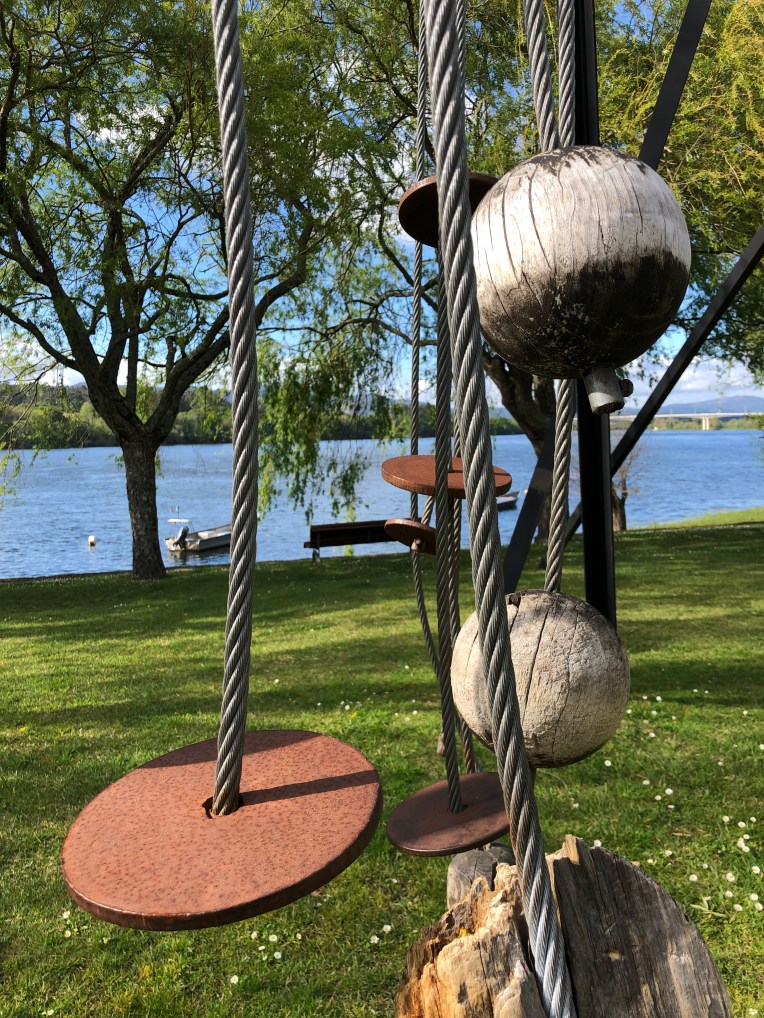
(Art piece: metal basket with knitting needles)

For balance here’s Denis’ advice: 1. Carry on as normal.

I’m not sure he took the whole thing seriously enough, Mairead.

(Alcobaça. Free parking, near town, free electricity, €1.50 for water)

What were you thinking?

(Nighttime in the sand dunes of Figueroa da Foz)

Next morning we headed for Figueira da Foz. This town was recommended by a Portuguese Camino walker friend who was here. It is lovely, thank you!

(An adorable statue gifted to the town for their role in world peace)

There’s a huge, gigantic sandy beach and huge sand dunes. Huge in coastline and in distance from land to water. Very impressive. There’s also a cute little old town with plenty of cafes and restaurants and even a casino.

(Wording at the statue)

We were in a restaurant in the old town on Monday night when we saw Notre Dame was in flames. (Did I mention every restaurant has a tv or two playing constantly?) It was a strange moment of disbelief, shock and sadness.

(Our view)

Since then I have been wondering why I was so affected. Yes, I have seen the cathedral in real life. No, I was never inside. No, I have no special memories attached to it. No, I’m not (secretly) French. And yet… I was upset. On top of that I had this intense interest in discovering if it was an accident or an attack.

(There was an old fort across the road with bunting)

It turns out it’s not the cathedral burning that’s upsetting me. It’s the meaning I was applying to the burning of this famous place that’s upsetting me. You can see a hint in the fact that I am so interested to discover if it was an accident or an attack. I have given that meaning too.

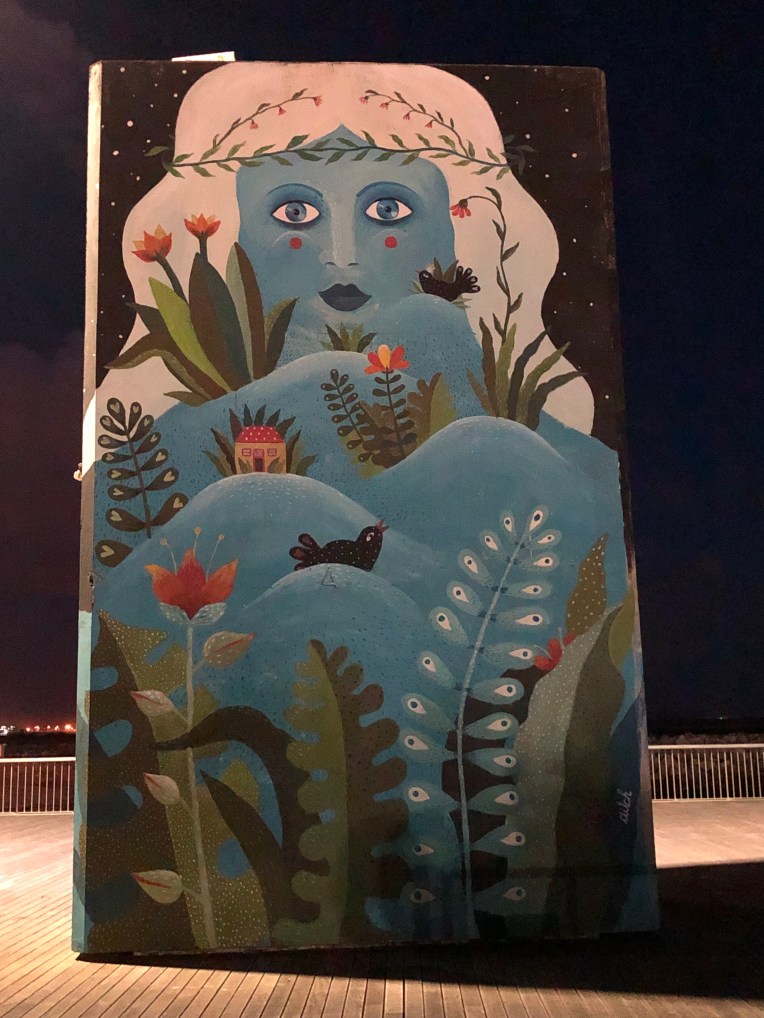
(Huge art piece on the boardwalk)

So what meaning is my mind giving to this situation? My mind thinks that if a huge part of the definition of Paris can be destroyed then nothing is safe. If nothing is safe then I’m not safe. That’s very upsetting indeed to my mind. And what about my interest in the cause of the fire? The difference between an accident and an attack? An accident is less frightening because there are no baddies when it’s an accident. No baddies means no future danger to me, just an accident, all over now.

It definitely upsets me to realise I’m so self-centered, Mairead.

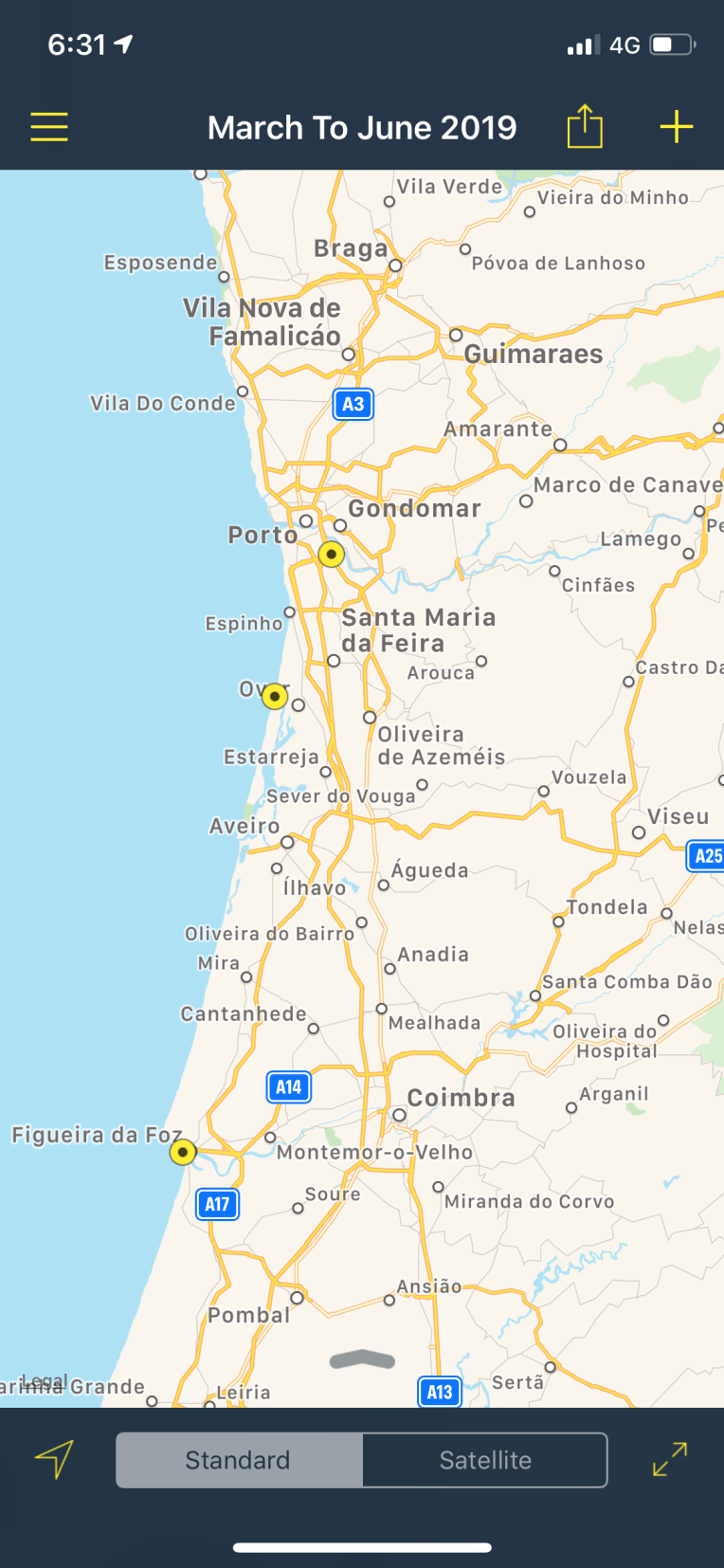
(Here we are on the map. Free parking in the car park near the fort at the beach near the old town)

How to find the supermarket

(For when you want some alone time…)

We’ve been in this town before. I don’t remember much about it but when I needed to get some groceries I remembered enough.

(Or there’s a table and chair for writing with a view)

Staying present is a really useful practice if you ever worry. I never worry. Oh I spelled that wrong, the right spelling is: I regularly worry.

(One step at a time)

Anyways, thought it might be useful to get some staying present opportunities so I went off to the supermarket without a map.

(The tables…)

First I remembered I needed to cross the car park and continue on to the square with all the tables. Then I had no clue. But as soon as I arrived at the square I just knew I had to pass the house with the green tiles.

(Green tiles)

When I got to the tiles I knew I had to keep the cafe with the crochet flowers to my right and walk up the incline. Then I came to a complete stop but only until I noticed another cafe with the garden and white walls, I had to go left there. And then I saw the supermarket across the road.

(Lots of crochet in this town)

You can scupper worry by staying present. Looking at what’s straight in front of you. Or listening to the sounds around you. Or tasting the food in your mouth. Or feeling the floor under your feet. Or smelling the roses.

Note to self: Worry isn’t useful, Mairead!

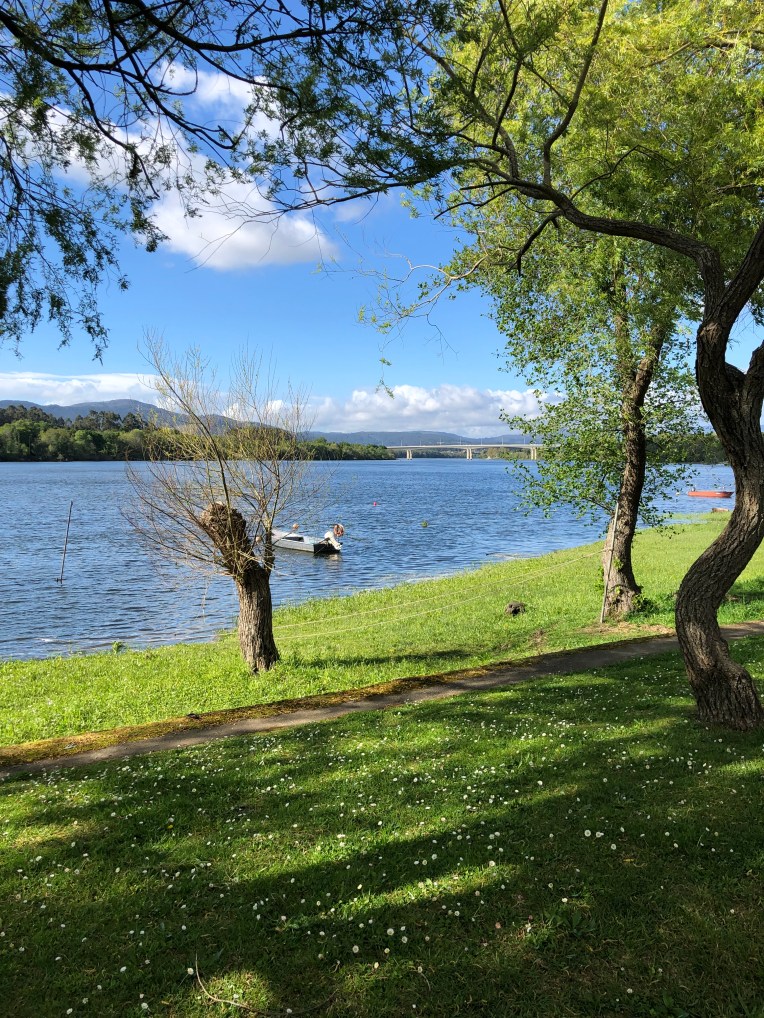
(There we are just over the border in a town called Vila Nova de Cerveira, free camper parking near the old town, the river and park)

Normal Service Resumes

(There’s the border, remember when borders were places you had to stop and show your passport?)

We have arrived in Portugal and the weather has changed! There’s heat! We had decided to go just one hour south from Santiago but our phones both stopped getting service. That’s unusual. Forty five minutes further we were crossing the border and service was back.

(We are parked beside a park…)

It’s funny how you (we) get used to something. Our phones for example. Of course they are more than phones now. They are weather forecasters. They are parking finders. They are restaurant finders. They are route finders. They are birthday greeting senders, get well message senders, how are you doing? senders.

(That’s Spain over there and the bridge joining the two countries in the distance)

They are notebooks. They are book writing helpers. They are blog message savers. They are newspapers. They are cameras and photocopiers. They are flash lights and alarm bells and reminders. They are books, a library of books. They are exercise monitors. They are music players. They are photo albums. They are offices.

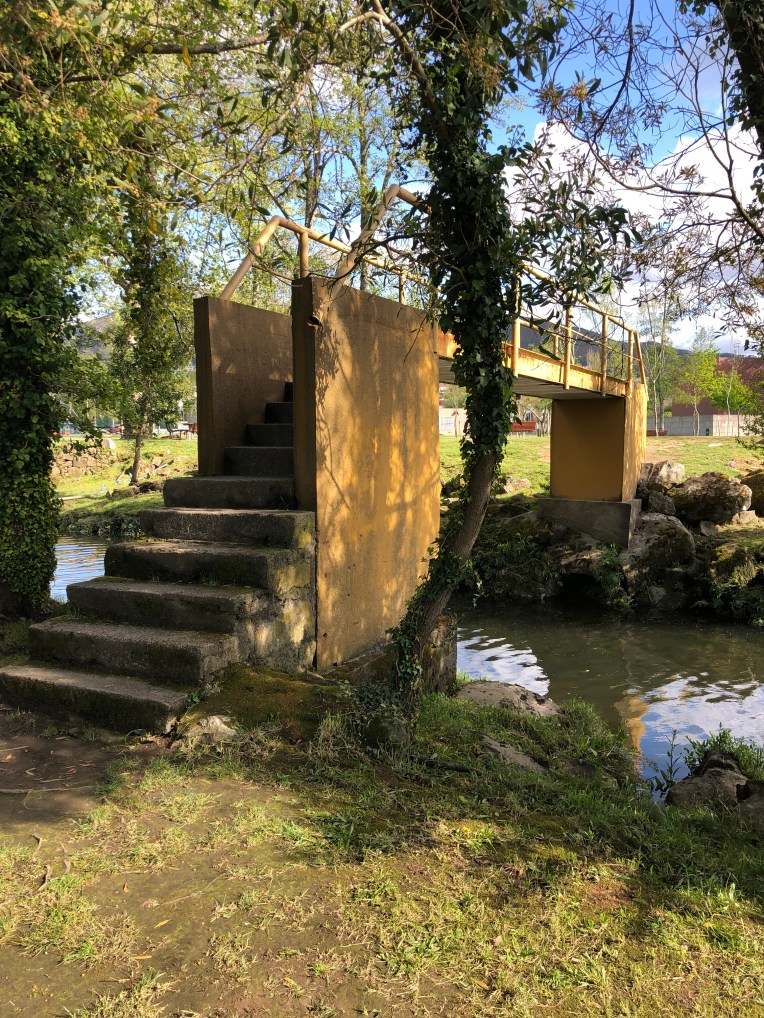
(A little bridge in the park joining us to the island)

They are clocks and calendars and bus timetables. They are televisions and translators. They are recipe books and talking books. They are information holders and sharers… and they are phones.

(The little island)

The phone network issue is making me grateful for my phone. Leaving my friend is making me sad but hugely grateful for friendship. Crossing the border is making me grateful that I am part of this place and sorry that our neighbours are leaving.

We’ll miss them when they’re gone, Mairead.

The stars aligned

(The cathedral which is built on the site of the original church. The original tomb is in the basement)

We’re leaving Santiago de Compostela today. My friend and I went on a free tour of the town yesterday. It was very interesting. Two hours of history and geography and tips and suggestions. I would definitely recommend it.

(Our tour guide with the white umbrella)

The story of this place is a little complicated and shrouded in mythic stories. I’m going to attempt to give you a potted version.

(This building is just 3 meters deep. It was originally just a front facade to give aesthetic balance to the plaza at the east facing entrance of the cathedral)

Once upon a time, more than 2,019 years ago Jesus was having a serious conversation with his disciples. He asked them to do something for him when he was gone, meaning dead. Of course he was only in his 30’s so they didn’t think he’d be gone for a long time and so it wasn’t hard for them to say, no problem whatsoever tell us what you want. He wanted them to spread the word of his message – about the loving god and the loving way to live – to all the ends of the earth.

(Narrowest lane in Santiago de Compostela)

He was dead very soon after and when the disciples recovered from the shock they started going about spreading the message. But one disciple took Jesus’ words very seriously and he literally went to the ends of the earth.

(Higgledy Piggledy layout of the old town)

At the time the earth was thought to end at the edge of Europe and the west coast of Spain was on that edge. So the disciple James headed in a stone boat to the end of the earth and arrived in a place called Fisterra. He began preaching about Jesus and his message. It didn’t go well. The locals weren’t very interested and he was probably getting a bit low in himself when Jesus’ mother Mary appeared to him and told him she would love to see him. So off he went back to the Holy Land. His message hadn’t fallen completely on deaf ears in Spain and he had two disciples so they went back with him in the stone boat.

(Cute window seats)

Well if he thought things were difficult in Spain they were ten times worse in the Holy Land. There was all sorts of bad things happening to anyone who was a follower of Jesus and poor James was beheaded. Now he became Saint James and his two helpers didn’t know what to do so they took his body and raced back home in the stone boat.

(A lot of ham)

When they arrived back they went to the forest and buried their friend. No more was heard about the message of Jesus or St. James in that place for 900 years. That’s when another guy, Pelagius, arrived to the very same forest. He was on a similar mission to St. James. Anyways one night he had a dream about a field of stars and one star was pointing directly to a spot in the forest. Next day when he went to that spot there was a tomb. He had found the tomb of St. James!

(Almost impossible to get lost in the old town, just look up, you’ll see the towers of the cathedral )

Absolutely delighted with himself, Pelagius went to the bishop and said we need to build a church for St. James and take care of his tomb. Long story short the king, Alfonso II, heard the story and paid for the church to be built. Then he did something millions of people have done since, he made a journey to the tomb.

(The covered market is very impressive, this is the restaurant section. At the first restaurant on the left you bring ingredients you have bought at the market stalls and they cook them!)

That was the beginning of the Camino of Santiago de Compostela and the town grew up around that first church. Camino means the Way. Santiago means St. James. Compostela means field of stars. People who make this journey are called Pilgrims. In the past they were coming to start again, to let go of their old sinful ways. These days there are probably as many reasons as people but usually pilgrims come with a wish or an intention.

(The shell is pointing the way. The Camino)

There are seven official routes, the French Way, the Portuguese Way, the Northern Way, the Original Way, the Silver Way, the English Way and the Fisisterre Way (Fisterra in English.)

(There’s the end of the earth, Fisterra)

I am here in Santiago de Compostela only because the stars aligned, the snow fell on the plateau and my friend choose this week to walk the Camino.

Life is lovely, Mairead.

Change of Plans

(See the snow on the mountains outside town?)

There I was getting a quick look (literally, I’m not joking, 30 seconds of a look) at the pretty pictures on Instagram and I spot my best friend/bridesmaid from the 80’s who lives in Australia has posted a pretty picture. Aww, lovely cows… but wait it says, Rural Spain in the description. Is it a typo? Is there a place called Spain in Australia?

(Another lovely view, ten minutes away)

Quick as a flash I turn off the power to Instagram and head over to Viber. Are you in Spain? That was yesterday and today I got the reply, Yes! She is 90 minutes away from us! We will meet! In a few days we will be chatting like we’ve never been apart!

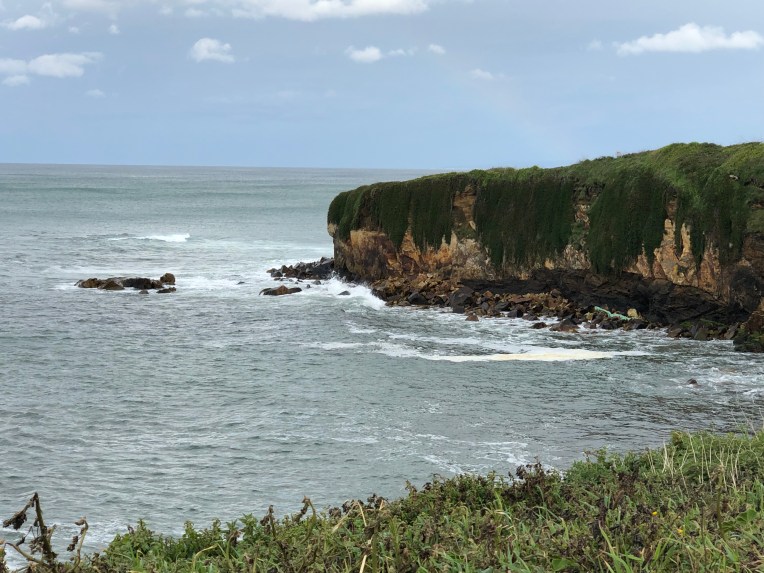
(And another… bit chilly on that beach today though)

Now… cast your mind back a few days to when I told you we had to change plans and go along the northern coast because of snow and low temperatures inland here in Spain. Because of that snow forecast we are in exactly the right place to avail of this opportunity to meet. I can’t wait! That’s pretty magical snow!

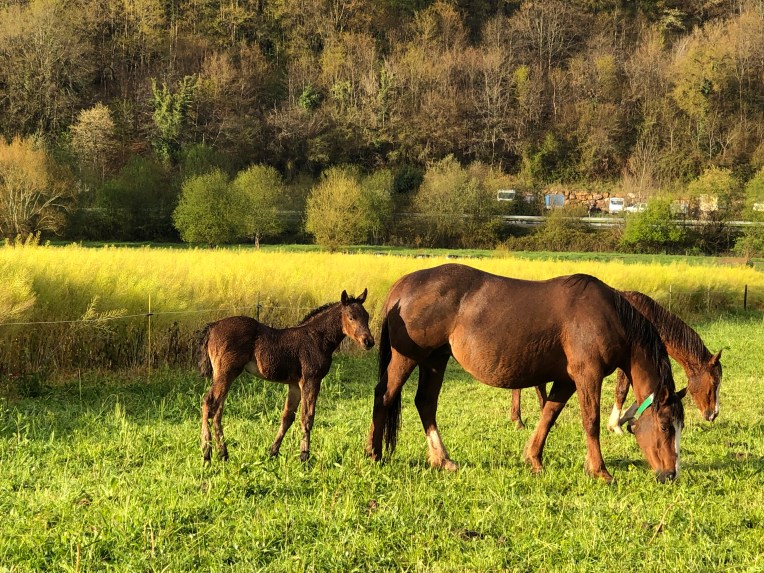
(The horses wear bells too)

Isn’t life amazing, it organises perfectly well on its own? Mairead.

PS. My sister (yes, the lovely one) will be singing on the Late Late Show tonight. She’s part of a choir at work, they got an amazing opportunity… the whole story will be on the show. I’ll have to wait until it gets to the RTÉ player on Saturday morning. You won’t want to miss it… well I don’t want to miss it, can you watch it for me?

(There we are on the coast in a town called Foz, €13 includes electricity, toilets and WiFi)

Night at the Museum

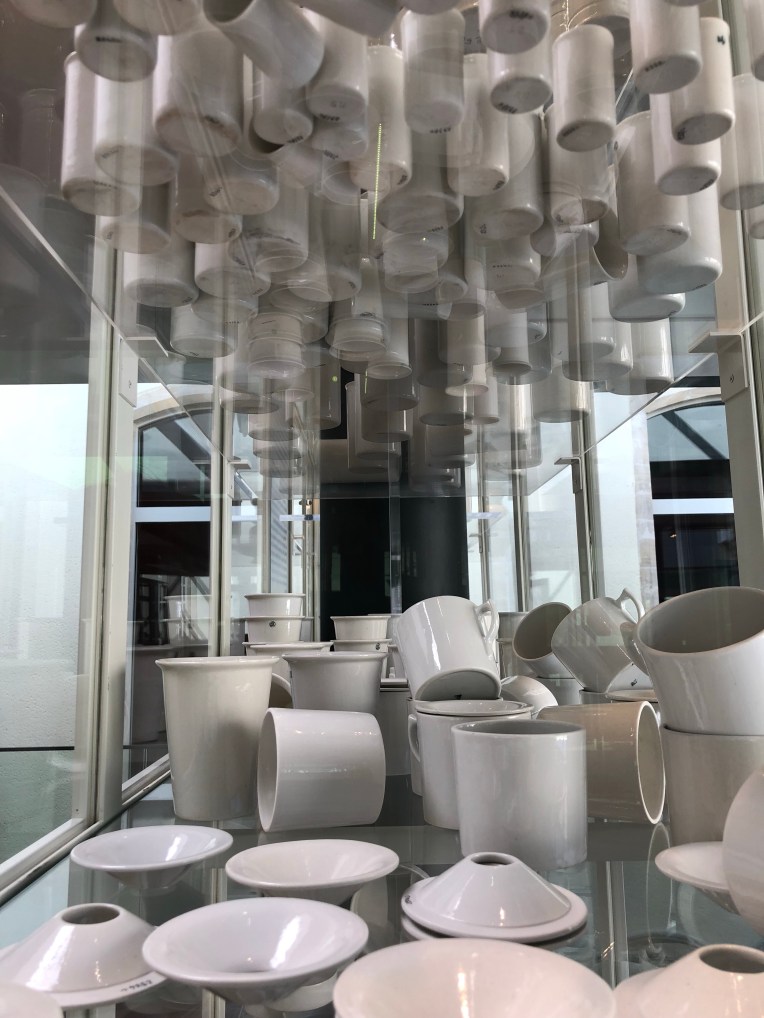
(Glass shelves filled with porcelain from a famous factory in Bayeux, no longer operational)

We have arrived in France! Our ship docked right on time at 4.15pm, at 5pm we were in the supermarket and back on the road by 6pm. We had planned to stay the night at Isigny sur Mer because it was a great place to stay back in February even though we nearly came to blows over the water being turned off… This time the water was turned on but there was no space to spend the night. That was a bit of a shock, it seems this might be the popular time of the year for motorhomes in France…

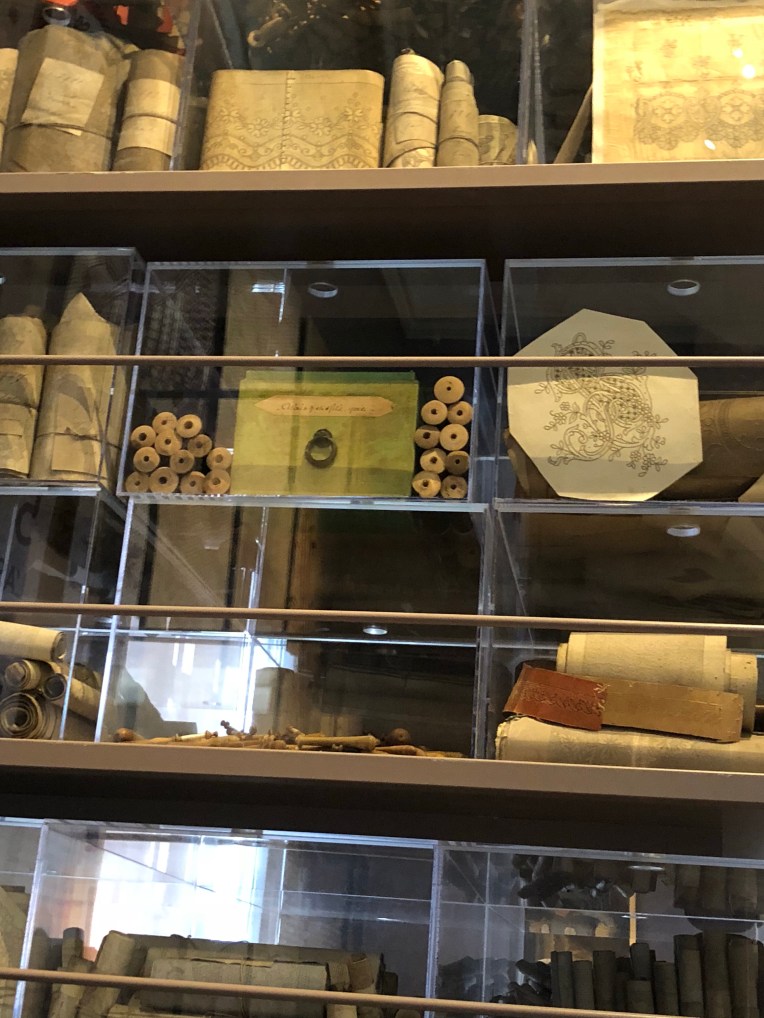
(Tools used to make the famous Bayeux lace)

Denis was not dismayed (I was a bit) so we decided to follow our previous advice to ourselves – take the opportunities when they arrive – we filled up with water. There was a moment of hilarity (not for me but for the watching Frenchmen) when I pressed the button and only half the water reached the tank, the rest spraying me in the face. Oh how we (read, they) laughed… but we were friends in the end because one man came over with a spanner and a bunch of connectors and made all the water go into the tank. I thanked him profusely with the water dripping down my glasses. Denis was in search of even a tiny spot for us to park and came back to see the Frenchman and me smiling at each other… so he smiled along too. He’s very trusting.

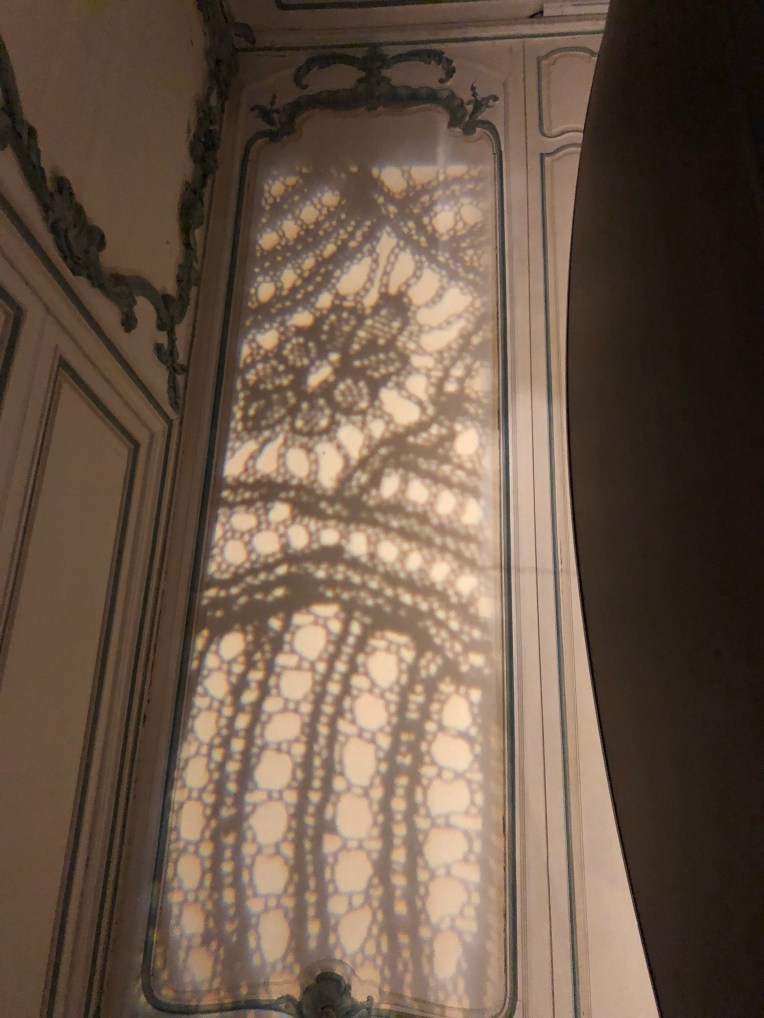
(I love the way the shadow of the lace fell on the wall panels)

It was nearly 7.30pm and I was hungry and tired, not a good combination – for Denis. There was nothing to do but head for another location and hope for the best. And we did really well. Half an hour later we were pulling into the parking area of a museum in Bayeux with plenty of space. The joy of finding a place cleared my hunger and tiredness so we locked up and took a walk into town. We had only reached the cathedral (very lovely looking building) when the hunger and tiredness returned. We raced (as only people of our levels of fitness can) back to Ruby, made dinner, washed dishes and straight to our lovely comfy bed, our first night back in France.

(Isn’t that just adorable? The antique chairs up hight out of harms way)

Then this morning we visited two very good museums. We took an early visit to the  Bataille de Normandie (100 meters from our parking spot) and saw a concise overview movie of the invasion of Normandy. For some reason that whole episode in history makes me tear up. After that I went to see the MAH-B. It’s an old restored town house with the history of the area told through art. So that includes prehistoric pottery, Roman artefacts, paintings,  lace making and modern porcelain. It was unique in the way it was designed, very simple but with style, very French. Very lovely.

(Very lovely French restaurant opposite the cathedral, Bayeux)

We’ve moved on again tonight and are behind the sand dunes of a Normandy beach. We can hear the waves, an insomniac seagull and we are so close to our neighbour’s motorhome we can hear him snoring.

All is well, Mairead.

Sorry we’re late…

2018 4

(There’s Denis with the rusty canons at Sagres Fort)

It’s different on the way back. We’re on our way back. We have been passing places we stayed in on the way out to this edge of Europe and now it’s different. On the way out at every parking spot it seemed like anything was possible. Stay for the night? Stay for a month? Come back again? Put off that tour, sure won’t we be back this way? It seems like the only restrictions were electricity, water and permission to stay.

2018 3

(More flora from the fort)

On the way back there’s another restriction. Time. Time moves more slowly in Portugal and not just for us. If we had places to go and people to meet then we might be frustrated by the laid back approach here. We might be… but we are not because we had neither places to go nor people to meet. That is changing. Fortunately for us it is changing slowly.

2018 8

(That’s the sound art, from yesterday’s post, to the right of the fencing)

Now we have places to go and people to meet. We have a ferry to catch and on the way we are meeting good friends. They will put up with us if we are late or if we just want to sit and stare at the sea or if we have nothing to say. They will give us electricity and a parking space and hot showers and if things work out like last time they will even feed us beautiful French food.

2018 5

(The view towards the east from Sagres Fort)

Hopefully by the time we reach Ireland we will know again how to be at a specific place at a specific time. Hopefully, we will successfully bring the car for it’s NCT while remembering that it needs a new battery before we can even get it out of the driveway. Hopefully, we will increase our trips to the washing machine and to the shower to allow more sweet-smelling encounters. I think we’re nearly ready but forgive us if we’re not.

2018 11

(Sunset looking at the lighthouse from Sagres)

We buy flexi tickets for the ferry each year, they allow us to move our booking if we need to. For things like snow and ice on the way out in February to staying longer on the way back. We’ve never used them but it seems this will be the year of flexibility so we changed our tickets. We even got a refund… of €5! But we’re not staying longer, we’re coming back sooner.

2018 9

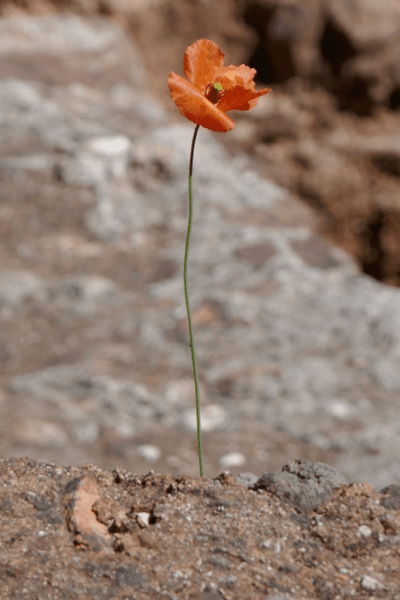
(A single wild poppy at the castle in Silves)

While we were away the date for the Repeal the 8th Amendment Referendum was set and it turned out to be the day before we were due back. So we would miss it. That played on my mind. I have never considered myself political. I voted because I had the vote and my vote was hard-won for me by women who were long dead. But I never thought my vote made a difference… until the Marriage Equality Referendum. That’s when I realised, it’s not just the vote that makes a difference, it’s how the question, of which way I will vote, makes me different. It makes me reflect, which I love to do anyway but usually I reflect on myself! Why I’m here, what something means, how will I do this or solve that… But the reflection related to voting makes me think about others. I think it teaches me compassion and that’s what being political means to me.

See you soon… but I’ll probably be late. Mairead.