My dark January.

14 1a

(From winter in Cashel 2010)

It’s January. For me that’s the time of year when my energy is at its lowest. When the winter has been long enough and I want some spring….. now! I want it now like my two-year old self wanted chocolate…. but Spring’s not ready yet. So I have to practice patience.

14 1b

(Spider art)

I thought this year it would be different. I am occupied and preoccupied by my course and I thought that would help me forget it was still winter. It hasn’t. Instead it’s shown up further “issues”. When I’m lacking patience with winter I also lack patience with everything else I meet. I am lacking patience with the accounts (my old foe), with my latest assignments, with housework, with bills, with Denis, with myself.

14 1d

(The lovely side of winter)

I had forgotten it all started with January and I was thinking, “these blasted accounts again”, “how can I ever get this history of art done?”, “when does housework finish?”….. but these are not the problem. In fact there is no problem, I just miss the light. I miss getting up after sunrise and having dinner before sunset, I want more time with the light. So I must choose… between making problems out of normal life and accepting the season called winter.

I want to choose to accept winter…. how hard can it be? Mairead.

Art Works – David Hockney

Dh david hockney pop art paintings

This is Bigger Trees Near Warter Winter Version by David Hockney.

Besides drawing, painting, printing and ceramics my course includes an art history module where I will learn to write essays about works of art, artists and the art period in which they worked. In order to write about the paintings I will need to learn the language of art and so far although I seem to have the words I don’t have the ability to put the words together. So… I was thinking that I could get some practice here on the blog and…. with your help I might learn faster. So for the first painting I picked Bigger Trees near Warter by David Hockney.

David Hockney at Tate Bri 001

(The artist with another of his pictures – that’s how big they are)

First, let me tell you about the words I have learned. The words are called Art Elements and you use them to describe any painting…. Point, as in dot or dots; Line, as in the shortest distance between two points but in art elements lines don’t have to be straight, they can be wavy; Shape, as in square, triangular, etc; Form, a 3D shape; Tone, I think this is lighting and shading; Colour, shouldn’t be a problem here; Texture, as in you get a sense of what it might feel like to touch; Pattern, as in there’s a pattern; Symmetry, as in there’s balance between one side and the other; Content, as in what’s it a painting of?

David Hockney

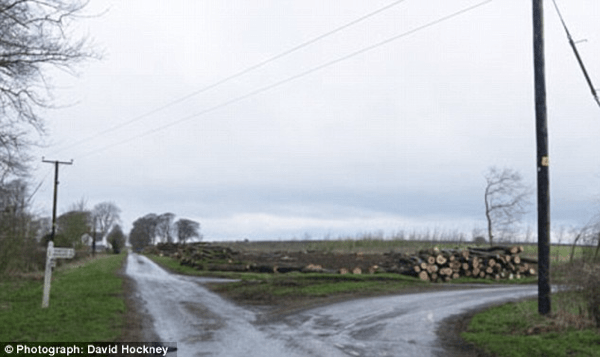
(The trees were cut down before Hockney had finished his painting….)

To describe this painting I want to say – I really, really love this! But that’s not using any art elements. So instead… In this picture the artist definitely includes lines, in the trees, some straight and some wavy. There are also lines for the lanes and the house. He uses colour to show the grass on the side of the lanes and of the trees. The grass definitely looks like it is nicer to touch than the prickly trees so he must be using texture? He is using pattern in the trees repeating on into the distance. I suppose you could say there’s symmetry with the little house on the left and the little hedges on the right. Finally the content, this is a picture of huge trees in winter (without leaves) in the countryside, located between two small country roads with a line of hedges in the right foreground and a house in the left background.

Any help gratefully received, Mairead.

The Personal Notebook

15 10e

(Ira Glass quote stuck on inside front cover of personal notebook)

It’s very early and the temperature has been dropping in the last few days so I’m cold and tired. The perfect scenario for returning to a nice warm bed… but that’s not going to happen. I’m going to type for an hour, get breakfast, a shower and go to my classes. But there’s something on my mind…. my personal notebook. I’d explain here what a personal notebook is but I’m not exactly sure yet myself and I wouldn’t like to steer you wrong.

15 10b

(Printing practice)

The personal notebook has been mentioned at various times since my course began. Initially I thought it was about the things I loved and I started to stick pictures of Monet paintings and patchwork quilts into an A5 notebook. Soon I realised I needed to add my daily drawing practice… and my notes and photographic examples of my notes and the mixed paint cards done in class. Then there was the dark day I realised the personal notebook would be part of my coursework…… It would be marked…. it’s been difficult to add anything to it since then. To be honest it’s always been difficult to mess up a new notebook, especially a nice one. I think that was because I usually judge my efforts and find them lacking. Is it possible someone else judging my efforts will be easier? Unlikely.

15 10c

(Perspective practice)

This weekend I made another stab at messing up my personal notebook (It’s now an A4 hardback notebook) and with the aid of this Ira Glass quote I’m learning to stop judging my efforts and keep up my practice.

15 10f

(Writing and spelling practice)

On a completely different topic, I have learned that the page size numbering system – A2, A3, A4, A5, etc. is all about how many times a sheet that size fits into an A1 (huge) sheet. For example, four A4 sheets fit into an A1 or five A5 sheets fit. That’s why an A5 sheet is smaller than an A4!

Practice, practice, practice, Mairead.

Friday Quote – You can do it!

07 9a

(You see that dot on the picture? That’s a man walking a tightrope between two (very tall) buildings in Niagara….)


“People become really quite remarkable when they start thinking that they can do things.”—Norman Vincent Peale


Our last day on holidays, we’re flying home tomorrow with lots of memories and tons of photos. Thank you Canada – you’ve been great! Mairead.


Japanese Gardens Co. Kildare

23 8a

(The Bridge of Life)

Yesterday we went to the Japanese Gardens. Our admission included a tour of the National Stud (horses) but we just went for the garden and the food. We arrived around midday and it was busy, tour buses and families. Ok everyone with the tour stand by the wall. As luck would have it there was a torrential rain shower as we got our tickets so we had an early lunch. Back in the garden it as a bit too busy for photographs, each time I lifted the camera to point at something picturesque a little one ran up to it. Look Gran-Mam, look at the stone!  But I got a few.

23 8c

(Couple of swans preening at the lakeside)

The garden symbolises the Life of Man. At the entrance you have the choice between the Easy Path and the Rugged Path. Of course we took the rugged path and before long were slipping and sliding on slick wet stones. Maybe the easy path would have been just fine….. We struggled on through the Cave of Birth – tight fit, the Tunnel of Ignorance – dark and wet, the Hill of Learning – more slipping and arrived at the Engagement Bridge. There’s a gap in the bridge and you have to leap (very small leap) across. On the Honeymoon Path there’s a Difference of Opinion and the path separates…  We bravely climbed the Hill of Ambition and arrived at the Chair of Old age.

23 8b

(Entrance to Fiachra’s Garden)

As the sun was still shining we decide to have a look at the Stud or at least the paddocks with the mares and foals, but it was not to be… another shower had us sheltering in the Beehive Monastic Cells. These are modelled on a monastic site found at Skellig Mhichil, off the west coast. A bit dark but very dry we sheltered with a few of the families. This was Fiachra’s Garden. Fiachra was a 6th century Irish monk who left Ireland and founded a hermitage in France. He encouraged manual labour, gardening and giving to the poor  and is the French patron saint of gardeners. His garden here was designed to make us think of this man (and many more like him) who followed a path of adventure inspired by their passion.

Paths can be slippery – be aware! Mairead.