What’s your story?

3 12a

(Mount Usher in Ashford, Co. Wicklow)

The story of our lives is not the story of what happened… It’s the story of what we are. The story that starts “I am….” The story we think we became because of our behaviour or our actions. The story that says this is the type of person I am. This story is probably built up from lots and lots of small experiences and things other people told us…  From the moment we learned the story of us everything that happened after that had to fit into that particular story. It had to make sense in our story. If it didn’t then it got deleted… We become very attached to our story.

3 12c

(Strong, beautiful tree even with all its flaws…)

Like a film maker producing a movie about a famous politician – only stories that agree with the filmmaker’s belief about the politician will be included…. if he believes the politician is a wonderful honest statesman then the stories from his life that show him as an honest and a wonderful statesman will be included. If the filmmaker believes that the politician is a dishonest scoundrel then the film maker will depict stories from the politician’s life where he is dishonest and a scoundrel. The filmmaker may be completely honest in his choices, i.e. he truly believes the politician is honest or he truly believes the politician is dishonest.

03 12d

(At the boundary of Mount Usher there’s a fence. Beyond the fence there’s a field with very old trees. You can either see the fence or shift your focus a bit and see the trees…..)

Same with our choice of what fits into our story – the movie of us. If the story we truly believe about ourselves says we are flawed then we will only include the times we have been flawed into our movie. Even if we have been a good friend at some point in our life we will delete or distort that memory and remember instead the time we were a bad friend. This is in order that our flawed friend story remains intact. If the story of you says you are flawed then fortunately, you can start again with a new story.

Choose something in your story you don’t like and start to notice the opposite. Mairead.

Art Works – Caravaggio.

26 11b

(Clare street looking onto Merrion Square – notice the perspective!)

I saw a documentary on Friday in class about Caravaggio (1573 – 1610), his full name is Michelangelo da Caravaggio. Poor guy, he had a difficult life, one of his parents died when he was five and the other when he was eighteen. He was also literally poor and lived in the poor part of town. Unfortunately he was also easily offended and regularly got into fights, once killing a man in a duel. Paradoxically he was also very religious, taking the bible stories very seriously and wanting to bring them to life in a truthful and lifelike way. At the time this was not the accepted practice. Art was nice and paintings of the saints were pretty. Caravaggio changed that.

26 11c

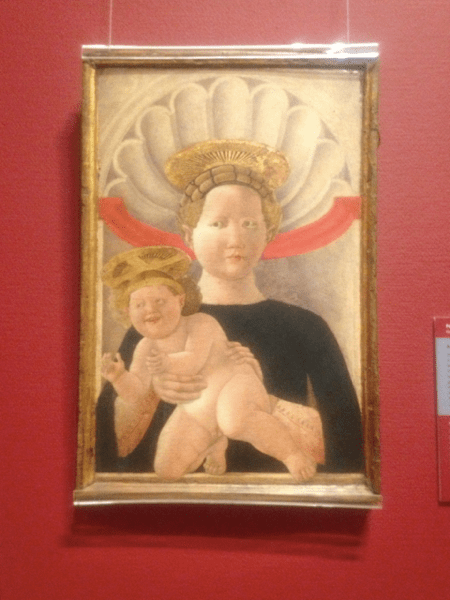
(The Virgin and Child (1440), Paolo Uccello, you can take a no-flash picture of this one – notice the baby’s feet are out of the frame)

He used ordinary people, those he met in the taverns as his models. Once when he painted the Death of the Virgin for a convent, the nuns returned his finished painting as it was too realistic – she looked dead! Of course it probably didn’t help that the model was dead, and when she was alive she worked as a prostitute…. He was very offended by the nun’s action. Another painting, Doubting Thomas shows Thomas’ finger going into a realistic looking deep cut under Jesus’ rib cage – not pretty.

26 11a

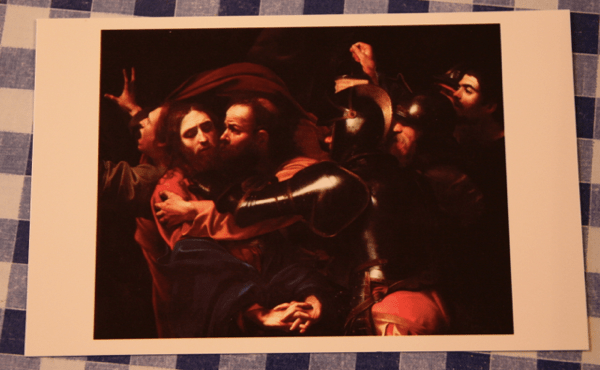
(Postcard of Caravaggio’s The Taking of Christ (1602) – four hundred and ten years old. Not the postcard…)

He was thirty-seven when he died, in mysterious circumstances. His behaviour (the fights) may have been caused by the lead in the paint he used or maybe he was just sensitive… On Saturday I went into the National Gallery in Dublin to see his The Taking of Christ, no pictures allowed but I got a postcard.The first time I saw this painting I was struck by the shiny armour of the soldier, it was only on a subsequent visit that I realised the illusion of shine was created by paint and a very talented (if tormented) painter.

You don’t have to be happy to create art… or buttons… or crochet…. or stories… or cakes… or….  Mairead.

Practice makes perfect…. bit by tiny bit.

08 10a

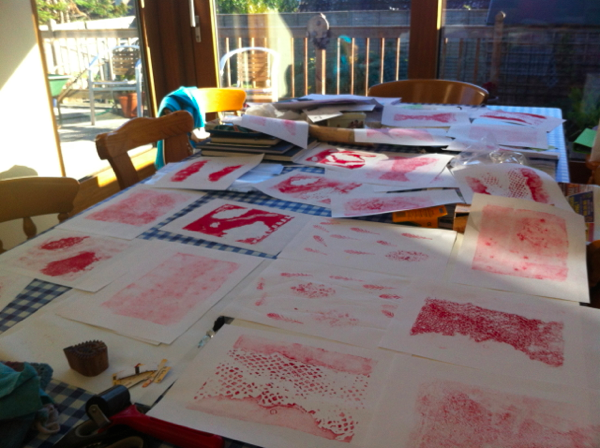
(Printing practice)

It’s before dawn on an autumnal wet kind of day here in County Wicklow. I’m up early because there’s a lot to do before I leave for my classes. Today it’s drawing… not my favourite but I want to improve so I continue to practice. Last week on my day off I found myself near the National Art Gallery on Merrion Square. Although I do love to visit, usually I go there only if I have time to kill while waiting for an appointment or a meeting. When I realised how close I was I went there purposefully… to practice my drawing.

08 10b

(Printing practice… possible wallpaper design?)

Practicing my drawing might seem straightforward, all I need is a pencil, paper and a subject, right? No. Well, yes I do need the pencil and paper, but I carry those with me all the time now and non-moving subjects are readily available. There are other requirements… 1.Making a choice – it is sometimes tempting to wander from potential subject to even better potential subject  and the available time is gone before I have even started. 2.Opening the notebook – it is also tempting to wait until the coast is clear and there is none nearby before I open the notebook and take the pencil in my hand…. (“Oh look, someone drawing”). It’s scary but I must be brave.

08 10c

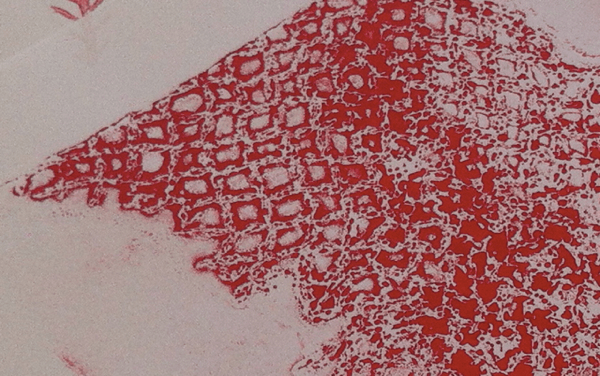
(Printing practice…. using a net the oranges come in)

3.Making a start – possibly the most important requirement, the potential for disaster is huge. Well… disaster might be too dramatic a word but if I don’t start there’s no drawing. 4.Perseverance, defined as, the steady persistence in a course of action, a purpose, a state, etc., especially in spite of difficulties, obstacles, or discouragement. Very useful because at this point there are many thoughts going through my head…. You don’t have enough time. On consideration, this is not a good subject. You need more practice to attempt this one. There’s someone coming, quick put your notebook away! What about a nice green tea and a scone instead? Time’s up!

08 10d

(Then we went for lunch)

So much of what I’m learning on this course of drawing, painting, printing and ceramics can be applied to any area of life. 1. Make a choice. 2. Open the notebook – be willing to be different. 3. Make a start. 4. Persevere in spite of difficulties. Last week in the art gallery I found a statue, sat down and practiced drawing and my drawing skills are improving… a bit…. very slowly, so I’m learning patience too.

Go Practice, Mairead.

PS not ready to share the drawing practice…. yet.

The rainy season has arrived…. time for a story change!

25 9a

(Lovely day in Cashel, Co. Tipperary on Saturday)

It rained all day yesterday and it looks like it’s ready to do the same today. As always it’s funny how I get used to the weather and think it’ll never be any other way…. then it changes. At the weekend it was dry a little cold and sunny, I thought that was going to last, in fact I can’t remember where I put my rain coat and I don’t remember when I last needed it. It’s like the story of our lives…..

25 9b

(Livestock in the grounds of Cashel Palace enjoying the sunshine)

When we’ve got past childhood and we’re making our way in the world we take with us lots of goodies. We’ve got skills like cooking, organising, speaking French, etc. We’ve got lots of baddies too, like nail-biting, eating with our mouth open, etc. And we’ve got our story. The story that defines us, tells us and the world who we are. Trouble is we are not completely aware of our own story. We’re not completely aware of the story of others either but at least we see their behaviours.

25 9c

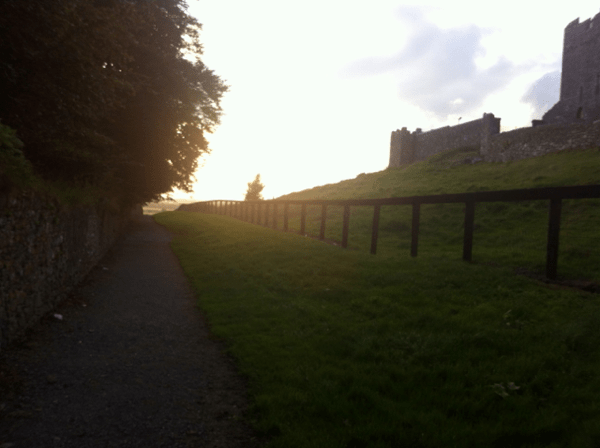
(Evening walk beside the Rock of Cashel)

When someone’s behaviour includes repeatedly putting themselves down, you can be sure their story includes a reason to be put down. When someone repeatedly allows others to bully them you can be sure their story includes them as the victim. When someone repeatedly makes fun of themselves, you can be sure their story includes the fool. But there’s good news, we can rewrite the parts of the story we don’t like, the parts that we notice when we notice our behaviour.

25 9d

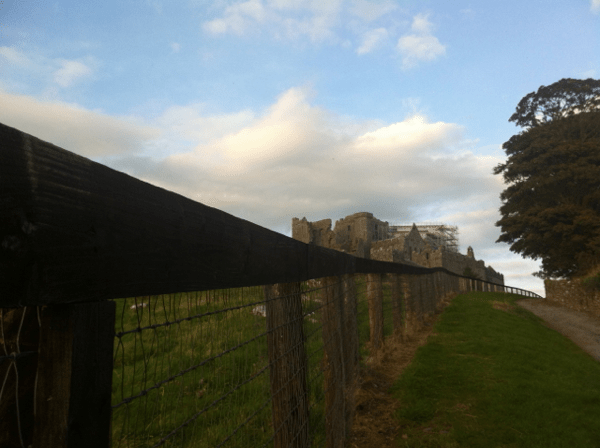
(Fence post perspective)

We don’t change it by putting ourselves down – that’s just more of the old story. We change the story when we are inspired. When something lights you up, lifts your heart, or just plain interests you – wallow in it!  Play with it. Allow it to inspire a different story.

What lights you up? Mairead.

The Walking Machine…. another gadget or a guru?

16 8a

(Collage)

We have a walking machine, we’ve had it about six months now. Having one doesn’t contribute to good health but using one might… I’ve started using it. It has an added benefit of allowing my mind to drift away and have some interesting non-worrying thoughts. Yesterday I was walking along when something popped into my head about noticing the stuff I do that’s ok.

29 6e

(Notice the pretty patterns… instead of the peeling paint)

Usually when the drift away thoughts come into my head they’re in the form of a big picture concept. Like a collage and it takes a little time to look at all the details in the big picture. After that it’s possible to unravel the concept in order to talk about it. I’m unravelling it this morning. In normal life we have the tendency to notice what’s wrong. With the weather, the newspaper article, the dinner, the artwork. Sometimes in our work it’s necessary to notice what’s not right, in order to fix it, make it right. So when we consider ourselves we use the same logic – notice what’s wrong in order to fix it.

29 6f

(Notice something beautiful about this picture)

Other people help us in this work – they notice what’s wrong and they tell us! But I’m not so sure this works well… Mark Twain said If you always do what you always did, You’ll always get what you always got!  So it might be useful to try something different. My big picture was… What if I began to notice what was right? What if I ignore (for a certain period of time) what’s wrong and notice what’s right?

What’s right with you? Mairead.