Soaring at Soure

2018 9

(Cars go down this street… granted it’s one way)

We have arrived in a really friendly town, called Soure. Initially we had been pronouncing it Sewer but we discovered it is pronounced Soar – much more appropriate. There’s a castle here and if the torrential rain will just hold off for fifteen minutes I’ll go and get some photos and maybe a little historic information. There’s also a museum so I’m definitely going to that. Two rivers meet at the town’s edge and there are lots of old bridges, one particularly narrow. Thankfully they have put lights on it so only one car can go across at a time. There’s a library here too, with free wifi. Denis spent some time there yesterday afternoon, so I’ll have a look today.
2018 3

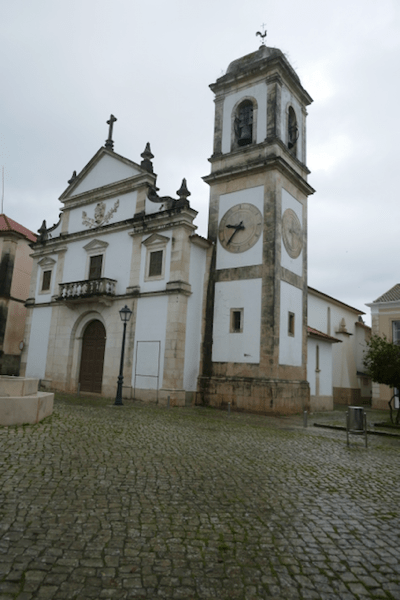
(Igreja de S.Tiago… big clock)

When Denis got back from the library we went off for a walk around the town, hopefully I will have pictures by the time you read this, if not,I can tell you: the streets are narrow and cobblestoned with old buildings. We stopped off at a cafe for a drink and when Denis got up to pay, one of the customers came over to talk to him. It was the chief of police (I think that’s what he said) and he wanted to welcome us to Portugal! He had brilliant English and he was very familiar with the history of the area and of Portugal.

2018 1 2

(Here you go, Grahame! From one police officer to another!)

He told us that Soure was given a charter by the King in 1111 for its critical role in the war against the enemy at the time (Moors I think). Our friend, the chief of police, had travelled a lot in his work and I guess he recognised that travellers like to meet the locals. We certainly liked meeting him. He introduced us to the Lupin bean, something the locals were nibbling alongside their drinks. Never heard of it before but it’s on Wikipedia if you’d like to find out about it.

2018 7

(Stained glass window in Igreja de S.Tiago. Now I’m wondering if that’s a shell on his hat and if Igreja S.Tiago is the Portuguese way of saying Church of Santiago? Is Soure on the Portuguese Camino de Santiago?)

He also told us about roman ruins at Monografico de Conimbriga, just 12 km from here. I’ve searched for them on Trip Advisor and  they look and sound very interesting so we’ll head off to those tomorrow. We chatted happily for about an hour and then Denis and I left in great form to find the local tapas restaurant. It was dark so not easy to find. I was hoping for a sign… when I looked up and saw a Guinness sign….right over the tapas restaurant! I guess that was a sign. We had very tasty chicken gizzards in a spicy pepper sauce. Yum!

Main message from our new friend: Portugal is very safe and you guys are very welcome over here! Mairead.

Pictures in a Museum

20 05a

(The Jewish Cemetery is outside and photography is allowed here)

We went to the Jewish Museum yesterday. It was a beautiful sunny day and the streets were packed. The museum was also packed. It’s not an ordinary museum, it’s a synagogue, the Pinkas Synagogue with small rooms and winding staircases. You have to get up close and personal with the other visitors. On entering you see the walls are covered in writing, very neat letters, names and dates of births and deaths, every space on every wall covered. There are 80,000 names. They are people who lived in the area that is now the Czech Republic during the second World War, but because they were Jewish they were killed. There are so many names it’s hard to take it in and anyway you don’t want to take it in, so you keep walking. It goes in on its own. Photography is not allowed in this part of the museum.

20 05b

(These are old graves)

I had heard there was an exhibition of children’s art upstairs in the museum and we went to see that. In 1941 the German occupying army started deporting Jewish people to a transit camp called Terezin, north of Prague. The church leaders deterred in the camp at the time considered it imperative to take care of the children, in a particular way. They wanted them to know about their heritage and they wanted to help them cope with their life in the camp. So there were lessons. Including art lessons.

20 05c

(It’s very crowded but a seed has managed to take root and is growing into a strong tree)

A lady called Friedl Dicker-Brandeis had studied art at the Bauhaus (one of her teachers was Paul Klee.) She was a painter and she took on the role of art teacher to the children. She was very clear in what she wanted the children to gain: understanding, communication, self-expression and a channel for their imagination and emotions. By the time she was transported to Auschwitz in 1944, she had hidden two suitcases full of children’s drawings (4,500). These were found after the war and given to the Jewish community. Photography is not allowed in this part of the museum either. The art in the glass cases show dormitories, guards, gates of the camp, and ordinary things like the sun, friends, flowers. Most of the pictures have an exhibit card that records the artist’s name, date of birth, of death and title of picture.

20 05d

Everything can be taken from a man but one thing: the last of the human freedoms—to choose one’s attitude in any given set of circumstances, to choose one’s own way.” Viktor E. Frankl, an Austrian neurologist and psychiatrist as well as a Holocaust survivor.

We’re leaving Prague today and travelling to Krakow, Mairead.

Free trip to the barracks.

04 03b

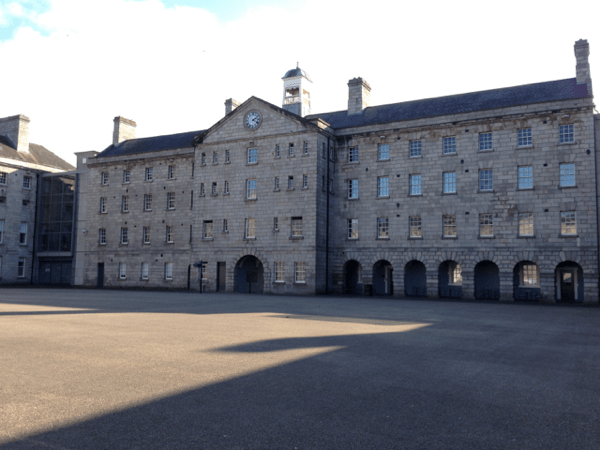
(Decorative Arts and History Museum, Collins Barracks, Dublin 7)

We went to visit Collins’ Barracks in Dublin yesterday. I had never been. It’s just twenty minutes walk from O’Connell Street and right beside Heuston Train Station. It has free parking and free admission. We were there because I was searching for some button history and I heard the museum had a permanent exhibition of Irish clothes, jewellery and accessories. There wasn’t much on buttons but there was lots of other stuff.

04 03c

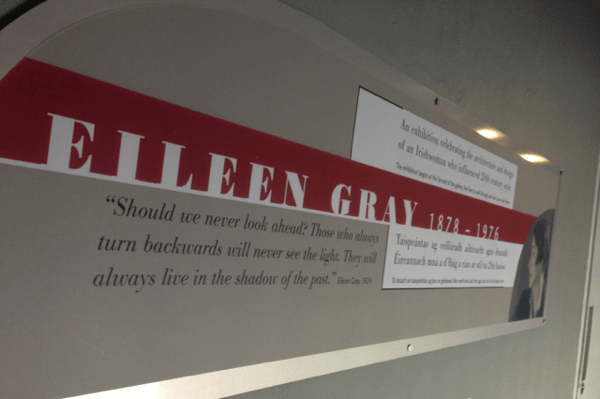
(Quote from Eileen Gray)

There was a huge area dedicated to the  life and work of Eileen Gray. She was “an Irish woman who became one of the most influential designers and architects of the 20th century.” (from the brochure.) She was still designing and working on a project when she died at 98. She had a design shop in Paris in 1922, where she sold her furniture.

04 03a

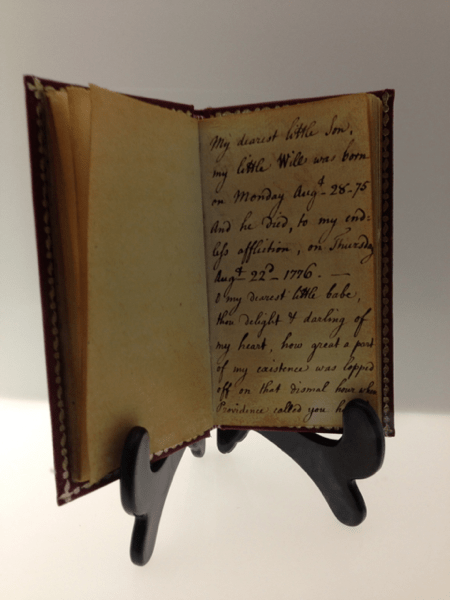
(This little book is about four inches high)

But the exhibit that had the biggest impact on me was in a glass case with no description or explanation. It seemed to be from a mother to her now dead son, Will, telling him how much she loved him and how much she misses him. He died on the 22nd of August 1776, he was almost a year old. It is sometimes difficult to connect with the characters of history, with their odd clothes and unfamiliar lifestyle, but I have no difficulty connecting with Will’s mother.

We’ll be back, Mairead.