Son of Alcacér do Sal

(Statue of Pedro Nunes in Alcacér do Sal)

After Setúbal we moved to the town of Alcacér do Sal. We were here last year. You might remember it was the place I built up the courage to ask someone to tell me their story?
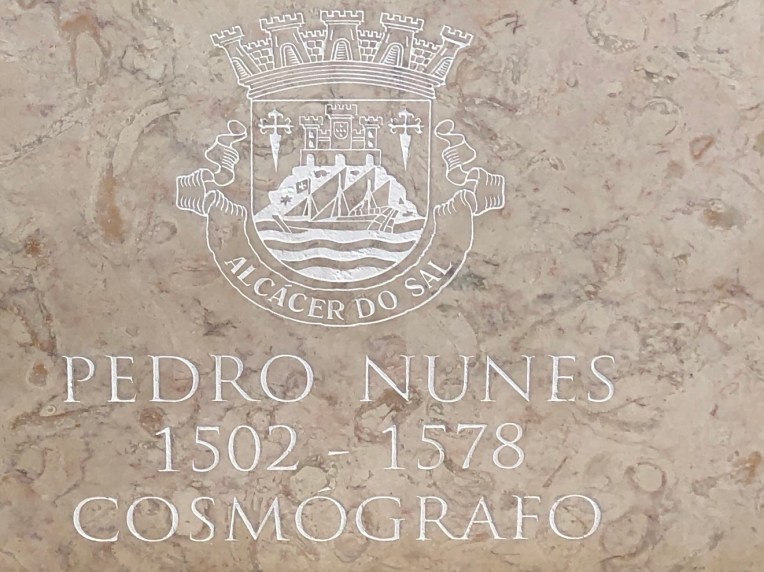
(Famous guy born here)

The weather was beautiful and we settled down in a parking space on the banks of the Sado river with views of the town. From the van I could see, across the river, the statue in the first picture above and remembered seeing it last time too but I couldn’t remember who it was.
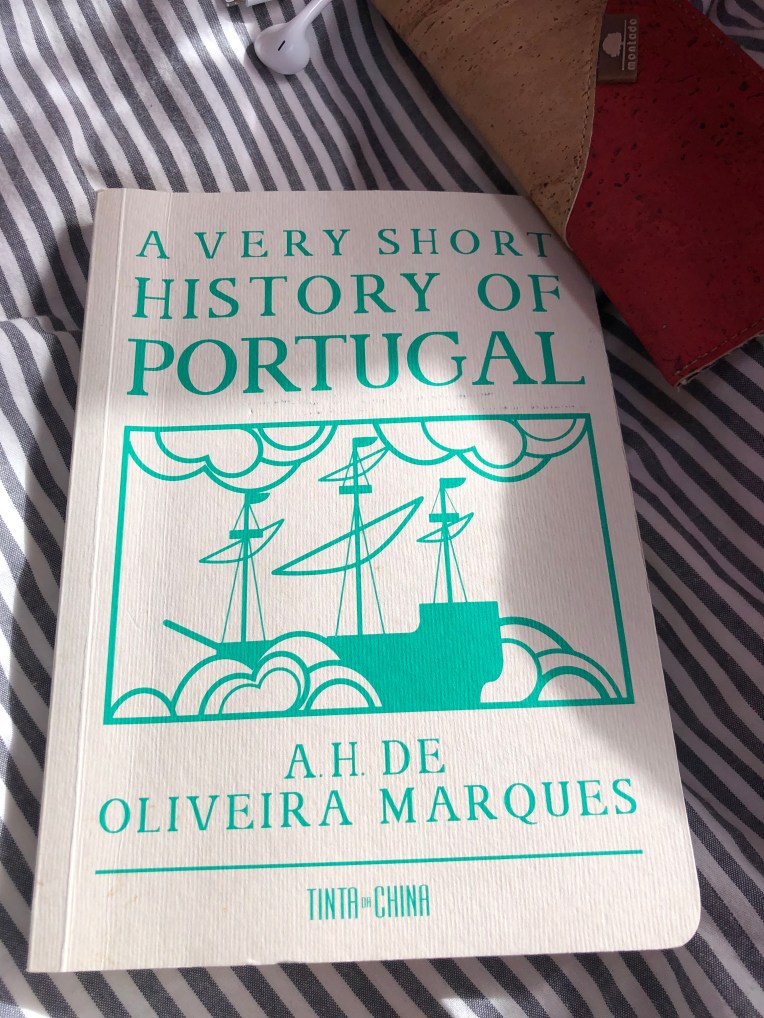
(Bought the book)

When we were in Porto on the morning before our tour I spotted a pretty book shop. There’s lots of lovely book shops but what made this one so interesting was there was a book in English in the window. It was called A Very Short History of Portugal by A.H. De Oliveira Marques. I have wanted to know more about Portuguese history since first going to the town of Beja two years ago. At one of the old churches I met a lovely guide with very little English but loads of passion for the history of his town and country. So of course I bought the book.

(Night time in Alcacér do Sal)

Now I have learned something very interesting from this book. That is to, Read the Title. Read it a few times to be sure this is the book you want. I read the title and was immediately attracted by the fact it was in English. Then it said Short. In fact it said Very Short. Excellent. Unfortunately, it was missing one word. Simple.

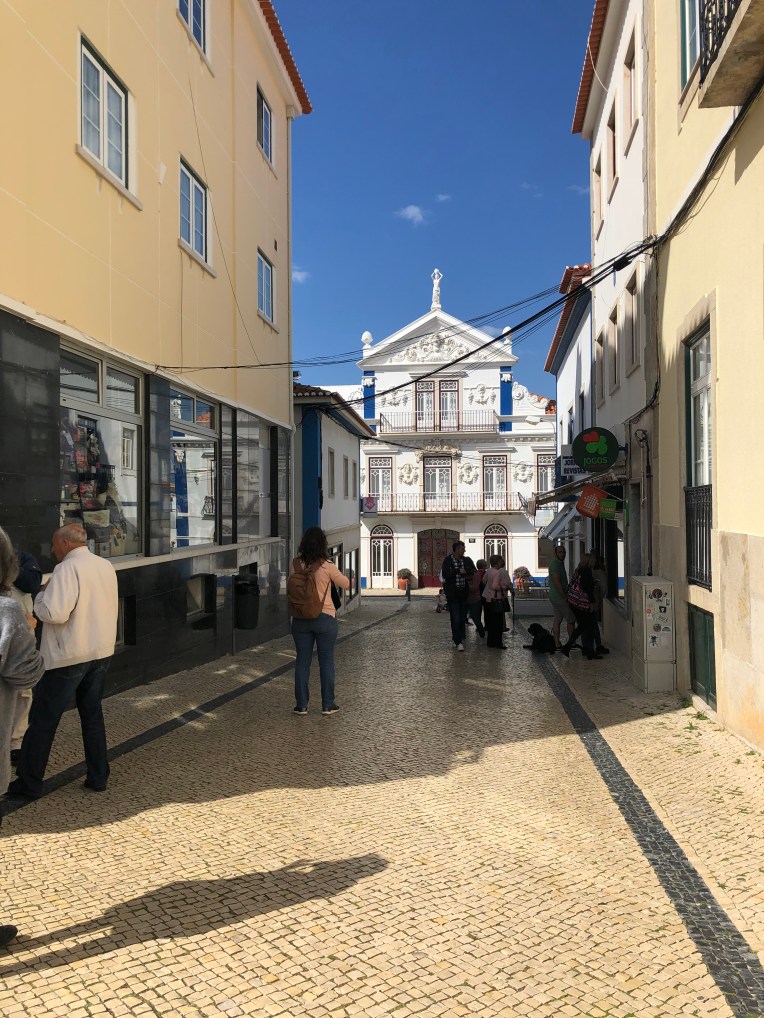
(Cute narrow streets)

The history of Portugal is long because a lot happened since man arrived here more than 4000 years ago. The author of the book is a renowned historian, he has degrees from all over the world, he was a professor in Portugal and Germany and America and he died in 2007. He has a lot to say. Making it very short was probably really, really difficult for him and he never promised simple. I thought short meant simple. So I pushed it to the back of the craft cupboard to lessen my guilty for not reading it.
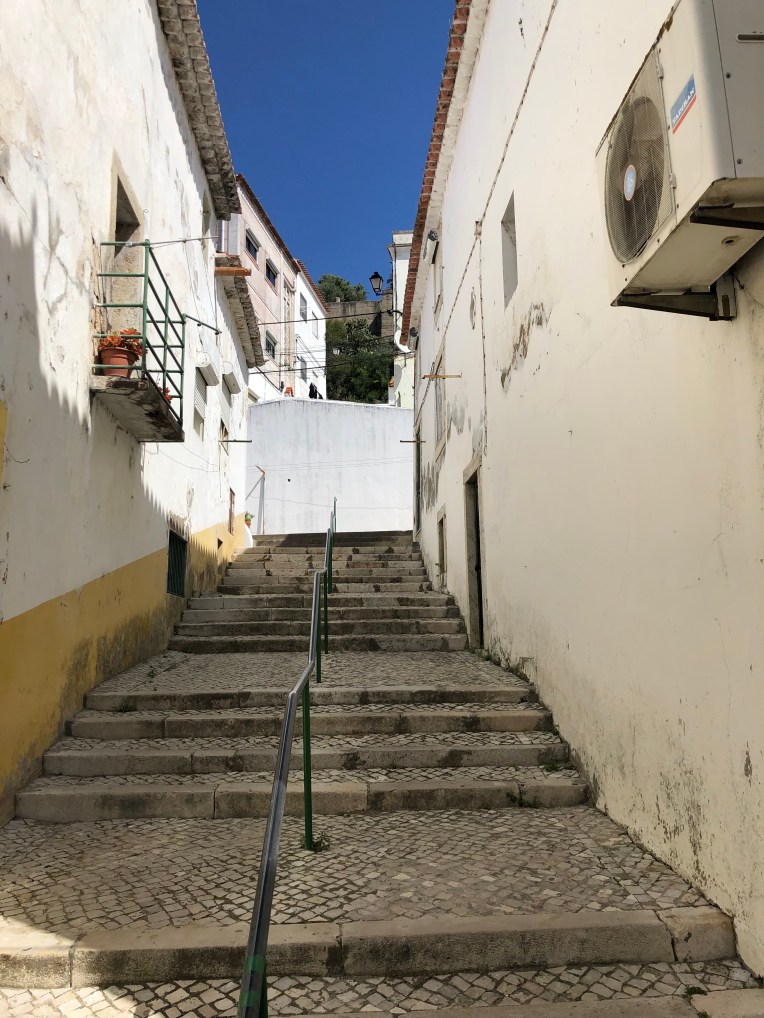
(And loads of steps)

Then I saw the Pedro Nunes statue and he was born in Alcacér do Sal, I wondered… I couldn’t find him in the book, he’d probably in the long version but I googled him and he invented something complicated for navigation. He was also a professor. What I did find in the book was Portugal in the 1500’s started getting into exploration and were really good at it. The king was interested and he provided the money to make it possible. They more than any one else proved through experience that the world was round. By 1640 things were going bad though, wars, fighting with neighbours, king issues. But for a short period of time Portugal was the smartest and richest country in the world.

Anyone interested in a barely used very short history of Portugal? Mairead.

(That’s Alcácer do Sal south east of Setúbal. Free parking by the river, public toilets nearby. There’s also a nice municipal campsite outside the town and a great tapas restaurant up the hill)

How to sit in nature…

(I loved this place)

After Lisbon we went to Setúbal, the place the train would have brought us to if we’d stayed on board. We arrived on a decent sized road and as often happens our sat-nav system decided we would appreciate some short cuts through the town. We never appreciate them.

(Early morning at Setúbal)

After a couple of reverse back up hill maneuvers we stopped obeying her (she has a female voice) and stopping in the middle of a junction to work out which direction might be widest. The locals were very kind, they did not beep, they’ve probably seen this many times.

(The town is very green and pretty)

Eventually we found the best route to the municipal campsite. Although the road was narrow the view was immense. It was Sunday afternoon the sun was shining and we got the last spot facing the sea. A light breeze made the perfect accompaniment to my cup of tea with a view.

(With lots of art)

I had been in training for this moment since the Spanish beach at Foz and I knew what to do. Sit, sip and smile. That’s what I did for two days.

(The world definitely does)

We had arrived without going to the supermarket (big mistake) and there were no shops or restaurants nearby so when the last pot noodle was eaten we had to leave paradise.

There’s no bread in Paradise, Mairead.

(There’s Setúbal, Municipal Campsite, €12 parking, electricity extra, magnificent toilets and showers included, sea front spot if you’re lucky)

Lisbon… Part 4

(Waiting for the bus)

We were pretty much finished in Lisbon after our scooter trip but before we left we had a Nata in Belém. No, not at the place with the queue. Then we waited for the bus.

(25th April bridge takes cars on top and trains underneath)

I mentioned previously that there was a transportation theme to our Lisbon tour. There was another theme: the 25th April bridge. So far we had driven over the bridge the previous Thursday, sailed past it in the ferry that morning, sat underneath it between scooter trips in the afternoon and now we were going under it.

(Red ticket machine and green ticket machine. The red one is for going over the bridge)

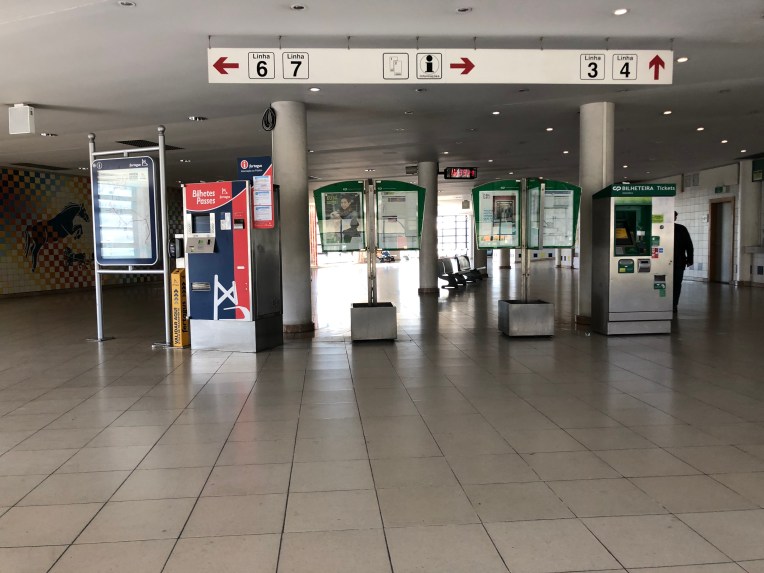
The 25th April bridge is a double decker bridge and the train between Setúbal and Lisbon goes under the motor vehicle deck of the bridge. We took a bus to Campolide station, north of the city. At first we couldn’t find the right ticket machine or the right line but eventually we spotted the colours of the machines were different… there were two train lines.

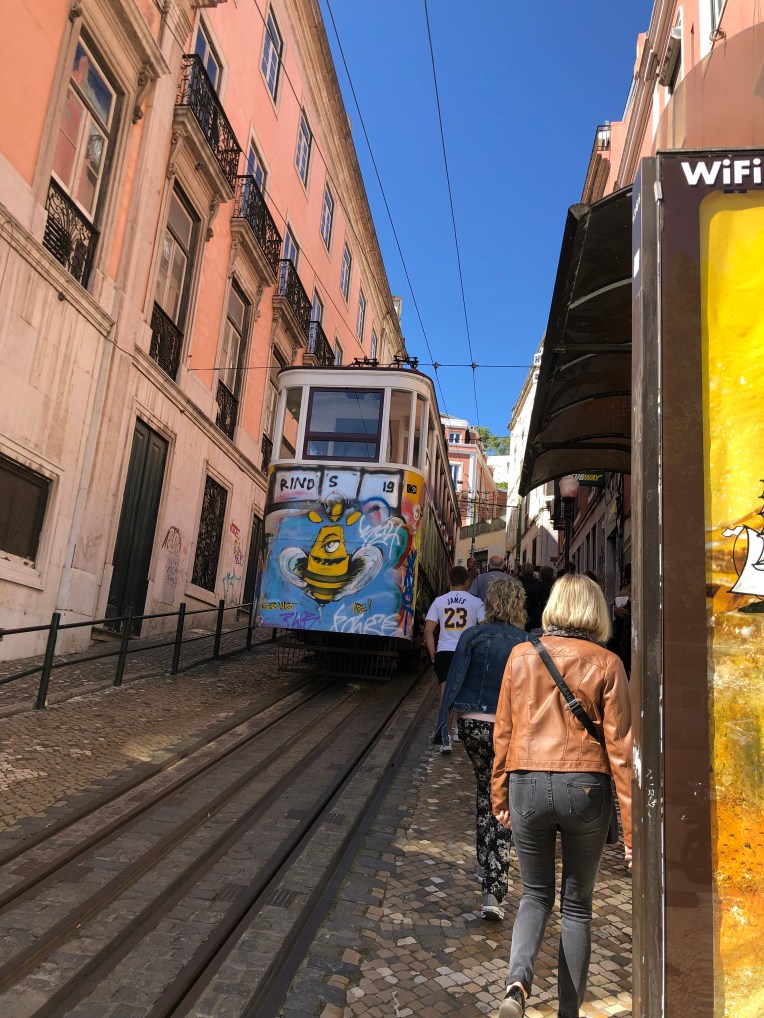
(Although we got very close to trams we never did get on one…)

The train is a two level commuter train and it was packed so I have no pictures but if you get a chance it’s well worth travelling on it to see unrestricted views up and down the estuary. Stand near the doors for the best views. Two stops are we were back at the beginning.

We walked home, tired and sun-burned but happy, Mairead.

Lisbon by Train, Boat, Tram and Scooter – Part 2

(Long queues to get on Ascenoir da Glória)

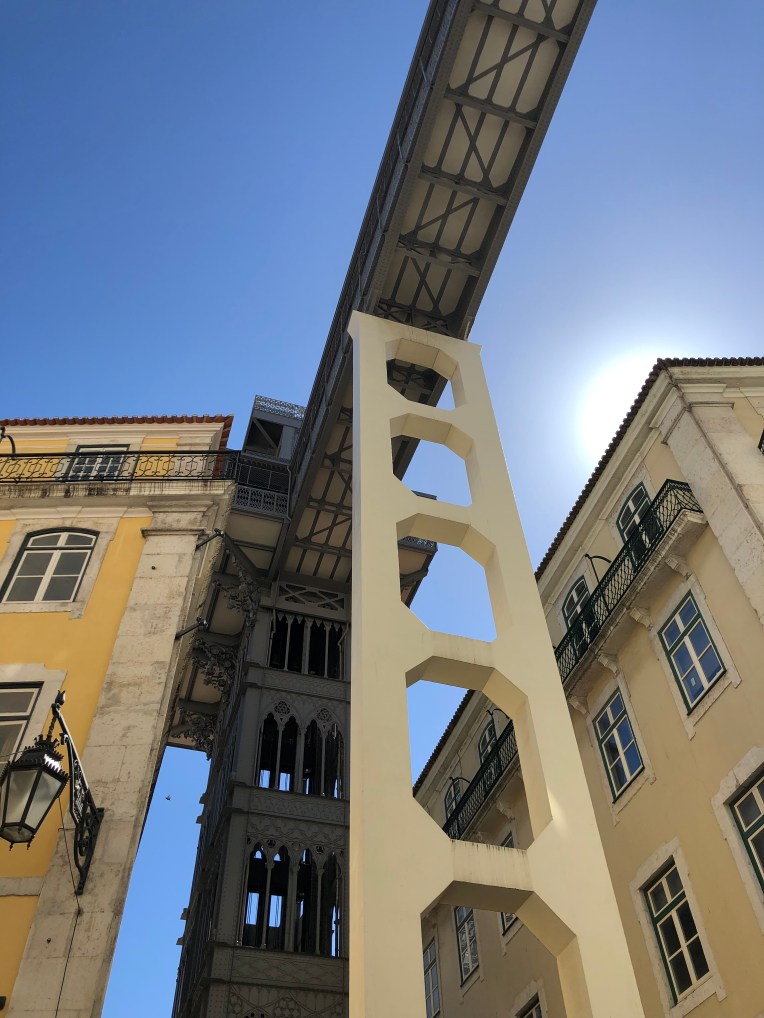
You might be already aware of a transport theme on our tour and as soon as we had descended the Ascenoir da Gloria we went in search of our next vehicle. I was hopeful we would be ascending this time but it was not to be. (Top Guide Tip: Saturday’s are busy, you may encounter long queues, consider moving your tour to a weekday.) Our next stop was the Elevador de Santa Justa. This is a lift and was built in 1899 to take the citizens of Lisbon up the steep hill. It’s still doing that nearly 120 years later.

(Elevador de Santa Justa from the back)

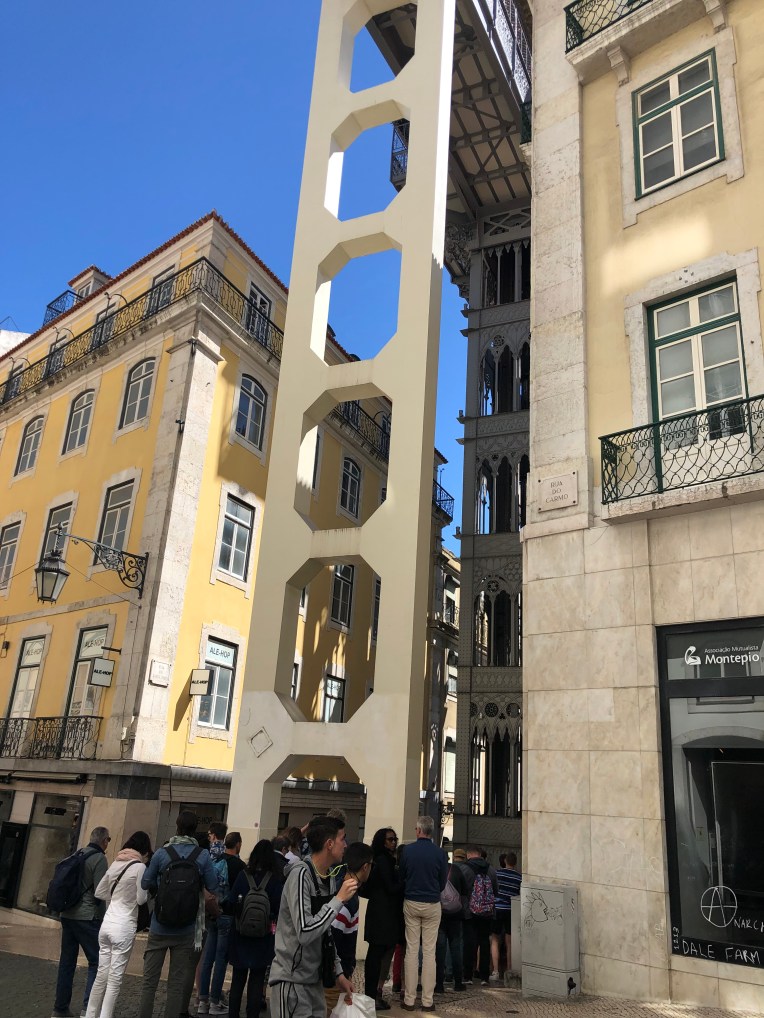
The queue snaked around the lift and up the path. It would be along wait as the lift could only take 29 passengers. My “client” said he was ready for lunch so we moved on.

(Queue to go on the Elevador de Santa Justa)
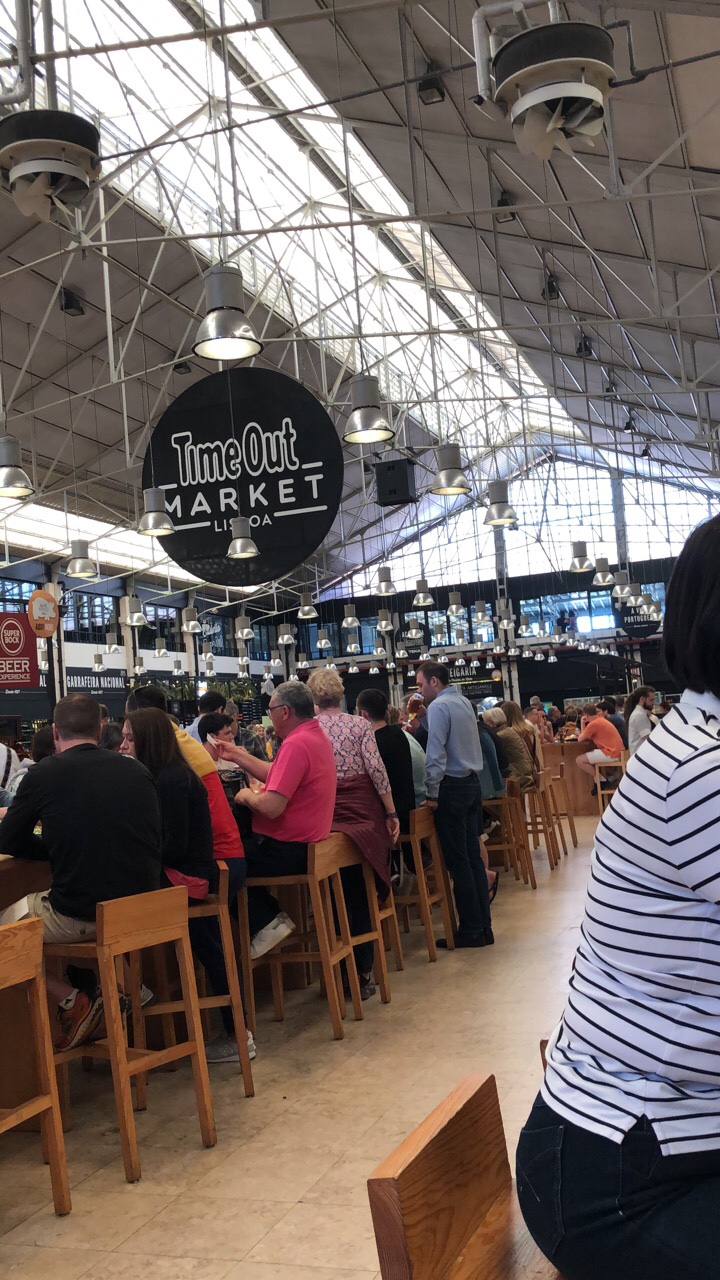
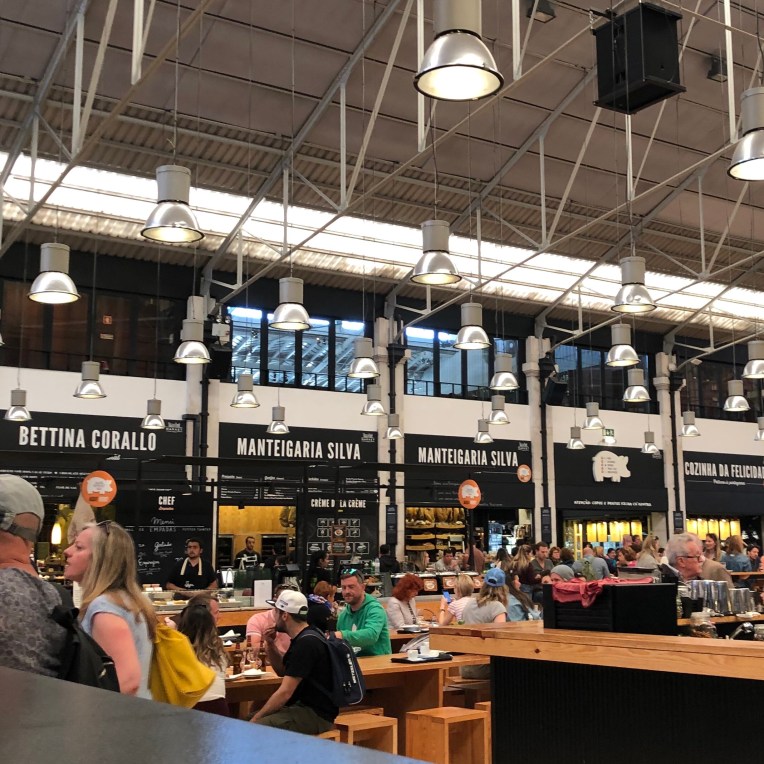
You remember yesterday the Time Out Market was closed when we got there? It would be open now. Again just an 18 minute walk and now we knew it was downhill. There’s a lot to be said for getting things wrong.

(Tables and chairs in the middle…)

While we were away the place filled up and there was hardly a chair free at the many tables. First things first we had to pick a meal. This involves walking by the many restaurant sections along the walls and checking out their menus. Then you make your decision, queue up, place your order, pay and get a beeper thingy. Then you search for a seat.

(…restaurants along the walls)

It was actually easy enough to find a place as people were coming and going all the time. We found a spot on the edge and settled in. Everything is cooked fresh so it was about twenty minutes before the beeper called us back to collect our food. The food is more expensive than we have paid in Portugal up to this.

(Time Out Market is attached to the old food market called Mercado da Ribeira)

Very soon people were joining our table and we had a lovely  chat with a couple who were originally from Taiwan but now living in California. He’d been to Ireland once for a day. It was a work thing and he’d flown in to Shannon, he couldn’t remember the name of the company but he remembers the cows in the fields. I loved that. It’s exactly what I’d want people to remember from a quick trip to Ireland. His wife was a programmer and Denis and she were conversing in letter groups and pretty words like  C++ and Java, as you do.

(A gun shop)

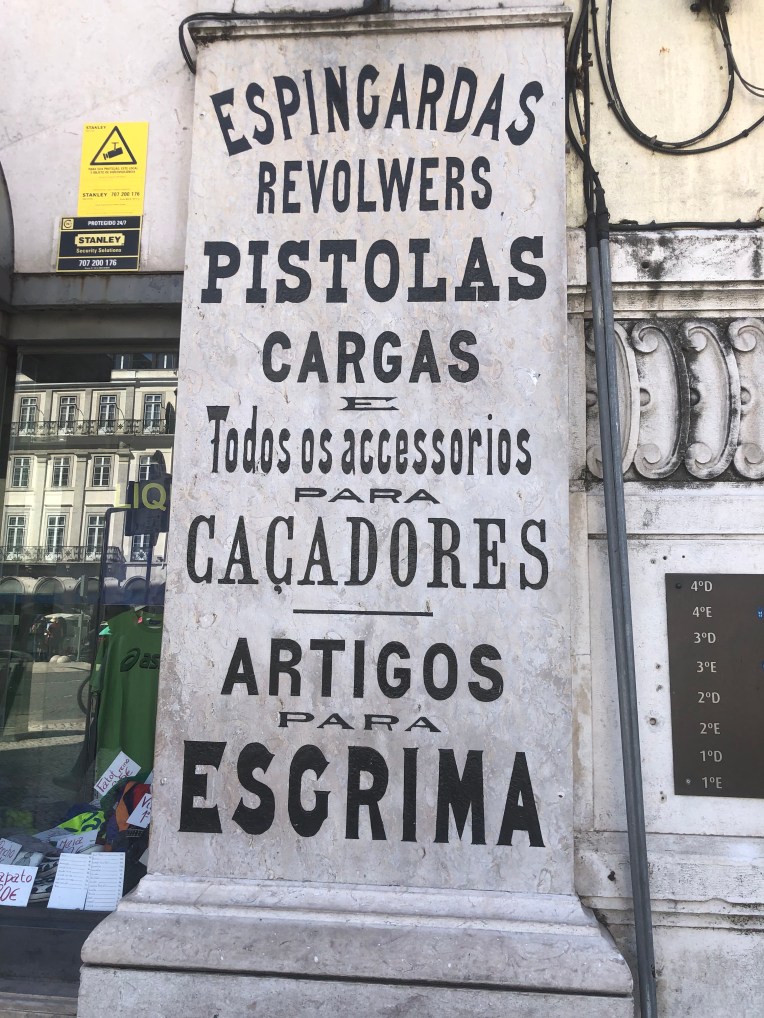
The whole guide and client thing broke down a bit after that. (Top Tip: Set your price early so there are no surprises or ill feeling between guide and client.) Denis had spotted something as we were coming through the ferry port in the morning. Scooters. Not the motorbike scooters. Scooters like the ones we had as children, two wheels, handlebars, no seat, one foot on the running board, other foot pushing off the ground to help you scoot along? Remember? Well those but electric… so they go at speed.

(Do not be fooled by how sweet they look.)

Not sure if you have gathered this from me but I’m not fearless. To be clear, I mean I am fearful. More like fear-FULL. There was no way I was going on one of those things. In a city. Maybe, maybe, possibly I would try one inside the walls of a well-padded room. With carpets. But there was no way I was going to get up on one in Lisbon. I had planned the next part of the journey by tram along the coast to Belem. I was going to take the pictures I had promised you of the people queueing for the Pastel de Nata’s from the original bakery near the Jeronimos Monastery where they were invented. It was a good plan. Everyone would have been happy.

Suffice to say, Denis wore me down, Mairead.

Lisbon by Train, Boat, Tram and Scooter – Part 1

(Love the colours. Cafe near the train station at Cais Sodré)

We went to Lisbon on Saturday. If you remember I was to be the tour guide and Denis the tourist. We set off at 8.30am to get the metro train (tram) from Corroios. Corroios turned out to be a bit of a hub for transport. There was a train north to Lisbon or south to Setúbal (also worth going to, tell you soon). There was also the metro tram train that went to Cacilhas and the ferry port. Also a bus just across the road from our parking spot going into central Lisbon. Then more busses within a twenty minutes walk.

(From the ferry, see the bridge?)

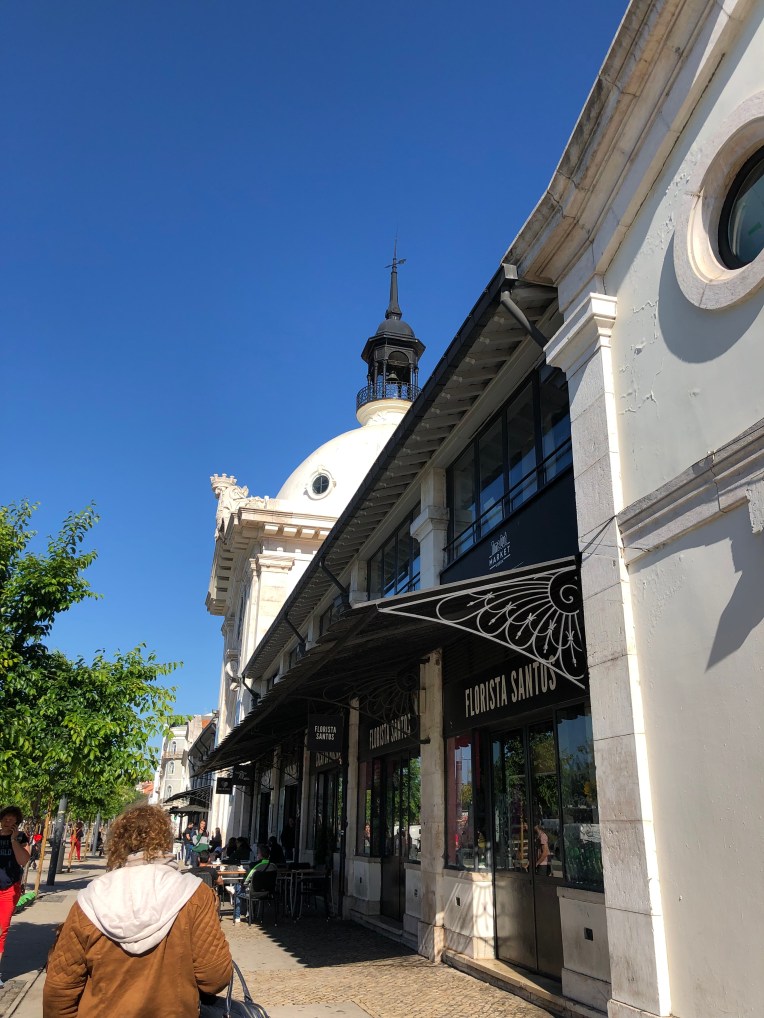
We were taking the ferry! It’s a passenger ferry that takes commuters from the south side of the estuary to the Lisbon side. Plus there’s a bonus – it’s two minutes walk from the port to the Time Out Market. Denis loves this place so it was to be our first stop. It’s an old food market with a new section with restaurants. It’s like an upmarket food court for good food from Portugal. We arrived about 9.45am but it wasn’t open yet.

(The outside of Time Out)

If you decide to run your own tour you might want to check the opening times of the attractions. Fortunately, I had built a little flexibility into my planning (sure I had) and there was a cafe on the outside so we loaded up with coffee and cake. Course we did.

(See the sea in the distance? That’s how far we’d walked and we weren’t there yet…)

Then we walked to the next attraction. It was only an 18 minute walk… but it was uphill and the temperature was rising. (Top tour guide tip: check the gradient of walks, over a certain percentage your clients may need public transportation.) My plan was to walk to the Ascensor Da Glória. You may not know this but Lisbon is built on seven hills. We were getting to know theses hills, exhaustively. My next two attractions were very old ways the people of Lisbon invented to cope with their hills. The Ascensor Da Glória is an old, old tram (technically not a funicular, seemingly) that travels up an impossible incline so you don’t have to.

(There it is, ascending)

We were almost there. I was following google maps and we had just one more street to go and it looked pretty straight on the map so no room for error. Well no room for that kind of error, I had made a different kind of error. I couldn’t believe it. We had arrived at the top! Google maps was directing me to the bottom of the incline via the route of the tram…

(There’s the driver and his empty Ascensor da Glória)

But Denis didn’t know that… hey look at this! Yes lovely. We waited for 190 (felt like it) people to get off and then the two of us, the driver and a local got on. No one, no one goes down the Ascensor da Glória, the hint is in the name. But hey, remember the best tours take you where the locals go, the locals go down, only the tourists go up!

Tour guide in training, Mairead.

Tour Guide for Hire

(Marigolds from Sintra)

We’re going into Lisbon tomorrow and I’ve a great tour organized for Denis. Isabel can’t make it so I’ll be the guide but he doesn’t know that yet. (I used to be a guide on the Rock of Cashel, did I tell you? I did? That many times? Oh right.) There’ll be food and coffee and many different forms of transportation. There’ll be stories, some of them true. There’ll be lots of walking and chances to engage with the locals.

(Twilight in Mafra)

That will be tomorrow, yesterday we parked in a residential area on the other side of the river from Lisbon. We were planning to go into the city but it was Freedom Day so everything was closed. You might remember Freedom Day from last year? We sure do. We were in a small town in the Algarve waiting for Ruby’s clutch to be fixed. Everything was closed.

(Aqueduct on the motorway)

That was last year, today we are happy in the suburbs and we’re getting to know the locals. I discovered (via google) that there is a coffee called um abatanado which is very like an americano so I order it every time now. Unfortunately, something about all the a’s in it gets me mixed up. I say ambatono or abentoto or anando. None of which is correct but because my efforts are always combined with a help-me-out-here pained expression I am generously understood.

(Organic wall, Alcobaça)

One of the things we loved the most about going on tour with Isabel in Porto was connecting with the locals and we sometimes forget we get to do that with every coffee experience. So I’ll definitely be including lots of coffee experiences tomorrow.

Say it with me, Um abat-an-a-do por favor. Mairead.

(There we are south of the river (estuary?) free parking, free water, 10 minutes walk to train or 1 minute walk to bus for Lisbon)

What’s an inverter?

(All the buildings in Sintra were ornate)

Our inverter broke last Thursday. It’s the thing that converts the solar energy into electricity to charge the computers. Usually it has a low pitch hum and drones on in the corner doing its inverter work making me ask regularly, can we turn off the inverter? Well last Thursday it turned itself off for good.

(Lots of green in Sintra)

Not good at all. It’s a big deal and kind of important if you’re using your computer every day. At the time we were in Mafra and there was free electricity so we weren’t stuck but we’d have to leave there sometime… Denis started searching the internet for motor home shops in Portugal and found one in Sintra. Just 20km away.

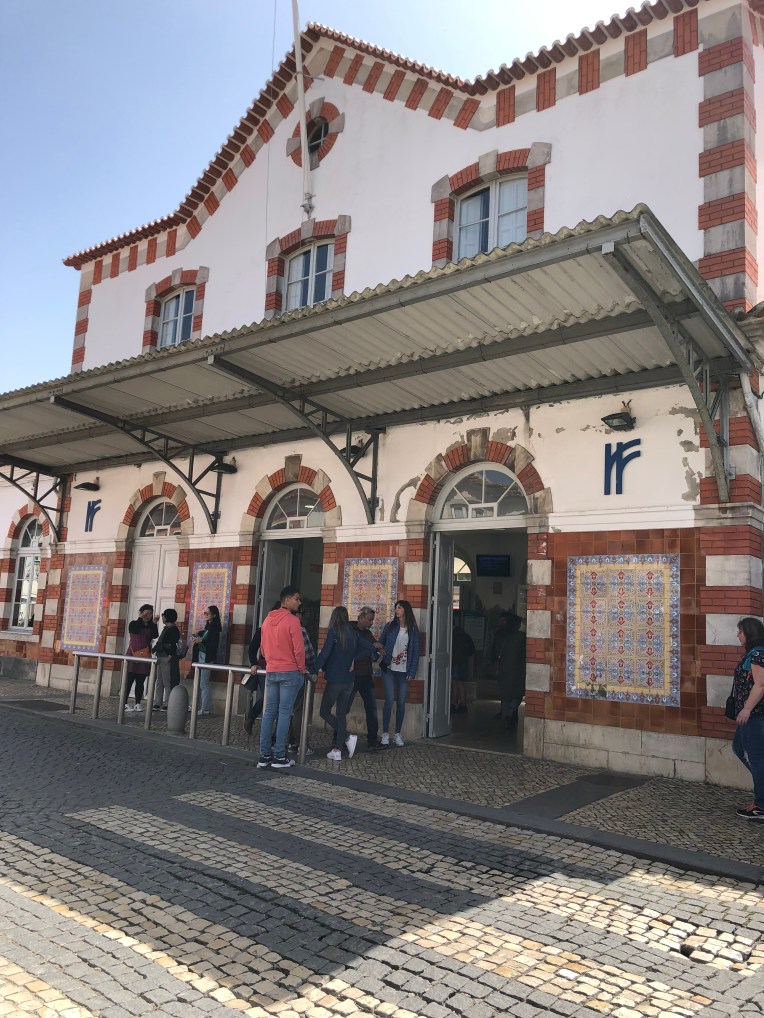
(That’s the train station)

Sintra is beautiful so we could go visit when we were done. But the shop was closed on Friday – Good Friday so we’d have to go on Saturday. We did. We got the inverter! Yaa! Then we found parking at the train station outside Sintra. Now, Sintra is busy at the quietest of times but this was Easter Saturday so not the quietest of times. The place was jammers.

(Various forms of transportation)

We took a break from the crowds at the first cafe we found and celebrated finding the new inverter. We then paid the most we’ve ever paid for coffee and natas in Portugal and it was still about a third of what we would have paid at home. So we celebrated that with a leisurely ramble around Sintra.

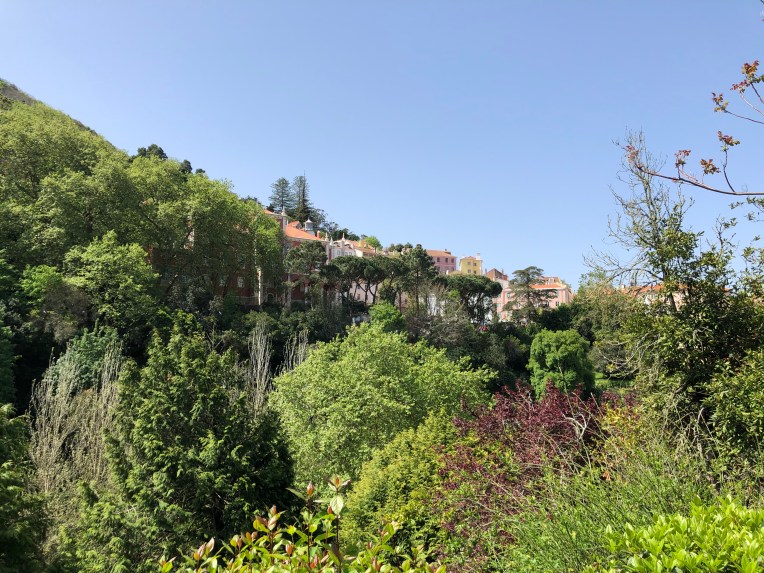
(I think that’s a castle up there)

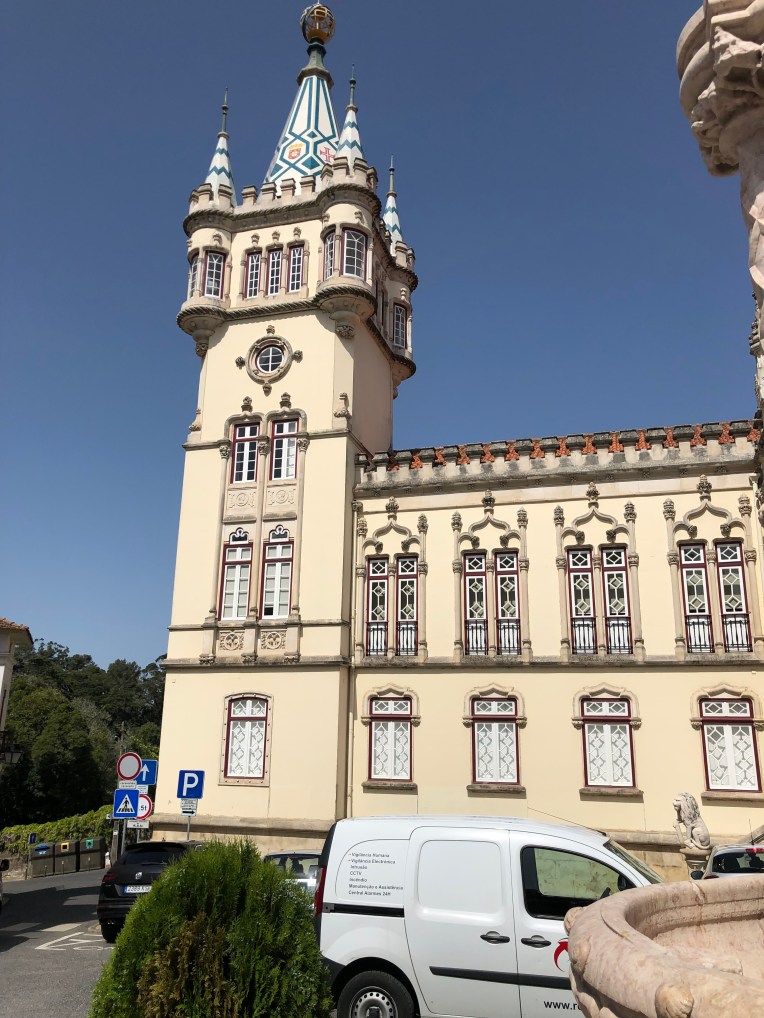
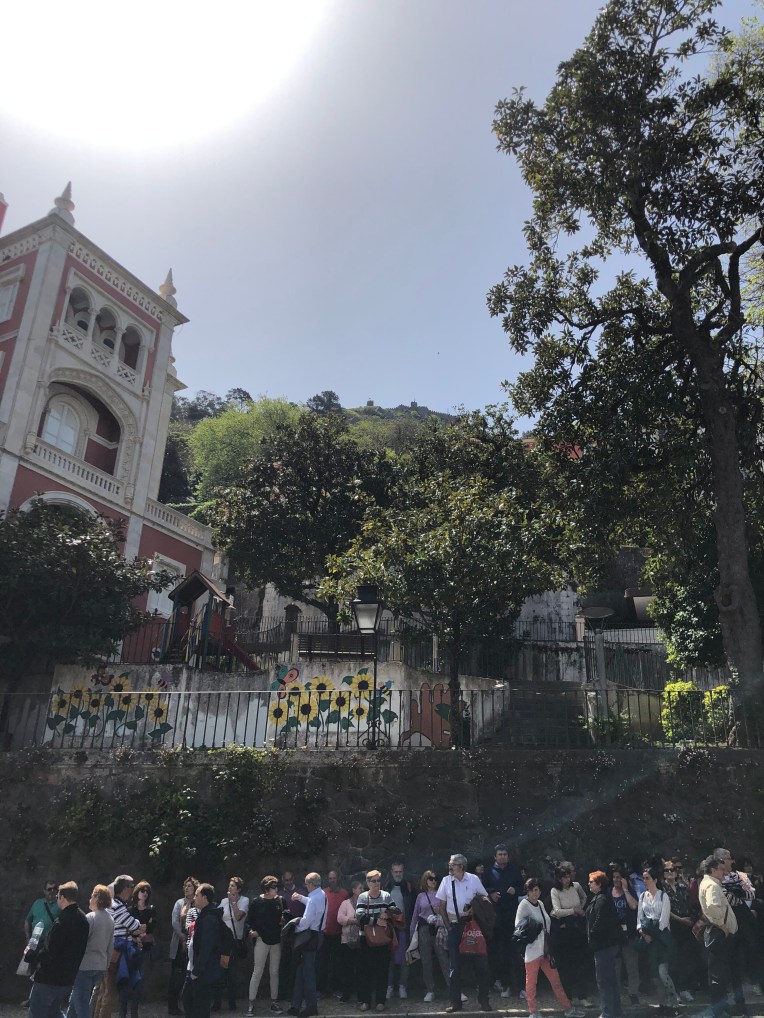
I’m not exactly sure which part is Sintra or maybe it’s all Sintra. If it is then it’s huge. This is where the royalty of Portugal used to come on their holidays. It’s very pretty, lots of hills, trees, old and unusual buildings, old and colorful buildings and people, lots of people. An hour wasn’t going to make a dent but we got the atmosphere and I’m definitely coming back again. I did visit last year but I was with a group of friends and spent most of my time talking and not much time immersing. Sintra requires a long soak.

(Long queues for the busses)

Afterwards we drove to Ericeira where Denis fitted the inverter. We have power. Not for the first time I am reminded of the small things that make life easier but that I forget to appreciate. Sintra is probably one of the most beautiful places in this country but the drone of a working inverter seems just as beautiful at the moment.

What are you forgetting to appreciate? Mairead.

The heat is on…

(Nice spot to wait for the laundry to dry on Sunday)

That title is supposed to say the heating’s on… we’re dipping below two digits on the thermometer again and as I’m not talking about the rain I can’t tell you about what’s happening outside. Oh but it’s windy enough to shake Ruby.

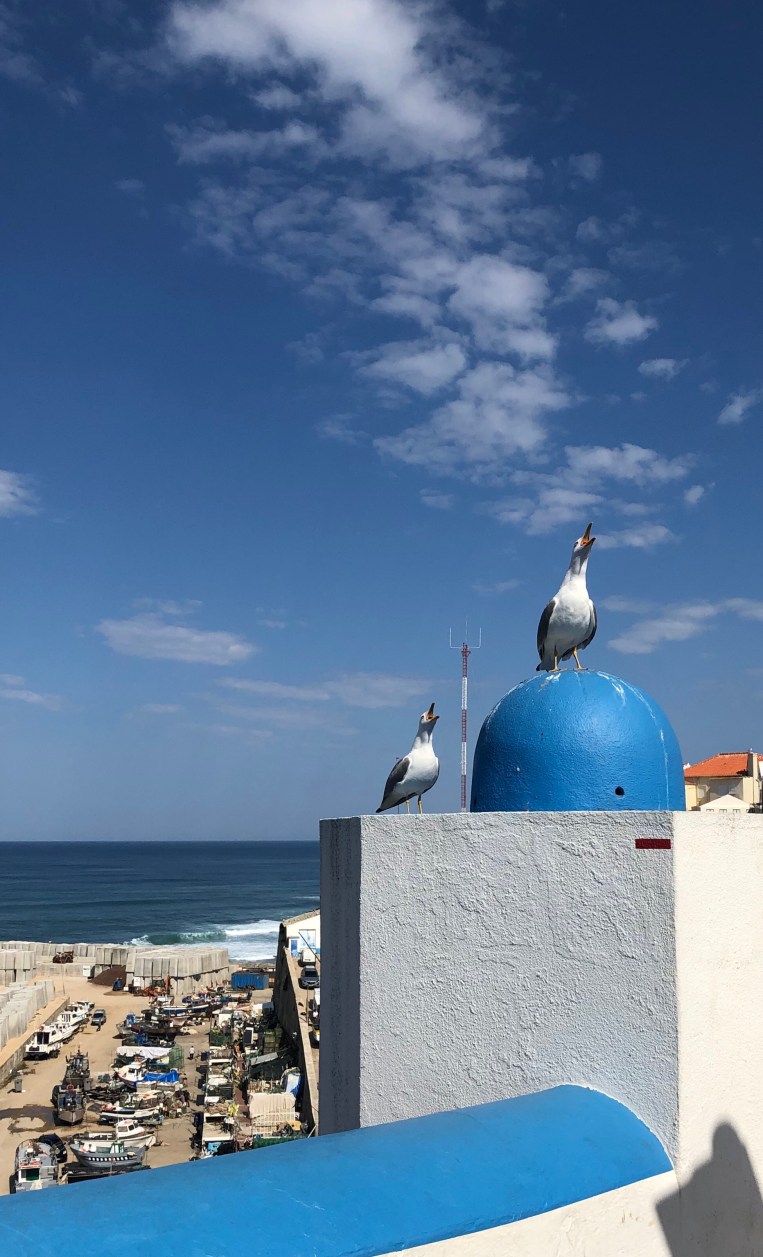
(The seagulls were having a bit of a sing along at the fisherman’s beach in Ericeira)

I’ll tell you what we did for Easter Sunday instead. We had dinner in the Intermarche. The Intermarche is a French supermarket chain here in Portugal.

(No fishermen but a few surfers)

While we were parked near Ericeira on Sunday doing the laundry we noticed a queue at the cafe in the supermarket. A very long queue, which made us curious. What are they selling? Why are these people willing to queue for it on Easter Sunday? How could we find out?

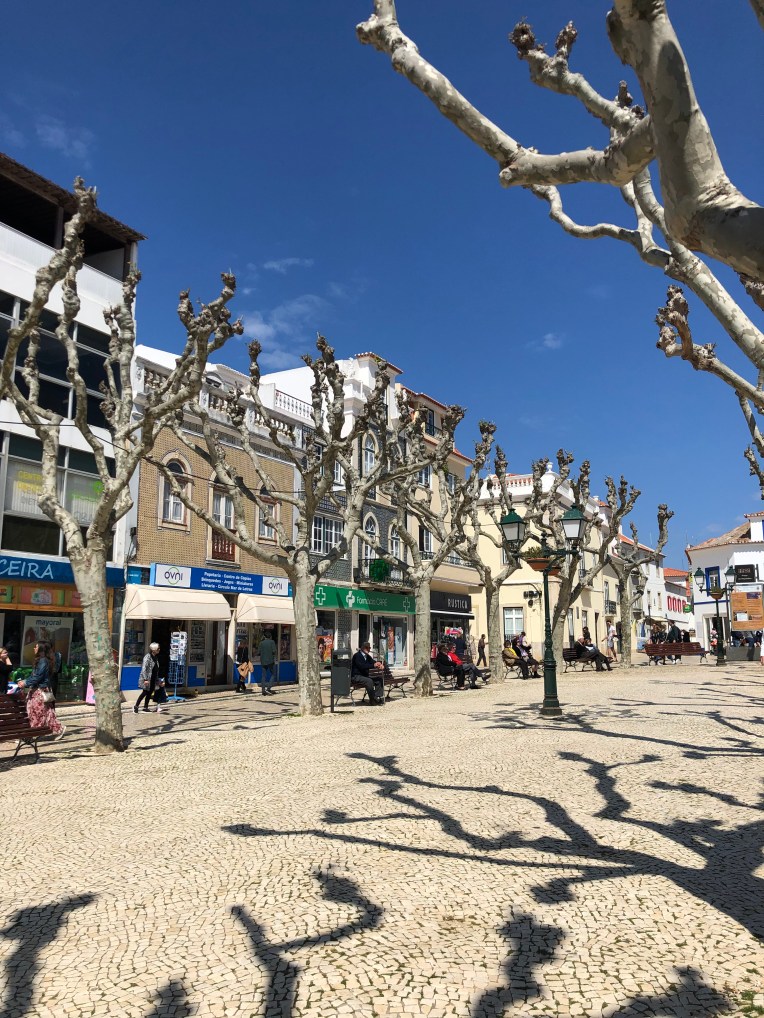
(Town of Ericeira)

We joined the queue. Well we joined the wrong queue to be precise. It was 12 noon, the queue started to move. As we got closer there was a choice to be made. Left arrow in blue with some Portuguese words and right arrow in red with different Portuguese words. We joined the left arrow queue. It was moving very slowly and when we got close to the top we noticed all the choices seemed to be raw…

(Saturday:Highest temperatures so far, left number inside van, right number outside)

We considered what this might mean. Probably not sushi. There was a Portuguese family behind us. I started with the boy who, I figured could be studying English, do you speak English? Alas, he mustn’t have been studying very hard he gave me the universal sign for not really. Behind him his granny gave me a huge smile, her son was next, they were a very smiley family. Finally the mum, she could speak English and explained, this queue was if you wanted your meal cooked from raw. The whole family smiled and nodded as we left that queue.

(Lots of blue and mustard trim in Ericeira)

So we found the other queue and all the food was cooked but it wasn’t easy to work out what it might be. Do you speak English? I asked the lady serving. She did. So I asked her what’s that dish there. It looked lovely. But I surprised her by asking in the middle of a busy queue on Easter Sunday, so she got stuck. You know how it is when you can’t remember the word for something? It often happens to me when I’m tired and I can’t remember the word for something. In English, I mean.

(We were loving the shade on Saturday)

So there she was trying to recall the word and the whole queue was holding its breath and the other servers were watching her and time stood still. Finally she said octopus! Would you have said lovely, I’ll have that? I so wanted to say lovely sad I would have… for anything other than octopus… I had a pained expression on my face when I said no sorry what’s that one beside it?

But I needn’t have worried she had found her stride and told me it was cod fish. You remember Isabel told us about the Portuguese love of cod? I could redeem myself and I did. Yes, please I’ll have that!

(Easter Sunday dinner with a view)

As I keep telling you everyone tries to help us and even when they can’t speak English they make us feel really welcome with huge smiles.

Easter Sunday dinner for two with beer, water and orange juice at Intermarche Ericeira? €10.20. Mairead.

How to say Green Tea in Portuguese

(Look at the book paper butterflies!)

We’re sitting in a cafe in the afternoon both in our phones. This is so romantic… well maybe it is. Isn’t romance when the other person turns up with just what you wanted? Or when they ask you what you want and then bring it to you? Or when they’re interested in you and your interests?

(Can you smell the bread?)

Anyways, we’re both interested in reading (him) and writing to you (me) on our phones and that’s how we do romance here in the cafe in Portugal. Plus the sun is shining after a downpour this morning. I was on my get-some-photos walk when the hailstones started. I did have a rain coat and an umbrella but I still ended up with soaking jeans. They’re dry now and the rain clouds are gone… so maybe I’ll stop talking about the rain. Sure I will.

(Flowers in the park)

When we walked in here (to the cafe) there were two ladies chatting and as the locals do I said Bem Dia (good day) and they said Bo Tarde (good afternoon). I think you can say good day at any time.. but it might be just for mornings? Then I asked for thé vert which is the French for green tea… and the waitress said Chá Verde, the Portuguese for green tea.

(That’s how you say green tea in Portuguese)

All this to tell you, no matter what you want to say the Portuguese will help you say it. They are very welcoming and interested in what you want. Like I said romantic.

Isn’t it lovely when someone is interested in you, Mairead.