The Ceramists of Silves

(The studio)

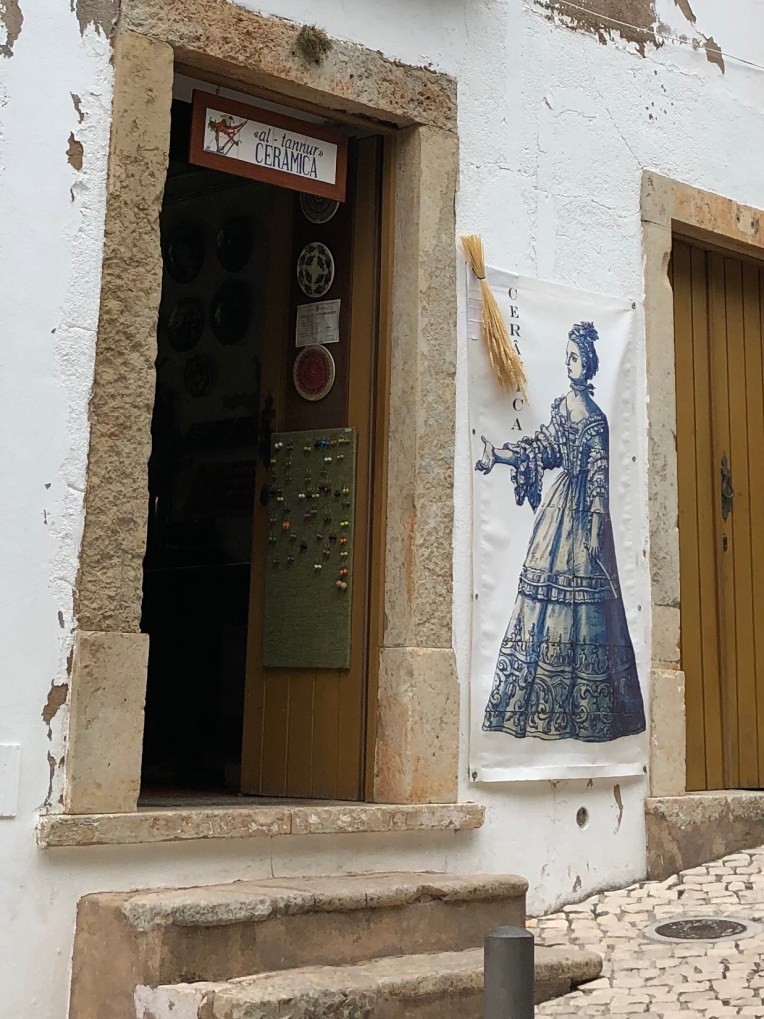
As I was walking up to the castle in Silves I passed a door with a sign saying… Cerimeca. Ceramics! Of course I had to go in.
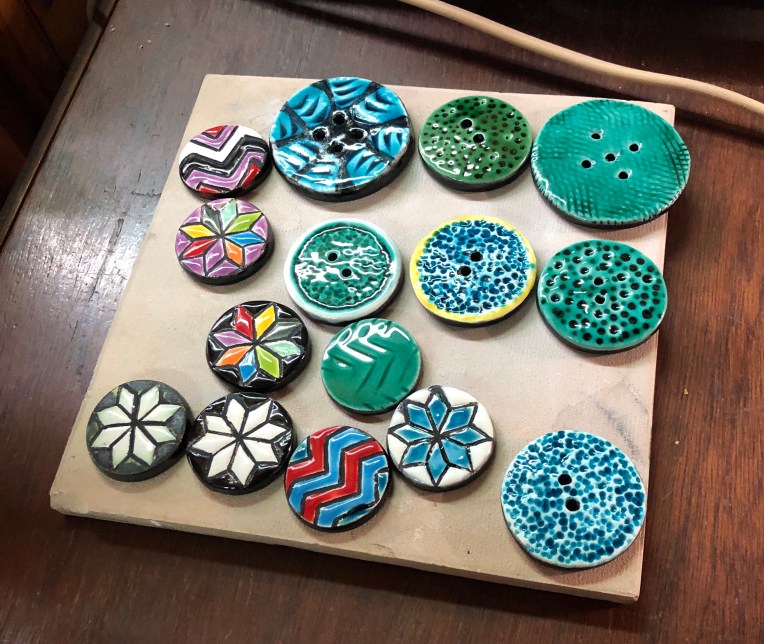
(Aren’t they gorgeous?)

Inside the dark interior there was a lady painting tiles. I nodded, Bom Dia and went to look at some buttons. They had buttons!After I had chosen and was paying a voice from the back said, you have chosen my work, I made those. Deeper inside the shadows there was a man, a very happy man, working on glazing some more of his work. I asked for a photo. He was happy to oblige.

(Happy man)

He was not happy with my photo though, so I took another. The second one was better. This man knew what he liked, he also knew what he loved. It showed on his face and in the way he spoke, he loved making ceramics and fortunately he loved explaining his work to me.
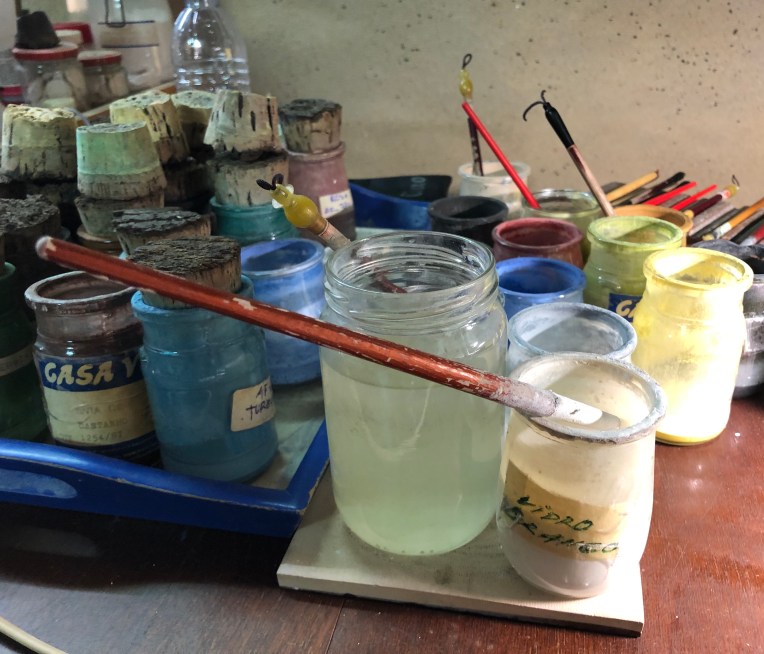
(His glaze collection)

He reminded me of a story I once heard. Once upon a time there was a shoemaker living in a small village. Every day he created shoes from his own designs. And every day the people of the village brought their old shoes to him for mending. No one liked his shoes.
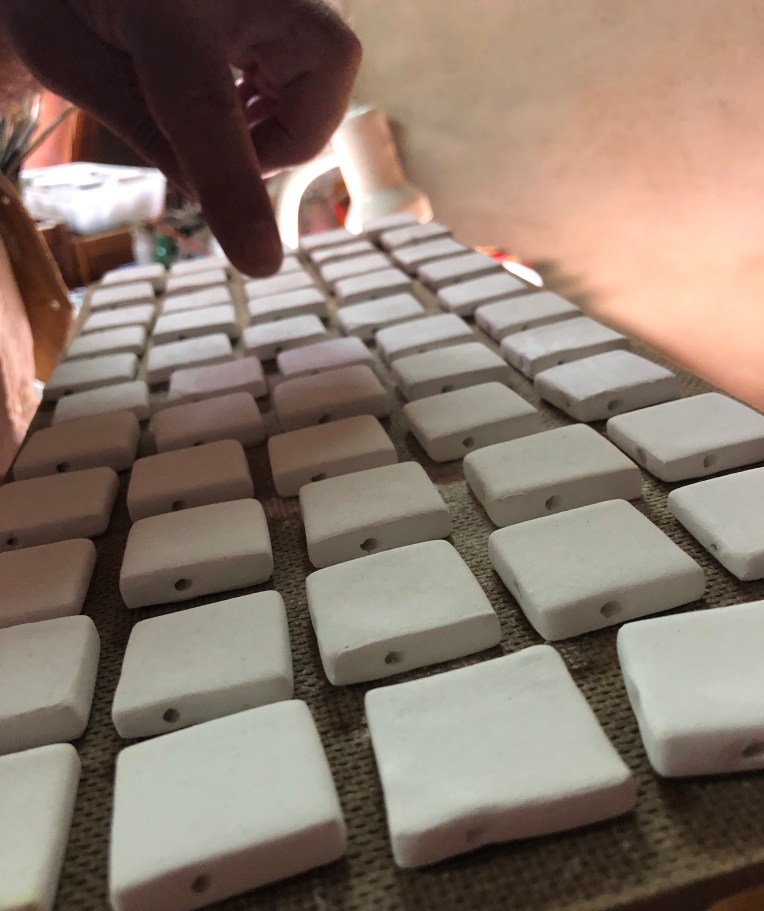
(Beads after first fire, before glaze)

After years of this he was completely discouraged. Now, there was a wise woman living in the village and one day she visited him. She said, People may not like what you make, it doesn’t matter if no one likes it but if you like it you have to make it. The shoemaker didn’t really like what he heard but he liked the wise woman so he continued to work away on his shoes.
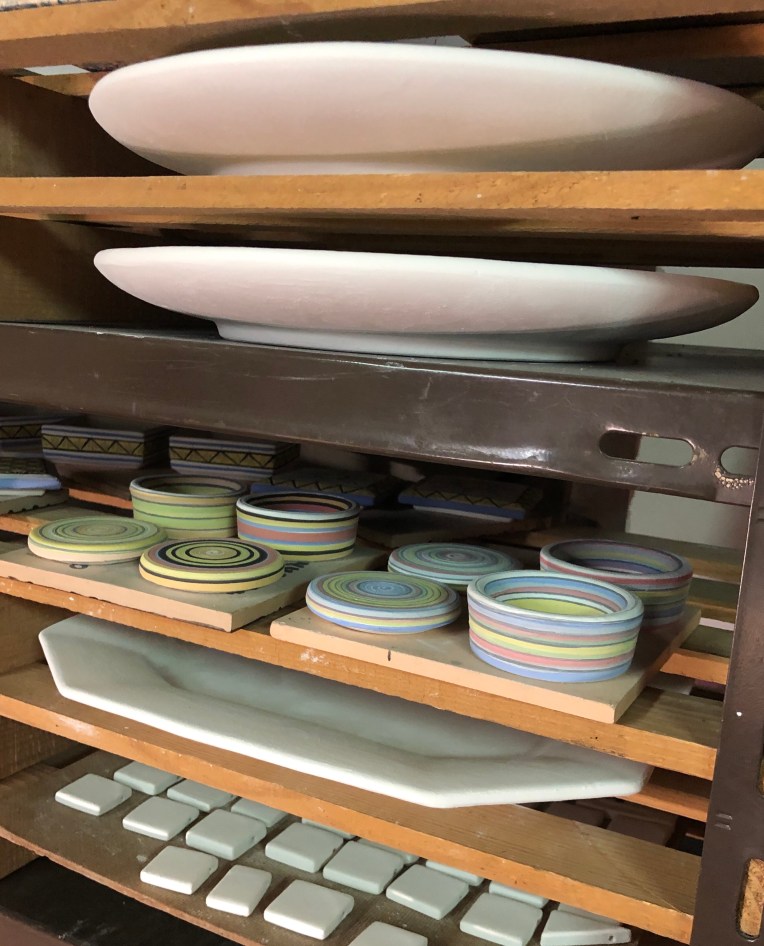
(After glazing)

Then one day, a stranger came to town. The stranger had a hole in her shoe and she asked around the village for the way to the shoemaker. She was in pain when she arrived and she sat outside his shop to take her shoe off and to rub at the pain in her sole. That’s when she heard the shoemaker whistling. It cheered her up instantly and she rose up to go into his shop. That’s when she saw all the shoes in his window. The most unusual shoes she had ever seen. The colours. The mix of fabric and leather. The buttons (of course he used buttons.) The laces. The variety alone was mesmerizing.
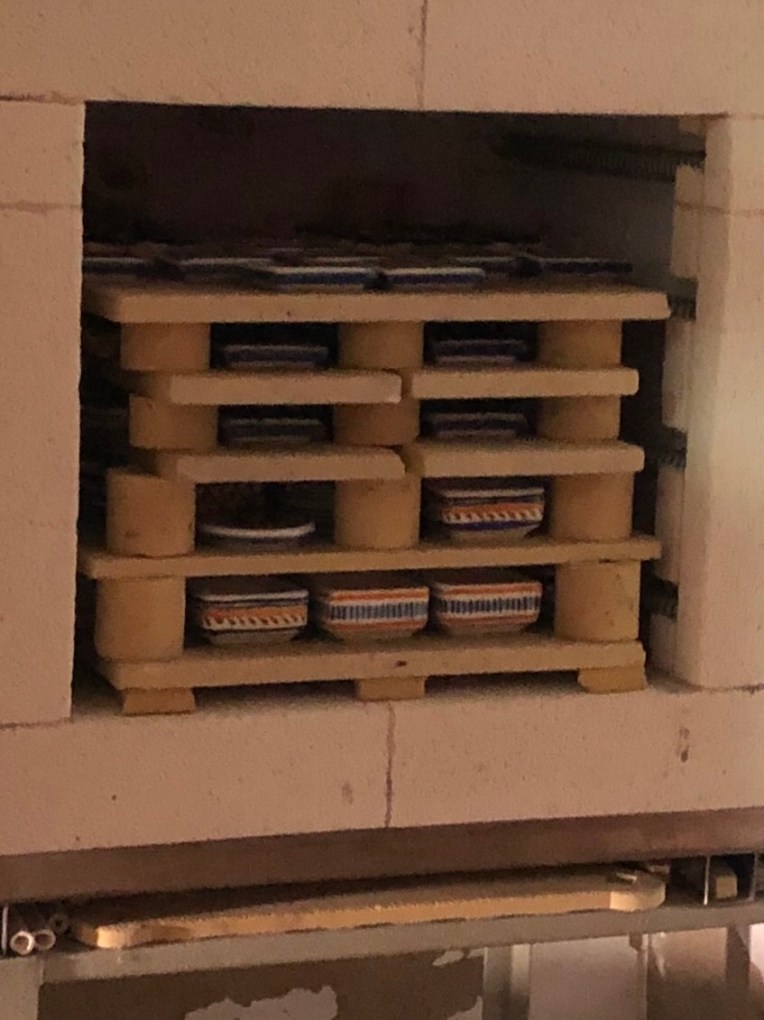
(More work cooling in the kiln)

From inside the shop the shoemaker could hear the young stranger’s gasps and sighs and wows! He stopped working to find out what was wrong.

Wrong? Nothing’s wrong! These are the most beautiful shoes in the kingdom! Please say you have my size!
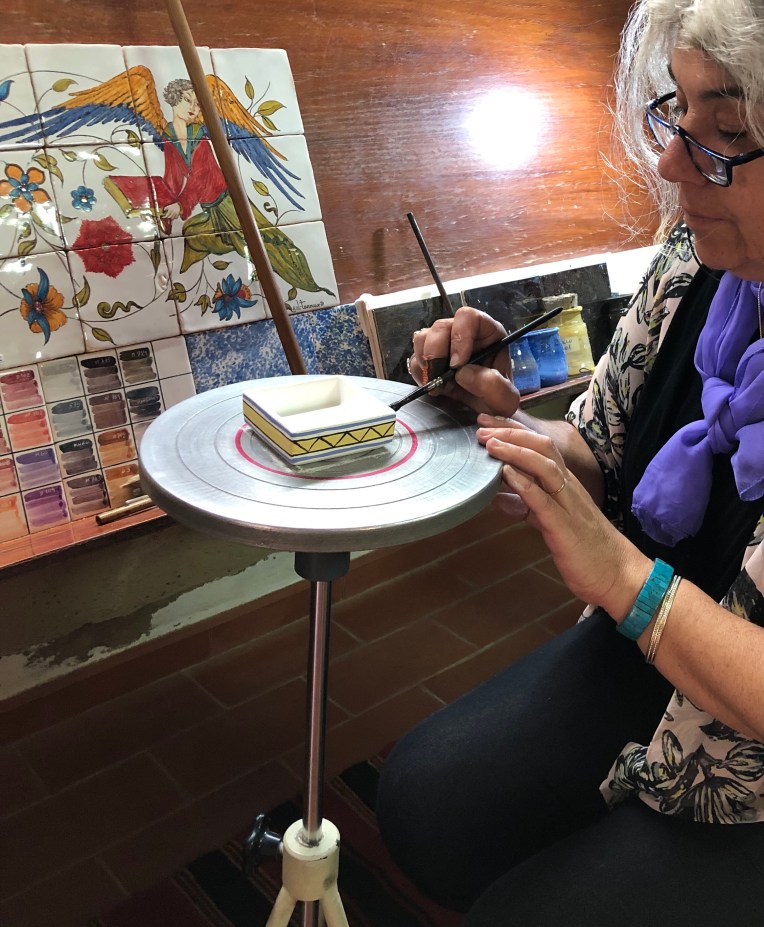
(His wife is also a ceramicist)

A teeny tiny smile played on the shoemaker’s lips, you like my shoes? She gawped at him. You made these? The smile spread across his face, yes I did would you like to try them on?

(Work in progress – the hopeful fish)

For the rest of the afternoon the shoemaker and the stranger talked shoes. She tried on all his shoes and had many questions which he answered happily, delighted to talk about his work. The stranger stayed for dinner and that night moved in with the wise woman (she had an AirBnB). Every day for a year they worked on building a website to find other people who loved the shoemaker’s shoes. Of course you know the ending… everyone lived happily ever after…. except for that time when the website crashed because it was so popular and the other time when they couldn’t sleep with the stress but mostly they were happy.

(The process)

If you like something that someone else has created you might be the only person in the whole world who likes it. So don’t miss the opportunity to tell them.

Go on be that person, tell them. Mairead.
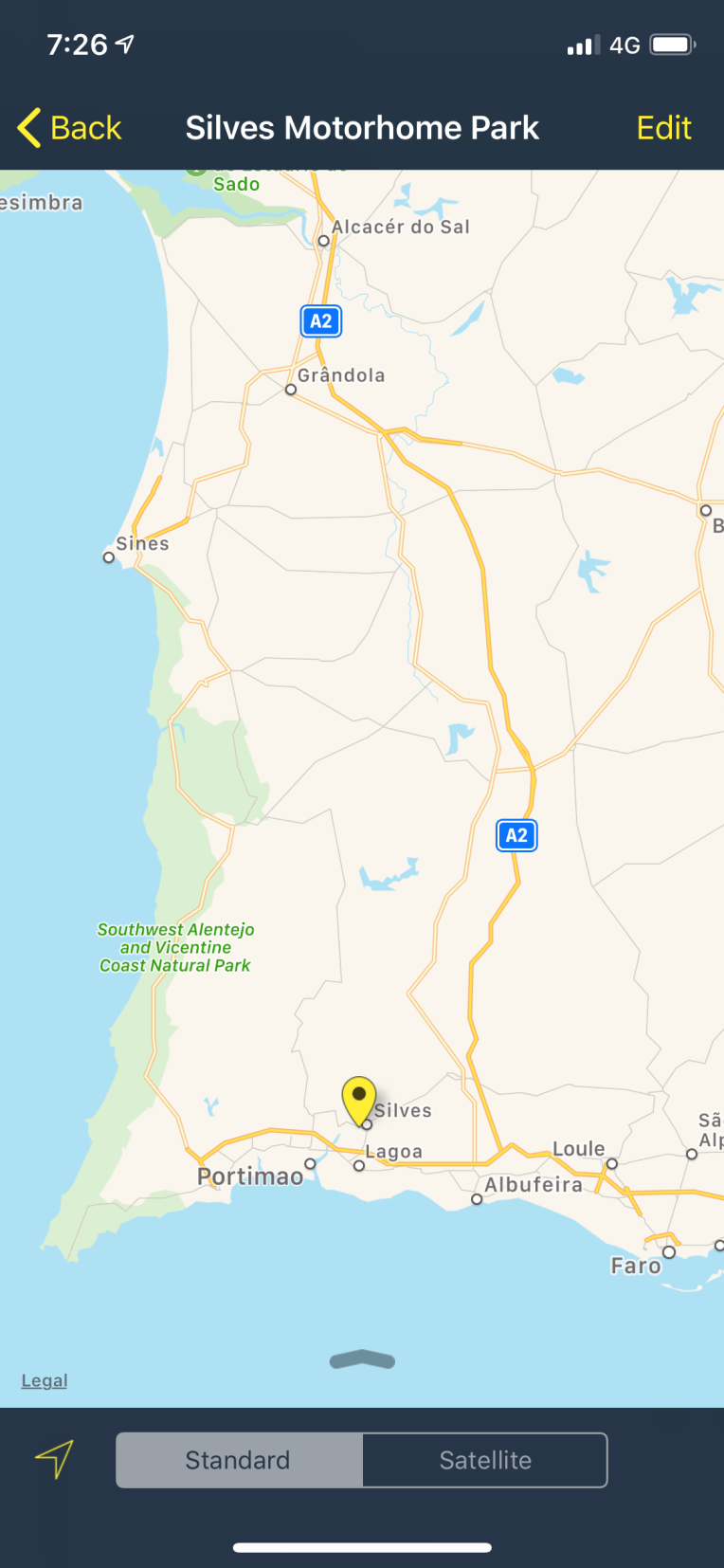
(Silves: €6 per night, parking, WiFi and water. Hot shower, 50 cent. No toilets. Supermarket 5 minutes walk, castle 20 minutes walk. Park with cafe, toilets, swimming pool, playground, tourist office 10 minutes walk. Loads of restaurants and cafes in the town.)

Silves’ elusive things

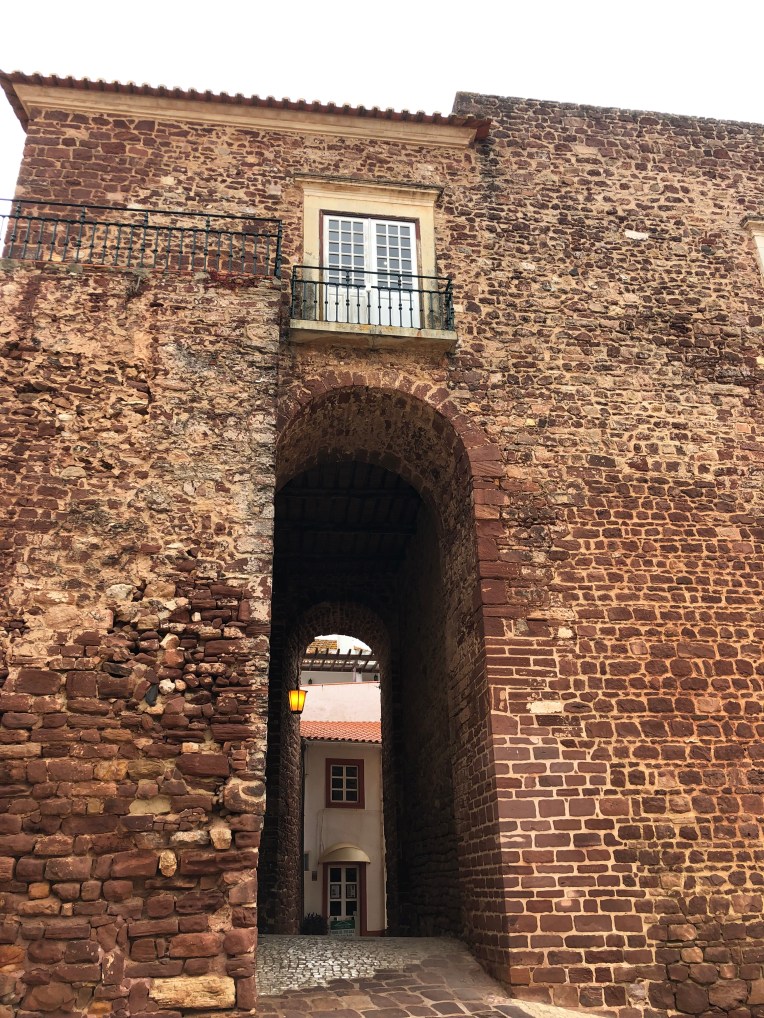
(A glimpse of the wall)

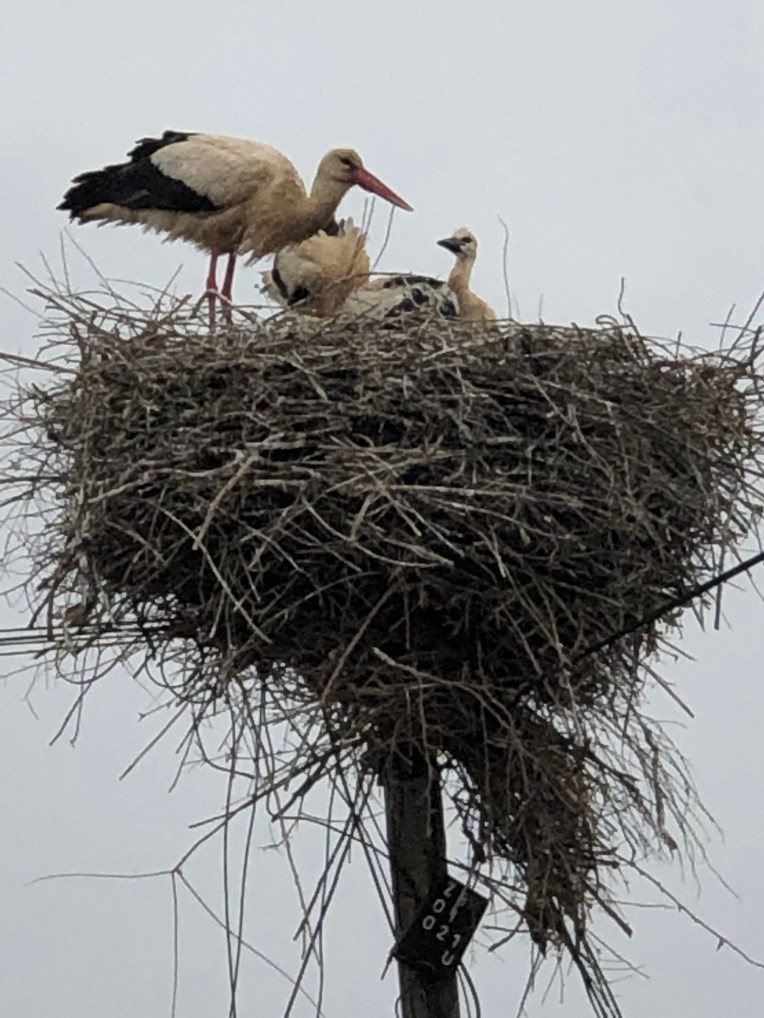
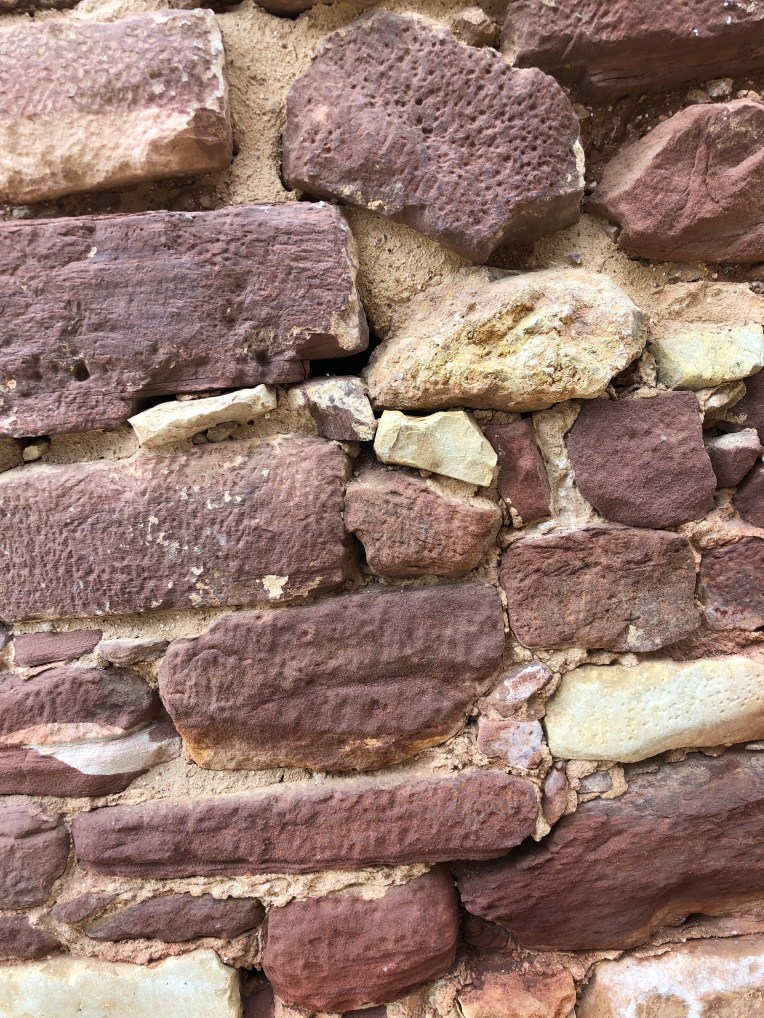
There are two things you see a lot of in Silves – the old moorish walls and the storks. Funny enough both are hard to photograph as you walk around. The storks are always too far away. So I had to stop trying and just watch them instead. The walls are surrounded by houses built in their shadow so there’s only a glimpse ever now and then of their red stone.

(Storks on top of the supermarket)

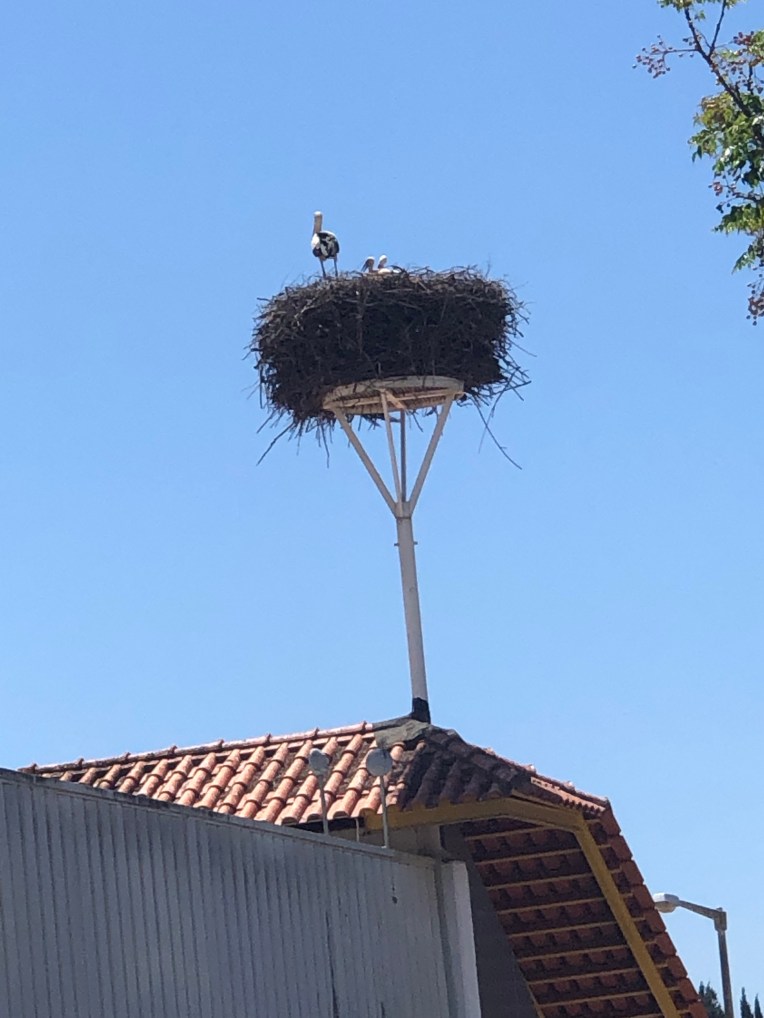
The storks build their nests on top of electricity poles or tall chimneys or on the corner of a very tall abandoned house. They are so graceful when they fly off to find food for their chicks. I think their grace is connected to their size, they have to glide everywhere to remain in balance. The ends of their wings are like long fingers and I think that’s what they use to change direction. When they have picked a direction their long legs seem to click back against their abdomen so that they are streamlined.

(On top of a pole)

Looking at them from underneath as they fly over me I am reminded of an airplane tucking in the wheels as it lifts off. Whenever they do fly over me I am unable to even think, all I can do is stare up with my mouth slightly open and watch. It’s only afterwards I consider my luck at being in exactly this place as they pass by.

(On an edge of the old walls)

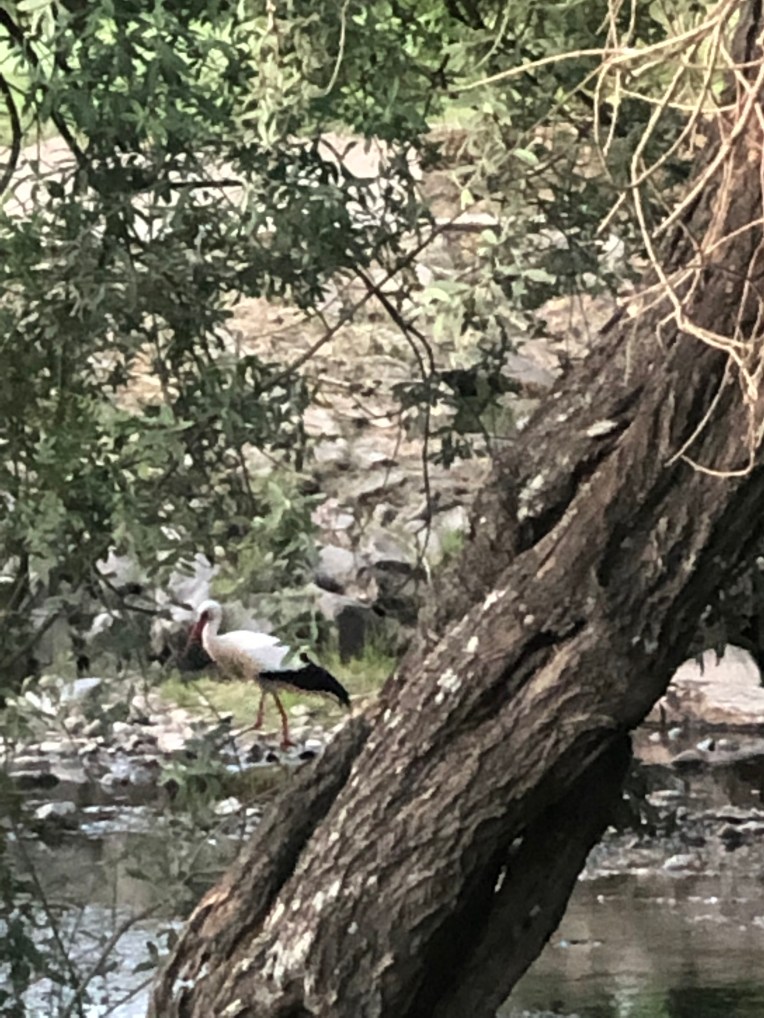
You will never guess what is happening as I write… we are parked beside a river today far away from Silves and a stork just walked up the river outside my window. It’s 7am there’s no one else around so I guess she feels safe to walk so close to the vans. Watching her now at such close quarters I realize why storks are so hard to capture on my phone. They are very, very wary. This one seems to jump when a smaller bird flies too close. She even seems to be aware of my watching. I am not moving a muscle, I am in the van and there is a window between us but she has stopped fishing and she is alert for danger.

(Can you see her?)

She started walking up the river out of my sight so I risked grabbing my other camera and sneaking out of the van and up the river bank. She didn’t hear me but as soon as I had cleared the trees she snapped to attention and rose into the air. I didn’t even get a chance to watch, I was watching my footing instead. When I looked up she was in the grass on the far side walking parallel to the riverbank. I had a clear view but she was far away from me.

(Here’s a zoomed in one)

This is the closest I’ve been to one as they walk and they are not as graceful on the ground. Her legs are impossibly thin and her body so much bigger. So the balancing requires more jerky movements as she places one foot down, rocks her body back to be able to place the other as she steps, steps, steps through the grass. For some reason it reminds me of a documentary on television where the scientist is placing drops into individual tiny glass cylinders. Drop, lift, tilt, drop.

(And another)

And then she was hidden by the trees. Of all the experiences I’ve had on this trip the storks are the ones who remind me to be present. They say, for this one moment I will tuck my impossibly thin legs under me and I will fly over your head and you will not be able to capture this moment, you will not be able to slow it down, you will not be able to share it with others, it is just for here and now and then I will leave.

Here and now, Mairead.

Silves and Mercy

(Old door on the church needs very big key)

Silves is a lovely town with plenty of cafes and restaurants and two motorhome parks, €6 per night if you spend more than one night here. You might remember we were here last year, I’d been very brave and walked on the walls at the castle.

(Part of the old town wall, Silves)

This year I’m visiting a couple of churches just outside the castle. One of them was very interesting and free. The other not so interesting and cost €1.50, which isn’t a lot to be honest.

(The street of Mercy)

The interesting church began as the hall for a volunteer group called The Misericórdia (the long name, translated, is The Brotherhood of the Invocation to Our Lady of Mercy) that was set up in 1498 in Lisbon by Queen Lenora. She set it up because there was great need to take care of the poor in Lisbon at the time. You might remember this was the time when Portugal was discovering the new world. It was becoming a prosperous country and people were flocking to the capital to make their fortune. Unfortunately, prosperity is never evenly shared and this led to a huge problem with poverty and overcrowding in the city of Lisbon. The brotherhood later spread to towns and cities all over Portugal.

(Close up of the old town wall)

The brotherhood had a list of intentions and there were huge wooden panels depicting them on the back wall of the church. Namely, clothe the naked, give shelter to the pilgrims, give drink to the thirsty, visit the infirm, ransom the captive, feed the hungry, bury the dead. I loved the simplicity. In Silves they built a hospital and now 500 years later it still serves the community. With a crèche, nursery school, day care, nursing home, day center, long term care unit, home care, and a Social Canteen.

(Detail from income and expenditure ledgers, 1700’s)

A funny thing happened in the 20th century, well I suppose it wasn’t that funny… There was a great tradition of people leaving money in their will when they died to the brotherhood at Silves. Unfortunately, they also including some stipulations that regular mass be said for their souls. What’s the problem with that? The brotherhood had to pay for masses to be said and it nearly bankrupted them.

More from Silves soon, Mairead.

Heading for the Hills

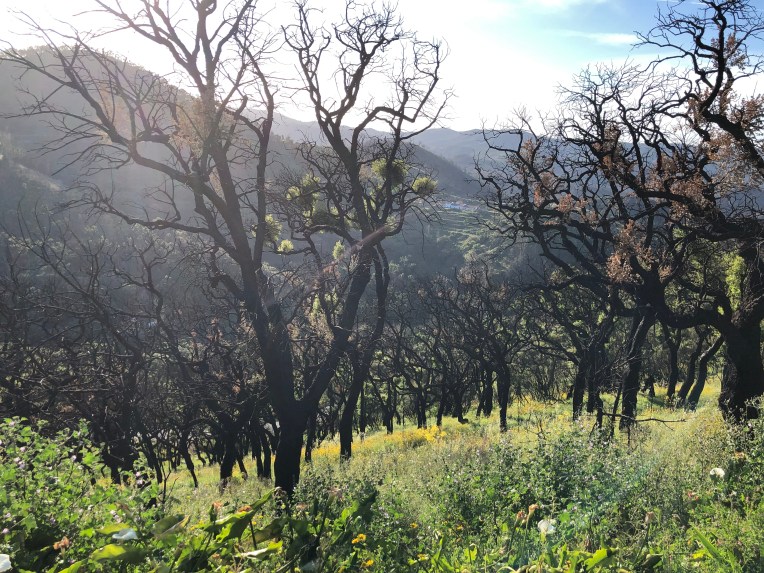
(The blackened trees surrounding Alferce)

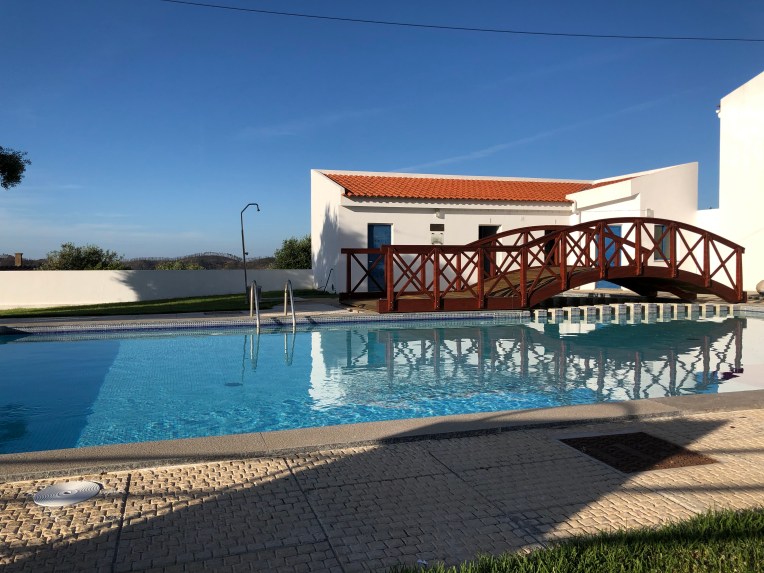
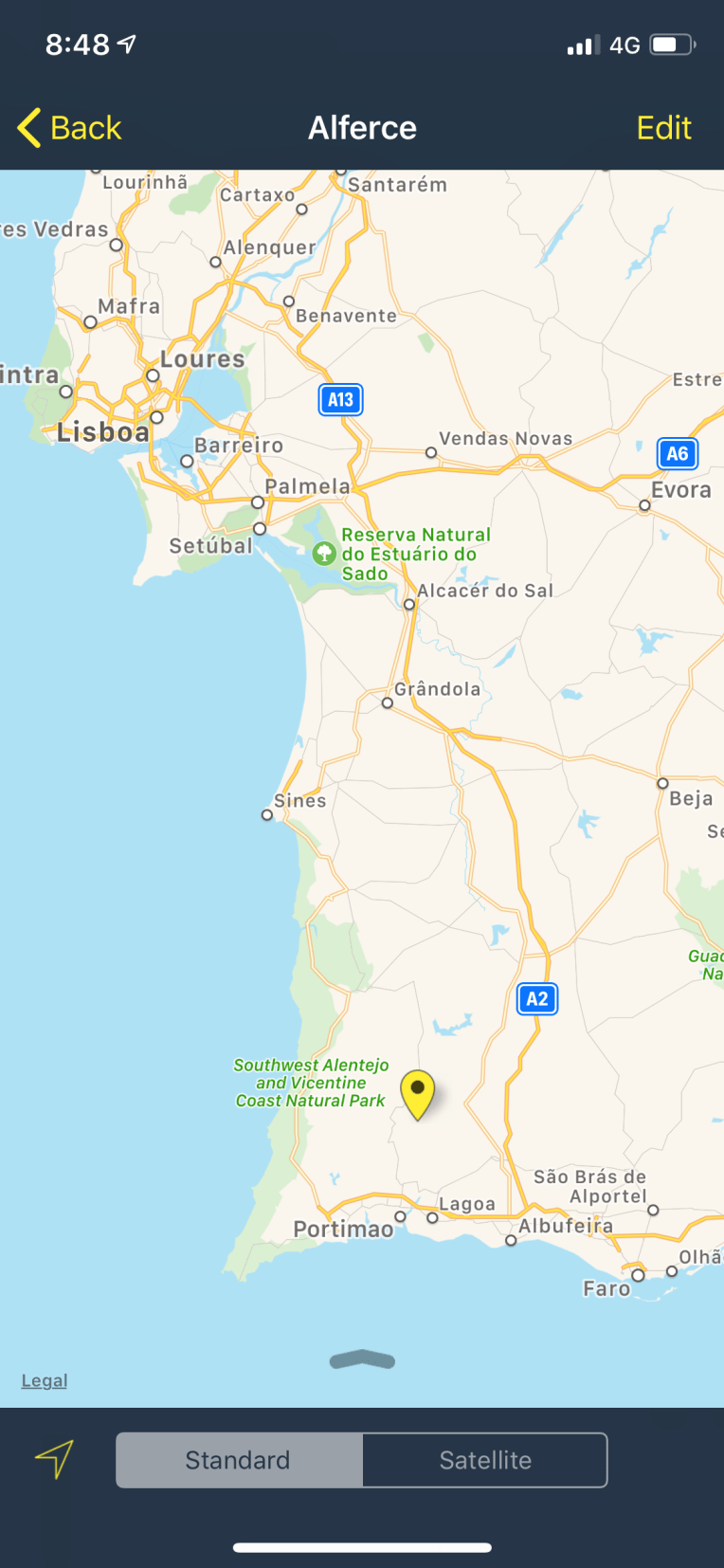
While at the beach Denis read about a village that had a swimming pool, showers and toilets just north of the Algarve. And it was all for free. So next morning we travelled past amazing views, up steep ravines and eye-wateringly scary ridges to come to the town of Alferce.

(The swimming pool with lovely toilets)

This town is in the middle of nowhere and has amazing views and very friendly inhabitants. It had nearly succumbed to forest fires last August but survived and in almost a display of courage they have painted almost every building in the town. You can hardly see a sign of the fire.

(View from the main street)

Until you look at the trees. All around on the steep slopes, blackened trees as a reminder, that nature can sometimes be cruel. You might think it would be eerie but it’s not, it’s beautiful.

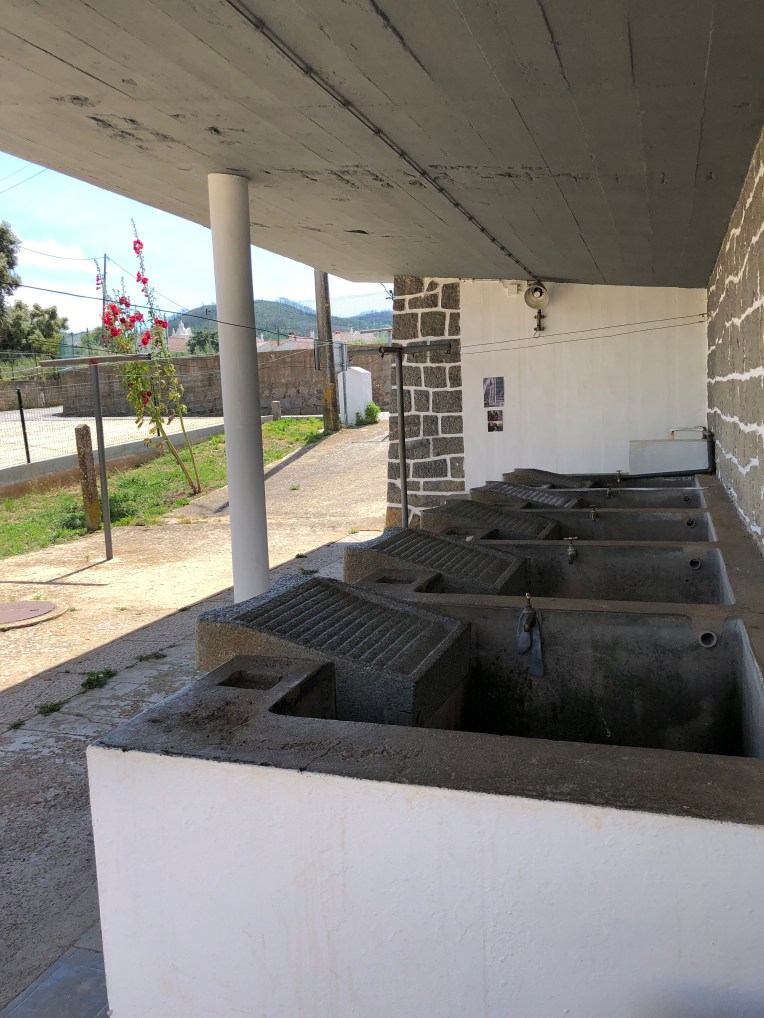
(The laundry)

The town also provided laundry facilities – the old fashioned kind with the built in washing boards and strings of clothes lines. But my favourite feature was the frogs. Right beside the motorhome parking there was a pond with about 20 frogs, all different sizes. I discovered them by following the sound. They had a very distinctive sound, like a complaint in grumpy language. Not very unpleasant but also not entirely attractive.

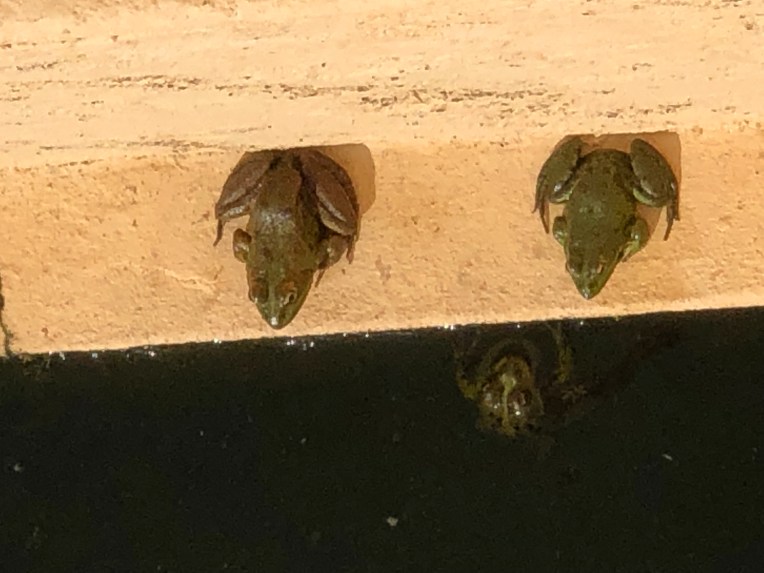
(Can you see the one pretending he’s dead in the water?)

Anyway I followed the sound to see what was making it and eventually noticed there were frogs. They seem to be able to make the sound without moving a muscle and as soon as they become aware of me everything stopped. No sounds. No movement. There’s isn’t a twitch. They remain completely still except for the one or two who had jumped into the water. They’d dived to the bottom and I could see small bubbles popping on the surface in their wake. There’s also one or two who know how to pretend to be dead in the water.

Smart Frogs, Mairead.

(There’s Alferce. Free parking, free water, free swimming pool, toilets, showers and frogs)

Off to the Beach

(Nice flowers in the dunes)

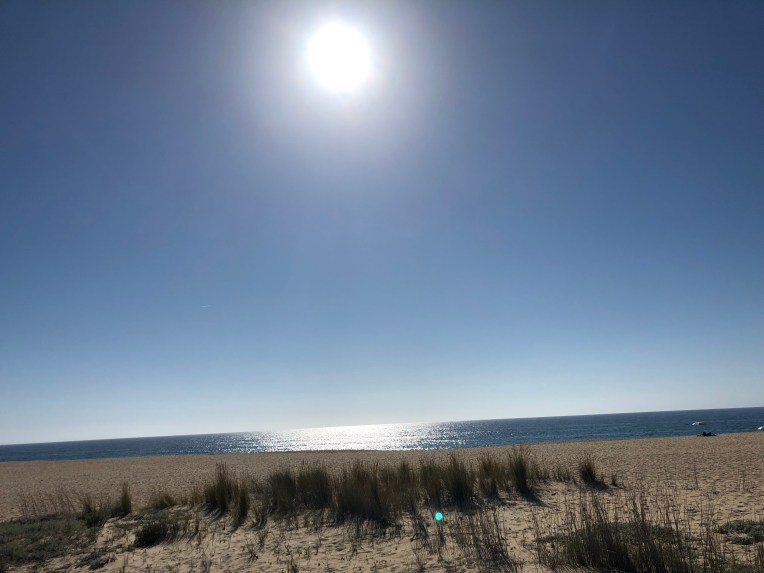
One of the great things about Portugal is that no matter how hot it gets there’s always (almost always) a breeze near the coast. So when it got really hot by the river we moved to a beach.

(Not a lot of shade)

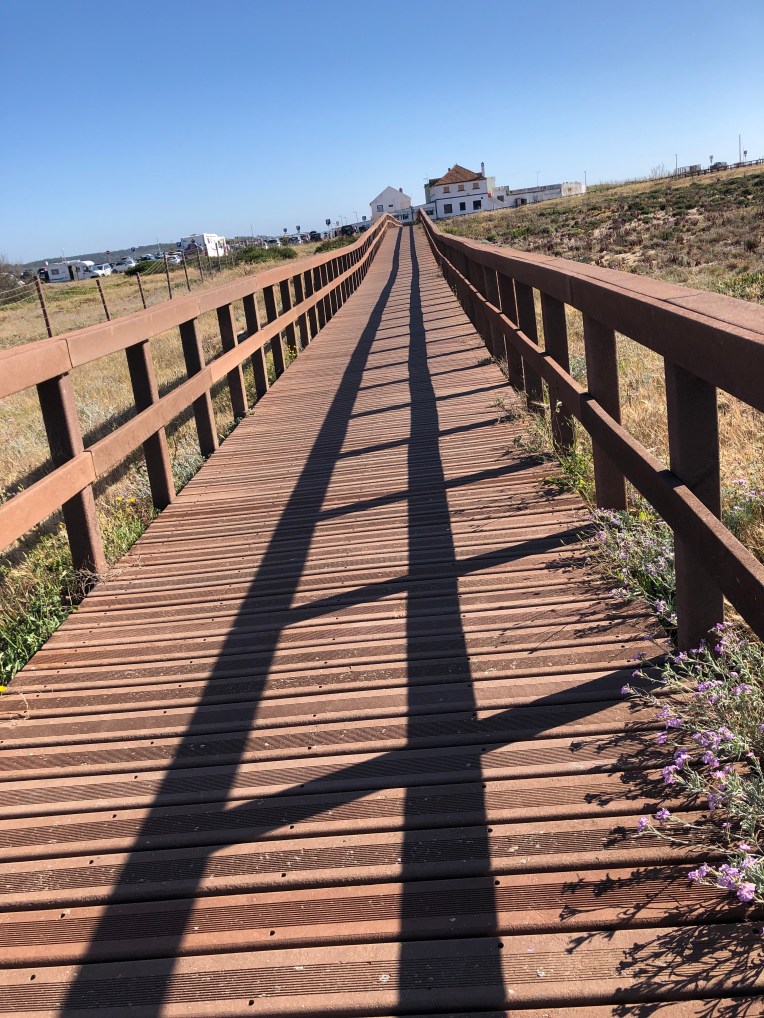
The beach was Santo André and it’s just north of the city of Sines. There are board walks, a cafe and a restaurant and lots of sand. We went for a couple of walks on the sand and along the boardwalk but the main attraction for us is the breeze and they have great breeze here.

(Can you feel the breeze?)

My band of comfortable temperatures does surprise me every time I hit up against it. It’s very narrow. For instance, at 10 degrees I think I’m freezing to death and at 25 degrees I think I’m roasting to death. Outside that band I stop making rational decisions. When the temperature hit 30 degrees in Alcacér do Sal the only thing I could think of to help was to go to bed.. inside the van… where the temperature was higher. Funny enough that’s also my answer when the temperature falls below 2 degrees.

(The boardwalk)

Meanwhile there are people out jogging, riding bikes, playing boules, lying in the sun. How do they do that? One of my favourite fairy tales when I was little was The Princess and the Pea. In case you don’t know the story… the Princess went to visit another kingdom and to make sure she was really the princess they did a bit of a test. They put a pea under her matress. Next morning they asked how she slept, she replied she was a little uncomfortable. Next night they gave her a second matress but the pea was still underneath. When they asked her next morning how she slept she said she was grand but the matress was still a little uncomfortable. They kept adding mattresses until she almost touched the ceiling and they were convinced she must definitely be a Princess if she could still feel the pea under so many mattresses.

I don’t want to blow my own trumpet but I’m obviously a Princess, Mairead.

(There’s Santo André. Free parking, toilets open when cafe open, free water, loads of breeze)

Son of Alcacér do Sal

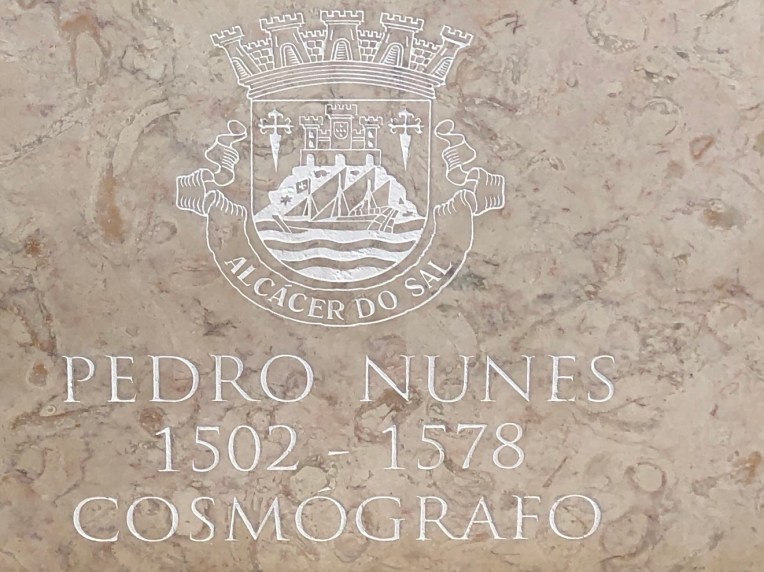
(Statue of Pedro Nunes in Alcacér do Sal)

After Setúbal we moved to the town of Alcacér do Sal. We were here last year. You might remember it was the place I built up the courage to ask someone to tell me their story?

(Famous guy born here)

The weather was beautiful and we settled down in a parking space on the banks of the Sado river with views of the town. From the van I could see, across the river, the statue in the first picture above and remembered seeing it last time too but I couldn’t remember who it was.

(Bought the book)

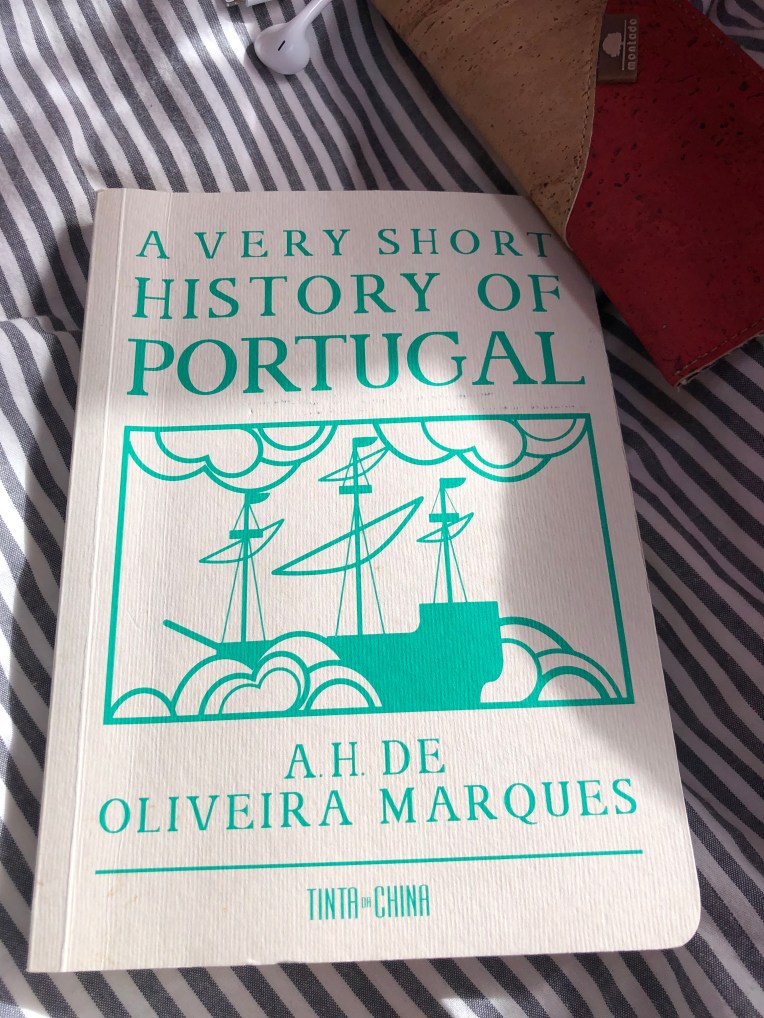
When we were in Porto on the morning before our tour I spotted a pretty book shop. There’s lots of lovely book shops but what made this one so interesting was there was a book in English in the window. It was called A Very Short History of Portugal by A.H. De Oliveira Marques. I have wanted to know more about Portuguese history since first going to the town of Beja two years ago. At one of the old churches I met a lovely guide with very little English but loads of passion for the history of his town and country. So of course I bought the book.

(Night time in Alcacér do Sal)

Now I have learned something very interesting from this book. That is to, Read the Title. Read it a few times to be sure this is the book you want. I read the title and was immediately attracted by the fact it was in English. Then it said Short. In fact it said Very Short. Excellent. Unfortunately, it was missing one word. Simple.

(Cute narrow streets)

The history of Portugal is long because a lot happened since man arrived here more than 4000 years ago. The author of the book is a renowned historian, he has degrees from all over the world, he was a professor in Portugal and Germany and America and he died in 2007. He has a lot to say. Making it very short was probably really, really difficult for him and he never promised simple. I thought short meant simple. So I pushed it to the back of the craft cupboard to lessen my guilty for not reading it.

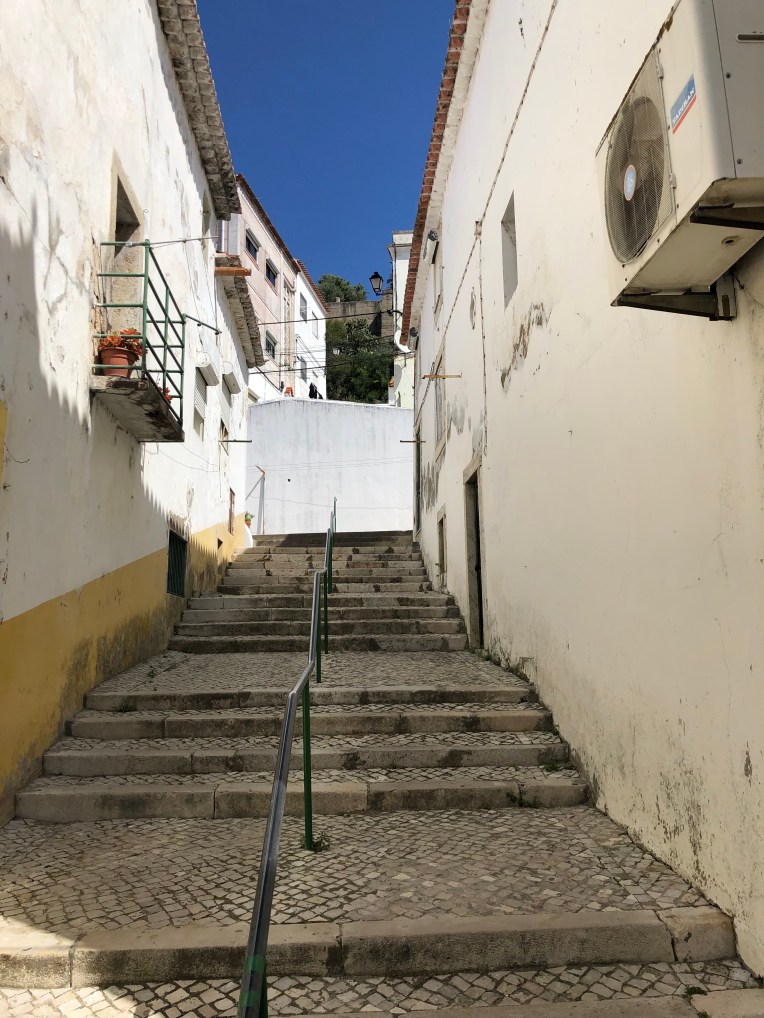
(And loads of steps)

Then I saw the Pedro Nunes statue and he was born in Alcacér do Sal, I wondered… I couldn’t find him in the book, he’d probably in the long version but I googled him and he invented something complicated for navigation. He was also a professor. What I did find in the book was Portugal in the 1500’s started getting into exploration and were really good at it. The king was interested and he provided the money to make it possible. They more than any one else proved through experience that the world was round. By 1640 things were going bad though, wars, fighting with neighbours, king issues. But for a short period of time Portugal was the smartest and richest country in the world.

Anyone interested in a barely used very short history of Portugal? Mairead.

(That’s Alcácer do Sal south east of Setúbal. Free parking by the river, public toilets nearby. There’s also a nice municipal campsite outside the town and a great tapas restaurant up the hill)

How to sit in nature…

(I loved this place)

After Lisbon we went to Setúbal, the place the train would have brought us to if we’d stayed on board. We arrived on a decent sized road and as often happens our sat-nav system decided we would appreciate some short cuts through the town. We never appreciate them.

(Early morning at Setúbal)

After a couple of reverse back up hill maneuvers we stopped obeying her (she has a female voice) and stopping in the middle of a junction to work out which direction might be widest. The locals were very kind, they did not beep, they’ve probably seen this many times.

(The town is very green and pretty)

Eventually we found the best route to the municipal campsite. Although the road was narrow the view was immense. It was Sunday afternoon the sun was shining and we got the last spot facing the sea. A light breeze made the perfect accompaniment to my cup of tea with a view.

(With lots of art)

I had been in training for this moment since the Spanish beach at Foz and I knew what to do. Sit, sip and smile. That’s what I did for two days.

(The world definitely does)

We had arrived without going to the supermarket (big mistake) and there were no shops or restaurants nearby so when the last pot noodle was eaten we had to leave paradise.

There’s no bread in Paradise, Mairead.

(There’s Setúbal, Municipal Campsite, €12 parking, electricity extra, magnificent toilets and showers included, sea front spot if you’re lucky)

Lisbon… Part 4

(Waiting for the bus)

We were pretty much finished in Lisbon after our scooter trip but before we left we had a Nata in Belém. No, not at the place with the queue. Then we waited for the bus.

(25th April bridge takes cars on top and trains underneath)

I mentioned previously that there was a transportation theme to our Lisbon tour. There was another theme: the 25th April bridge. So far we had driven over the bridge the previous Thursday, sailed past it in the ferry that morning, sat underneath it between scooter trips in the afternoon and now we were going under it.

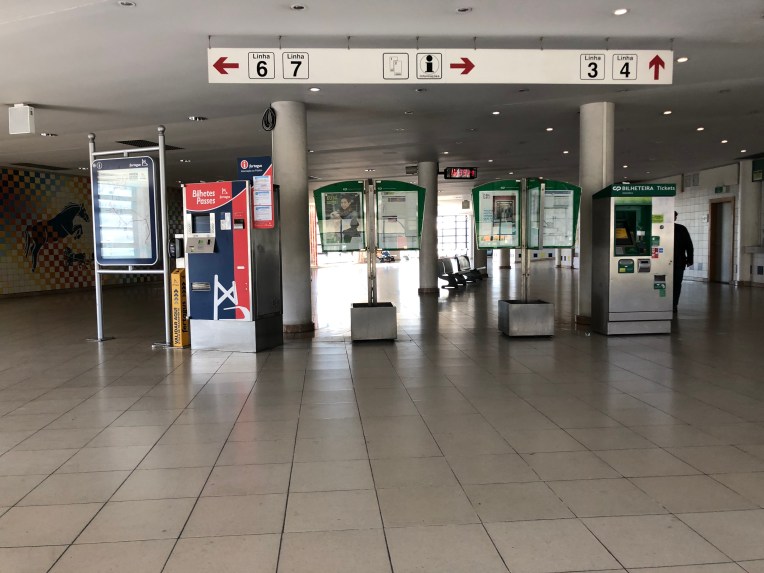
(Red ticket machine and green ticket machine. The red one is for going over the bridge)

The 25th April bridge is a double decker bridge and the train between Setúbal and Lisbon goes under the motor vehicle deck of the bridge. We took a bus to Campolide station, north of the city. At first we couldn’t find the right ticket machine or the right line but eventually we spotted the colours of the machines were different… there were two train lines.

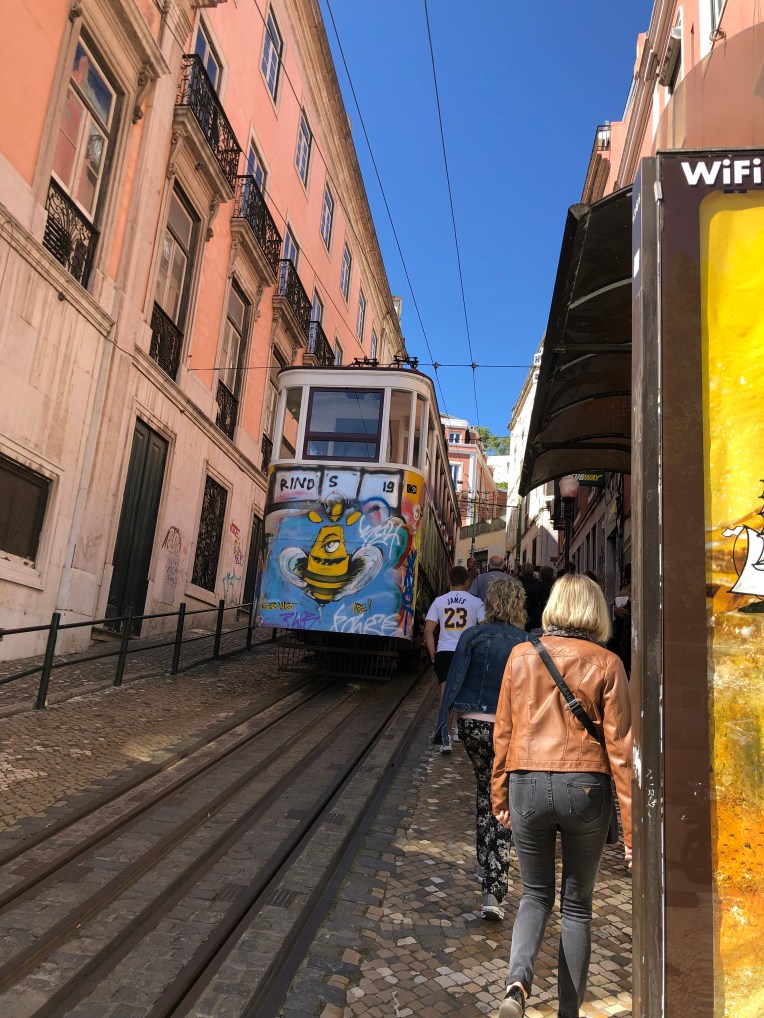
(Although we got very close to trams we never did get on one…)

The train is a two level commuter train and it was packed so I have no pictures but if you get a chance it’s well worth travelling on it to see unrestricted views up and down the estuary. Stand near the doors for the best views. Two stops are we were back at the beginning.

We walked home, tired and sun-burned but happy, Mairead.

Lisbon by Train, Boat, Tram and Scooter – Part 2

(Long queues to get on Ascenoir da Glória)

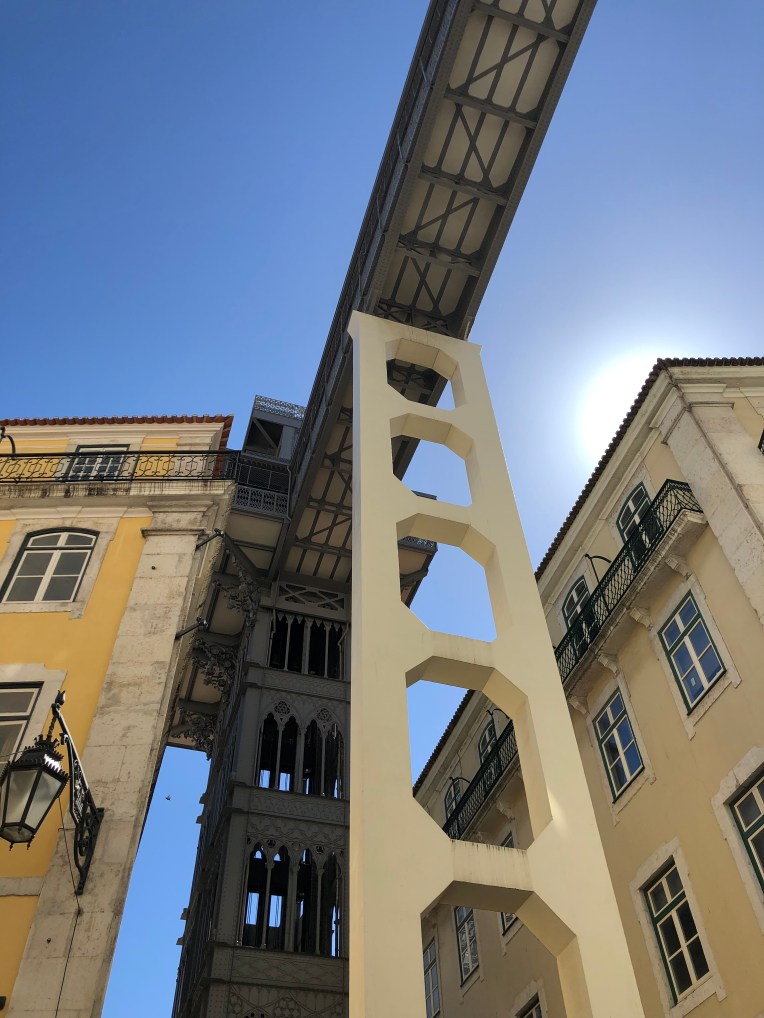
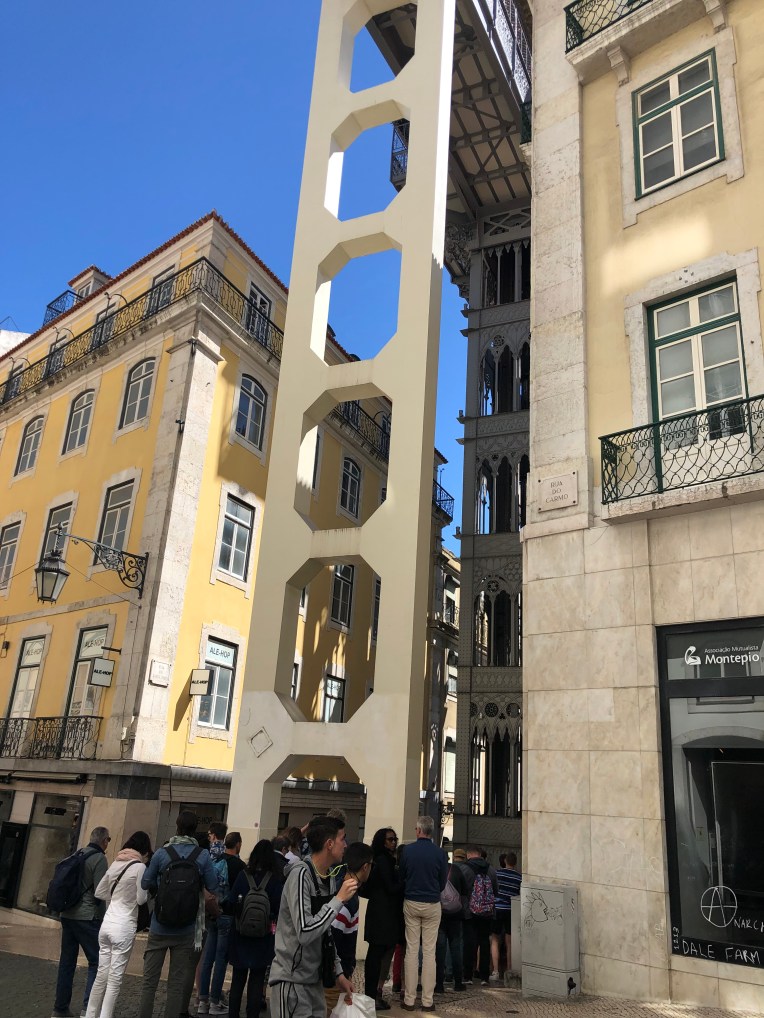
You might be already aware of a transport theme on our tour and as soon as we had descended the Ascenoir da Gloria we went in search of our next vehicle. I was hopeful we would be ascending this time but it was not to be. (Top Guide Tip: Saturday’s are busy, you may encounter long queues, consider moving your tour to a weekday.) Our next stop was the Elevador de Santa Justa. This is a lift and was built in 1899 to take the citizens of Lisbon up the steep hill. It’s still doing that nearly 120 years later.

(Elevador de Santa Justa from the back)
The queue snaked around the lift and up the path. It would be along wait as the lift could only take 29 passengers. My “client” said he was ready for lunch so we moved on.

(Queue to go on the Elevador de Santa Justa)
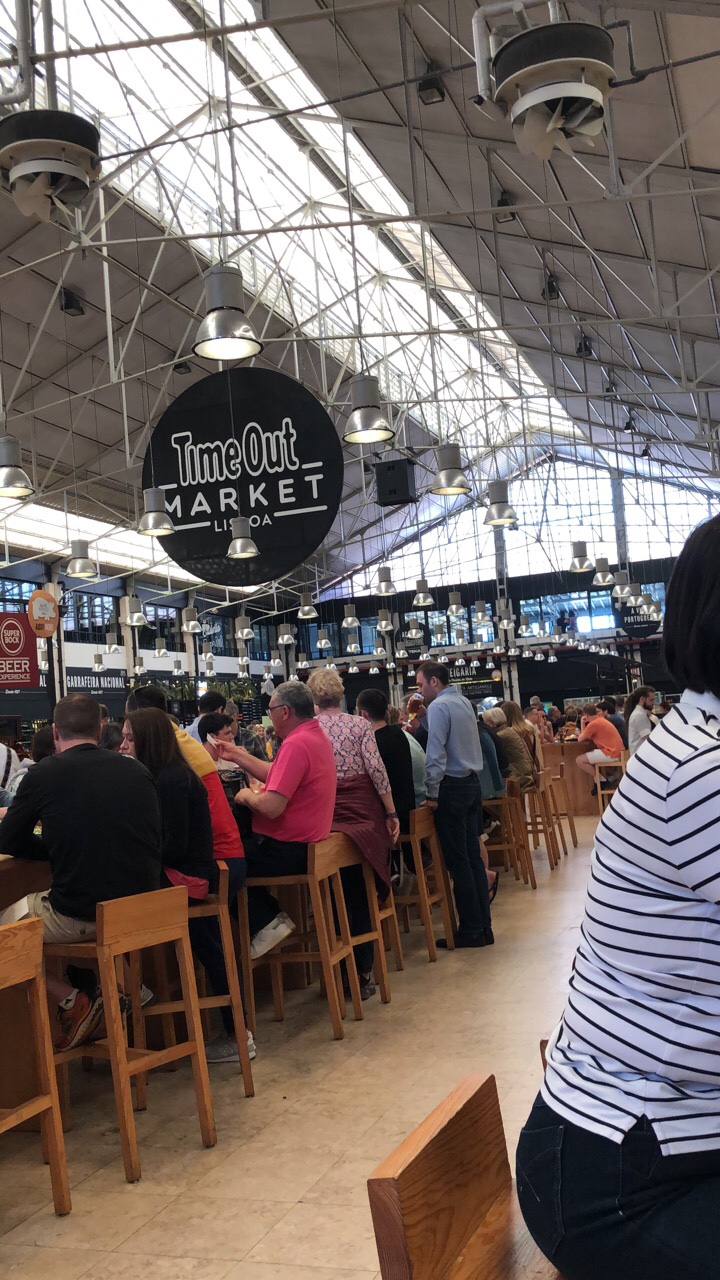
You remember yesterday the Time Out Market was closed when we got there? It would be open now. Again just an 18 minute walk and now we knew it was downhill. There’s a lot to be said for getting things wrong.

(Tables and chairs in the middle…)

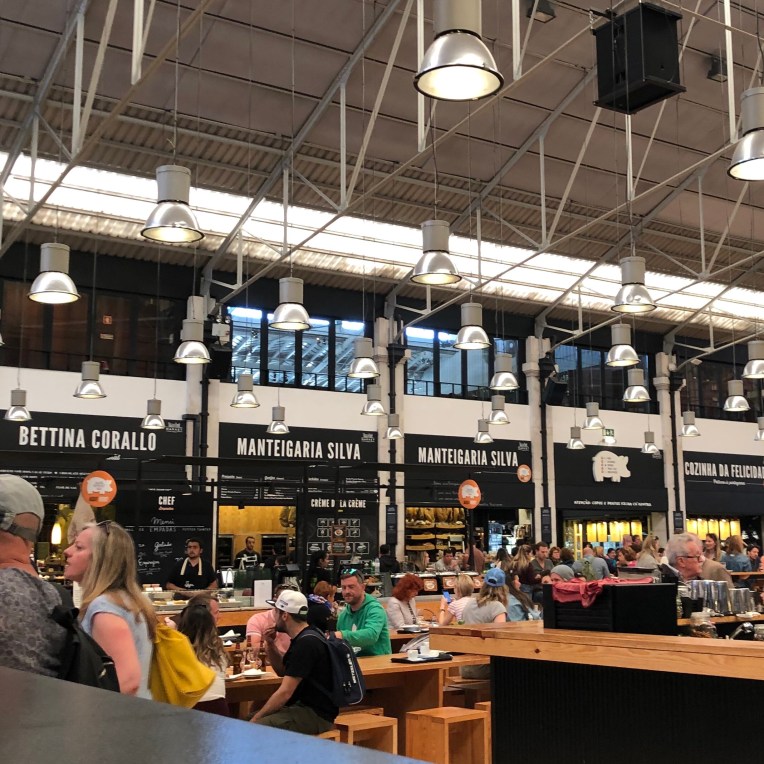
While we were away the place filled up and there was hardly a chair free at the many tables. First things first we had to pick a meal. This involves walking by the many restaurant sections along the walls and checking out their menus. Then you make your decision, queue up, place your order, pay and get a beeper thingy. Then you search for a seat.

(…restaurants along the walls)

It was actually easy enough to find a place as people were coming and going all the time. We found a spot on the edge and settled in. Everything is cooked fresh so it was about twenty minutes before the beeper called us back to collect our food. The food is more expensive than we have paid in Portugal up to this.

(Time Out Market is attached to the old food market called Mercado da Ribeira)

Very soon people were joining our table and we had a lovely  chat with a couple who were originally from Taiwan but now living in California. He’d been to Ireland once for a day. It was a work thing and he’d flown in to Shannon, he couldn’t remember the name of the company but he remembers the cows in the fields. I loved that. It’s exactly what I’d want people to remember from a quick trip to Ireland. His wife was a programmer and Denis and she were conversing in letter groups and pretty words like  C++ and Java, as you do.

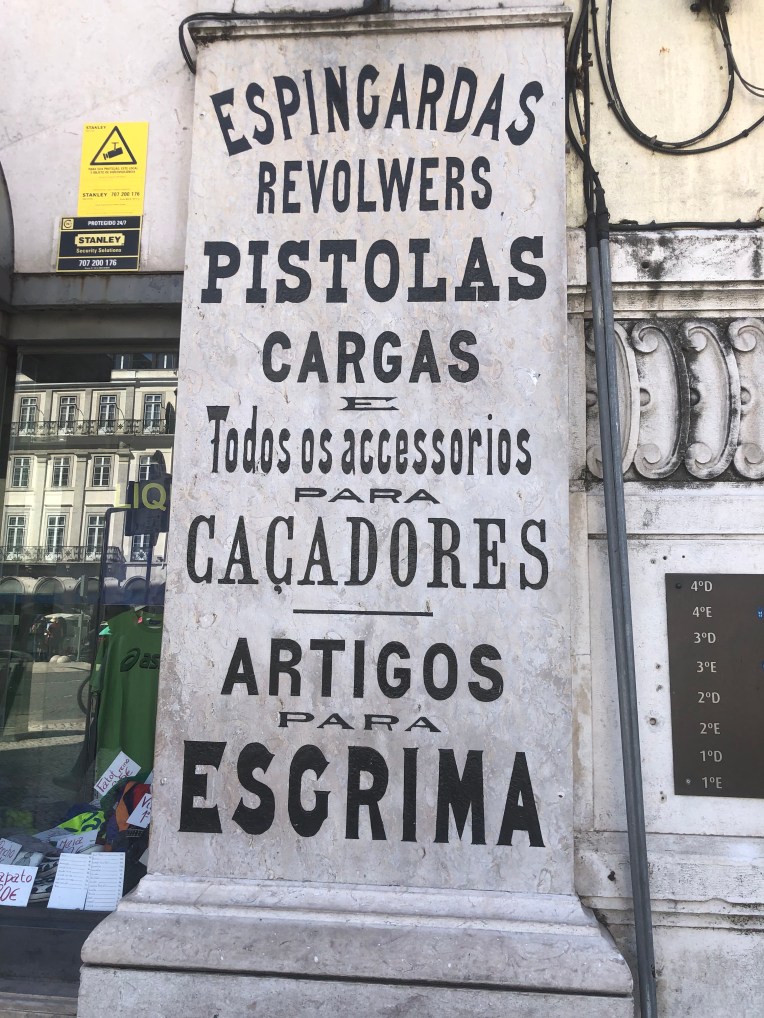
(A gun shop)

The whole guide and client thing broke down a bit after that. (Top Tip: Set your price early so there are no surprises or ill feeling between guide and client.) Denis had spotted something as we were coming through the ferry port in the morning. Scooters. Not the motorbike scooters. Scooters like the ones we had as children, two wheels, handlebars, no seat, one foot on the running board, other foot pushing off the ground to help you scoot along? Remember? Well those but electric… so they go at speed.

(Do not be fooled by how sweet they look.)

Not sure if you have gathered this from me but I’m not fearless. To be clear, I mean I am fearful. More like fear-FULL. There was no way I was going on one of those things. In a city. Maybe, maybe, possibly I would try one inside the walls of a well-padded room. With carpets. But there was no way I was going to get up on one in Lisbon. I had planned the next part of the journey by tram along the coast to Belem. I was going to take the pictures I had promised you of the people queueing for the Pastel de Nata’s from the original bakery near the Jeronimos Monastery where they were invented. It was a good plan. Everyone would have been happy.

Suffice to say, Denis wore me down, Mairead.